Google shipped two Gemini 4 models in three days: Carbon on November 10, 2026 and Hydrogen on November 12. The lazy summary is "Carbon is smart, Hydrogen is fast." That summary costs money. On one grounded-video benchmark, the 25% cheaper Hydrogen produced a $35.35 bill against Carbon's $27.94 because it emitted 2.6x more output tokens.
Both expose gemini-4-carbon and gemini-4-hydrogen through the Gemini API and AI Studio, share a 1,048,576-token unified context window, and accept text, images, audio, video and PDFs with text output (OpenRouter live comparison). Carbon is the frontier long-horizon reasoner; Hydrogen is its distilled, speed-optimized derivative for everyday execution. Google's framing, in the Carbon launch post and the Hydrogen launch post, is that Hydrogen can also run as the execution model underneath a Carbon plan.
The cheaper model lost on the bill
The public end-to-end test cited here is Agnify's grounded-video QA benchmark: pick the object a question asks for, box it in keyframes, track it through video, with 300 questions, 1.9 hours of video and the same 7.6M input tokens per model. The headline on this video workload is a tie that embarrasses per-token math.
| Model | HOTA | Correct object | Run cost | Cost / video hour |
|---|---|---|---|---|
| GPT-6.1 Terra | 0.6169 | 94.3% | — | $8.19 |
| Gemini 4 Carbon | 0.6016 | 94.3% | $27.94 | $14.60, $29.20 from Dec 1 |
| Gemini 4 Hydrogen | 0.6006 | 95.1% | $35.35 | ~$18.50 flat |
| Claude Opus 5.5 | 0.5944 | 92.7% | — | $43 |
Carbon and Hydrogen differ by 0.001 HOTA with overlapping confidence intervals. That is statistically tied, and tied with Terra, Sol and Opus 5.5 in the same sample. But Hydrogen generated 3.19M output tokens against Carbon's 1.23M, with stage-3 medians of 387 vs 47 tokens for single-object boxes. In one foam-letter case Hydrogen burned 62,138 tokens, boxed the wrong letter and scored 0.36 while Carbon used 80 tokens and scored 0.70. The full Agnify report estimates that holding Hydrogen to Carbon-level stage-3 verbosity would cut its run to about $24.
The rule from Vercel's workload guide applies verbatim: equal token rates don't imply equal task costs. Measure cost per accepted task, retries included, not cost per million tokens.
What Google actually shipped
Vercel's guide positions Argon as the default generalist starting point for synthesis and knowledge work (Vercel). Against that baseline, Carbon is the escalation path for difficult debugging and open-ended science, and Hydrogen is the volume path for routine, bounded work. Argon detail lives in our Carbon vs Argon and Hydrogen vs Argon guides.
The interesting architecture is the pair. Antigravity's Orchestrator mode lets Carbon plan read-only, then hands file edits and test runs to Hydrogen, returning control to Carbon on stalls, as described in Vercel's eve routing writeup and DataCamp's Hydrogen overview. That pairing has a reported 24% quota reduction and 19% faster completion on near-Carbon Terminal-Bench success: pay the frontier model once for the plan, pay the fast model for the volume.
Both models are closed-weights (OnlySOTA), multimodal-in and text-out with reasoning support (OpenRouter). Carbon offers low, medium, high thinking levels defaulting to medium. Hydrogen adds xhigh and defaults to high. Identically named levels are not equal compute across models, so log model plus level on every test.
Price after December 1 flips the math
Carbon's headline rate is promotional. Hydrogen's is flat, and that asymmetry decides more purchases than any benchmark.
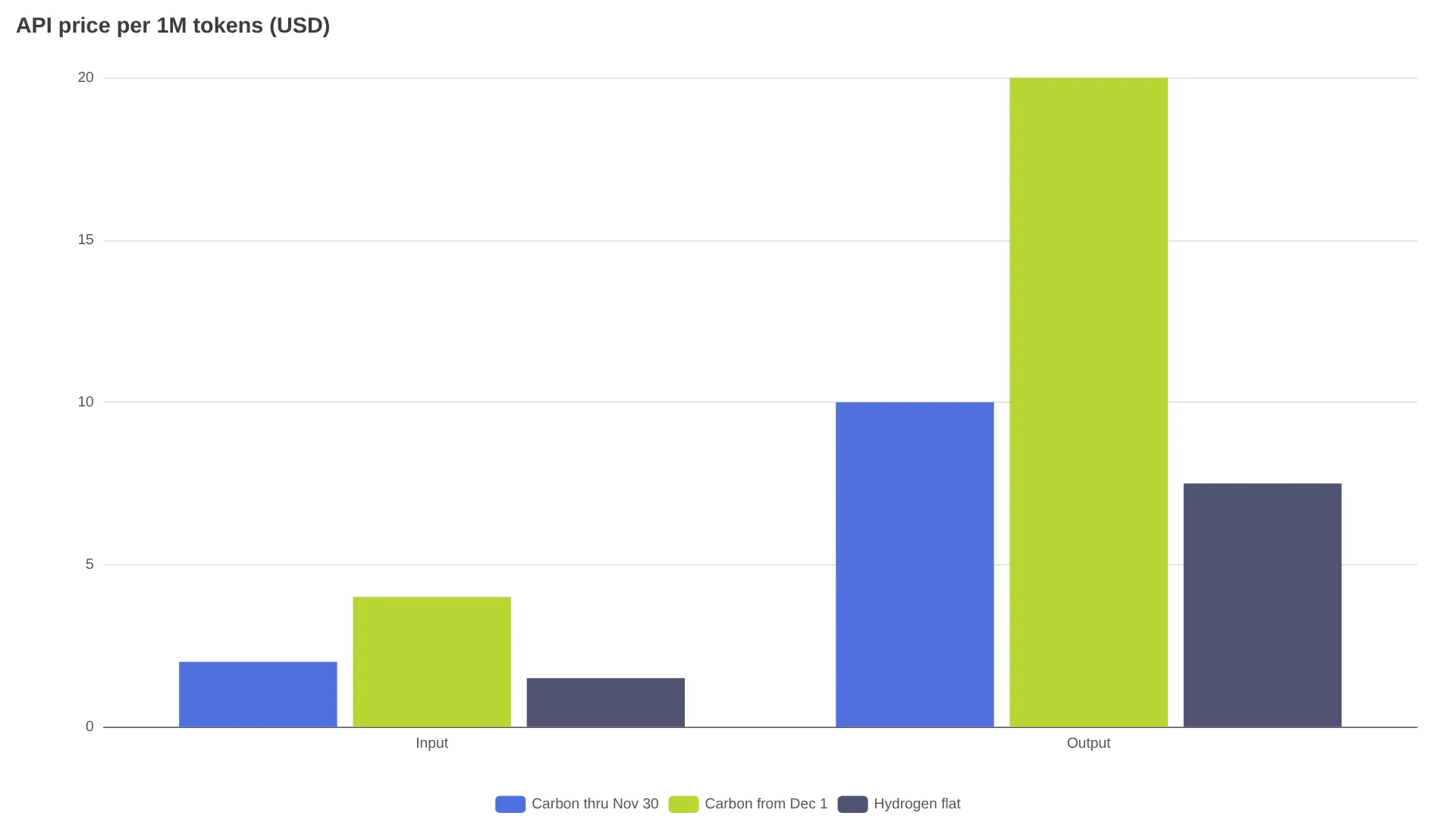
| Tier | Carbon thru Nov 30 | Carbon from Dec 1 | Hydrogen |
|---|---|---|---|
| Input / 1M | $2.00 | $4.00 | $1.50 |
| Output / 1M | $10.00 | $20.00 | $7.50 |
| Cached input / 1M | $0.10 | $0.20 | $0.075 |
| Input+output batch | $1.00 / $5.00 | $2.00 / $10.00 | provider-dependent |
| Input+output priority | $3.60 / $18.00 | $7.20 / $36.00 | provider-dependent |
Pricing: Google launch rates via LiteLLM's day-0 notes and Cloud pricing tables; Hydrogen flat rates via DataCamp and AI Studio docs. Output pricing includes thinking tokens, so Carbon's deeper reasoning bills twice: once in tokens used, once in the December doubling.
Through November, Carbon's video run was 9% cheaper than Argon's at identical per-token rates because it used fewer tokens. From December, Hydrogen becomes cheaper on any workload with similar verbosity. Blended at a 3:1 input-to-output mix (OnlySOTA), Hydrogen is $3.00/M vs Carbon $4.00/M in November and $8.00/M from December. To call both behind one key, the Gemini 4 Carbon API page routes to either model.
Speed and thinking levels decide agent feel
Live medians from OpenRouter's comparison: Carbon p50 latency 11.32s at 57 tokens/s; Hydrogen 1.68s at 144 tokens/s. Hydrogen is roughly 6.7x quicker to first response with 2.5x the throughput, which dominates interactive agent feel.
| Hydrogen level | Task cost | Intelligence Index | Use |
|---|---|---|---|
low | ~$0.29 | 27 | Simple high-volume jobs |
medium | ~$0.80 | 41 | Routine work where speed matters |
high (default) | ~$1.87 | 51 | Most coding and agentic work |
xhigh | ~$3.16 | 54 | Harder multi-step problems only |
Estimates via Artificial Analysis as reported by DataCamp. High to xhigh pays 69% more per task for 3 index points and risks overthinking simple prompts.
API quirks to code around (DataCamp):
thinking_budgetandMINIMALreturn HTTP 400; usethinking_levelinsteadtemperatureis ignored- Sync output caps at 65,536 tokens (Carbon caps lower at 32,768 per Agnify's test)
- Hydrogen is short-term GA with at least 45 days retirement notice
Benchmarks split by job, not by trophy
| Source | Carbon | Hydrogen | Comparator |
|---|---|---|---|
| Intelligence Index (OnlySOTA) | 60.0, No. 2/57 | 53.9, No. 7/57 | — |
| Arena Agent | 0.164, No. 3/65 | 0.149, No. 5/65 | — |
| Terminal-Bench 4.0 (OnlySOTA) | 64.5%, No. 3/59 | 56.4%, No. 12/59 | Sonnet 5.5 64% (AA independent) |
| Arena Code | 1768, No. 4/157 | 1704, No. 11/157 | — |
| Arena Text | 1526, No. 1/421 | 1490, No. 15/421 | — |
| Agents' Last Exam (DataCamp) | 77.4% | 71.6% | Argon 69.0% |
| AA-Omniscience hallucination | — | 8% | 5x fewer fabricated claims than Flash 3.8 (Google via DataCamp) |
OnlySOTA aggregates third-party boards rather than running tests (OnlySOTA). Google's adjusted Terminal-Bench 4.1 table via DataCamp: Hydrogen 57.0% vs Flash 18.2% vs Sonnet 63.9%. Bottom line: Hydrogen is competitive on agentic coding but not the best terminal-heavy pick.
Access right now is the blocker
Model IDs are stable (gemini-4-carbon, gemini-4-hydrogen). Hydrogen is documented for all API tiers including free with a rate-limited tier (DataCamp, AI Studio docs). Carbon is paid API and Ultra-gated (Carbon launch post). In practice the rollout has been ragged, with Hydrogen appearing, disappearing and auto-replacing Flash depending on app and account (r/GeminiAI release thread). Details live in our Hydrogen pricing and release-status tracker.
Quota reports are worth pricing into any migration:
"Yesterday limits were more generous. I have paid pro. Today prompts (for example write chapter about 6-7k words) eats around 4-5 percent each. Yesterday when hydrogen appeared 3 chapters were about 2% for 5h quota. 5h limit is a joke" — u/Neat_Reaction9164, r/GeminiAI
"I've been coding with it and Sonnet today and Hydrogen has definitely cooked and been surprisingly efficient while Sonnet has been a been a mixed bag and hit usage limits ... Too soon still to judge." — u/mmmtv, r/GeminiAI
Test with the exact route you will ship (AI Studio vs Antigravity vs Cursor vs API), since tier, integration and thinking level can materially change effective quota. If you auto-route, count the decision call in latency and cost: Vercel's eve pattern uses google/gemini-decision-1 per turn with Argon as fallback.
Call this one for your workload
Three profiles cover the most common API workloads:
- Ship everyday volume on Hydrogen. Routine code edits with inspectable diffs, settled-format extraction, single-source Q&A, high-volume triage. Pin
high, regression-test atmedium, reservexhighfor multi-step cases that demonstrably need it. - Escalate the hard 10% to Carbon. Competing explanations, root-cause analysis where a patch could hide the symptom, conflicting experiments needing a discriminating test, document sets where amendments override proposals. Accept the latency and the December price.
- Pair them. Carbon plans read-only, Hydrogen executes edits and tests, Carbon re-takes on stall. This setup has a reported 24% quota reduction and 19% faster completion.
The unresolved trade-off is verbosity risk. In Agnify's probe Hydrogen's default high emitted 89 to 201 thought tokens where Carbon's default emitted 51 to 64. Use output caps and measure emitted tokens on your own prompts. For now, budget Hydrogen by tokens emitted, not tokens priced.
FAQ
Is Carbon better than Hydrogen for reasoning?
Yes. Index 60.0 vs 53.9, Terminal-Bench 4.0 64.5% vs 56.4%, Arena Text No. 1 vs No. 15; video QA ties at 0.6016 vs 0.6006 HOTA.
Which is cheaper?
Hydrogen at $1.50/$7.50 per 1M, flat. Carbon at $2/$10 through Nov 30, $4/$20 from Dec 1.
Which is faster?
Hydrogen: 1.68s vs 11.32s median latency, 144 vs 57 tokens/s throughput.
Same context window?
Yes, 1,048,576 tokens unified for both.
Can Carbon plan while Hydrogen executes?
Yes, via Antigravity Orchestrator or per-turn routing with gemini-decision-1.
Which thinking level?
Carbon medium, Hydrogen high; keep xhigh only when acceptance rate measurably rises.