 AIREITER
Both decision endpoints list the same $0.10 per 1M input tokens, yet a repeated policy document can cost $520 on one and $70 on the other. OpenAI Decisions API fits agent transcripts with repeated context, while Gemini Decisions API fits audio, video and 1,000-rule checklists.
Same $0.10 sticker, different bill
OpenAI Decisions API and Gemini Decisions API both charge $0.10 per 1M uncached input tokens with zero output-token billing. OpenAI Decisions API reached general availability on October 22, 2026 on model gpt-6-luna, while Gemini Decisions API launched November 11, 2026 in v1beta on model gemini-decision-1. The cheaper option depends on input repetition and input modality, not on the logo.
| Dimension | OpenAI Decisions API | Gemini Decisions API |
|---|---|---|
| Model | gpt-6-luna | gemini-decision-1 |
| Status | GA since Oct 22, 2026 (OpenAI docs) | Preview v1beta since Nov 11, 2026 (Google announcement) |
| Questions per request | 1–400 (OpenAI docs) | 1–1,000 (Google announcement) |
| Context window | Long-context 2x multiplier above 272K tokens | 262,144 tokens |
| Inputs | Text, images, input_json, conversation + tool calls | Text, images, audio, video, PDF |
| Output charge | $0 | $0 |
| Cached input | $0.01 per 1M tokens, prefix ≥1,024 tokens | Not supported |
| Free tier | No separate free tier stated | Yes in AI Studio, 200 RPM / 50K TPM / 10K RPD |
| Published latency | About 10x faster than Responses API | 50–100 ms model compute, 150–250 ms end-to-end to 16K tokens |
| Enterprise | ZDR, HIPAA, US/EU regional (+10%) | Cloud support coming soon |
How a request actually looks
OpenAI Decisions API uses POST /v1/decisions with an ordered array of questions, each with an optional name. Gemini Decisions API uses client.decisions.create() with a map keyed by developer-chosen IDs. Both support three question types, but the names and bounds differ.
OpenAI question types are predicate (probability 0 to 1), choice (unordered categories), and score (2–10 ordered levels with probability-weighted average), per the OpenAI guide. Gemini question types are noul (yes/no, probability 0.01 to 0.99), choice (2–255 options), and score (2–255 levels, 2–10 recommended), per the Google announcement. Questions in one request are independent on both sides; chained logic needs application code or a second call.
Three gotchas that break ports
Gemini sorts choice keys alphabetically before scoring, so a catch-all named none_of_the_above can sort before shipping (documented behavior). OpenAI echoes the question name in the answers array, while Gemini returns a map keyed by question ID. Gemini noul never returns above 0.99, so a threshold of >0.99 never fires.
Refusal handling also differs. OpenAI can return a refusal for one question and still answer the rest, per the OpenAI guide. Gemini rejects the whole request with HTTP 400 on safety or prohibited-content triggers, with codes such as safety and prohibited_content.
"One weird thing is that it looks like Decisions and normal text generation appear to have separate caching and inference paths." — u/Balance- on r/OpenAI
Plan a thin adapter if both endpoints must be supported. Normalize question IDs, rename Gemini keys to avoid alphabetical tie-break surprises, and clamp thresholds to ≤0.99 for Gemini.
What each side accepts, and what it forces you to build
Gemini Decisions API accepts text, images, audio, video and PDFs natively in one shared input. OpenAI Decisions API accepts text, images, input_json, conversation history, function calls and tool outputs, but not files or audio. The gap decides whether preprocessing disappears or appears.
A call recording plus account metadata goes directly to Gemini without transcription, and a scanned claim PDF plus damage photos goes without OCR. An agent transcript with tool calls goes natively to OpenAI with call_id matching, while Gemini needs the same transcript flattened to text. OpenAI also supports images inside question instructions for candidate-vs-reference checks.
Image-token accounting differs by vendor. In one independent hands-on test (System Design Academy), a 224×224 egg photo counted 523 input tokens on OpenAI with three questions, versus an estimated 390 tokens on Gemini Low (257 image tokens), 663 on Medium, and 1,223 on High, or $0.039, $0.066 and $0.122 per 1,000 photos.
Latency claims are vendor-reported. Google reports 150–250 ms end-to-end and near-flat scaling from 1 to 100 questions to 16K tokens. OpenAI reports about 10x faster than the Responses API without an absolute figure. Real-user reports are mixed:
"Speed and cost. The outputs are almost instant and cost fractions." — u/zyeus-guy on r/OpenAI
Tested Gemini Decision 1 on the free tier: 30/30 routing at ~0.24 s median, with deterministic repeats, but it confidently picked a wrong category when "other" was missing. — hands-on test on r/GeminiAI
Treat vendor latency as a ceiling to beat in testing, not as a production SLA.
What 1M requests really cost
Shared input is billed once per request on both APIs. Extra questions add only instruction tokens. Repeated input across requests is where the bills diverge, because OpenAI caches and Gemini bills in full.
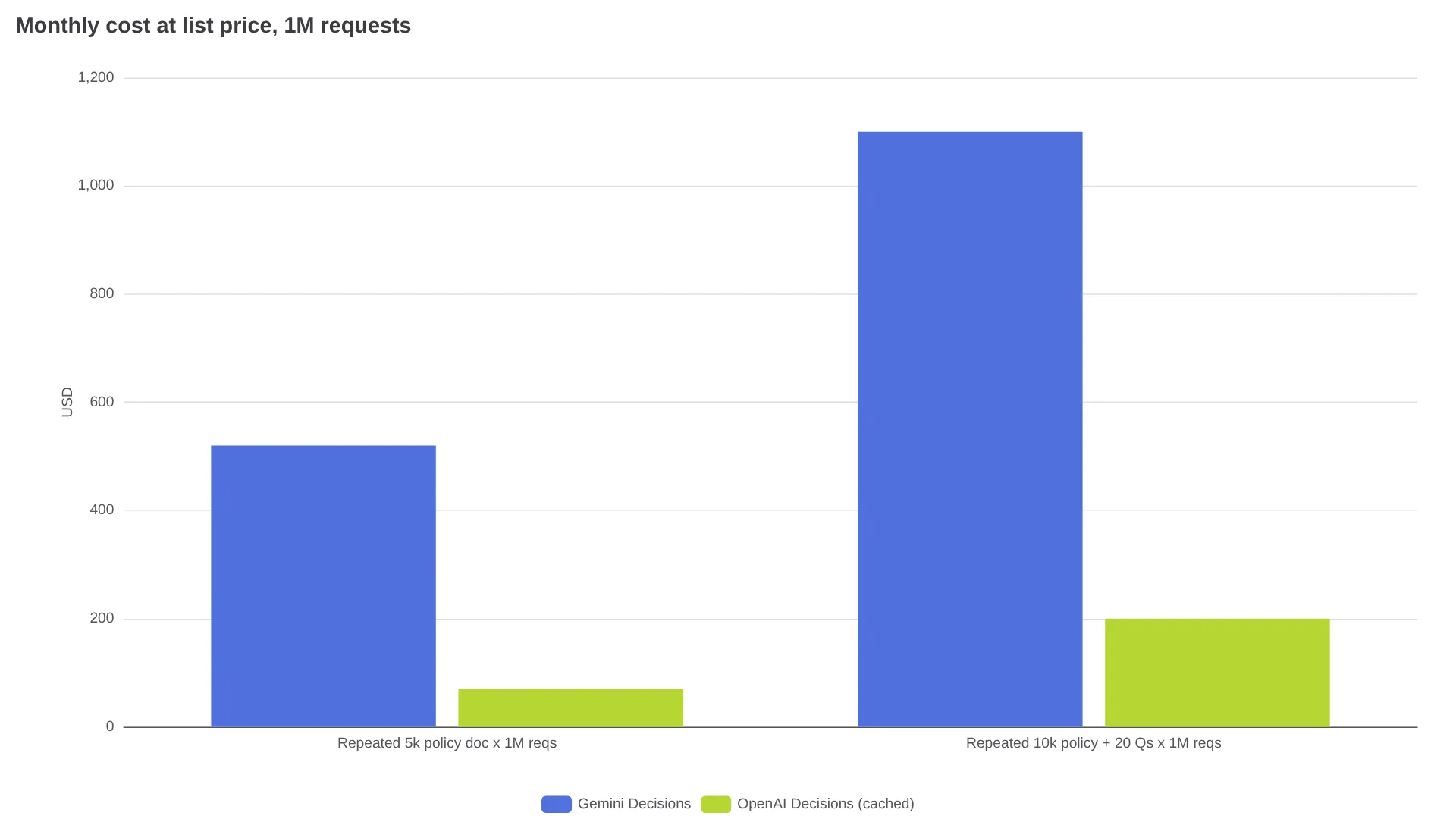
Illustrative math at list prices, following the pattern published by Apidog and BaristaLabs, assumes cache hits on OpenAI before cache-write charges:
- 1M tickets with the same 5,000-token policy plus 200 fresh tokens: Gemini about $520, OpenAI with cache about $70.
- 1M requests with the same 10,000-token policy plus 20 questions of ~50 tokens: Gemini about $1,100, OpenAI with cache about $200 plus writes.
Fresh unique input erases the gap, since a 400-token message with no reusable prefix costs the same $0.10 per 1M rate on both. Batching matters more than model choice: one request with 20 checks on a 4,000-token record costs about $0.50 per 1,000 records, while 20 separate requests cost about $8.10.
Long conversations re-read every turn favor caching. A modeled 30-turn router reading 124,680 tokens costs about $12.47 per 1,000 chats on Gemini Decision 1 without caching, versus about $6.31 on a cached chat model.
Can you trust the number it returns?
In Google's reported table, summarized by AIToolsReview, Decision 1 leads Luna on every shared test with top-1 ECE of 0.0250 versus 0.0721 for Luna and 0.0494 for Jev 1.14. JevBench public split shows 92.2% for Decision 1, 90.9% for Luna, and 90.0% for Jev 1.14. Total suite cost was $0.88 for Decision 1, $0.68 for Jev, and $0.93 for Luna.
An independent roundup of Artificial Analysis cited in the same review gives Decision 1 a Decision Index of 66, tied with Jev 1.14 and 9th of 18, about 7 points behind Drex Max v1.1. On When2Call it shows 75.2% for Decision 1, 80.8% for Jev, and 94.6% for Drex Max, at $345 per 1M tasks and 211 ms for Decision 1 versus $156 at 92 ms for Jev.
Calibration matters more than headline accuracy for threshold automation. A confidence of 0.90 should be right about 9 times in 10 on the deployment distribution. Validate thresholds on 200–500 labeled cases and measure accuracy by confidence band.
"Confidence: Jev-style calibrated probabilities are not something every OpenAI-compatible endpoint returns." — u/xapep on r/LLMDevs
Two failure patterns recur. Early practitioner tests report first-choice bias on OpenAI (@NatashaTheRobot), and the Gemini hands-on above shows a missing catch-all picks the least-bad option instead of abstaining. Fix both with an other option, a separate scope-check predicate, short distinct descriptions, and human review below threshold.
Production checklist before you ship
OpenAI is GA with caching, usage reporting at GET /v1/organization/usage/decisions, ZDR and HIPAA for eligible customers, and US/EU regional processing with a 10% uplift. Gemini is v1beta with Cloud support coming soon. Both vendors list framework integrations such as OpenRouter, LangChain, Vercel and LiteLLM.
Caching rules decide architecture. OpenAI reuses a shared-input prefix of at least 1,024 tokens; question content does not count toward the minimum. Gemini has no context caching, Batch, Flex or Priority tiers. Free-tier prototyping favors Gemini, but free-tier content may be used to improve Google products, so keep real customer data on paid keys. Log confidence distributions for a week before automating high-stakes actions.
Pick by workload, not by logo
Agent transcript loop with tool calls and repeated instructions points to OpenAI Decisions API. ZDR, HIPAA or EU residency requirements point the same way.
Call recording, video clip, or scanned PDF with hundreds of checks points to Gemini Decisions API. Native audio, video and PDF intake removes transcription and OCR stages, and 1,000 questions per request covers rule lists above 400. Budget limits: 100 MB inline per request, 50 MB per PDF, 15 MB per external URL.
Short unique text with fewer than 400 questions is a tie at list price. Prototype on Gemini free tier with synthetic data, then re-run the same 200–500 labeled cases on both and compare accuracy by band, p50/p95 latency, tokens per request and monthly cost.
| Workload | Pick |
|---|---|
| Repeated 5K–10K policy doc, high QPS | OpenAI Decisions API, caching saves 80%+ |
| Agent routing with tool-call history, GPT-Live voice | OpenAI Decisions API |
| Audio / video / PDF decisions, >400 rules | Gemini Decisions API |
| Short unique text, <400 questions | Tie — pick incumbent stack |
| Free prototyping | Gemini AI Studio, then re-evaluate on paid |
Is Gemini cheaper than OpenAI?
List price ties at $0.10 per 1M with no output charge; OpenAI wins with repeated cached context, Gemini wins for free prototyping.
Can OpenAI read audio, video or PDFs?
No, only text, images, JSON and tool-call conversations; Gemini handles audio, video and PDFs natively.
How many questions per request?
Gemini 1–1,000 within 262,144 tokens; OpenAI 1–400.
Is Gemini production-ready?
Gemini is v1beta with Cloud pending; OpenAI is GA with ZDR, HIPAA and regional processing.
Do I still need Jev or a local classifier?
Jev lists $0.042 per 1M and leads some tool-selection tests; benchmark it alongside when cost per task dominates.
How should low confidence be handled?
Set thresholds from labeled data, auto-act above, route the middle band to a larger model and blocks to human review, always with an other option.
Related reading: