 AIREITER
There is no official Midjourney API to price as of November 2026, only $10-$120 human subscriptions. If your app needs REST calls and per-image billing, you need a different model, not a wrapper.
No public API in November 2026 — and subscriptions are not API plans
Midjourney's four subscriptions apply only to its web app and Discord bot, as documented in Midjourney's official plan comparison:
| Plan | Monthly | Annual (20% off) | Fast GPU time | Relax mode | Stealth |
|---|---|---|---|---|---|
| Basic | $10 | $96 ($8/mo) | 3.3 hrs | — | — |
| Standard | $30 | $288 ($24/mo) | 15 hrs | Unlimited images | — |
| Pro | $60 | $576 ($48/mo) | 30 hrs | Unlimited images + SD video | Yes |
| Mega | $120 | $1,152 ($96/mo) | 60 hrs | Unlimited images + SD video | Yes |
The same comparison table lists extra GPU time at $4/hour on every tier, and restricts companies grossing over $1M/year to Pro or Mega under the General Commercial Terms. On API status: a July 2025 @midjourney post described an Enterprise API survey as an investigation, and an October 2026 MCP test announcement explicitly excluded SaaS products. Neither has produced public docs, keys, or endpoints through November 2026.
For cost context, one third-party estimate (ToolColumn's pricing survey) assumes ~0.8 GPU-minutes per standard prompt, yielding roughly 1,100 prompts from 15 Fast hours — about $0.027 per prompt on Standard. Treat that as an author's estimate, not an official rate, and note that one Midjourney prompt returns a grid of up to four images (per ToolColumn's comparison), so prompt counts never equal kept-image counts one-to-one.
Cheap wrappers carry the ban risk, not the provider
Midjourney's Community Guidelines state that, except for rare explicitly granted exceptions, Midjourney provides no API and prohibits automated interaction. Its Terms of Service prohibit automated tools from accessing or generating through the service and reserve suspension rights. Third-party "Midjourney API keys" automate ordinary accounts behind the scenes — the exact prohibited pattern.
Concretely, Wireflow's wrapper comparison prices hosted PiAPI tasks from about $0.01 per imagine and notes that low-volume APIFrame-style services queue visibly under parallel load. Four failure modes follow from that architecture:
- Account ban. Hosted pools spread the risk; bring-your-own-account plans put your own subscription in the blast radius.
- Silent breakage. A Midjourney site, auth, or queue change breaks the wrapper with no notice and no SLA.
- Queue lottery. Latency follows Midjourney's queue, not your rate limit.
- Privacy leakage. Generations are publicly viewable and remixable by default (per TopAI's October 2026 review); only Pro and Mega Stealth mode keeps them private.
"It makes me really sad because MJ blows the competition out of the water but I can't use it in my dynamic art projects because no API and don't want to be banned :(" — u/amanda_cat, r/midjourney
"It's wild to me how midjourney is still so relevant despite having no API, purely because the creativity / whimsy of the model is unmatched." — @pwnies
Use wrappers only for throwaway experiments on images you can afford to lose. Anything that ships belongs on an official API with documented billing and support.
Pick by the job Midjourney did for you, not by brand
No single model reproduces Midjourney exactly. Match the strength you actually used to the API that leads there:
| If Midjourney did this for you | Start with | Why | Reference images | Per-image from |
|---|---|---|---|---|
| Polished hero images, covers, ads | Nano Banana Pro (Google) | Postcard lighting, 4K, strong text in cited test | Up to 14 | ~$0.07 |
| Long precise prompts, edits, masks | GPT Image 2.5 (OpenAI) | Strongest prompt adherence in cited test, mask editing | Up to 16 | ~$0.07 |
| Posters and covers with heavy text | Seedream 5.0 Pro (ByteDance) | Top text accuracy in cited test | Up to 10 | ~$0.078 |
| Multi-photo scenes, photorealism | FLUX.2 pro (Black Forest Labs) | Multi-reference composition | Up to 8 | ~$0.069 |
| Plain text-to-image, no references | Imagen 4.0 (Google) | Simple prompt-in, image-out | — | ~$0.115 |
| Cheap drafts, text lockups, vectors | Ideogram / Recraft | Bounding-box text (Ideogram), editable SVG vectors (Recraft) | Varies | ~$0.03 / $0.035 |
Per-image figures are normalized to common 1K output from Jantaris's October 2026 comparison and ToolColumn's pricing survey; aggregator prices may differ from first-party list prices. GPT Image billing is token-based, so treat ~$0.07 as a mid-quality anchor — OpenAI's image guide shows roughly $0.006 at low quality and above $0.20 at maximum quality for 1024×1024.
The text-accuracy ranking above comes from Jantaris's October 1, 2026 Kraków test (one attempt per model, Polish signage with diacritics): GPT Image 2.5 Sunburst rendered 8 of 8 strings in 45 seconds, Seedream 5.0 Pro 8 of 8 in 63 seconds, Nano Banana Pro 7 of 8 in 38 seconds. None of these APIs accept Midjourney's double-dash flags literally — the mapping is in the porting section below.
What switching costs at 100 and 1,000 images
Assume one kept image per Midjourney prompt for comparison; if you keep two images from each 4-up grid, halve the subscription side. Failed API generations cost nothing on providers such as Jantaris, which states this in its billing model, while every Midjourney Fast prompt burns GPU time whether you keep the grid or not.
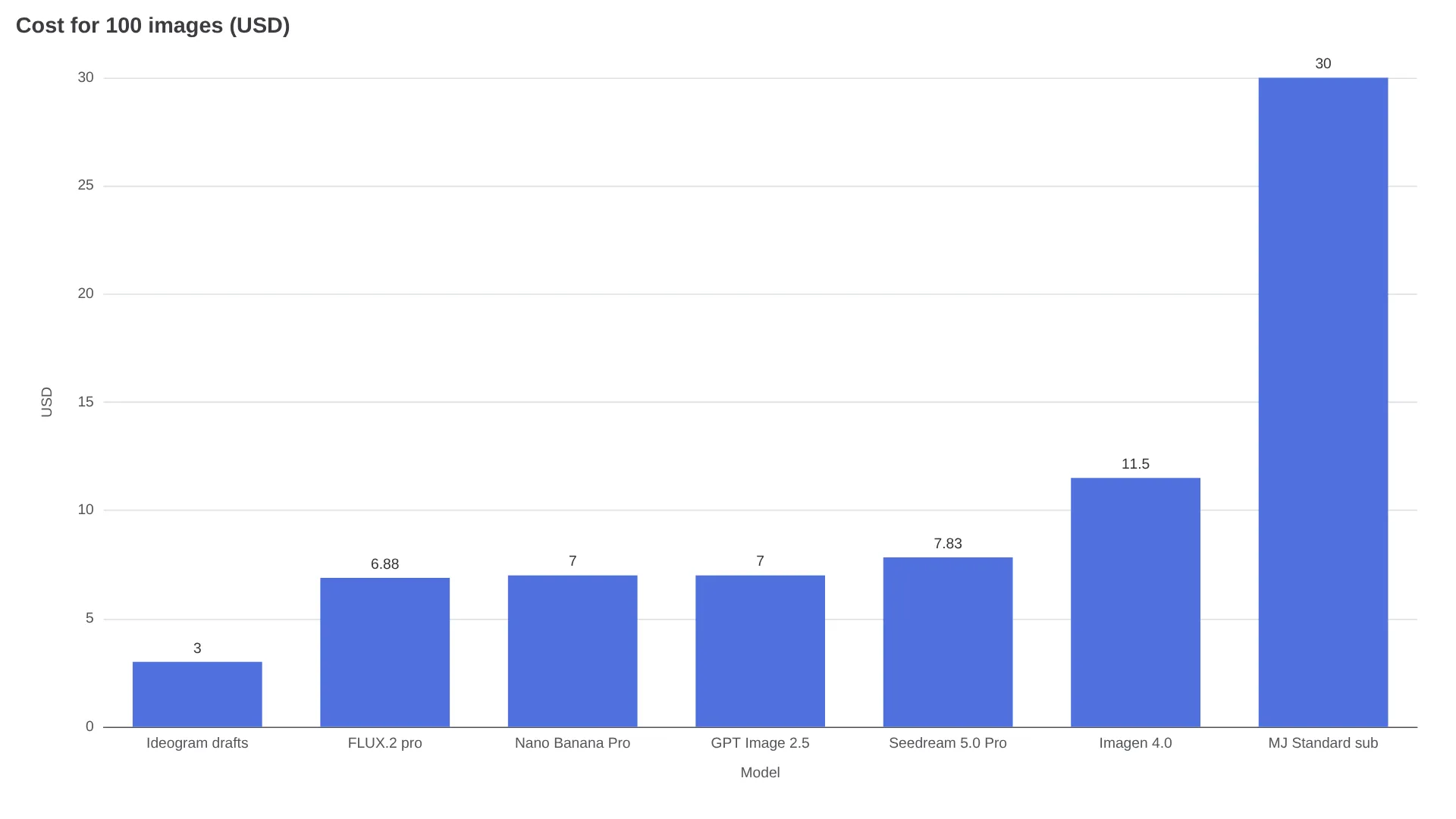
| Model | 100 images | 1,000 images | Notes |
|---|---|---|---|
| Ideogram drafts | ~$3.00 | ~$30.00 | Composition tests and text lockups |
| FLUX.2 pro | ~$6.88 | ~$68.80 | Photoreal default for most migrations |
| Nano Banana Pro | ~$7.00 | ~$70.00 | Add ~60% at 4K (~$0.113/image) |
| GPT Image 2.5 | ~$7.00 | ~$70.00 | $0.60–$21.10 per 100 images by quality tier |
| Seedream 5.0 Pro | ~$7.83 | ~$78.30 | Poster tax worth paying for text |
| Imagen 4.0 | ~$11.50 | ~$115.00 | Simplest integration, highest flat rate |
| Midjourney Standard | $30 flat | $30 flat | ~1,100 Fast prompts, then Relax queue |
Under roughly 400 kept images a month, per-image billing (≈$28 at $0.07) is cheaper than Standard without Midjourney's shared queue. Past ~1,000 kept images a month with a human in the loop, Standard plus Relax mode becomes attractive — but only for manual work, never as a backend. A related comparison of GPT Image 2 versus Nano Banana walks through the same quality-versus-cost tradeoff with side-by-side generations.
Port a Midjourney prompt to a real API in five minutes
Keep the descriptive core and translate the flags. Midjourney's parameter dialect arrives as plain text on other APIs unless mapped to real fields:
| Midjourney | Real API equivalent |
|---|---|
--ar 16:9 | aspect_ratio: "16:9" field (GPT Image uses pixel sizes like 1536x1024) |
--no text | Write "no text, empty sign" in the prompt, or negative_prompt where supported |
--seed 123 | seed field on compatible endpoints (e.g., FLUX.2) for reproducible drafts |
--sref <url> / style image | image_urls array plus "match this style reference" in the prompt |
--stylize, --chaos | No equivalent — describe the style in words ("matte oil poster, muted teal palette") |
Field names vary by provider — OpenAI, fal, and Replicate schemas differ — so treat this as a pattern and check your provider's docs:
import requests
resp = requests.post(
    "https://api.provider.com/v1/images",  # provider endpoint; schemas differ
    headers={"Authorization": "Bearer YOUR_KEY"},
    json={
        "model": "flux-2-pro",
        "prompt": "red-and-white lighthouse on the Baltic coast at blue hour, vintage 1950s travel poster, matte paper texture",
        "aspect_ratio": "16:9",
        "seed": 123,
    },
    timeout=120,
)
image_url = resp.json()["data"][0]["url"]
In the cited comparison, full-sentence scene descriptions outperformed keyword piles such as "lighthouse, moody, cinematic." Fix the seed while iterating on wording so only one variable changes, then re-run the winner at full resolution — that two-pass loop is where the draft-versus-final gap pays off.
FAQ
What is the cheapest official alternative to the Midjourney API?
Draft tiers start near $0.02–$0.03 per image; for final-quality work the practical floor is about $0.07 per image on Nano Banana Pro, GPT Image 2.5, or FLUX.2 pro at 1K. Above ~400 kept images a month, compare against the $30 Standard subscription using the one-kept-image-per-prompt assumption above.
Can I paste my Midjourney prompts directly into an image API?
The description transfers, the flags do not. Strip --ar, --seed, --sref, and --chaos, then set aspect ratio, seed, and reference images through the target API's own fields per the mapping table.
Can companies use these images commercially?
Each vendor sets its own license, so confirm the model you ship on before client campaigns. Midjourney itself allows commercial use on paid plans but requires Pro or Mega above $1M annual revenue per its plan comparison; check the equivalent commercial clause at OpenAI, Google, Black Forest Labs, Ideogram, Recraft, or BytePlus.
What does $30 buy: Standard or API credits?
Standard buys roughly 1,100 Fast prompts plus unlimited Relax-mode images for manual work. The same $30 buys roughly 400 final-quality API images at $0.07 each with webhooks, polling, and without Midjourney's shared queue — the right unit for anything programmatic.
| Your situation | Do this |
|---|---|
| Shipping an app or automation this month | Pick one API from the job table and port prompts with the flag map |
| Under ~400 images/month, quality matters | Nano Banana Pro or GPT Image 2.5 at ~$0.07/image |
| Posters, menus, or anything with spelling | Seedream 5.0 Pro despite the slower clock |
| Human artist who loves the Midjourney look | Keep the $30 Standard subscription — just don't automate it |