 AIREITER
Pick GPT Image 2 when the job demands precise text inside images, multilingual posters, or reference-based edits with identity preservation. Pick Nano Banana 2 when raw photorealism, fast iteration, and predictable per-image pricing matter more. Two independent benchmarks reached opposite conclusions - Vidguru's 10-test blind study scored GPT Image 2 at 48/50 against Nano Banana 2's 40/50 (vidguru.ai), while eWeek's six-prompt practical test had Nano Banana 2 winning four of six rounds (eweek.com). The split isn't contradictory: each test favored the model whose strengths matched its prompts.
Text Rendering: Where GPT Image 2 Pulls Ahead
For simple English text inside images, both models are now at a point where differences are marginal. The divergence shows up when the text gets complex, multilingual, or embedded in a structured commercial layout.
English Text: Effectively Tied
Vidguru's chalkboard menu test asked both models to render two exact price lines - "Caramel Latte $4.99" and "Mocha Frappuccino $5.49." Both scored 5/5 with sharp, accurate lettering. In Masonry's serum-bottle poster test, both models rendered all three required English strings ("NIGHT BLOOM," "Barrier Serum," "30 mL") exactly once with no extra characters (masonry.so). For single-language, short-copy work, neither model holds a meaningful advantage.
Multilingual and Complex Layouts: GPT Image 2 Wins
The gap widens with non-English text and multi-zone compositions. Vidguru's Japanese travel poster test required the title 東京へようこそ ("Welcome to Tokyo") and a subtitle. Nano Banana 2 rendered all characters correctly but scored 4/5 because its composition was loose enough to need manual cropping. GPT Image 2 scored 5/5 with tighter, deployment-ready typography.
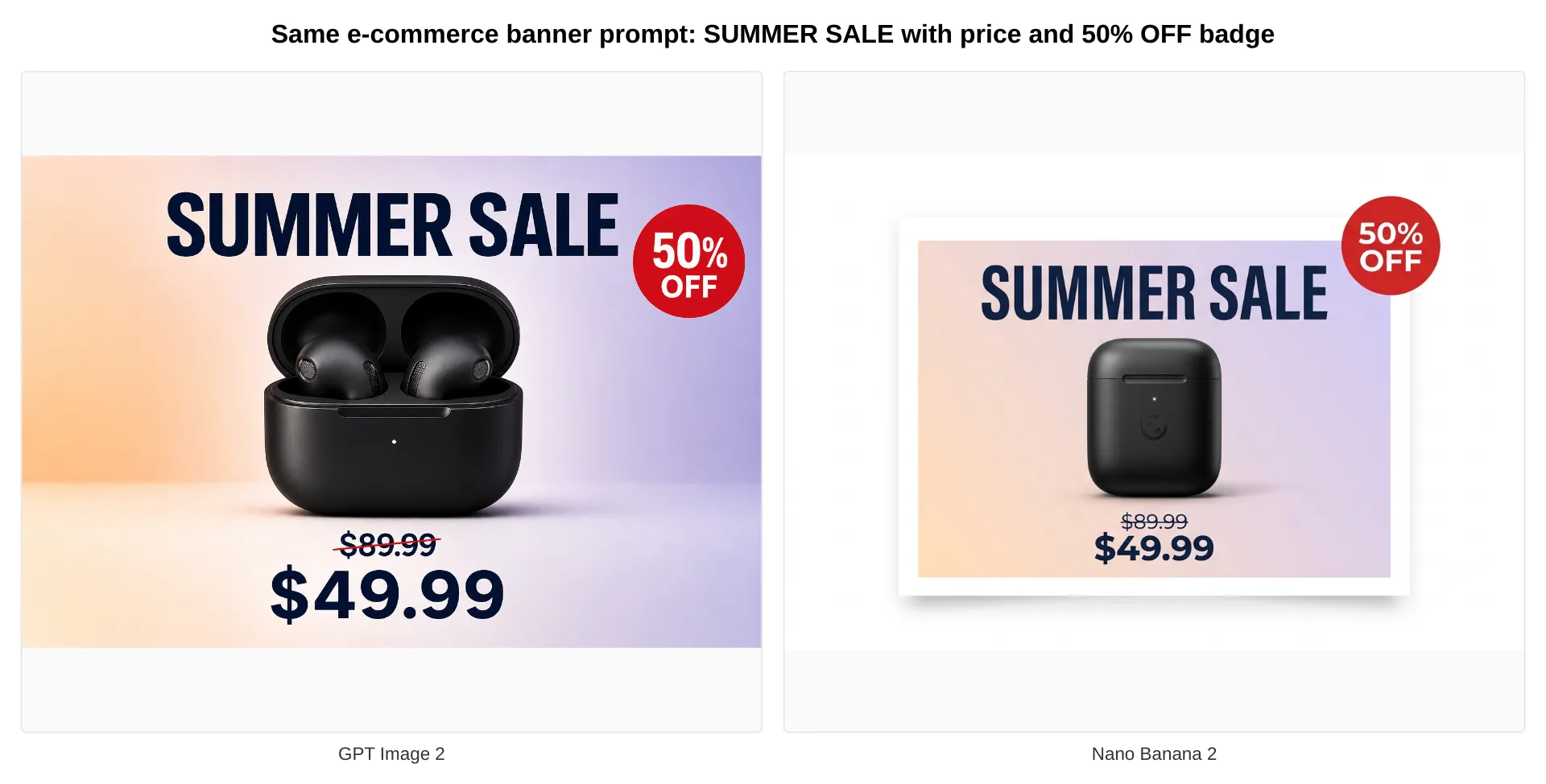
Pollo AI's 3×3 grid test exposed an even sharper divide: GPT Image 2 treated the grid as a strict spatial constraint, keeping each outfit item in its own cell with distinct boundaries. Nano Banana 2 blended items across cells and treated the layout loosely (pollo.ai). In the e-commerce banner test - requiring a product image, two prices, and a discount badge - GPT Image 2 produced a shipping-ready result; Nano Banana 2 added hallucinated extra text that required cleanup.
"The difference is not basic text accuracy; it is design completion quality." - Vidguru AI Lab, 10-test blind benchmark (vidguru.ai)
Photorealism and Portrait Quality: Nano Banana 2's Strength
Where GPT Image 2 dominates structured design, Nano Banana 2 takes the lead in natural photographic output. eWeek's product photography test - wireless headphones on a white background - awarded the round to Nano Banana 2 for stronger material detail and a more realistic texture. The headshot editing test and the rainy cafe scene both went the same way: Nano Banana 2 produced softer studio lighting and more convincing atmosphere.
Pollo AI's visual-quality round scored Nano Banana 2 at 9/10 for portrait realism against GPT Image 2's 7/10, citing more natural fur texture, clothing drape, and dynamic lighting.
"Nano Banana 2 takes the crown for raw photorealism." - Pollo AI comparison (pollo.ai)
One Reddit thread in r/ImagineAiArt echoes this pattern, describing Nano Banana 2's output as having a "natural iPhone-photo" quality while GPT Image 2 looks more "staged" or "polished" (reddit.com). That helps for lifestyle and social imagery where candid realism matters.
Image Editing and Reference Fidelity
Both models accept reference images, but their fidelity under demanding edit conditions diverges significantly. Vidguru's dual-reference identity transfer test - moving one person's face and hairstyle onto a samurai from a second reference image - produced a clear split. GPT Image 2 scored 5/5 for preserving identity through the action scene. Nano Banana 2 scored 3/5 because the face drifted toward an illustrated look and lost one-to-one identity.
The ice refraction test was even more revealing. The prompt asked each model to place a perfume bottle with a "V" logo inside irregular raw ice, with the logo optically distorted by refraction. GPT Image 2 correctly refracted the logo through the ice. Nano Banana 2 replaced the logo entirely instead of distorting it - a material-logic failure that scored 3/5 versus GPT Image 2's 5/5.
On the control side, Nano Banana 2 accepts up to 14 reference images (Masonry route) against GPT Image 2's 10, and exposes a seed parameter for reproducible batch configurations. GPT Image 2 compensates with automatic edit-mode switching when a reference is supplied and higher per-edit fidelity. For production workflows where you need to preserve a specific product, face, or brand asset through edits, GPT Image 2's fidelity advantage outweighs Nano Banana 2's higher reference count.
What Each Image Actually Costs
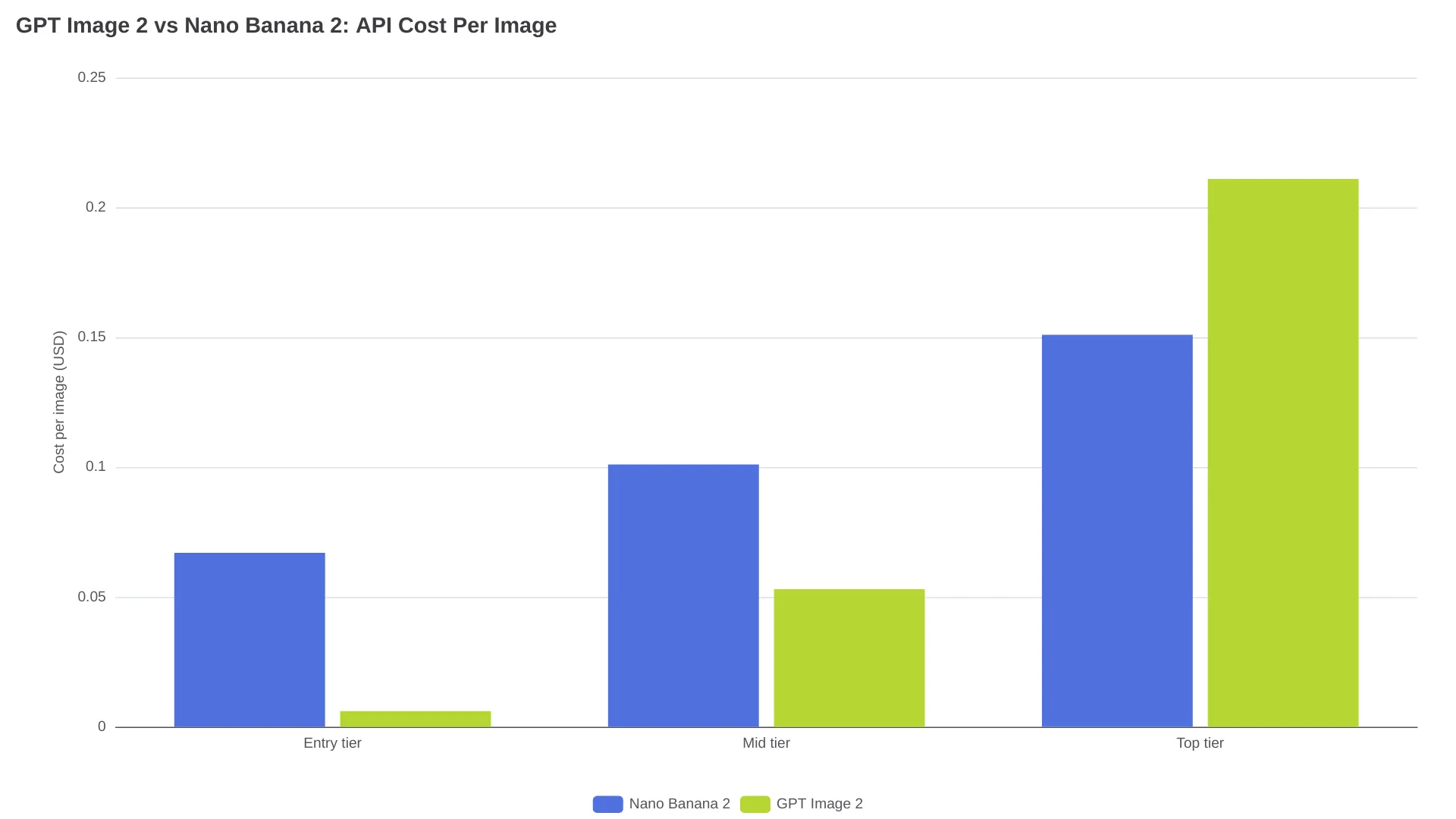
Neither competitor article published a complete pricing comparison. API pricing differs sharply by billing model. The APIs charge as follows, sourced from OpenAI's April 21 2026 launch announcement (community.openai.com) and Google's Nano Banana 2 tier pricing as reported by Vidguru (vidguru.ai):
| Nano Banana 2 | GPT Image 2 | |
|---|---|---|
| Billing model | Fixed per-image by resolution tier | Token-based: $5/M text input, $8/M image input, $30/M image output |
| 1K resolution | ~$0.067/image | ~$0.006/image (1024×1024, low quality) |
| 2K resolution | ~$0.101/image | ~$0.053/image (1024×1024, medium quality) |
| 4K resolution | ~$0.151/image | ~$0.211/image (1024×1024, high quality) |
| Reference image input | Included in tier | $8/M tokens |
| Budgeting | Predictable - pick a tier, multiply by volume | Variable - depends on prompt length, references, and quality setting |
GPT Image 2's per-image estimates assume a 1024×1024 output at three quality levels, based on typical output-token counts reported in OpenAI's launch thread. Nano Banana 2's tiers reflect different native resolutions (1K, 2K, 4K), so these are not like-for-like resolution comparisons. For budget planning, Nano Banana 2's fixed tiers are easier to model: 1,000 images at 2K costs roughly $101.
The cited banner and poster tests showed Nano Banana 2 producing hallucinated text in complex layouts that required cleanup, while GPT Image 2 produced deployment-ready output on the first attempt. For text-heavy commercial work, test cost per accepted image rather than cost per generation, since cleanup time and retry frequency vary by prompt complexity.
Speed, Resolution, and Control Parameters
| Parameter | Nano Banana 2 | GPT Image 2 |
|---|---|---|
| Generation speed | ~2–5 seconds | ~3–5 seconds |
| Max resolution | 4K | 3840 × 2160 |
| Resolution options | 1K, 2K, 4K tiers | Low, medium, high quality |
| Aspect ratios | 14 presets | 6 fixed sizes (1024² to 3840×2160) |
| Seed control | Yes (0–2,147,483,647) | No |
| Max reference images | 14 | 10 |
| Edit mode | Manual selection | Auto-switches with reference input |
| API name | gemini-3.1-flash-image-preview | gpt-image-2 |
Sources: Speed, resolution, and reference limits from Masonry's route documentation (masonry.so) and Vidguru's technical snapshot (vidguru.ai). API names from OpenAI's model docs and Google's Gemini API model catalog.
Nano Banana 2's seed parameter is the standout control feature for repeatable workflows. Without an exposed seed parameter, GPT Image 2 offers less direct control over repeatable batch configurations. GPT Image 2 compensates with automatic edit-mode detection when you supply a reference image.
Decision Framework: Which Model for Your Job
| Use case | Recommended model | Why |
|---|---|---|
| Posters, banners with exact copy | GPT Image 2 | Stronger text and layout performance in cited tests |
| Social media portraits, lifestyle imagery | Nano Banana 2 | Natural photographic quality, iPhone-photo aesthetic |
| Reference-based image editing | GPT Image 2 | Higher identity fidelity, better material logic |
| Bulk high-volume generation | Nano Banana 2 | Predictable tier pricing, faster minimum speed |
| Multilingual design (Japanese, etc.) | GPT Image 2 | Tighter typography and layout for non-English text |
| 4K photorealistic output | Nano Banana 2 | Cheaper at 4K ($0.151 vs ~$0.211), strong cinematic quality |
| Product photography | Nano Banana 2 | Better material detail and studio-realistic textures |
| E-commerce banners with prices/badges | GPT Image 2 | Shipping-ready output without cleanup |
For workflows that span both strengths, a two-model pipeline can cover both needs: generate lifestyle imagery with Nano Banana 2, then add text overlays or precise layout with GPT Image 2. Test the handoff against your identity-retention requirements, as cross-model editing may not preserve all visual details from the original generation.
FAQ
Which is better for text-heavy posters and banners?
GPT Image 2, because the cited banner and poster tests show stronger exact-copy layout performance.
Which model produces more realistic portraits?
Nano Banana 2. Pollo AI scored it 9/10 for portrait realism against GPT Image 2's 7/10, and Reddit feedback describes its output as more natural and candid.
Is Nano Banana 2 cheaper than GPT Image 2?
It depends on the tier. GPT Image 2 at low quality (~$0.006) is cheaper than any Nano Banana 2 tier, but low quality limits production use. At mid-range settings, Nano Banana 2's 2K tier (~$0.101) costs roughly twice GPT Image 2's medium quality (~$0.053), though these are not matched on resolution. See the pricing table above for the full breakdown.
Which is better for image editing with reference images?
GPT Image 2. Vidguru's dual-reference identity transfer and ice refraction tests both scored GPT Image 2 at 5/5 versus Nano Banana 2's 3/5.
Should I use Nano Banana 2 or Nano Banana Pro?
Nano Banana 2 targets speed, cost efficiency, and high-volume generation. For a comparison of GPT Image 2 against the higher-tier Nano Banana Pro variant, see our GPT Image 2 vs Nano Banana Pro analysis.