 AIREITER
Edge0-145B promises 145 billion parameters on a laptop at 80 tokens per second. The weights are downloadable, but the fine print points to an NVIDIA desktop with CUDA 13 and about 105GB of SSD.
This Edge0-145B review compares the launch claims against the launch blog, the model doc and Q3_K card, plus the first community runs, so you can decide before downloading whether to run it or call an API.
What shipped on November 12: weights, engine, and limits
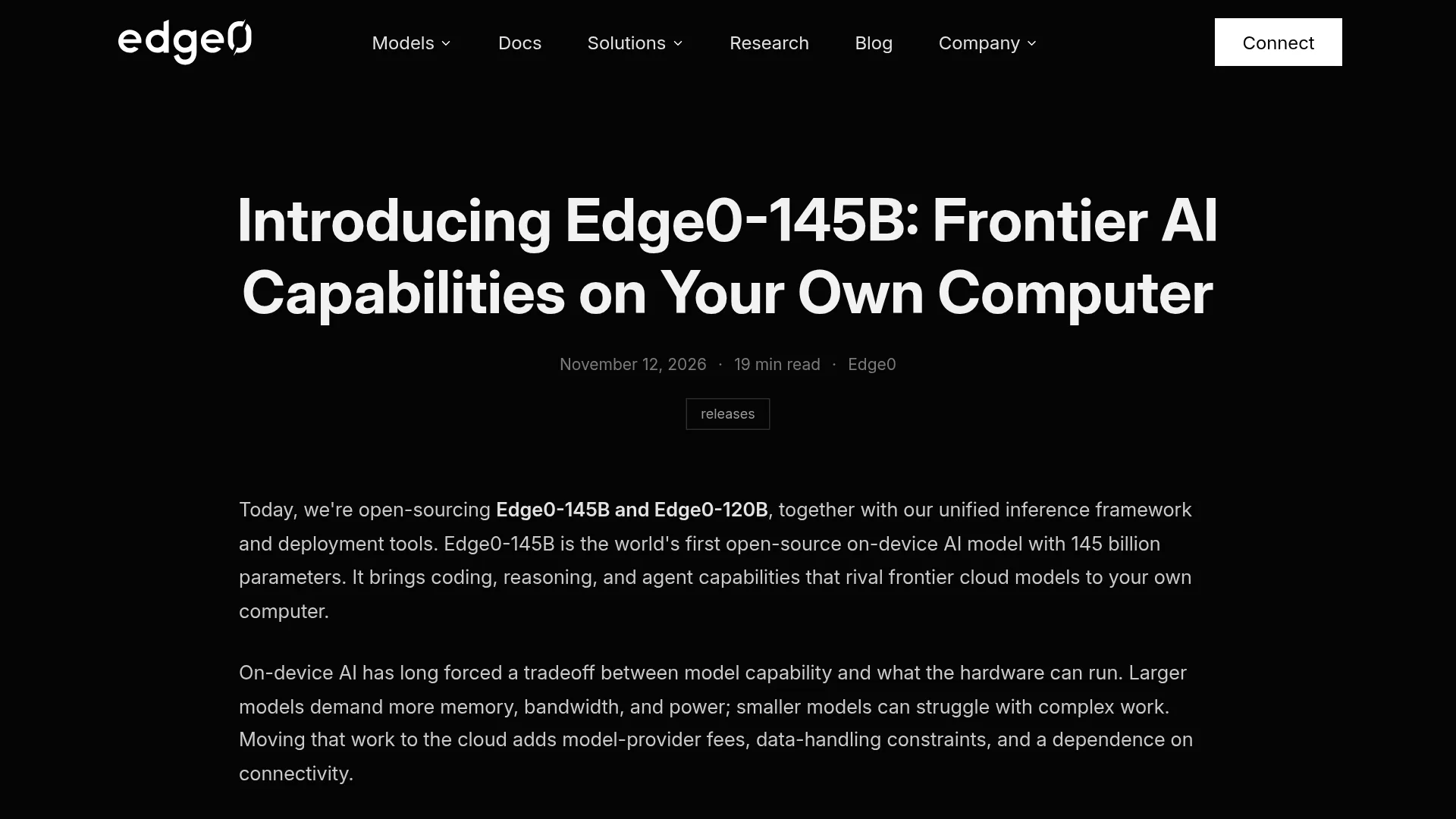
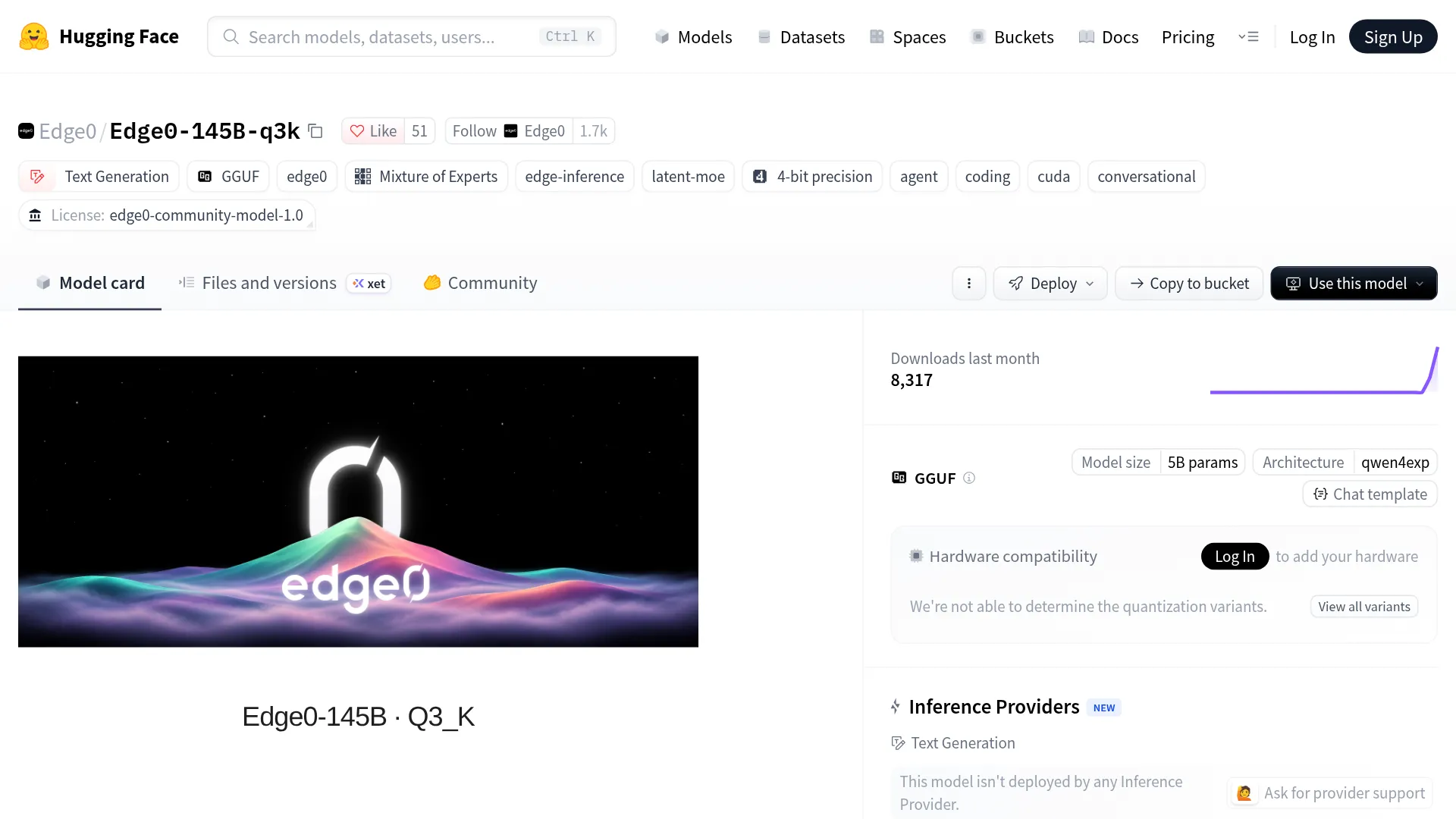
Edge0 released Edge0-145B and Edge0-120B on November 12, 2026, with weights in Edge0-145B-q3k and Edge0-145B-NVFP4 and the edge0-strata engine in Edge0-AI/Edge0. Edge0-145B is a text-only latent Mixture-of-Experts model with 256K context, derived from Qwen3.8-Flash-Next and trained natively at 4-bit. About 10.12B parameters activate per token, so 145B total does not need 145B in VRAM.
The total splits into about 84.6B expert parameters, a 51.2B PLE n-gram table memory-mapped from SSD, a 1.26B draft head for speculative decoding, and a 6GB skeleton. Q3_K ships 40.81 GiB of weights in a 105.4GB repository, NVFP4 ships 47.79 GiB in 112.9GB. The routed experts live in a custom experts.bin pack rather than a portable GGUF.
The 29GB claim does not fit in 29GB
The blog lists 29GB peak in one section and 28GB in another, alongside 1,100+ tokens per second prefill, 80+ decode, and 120W power. The Q3_K card reports 23.14 GiB VRAM plus 31.28 GiB host RAM on an RTX 5090 D, and 23.25 plus 38.27 for NVFP4. The expert library is about 40GB in RAM with about 48GB of vocabulary streamed from SSD.
Hot experts stay in VRAM, warm experts sit in RAM, and the 51.2GB PLE table reads from SSD on demand. Active residency can approach 29GB narrowly defined, but storage and streaming still require the full repository.
| What the number means | Size | Where it lives |
|---|---|---|
| Blog peak-memory claim | 28-29GB | Active residency, methodology undocumented |
| Q3_K repository download | 105.4GB | NVMe SSD, 51.2GB PLE + 40.1GB experts.bin |
| NVFP4 repository download | 112.9GB | NVMe SSD, 51.2GB PLE + 47.6GB experts.bin |
| Measured 5090 D Q3_K residency | 23.14 GiB VRAM + 31.28 GiB RAM | VRAM + system RAM during inference |
| Measured 5090 D NVFP4 residency | 23.25 GiB VRAM + 38.27 GiB RAM | VRAM + system RAM during inference |
What you actually need to run Edge0-145B
Edge0-145B runs on Linux or Windows with an NVIDIA GPU and CUDA 13 through edge0-infer. Stock llama.cpp, Ollama, and LM Studio have no load path in the released files: the skeleton GGUF lacks routed-expert weights and Edge0 documents only edge0-infer (see repo instructions), which is why the llama.cpp v1.0 guide workflow does not apply here. The blog names macOS and MacBook Pro as day-one support, yet the platform table lists only Linux and Windows with CUDA 13 for 145B and 120B.
Minimum tested is 16 GiB VRAM plus 20 GiB RAM at 44.9 tokens per second agent decode on Q3_K; recommended is a 24GB NVIDIA card, 32GB system RAM with 48GB more comfortable, 120GB free NVMe, and CUDA 13 plus CMake, Ninja, and uv. Build and serve per the repo instructions:
git clone https://github.com/Edge0-AI/Edge0.git edge0
hf download Edge0/Edge0-145B-q3k --local-dir ./Edge0-145B-q3k   # ~105 GB
export EDGE0_145B=$PWD/Edge0-145B-q3k
build/cpu/bin/edge0-infer serve --model "$EDGE0_145B"  # :8000
Windows users can instead grab Edge0 Chat app v0.2.0 from GitHub Releases. AMD needs manual fixes: u/UghrUghr reports about 35 lines of build and runtime changes on an RX 7900 XTX under Windows 11 in this r/LocalLLaMA thread, with CUDA-fused kernels on a slower fallback.
Q3_K vs NVFP4: which file to pull
Q3_K at 105.4GB is the default, with 121.2 tokens per second agent decode on a 5090 D in Edge0's table. NVFP4 at 112.9GB targets Blackwell acceleration at 98.3 on the same card. Without Blackwell hardware, start with Q3_K.
How fast is it on real cards
Figures below are Edge0-reported Q3_K with 16K prefill unless noted. The M2 Ultra row is a Metal measurement and does not establish a macOS release.
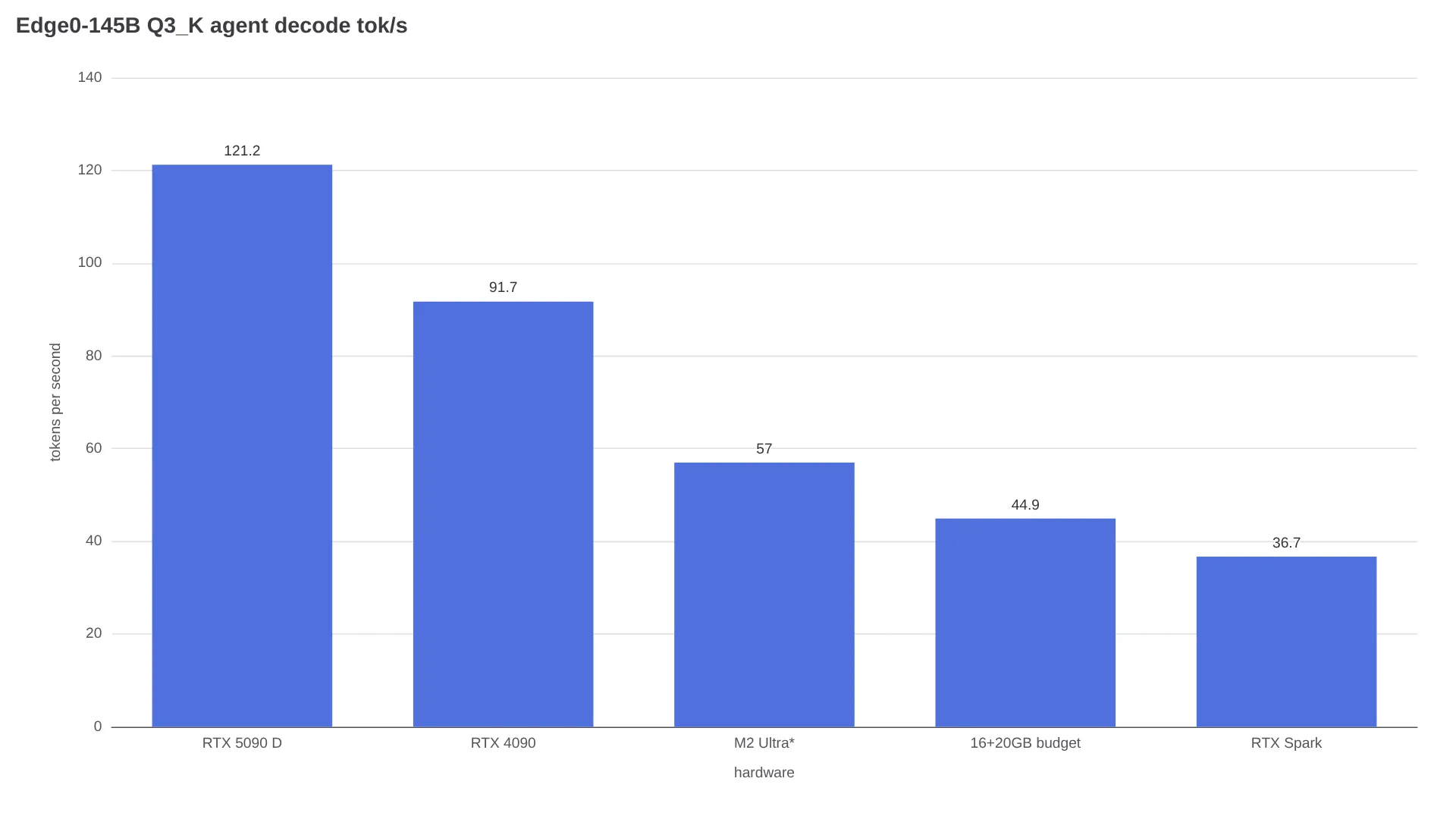
| Hardware | Chat decode | Agent decode | 16K prefill |
|---|---|---|---|
| RTX 5090 D 24GB Q3_K | 99.7 | 121.2 | 3,554.9 |
| RTX 4090 24GB Q3_K | 69.9 | 91.7 | 3,179.4 |
| Apple M2 Ultra Metal Q3_K | 60.9 | 57.0 | 800.3 |
| 16 GiB VRAM + 20 GiB RAM budget Q3_K | 36.8 | 44.9 | 335.0 |
| RTX Spark 60GiB Q3_K | 37.7 | 36.7 | 770.3 |
An RTX 3090 user reports 20.1 seconds time-to-first-token, 1,583 prefill, and 56.2 decode on Q3_K, suggesting pace below the flagship cards:
Just tried it out on my 3090 setup — 20.1s TTFT, 1583 tok/s prefill, 56.2 tok/s decode for Edge0-145B Q3_K.
— u/LightBrightLeftRight, r/LocalLLM thread
On the AMD setup above, u/UghrUghr reports about 40 decode, about 54 with ROUTE_TAIL_SKIP=7 and ROUTE_PRIOR=1.5, and about 320 prompt processing. These are single-user snapshots, not controlled reproductions, at roughly half to two-thirds of 5090 D pace.
Benchmarks: two wins, four caveats
Edge0's table mixes internal runs for Edge0, Qwen, DeepSeek, and Claude with third-party figures for others, per the model doc. Edge0-145B leads the two coding-agent tests and trails its Qwen base on knowledge and instruction tests. I found no linked independent reproduction as of November 13, 2026, and the scores describe the full model rather than the quantized downloads.
| Benchmark | Edge0-145B | Qwen3.8-Flash-Next | DeepSeek V4 Flash | Claude Opus 4.6 Max |
|---|---|---|---|---|
| DeepSWE 1.1 | 64.6 | 58.7 | 54.4 | — |
| Terminal-Bench 2.1 | 86.52 | 83.3 | 82.7 | 78.2 |
| HLE | 35.4 | 35.9 | 33.8 | 40.0 |
| GPQA-Diamond | 90.4 | 91.7 | 90.8 | 91.3 |
| IFBench | 80.6 | 81.3 | 79.2 | 62.5 |
| AA-LCR | 79.3 | 79.1 | 79.7 | 78.0 |
The mean is 72.8 for Edge0-145B against 71.7 for Qwen3.8-Flash-Next and 70.1 for DeepSeek-V4-Flash in Edge0's math, with 120B at 68.9. My take: with similar peak claims for both sizes, choose the 145B unless disk is tight.
License: open weights is not open source
The framework is Apache 2.0 and the Strata base is MIT, but weights carry Edge0 Community Model License 1.0 with Qwen terms also applying. Personal, research, internal business, and commercial use of outputs are allowed. Selling or bundling the model, running a paid service, or shipping a commercial coding or office assistant needs separate written permission.
Should you download it or call an API instead
Download if you have the hardware and need code to stay on-device. For a one-off test, compare hosted API pricing before buying hardware. Developers comparing hosted inference can check the DeepSeek V4.1 Flash API page before committing 105GB of disk.
| Your situation | Pick |
|---|---|
| 24GB NVIDIA + 32-48GB RAM + 120GB NVMe, Linux/Windows | Download Q3_K, serve via edge0-infer |
| Blackwell card, prefer NVFP4 path | Download NVFP4 build |
| Mac only, 8-16GB laptop, or need Ollama/LM Studio | Do not download yet; use a hosted API |
| Shipping a paid API or assistant on the weights | Pause for written license; use an API |
| Want the scores without ops work | Use Qwen-class or frontier APIs; revisit after reproductions |
Provenance versus practicality is the trade-off: expert streaming lowers the VRAM bar for 100B-plus models, but laptop, macOS, and 29GB framing runs ahead of released code, and Edge0's published table gives no separate Q3_K quality numbers.
FAQ
Can Edge0-145B run on a laptop?
Only a high-end NVIDIA laptop with about 24GB VRAM, 32GB-plus RAM, and 120GB NVMe on Linux or Windows with CUDA 13. An 8GB or 16GB ultrabook cannot run the 145B build, which needs 105.4GB download and 23 GiB-plus VRAM residency.
Does Edge0-145B work on Mac?
No supported macOS release appears in the platform table as of November 13, 2026. M2 Ultra figures are Metal measurements only.
Does it work with Ollama, llama.cpp, or LM Studio?
No. Stock builds cannot load custom experts.bin packs, and the skeleton GGUF lacks routed-expert weights. Use edge0-infer serve or the Windows Chat app.
Is Edge0-145B better than Qwen3.8-Flash-Next?
Ahead on DeepSWE at 64.6 vs 58.7 and Terminal-Bench at 86.52 vs 83.3 in Edge0's tests, behind on HLE at 35.4 vs 35.9 and GPQA-Diamond at 90.4 vs 91.7. Independent tests are pending.
Can I use Edge0-145B commercially?
Outputs yes, but selling the model, running a paid service, or shipping a commercial coding or office assistant needs separate written permission under the community license, with Qwen terms also applying.