 AIREITER
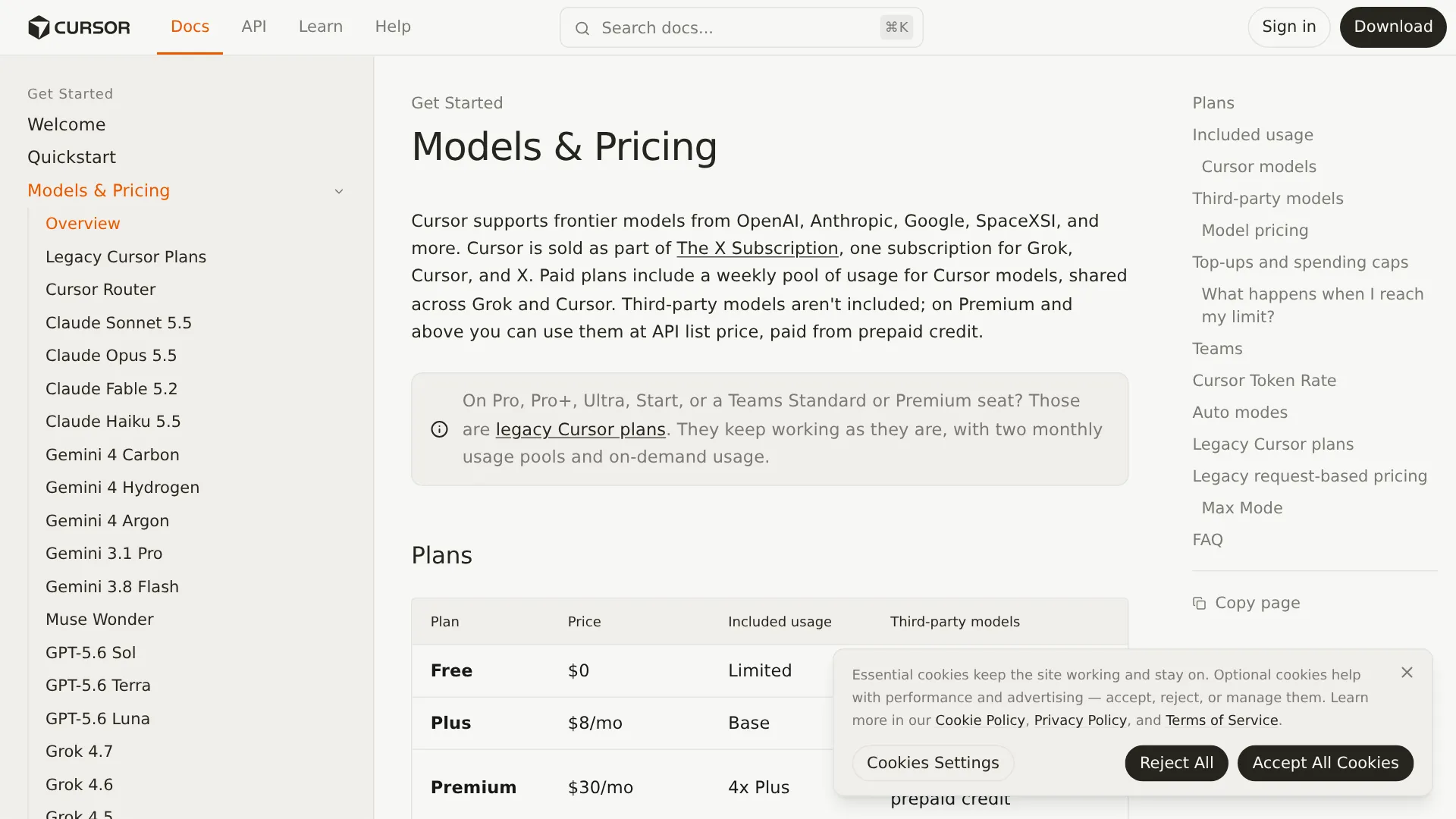
Google shipped Gemini 4 Hydrogen on November 12, 2026 as its fast Flash-tier agent model. Cursor lists it as a third-party model, an addition reported November 12 alongside a 54.3% CursorBench result at one-tenth of Opus 5.5 token prices. Four effort levels change your actual bill far more than that list price suggests.
What you actually get when you pick Hydrogen in Cursor
Hydrogen is generally available under the model ID gemini-4-hydrogen, per the Google launch post and DeepMind model card. In Cursor you select it from the model picker in Agent or Chat, then choose an effort level: Low, Medium, High, or Xhigh. High is the default and the setting behind the published 54.3% score.
Two details catch teams off guard:
- Context is 1M on paper. Google advertises a 1-million-token input window with flat pricing across the full window and up to 1 million output tokens in a special long-decode mode. The default synchronous output cap is 65,536 tokens. Usable limits inside Cursor follow Cursor's own model list, so confirm there before planning a full-repo pass.
- It is billed separately. Cursor lists Hydrogen at $1.50 input / $7.50 output per 1M tokens, versus Argon and Carbon at $2.00 / $10.00 and Opus 5.5 at $15.00 / $75.00. Third-party models are charged separately from Cursor's included model pool, so enabling Hydrogen is not free even on a paid plan.
What the 54.3% CursorBench score actually proves
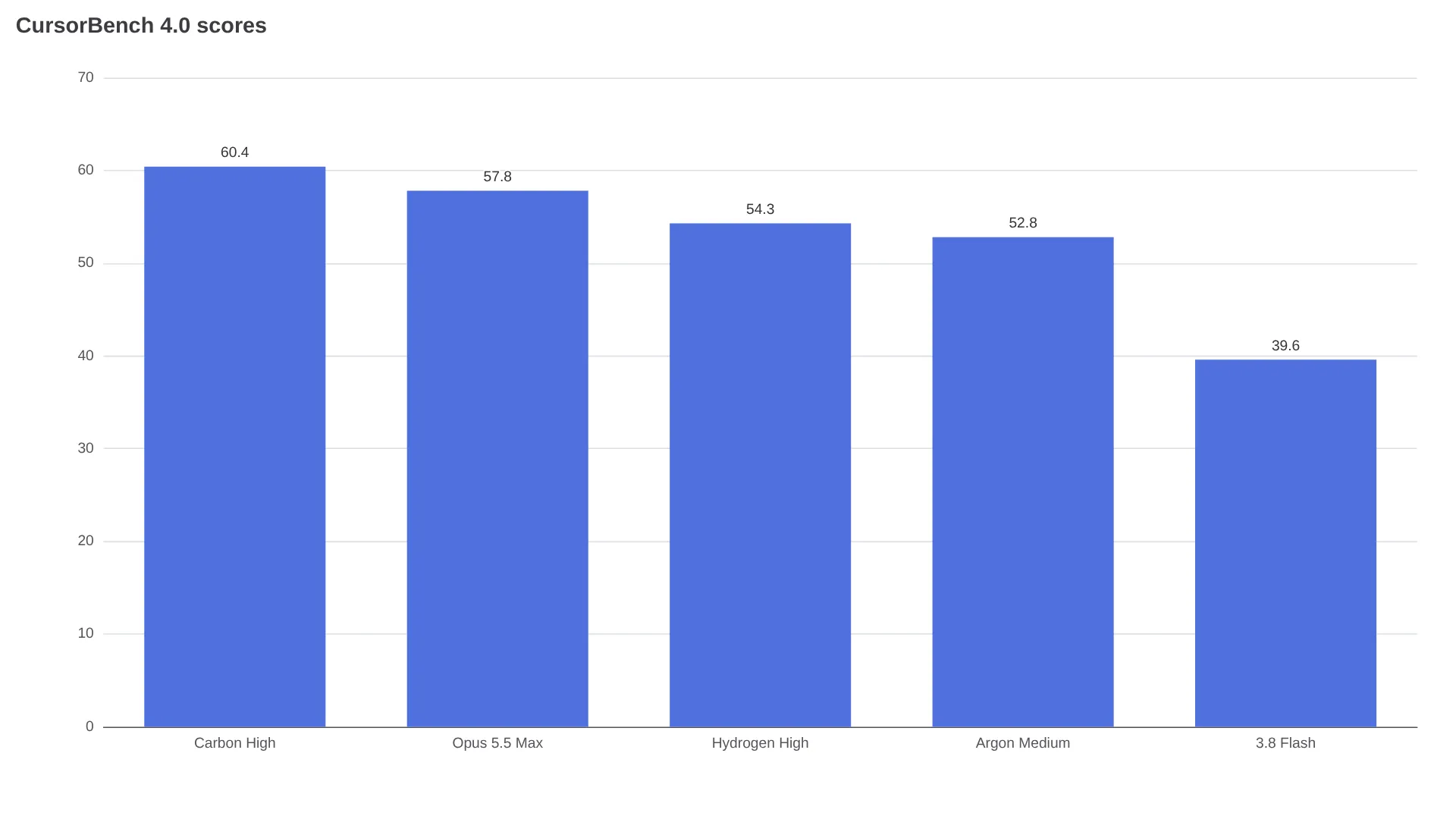
CursorBench 4.0 tests ambiguous, multi-file work sampled from real Cursor sessions: planning, tool use, debugging, edits, and repo navigation inside Cursor's own agent harness. Results have variance, and Cursor warns that small gaps may not be statistically meaningful. Effort levels differ across rows, so this is not a perfectly controlled ranking.
| Model | Effort | CursorBench 4.0 |
|---|---|---|
| Gemini 4 Carbon | High | 60.4% |
| Claude Opus 5.5 | Max | 57.8% |
| Gemini 4 Hydrogen | High, default | 54.3% |
| Gemini 4 Argon | Medium | 52.8% |
| Gemini 3.8 Flash | — | 39.6% |
Other benchmarks broadly corroborate Hydrogen below the top reasoning models: 51 at High and 54 at Xhigh on the Artificial Analysis Intelligence Index versus Argon at 50, and 54.04% on Vals Terminal-Bench 4.0, as aggregated with receipts on Ridge's Hydrogen profile. Google separately claims 57% on Terminal-Bench 4.1, which remains a vendor claim.
The billing math that flips the cheap story
Per-token, Hydrogen is 25% cheaper than Argon and 90% cheaper than Opus 5.5. A hypothetical 100K input + 20K output run costs about $0.30 on Hydrogen, $0.40 on Argon, and $3.00 on Opus, before reasoning depth, caching, and retries.
Per completed short task, the order reverses because thinking tokens are billed as output tokens. The table below comes from Ranthis's November 13 API test: 171 paid-tier calls across three office tasks run three times each (45 checks total) and 10 hard math problems. These are short single-turn API tasks, not Cursor agent runs, so treat them as a proxy for reasoning overhead, not as Cursor invoices.
| Model and effort | Office set cost | Math set cost | Thinking tokens observed | Median latency |
|---|---|---|---|---|
| Hydrogen High | $0.0723 | $0.1134 | 1,230–1,350 on sample task | 5.7s |
| Hydrogen Low | $0.0506 | $0.0927 | 128–1,438 per call; 813–864 on sample task | 3.8s |
| Hydrogen Xhigh | $0.1855 | $0.4995 | up to 6,112; one integral 22,508 over 94s | 11.4s |
| Argon default | $0.0195 | $0.0566 | 0–236 on sample task | 5.4s |
| 3.8 Flash default | $0.0387 | $0.0381 | — | 8.4s |
| 3.8 Flash Low | $0.0163 | $0.0267 | — | 5.2s |
| Carbon Low | $0.0148 | $0.0445 | zero on all 19 measured calls | 5.1s |
Every Hydrogen level scored 45/45 and 10/10 in that test, yet Hydrogen High measured about 3.7x Argon on the office set and 2x on math. Carbon Low used zero thinking tokens where Hydrogen Low never reached zero.
Google's 2.5x-faster-than-Flash claim and partner reports of 2–2.8x faster execution with 12–23% lower token use come from agentic tool-call workloads. On short single-turn tasks Ranthis measured closer to 1.5x (5.7s vs 8.4s). Speed compounds the discount mainly when tasks use tools and fan-out.
Which effort level to run in Cursor
Effort changes billed tokens, not list price. Higher effort does not raise $1.50/$7.50, but it generates more thinking tokens you pay for.
- Low: start here for routine work. Cheapest Hydrogen setting in the cited API test, 30% below High on office work with full marks. Candidate for small features, focused fixes, predictable refactors, parallel workers, diff review, and test triage, then validate against High on your repo.
- High: the balanced default. The 54.3% score lives here. Keep it when tasks need planning across files or ambiguous debugging and Low starts missing constraints.
- Medium: no clear cost advantage. In one math run Medium cost $0.1346 versus $0.1134 for High on a single noisy problem. Do not treat it as safely between Low and High.
- Xhigh: escalation only. The setting behind the 54 index score, suited to hard planning and debugging. Avoid it for routine work.
The pattern that fits the data is Hydrogen as worker and verifier under a stronger coordinator. Let Carbon (60.4%) or Opus 5.5 (57.8%) own architecture and tricky debugging, then fan out routine implementation, verification, and large-context reads to Hydrogen agents, as our Hydrogen vs Sonnet 5.5 agent pick details.
Rollout quirks to watch this week
Early reports across the Gemini ecosystem are positive on speed but inconsistent on access and quota reporting. Treat these as single-day anecdotes, not settled limits; Cursor-specific billing should be checked in your dashboard.
"I've been using it to code a 3d voxel game the past 4hr, over 25 prompts in, 5% weekly used. No errors." — u/More-Secret3587, r/GeminiAI Hydrogen coding thread
Separate early threads report the picker appearing then disappearing and switching between Hydrogen and Flash in real time, per this availability thread, plus quota-efficient PDF batches alongside responses that consumed quota faster than expected, per this usage thread. The cited threads do not establish the cause.
What to do:
- If Hydrogen is missing from the picker, check Cursor's model list and plan allowance, then retry.
- If quota looks inconsistent, track usage in your Cursor dashboard rather than trusting launch-day averages.
- If latency spikes, drop to Low, split the task, and retry before changing models.
Should Hydrogen be your Cursor default?
| If your work looks like | Pick | Why |
|---|---|---|
| Routine features, fixes, refactors, reviews, parallel agents | Hydrogen Low, escalate to High when stuck | Cheapest Hydrogen setting in cited API test; escalate if quality drops |
| Ambiguous multi-file planning, deep debugging | Carbon High or Opus 5.5 Max as coordinator | 60.4% and 57.8% beat Hydrogen when reasoning depth dominates |
| High-volume short calls where cost rules | Argon default or 3.8 Flash Low | $0.0195 and $0.0163 per office set beat Hydrogen Low's $0.0506 in API tests |
| Uncertain workload | Test Low vs High on five repo tasks | Completion rate, charge, latency, and retries decide the default |
Hydrogen Low is a reasonable starting point for routine Cursor work when throughput matters, with Carbon or Opus one click away for hard planning. Confirm the economics on your own tasks before locking a default.