 AIREITER
If you run coding agents all day, Gemini 4 Hydrogen vs Claude Sonnet 5.5 comes down to this: Hydrogen is about 25% cheaper under a 50/50 input-output blend ($4.50 vs $6.00 per million), but Sonnet 5.5 still finishes more terminal and computer-use tasks without hand-holding. Neither the price tag nor the benchmark table tells you what an agent costs per finished task.
Both Gemini 4 Hydrogen and Claude Sonnet 5.5 pitch a 1M-token context for fast coding and agentic loops, with Hydrogen adding four adjustable thinking levels.
What changes if you swap Sonnet 5.5 for Hydrogen tomorrow?
A team running 200 agent tasks a day feels the swap in two places: the invoice and the intervention rate. Hydrogen cuts the per-token rate and, in LLM Leaderboard's independent speed sample, generates around 198 tokens per second versus about 144 for Sonnet 5.5. That is the "bulk executor" profile: fast drafts, parallel file reads, quick repairs.
Sonnet 5.5 is the "careful completer." Google's launch table puts Sonnet 5.5 ahead on the three terminal-heavy and computer-use benchmarks (Terminal-Bench 4.1, OSWorld 2.1, Terminal-Bench-Science), detailed in the table below. Those are exactly the tasks where an agent either recovers from a failed command or stalls.
Launch-week Reddit discussion shows the same split at task level:
"hydrogen is alright but honestly i don't feel it's better than sonnet 5.5." — u/FewKey5274 on r/GeminiAI
That thread has no controlled coding benchmark, so read it as a caution flag: isolated-task wins do not predict end-to-end harness performance. Test both on the same workflow before migrating.
The bill: $4.50 vs $6.00 blended is only the start
Official API rates are simple. Hydrogen costs $1.50 per million input tokens and $7.50 per million output tokens, flat across the full context window, per Google's announcement. Sonnet 5.5 costs $2.00 per million input tokens and $10.00 per million output tokens, per Anthropic's pricing and OpenRouter's side-by-side comparison.
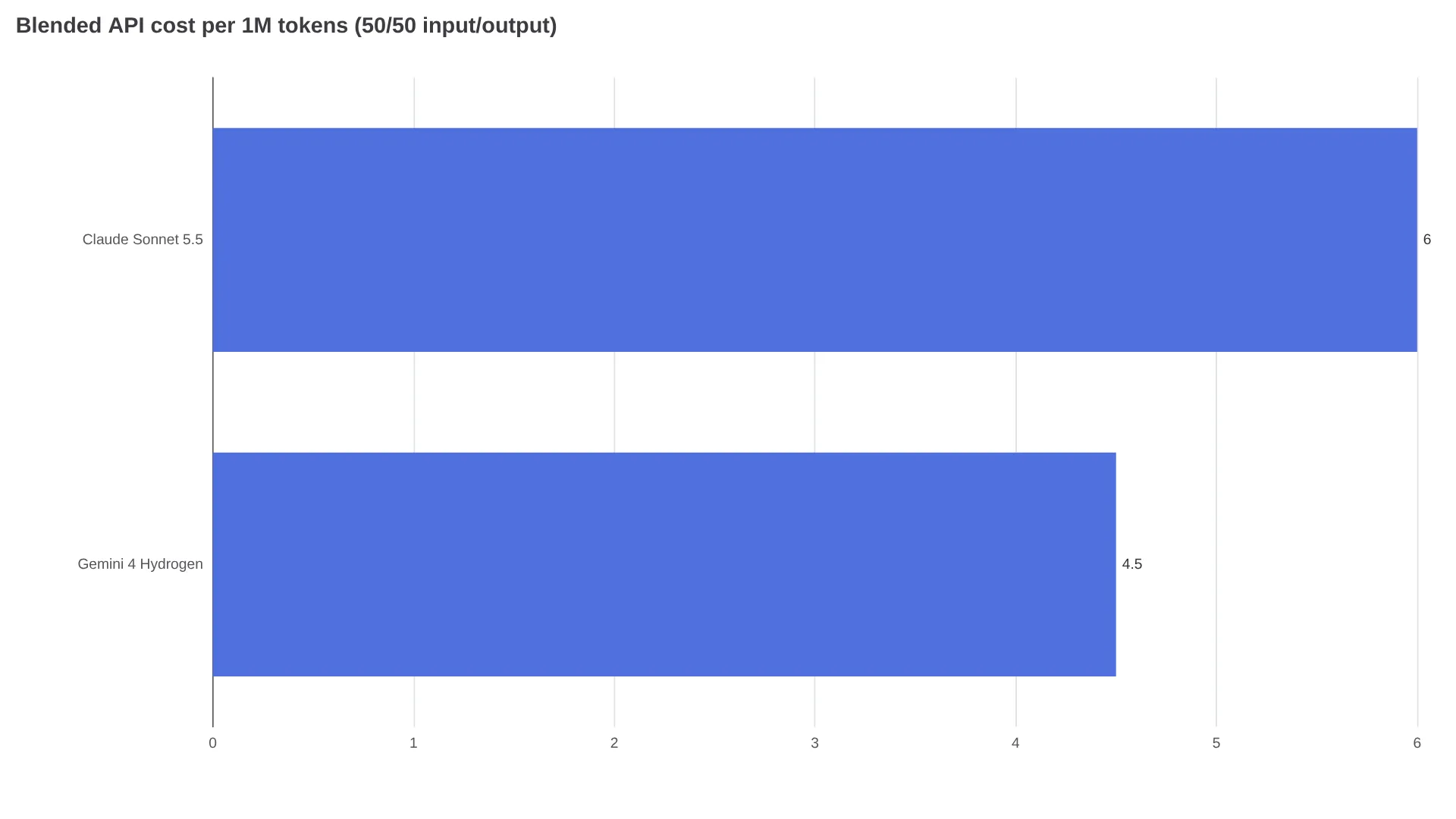
The 50/50 blended math — 500K input plus 500K output — gives Hydrogen $4.50 per million against Sonnet 5.5's $6.00. That 25% gap is real, but three details decide whether you keep it:
- Output-heavy agents widen the gap. Agentic loops with long reasoning traces skew output-heavy, where Hydrogen's $2.50-per-million output discount matters most.
- Caching and batch tiers are excluded. Anthropic's prompt-cache reads and Batch API discounts can move the real bill several percent; LLM Leaderboard notes explicit caching was unsupported in its Hydrogen speed sample.
- A worked example keeps it concrete. One agent turn averaging 10K input and 3K output tokens, 1,000 turns a day, means 10M input plus 3M output: roughly $37.50/day on Hydrogen versus $50.00/day on Sonnet 5.5 at list rates, or about $275/month difference per concurrent agent over 22 workdays — before retries.
Retries decide the real winner. Cost per completed task equals token cost per attempt divided by success rate, plus human fix-up time. As an illustration only, a $37.50 Hydrogen day at an 80% first-pass rate costs about $46.90 per 1,000 completed tasks in tokens alone, while a $50.00 Sonnet day at 95% costs about $52.60. The gap narrows fast when success rates differ, so track first-pass merge rate for two weeks rather than trusting either vendor's table.
Benchmarks split by job type, not by winner
Google's launch table, also published in the DeepMind model card, compares Hydrogen, Sonnet 5.5, and GPT-6.1 Terra across ten evaluations. Hydrogen leads seven of the ten against Sonnet 5.5; Sonnet 5.5 leads the other three. Vendor rows use each side's own harness; independent rows come from LLM Leaderboard re-runs.
| Job family | Benchmark | Gemini 4 Hydrogen | Claude Sonnet 5.5 |
|---|---|---|---|
| Repo coding | SWE-sweep (vendor) | 13.5% | 3.1% |
| Repo coding | Terminal-Bench 4.1, cheating-adjusted (vendor) | 57.0% | 63.9% |
| Knowledge automation | Agents' Last Exam v1.1 (vendor, harness-sensitive) | 71.6% | 60.4% |
| Knowledge automation | AutomationBench-AA (vendor) | 76.1% | 71.8% |
| Knowledge automation | Vending-Bench 2 final balance (vendor) | $14,549 | $11,165 |
| Computer use | OSWorld 2.1 offline subset (vendor) | 77.6% | 83.9% |
| Multimodal | MKA Climb WSR (vendor; independent 49.52%) | 53.4% | 52.0% |
| Multimodal | Chartography (mixed provenance) | 66.6% | 61.6% |
| Science | Terminal-Bench-Science 0.1 (vendor; independent 49.52%) | 51.4% | 59.9% |
| Reasoning | HLE-Diamond (independent xhigh) | 58.8% | 53.3% |
Tool calls are where agents live or die
Benchmarks score answers. Agents live on tool calls: batching reads, calling the right function, and recovering when a search returns nothing or a command fails.
Google says Hydrogen batches file reads and searches in parallel rather than inspecting files sequentially, and makes focused repository edits instead of rewriting unrelated files. Partner reports in the launch post cite 2x to 2.8x faster graph and SQL work with 12% to 23% fewer tokens than Gemini 3.8 Flash, plus 2.5x faster completion at default high reasoning. Those are vendor-selected partner numbers, direction rather than guarantees.
The counterweight is harness maturity, visible in the Claude Code vs Antigravity thread where users report Antigravity uptime problems and missing workflow pieces (SSH, reusable hooks, skills, subagents). That is user perception from launch week, not a controlled measurement, and it concerns the harness rather than the model weights.
Verify three things before moving a production agent: parallel tool-call reliability under your MCP server count, recovery rate after a failed bash or browser step, and permission-boundary behavior. Google's internal checks claim up to 81% less agentic overreach, 79% less under-service, and 96.7% honesty on its agent-honesty evaluation. Confirm with your own 50-task canary of blocked actions and dead-end searches.
Thinking levels: high is the default, xhigh is selective
Hydrogen ships low, medium, high, and xhigh levels with high as the default. Per Google's thinking-level table, the Artificial Analysis Intelligence Index v5.0.1 moves 27 / 41 / 51 / 54 from low to xhigh, with default high (51) edging Argon (50). On Terminal-Bench 4.0 the same table has high at 54.0% beating xhigh at 53.5%, while AutomationBench-AA (60.5% to 76.1%) and HLE-Diamond (32.2% to 58.8%) climb steadily.
The rule for agent loops: start at high, escalate single tasks to xhigh only when reasoning is the bottleneck (analysis, synthesis, multi-document research), then check the token delta. Per the DeepMind model card, Hydrogen may consume more tokens at higher thinking levels, and its knowledge cutoff is March 2026, so freshness-sensitive work needs retrieval either way.
The harness question to test before you migrate
Per the DeepMind model card, Hydrogen offers a 1,048,576-token context with up to 64K synchronous output (up to 1M via background long decode); per Anthropic's docs, Sonnet 5.5 offers 1M input with up to 128K output. The headline windows look equal, but compaction decides large-codebase work: ask how much survives after 50 turns, not what the spec sheet says.
| Gemini 4 Hydrogen | Claude Sonnet 5.5 | |
|---|---|---|
| Context / output cap | 1,048,576 tokens in; 64K sync out (1M background decode) | 1,000,000 tokens in; 128K out |
| Where it runs | Gemini API, AI Studio, Antigravity, Gemini app, per Google | Claude API, Bedrock, Vertex AI, Microsoft Foundry, per Anthropic |
The Antigravity vs Claude Code thread makes harness stability the bigger migration risk than model quality: users question compaction survival, quota persistence, and uptime. Run the same repository, same commit, same prompt, and same acceptance tests in both harnesses, and compare completed tasks per subscription window and first-pass merge rate.
Pick in 60 seconds: three agent profiles
No single winner serves every agent. As an editorial judgment from the benchmark split above (not a measured trial): route parallel, repetitive execution to Hydrogen and recovery-sensitive, long-horizon work to Sonnet 5.5. Single-vendor planner-executor pairs keep auth and compaction consistent; mixing a Claude planner with a Hydrogen worker is worth testing only after the single-vendor baseline is measured.
| Your agent | Pick | Why (evidence level) |
|---|---|---|
| High-volume executor: bulk repairs, boilerplate, data wrangling, multimodal triage | Hydrogen at high | Vendor benchmark lead on AutomationBench, Agents' Last Exam, Vending-Bench; independent speed sample ~198 vs ~144 tok/s |
| Long-horizon completer: terminal-heavy debugging, OS/browser automation, science tooling | Sonnet 5.5 | Vendor benchmark lead on Terminal-Bench 4.1, OSWorld 2.1, Terminal-Bench-Science; ecosystem judgment on Claude Code hooks and subagents |
| Research synthesizer: long docs, charts, audio/video, Sheets-heavy analysis | Hydrogen at high, xhigh for the hardest passes | Vendor lead on HLE-Diamond, Chartography, MKA; caveat that independent MKA re-ran lower at 49.52% |
Is Hydrogen actually faster than Sonnet 5.5?
Throughput favors Hydrogen in LLM Leaderboard's sample (about 198 vs 144 tokens per second), but OpenRouter's live p50 feed shows Sonnet 5.5 ahead on latency (2.08s vs 6.92s median) because provider, region, and load differ. Measure both on your own provider.
Can Hydrogen replace Sonnet 5.5 inside Claude Code?
Not by swapping a model ID. Sonnet 5.5 runs natively in Claude Code, where teams rely on hooks, skills, and subagents; Hydrogen runs through the Gemini API, AI Studio, Antigravity, and the Gemini app. Replacement means migrating harnesses.