 AIREITER
Search results for the World Labs Atlas API still show September guides that say there is no public API. World Labs opened Atlas apps and developer endpoints to everyone on November 12, 2026, but Atlas remains closed-weights with no public price page, so plan a pilot before committing production work to it.
Is the World Labs Atlas API public now?
Yes. World Labs Atlas is publicly accessible as a product and developer API as of November 12, 2026. World Labs announced "opening up access to Atlas to everyone today," with web apps plus API endpoints for keyframes, video clips, and 3D Gaussian splats.
The timeline matters because older pages describe a different status:
| Date | Atlas status |
|---|---|
| Sept 1, 2026 | Atlas announced as early-access model for selected partners |
| Nov 5, 2026 | Frameboy released as free browser demo with preset scenes, up to 15 fps, no sign-up |
| Nov 12, 2026 | Viewfinder, Chisel, and API endpoints opened to everyone with registration; weights stay closed |
What opened on November 12 is product access through Atlas apps and the developer API. What did not open is open weights, unlimited free use, or a general-availability SLA.
Start at atlas.worldlabs.ai/sign-in for the apps, read the Atlas API reference for endpoints, and use Frameboy if you want a no-registration walkthrough first.
What Atlas generates — and what it does not
Atlas is an omni world model: a multimodal autoregressive diffusion transformer that keeps text, images, video frames, camera poses, and depth maps in one shared spatial context. Camera position and depth are native numeric inputs, not text hints like "pan left," so Atlas can render new views along a specified trajectory and reconstruct explicit 3D from the same representation.
| Category | Details |
|---|---|
| Text inputs | Prompts, graybox scene descriptions in Chisel |
| Image inputs | 1 to 6 reference images for camera-controlled generation; more than 100 images in reconstruction context |
| Camera and geometry inputs | Camera poses, depth maps, video represented as posed image sequences |
| Image and video outputs | Novel views, camera-path video up to 1 minute at up to 1440p in World Labs demonstrations |
| 3D outputs | Depth maps, point clouds, 3D Gaussian splats, splat-to-mesh conversion, 360-degree panoramas |
| Named tools | Viewfinder, Chisel, Splats to Mesh, Relight, Frameboy, developer API and Blender integration |
Two boundaries decide whether Atlas fits a task. First, unseen geometry is synthesized, not retrieved: where source photos do not observe a space, Atlas invents plausible geometry that can look consistent while being wrong as a measurement. Validate camera-path adherence, re-observation consistency, depth quality, and sim-to-real correlation before using Atlas output for surveying, documentation, or robot training. Second, Atlas is a renderer plus partial simulator, not a planner: public inputs do not include robot actions, and World Labs has not published standalone Atlas evidence for friction, contact, deformation, or action-conditioned dynamics.
World Labs reports human-rater preference for Atlas camera trajectories rising with trajectory complexity, and a company-run sparse-view reconstruction benchmark led by Atlas. Treat both as vendor-organized signals, not independent proof. Figures below are as reported in World Labs materials via independent technical coverage (XenoSpectrum analysis); the underlying announcement is the World Labs Atlas blog post.
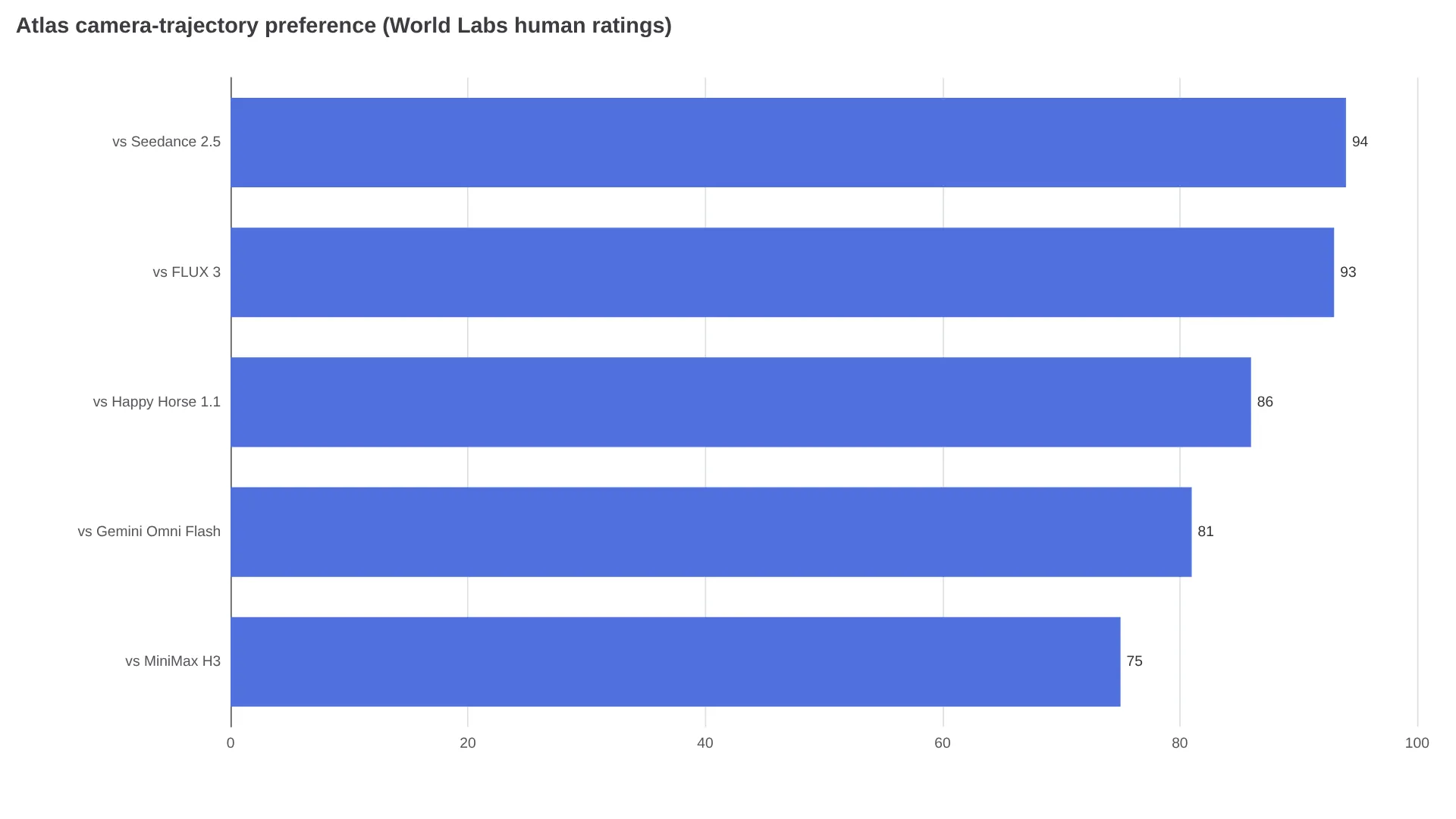
The comparison is asymmetric by design: Atlas received trajectories as native camera geometry while comparators received text descriptions of the same moves, as documented in the XenoSpectrum analysis. Read the 75 to 94 percent figures as trajectory-following signal under that design, not as an overall image-quality ranking.
Try Atlas without code first: Frameboy vs Viewfinder vs Chisel
Match the tool to the question being asked. The fastest calibration is one session in each surface that fits the task.
| Tool | Use it when | What to expect |
|---|---|---|
| Frameboy | Testing whether walkable generation matters for an idea | Free preset scenes in the browser, cloud-streamed at up to 15 fps; no custom uploads |
| Viewfinder | Reconstructing a specific place from your own photos or generated images | Upload images, explore new viewpoints, render camera paths and video |
| Chisel | Directing structure instead of accepting reconstruction | Graybox blocking, move elements, watch camera views update; agentic text-or-reference workflow |
| Splats to Mesh + Relight | Shipping to engines and 3D tools | Convert splats toward meshes with geometry for games and interactive scenes; experiment with lighting on splats |
Early reports praise walkable scenes; documented limits include the 15 fps Frameboy ceiling and, before November 12, closed-beta custom uploads:
"World Labs' Frameboy lets you walk around generated plazas and atriums right in the browser, up to 15 fps. genuinely fun." — @OiCkilL (source)
"浏览器打开就能逛,免费、不用注册、不用绑卡,6 个预设场景随便走。" — @SilenceTseng (source)
The November 12 change directly answers the custom-upload complaint: Viewfinder custom-scene access is now registration-based rather than invite-only. Frameboy limits still apply to the free demo itself.
Connect the World Labs Atlas API: key, first task, polling, exports
Atlas developer access uses project-scoped keys and asynchronous operations. Endpoint paths and task names can move while the docs are in beta, so treat the official Atlas API reference and authentication guide as authoritative over any third-party code sample.
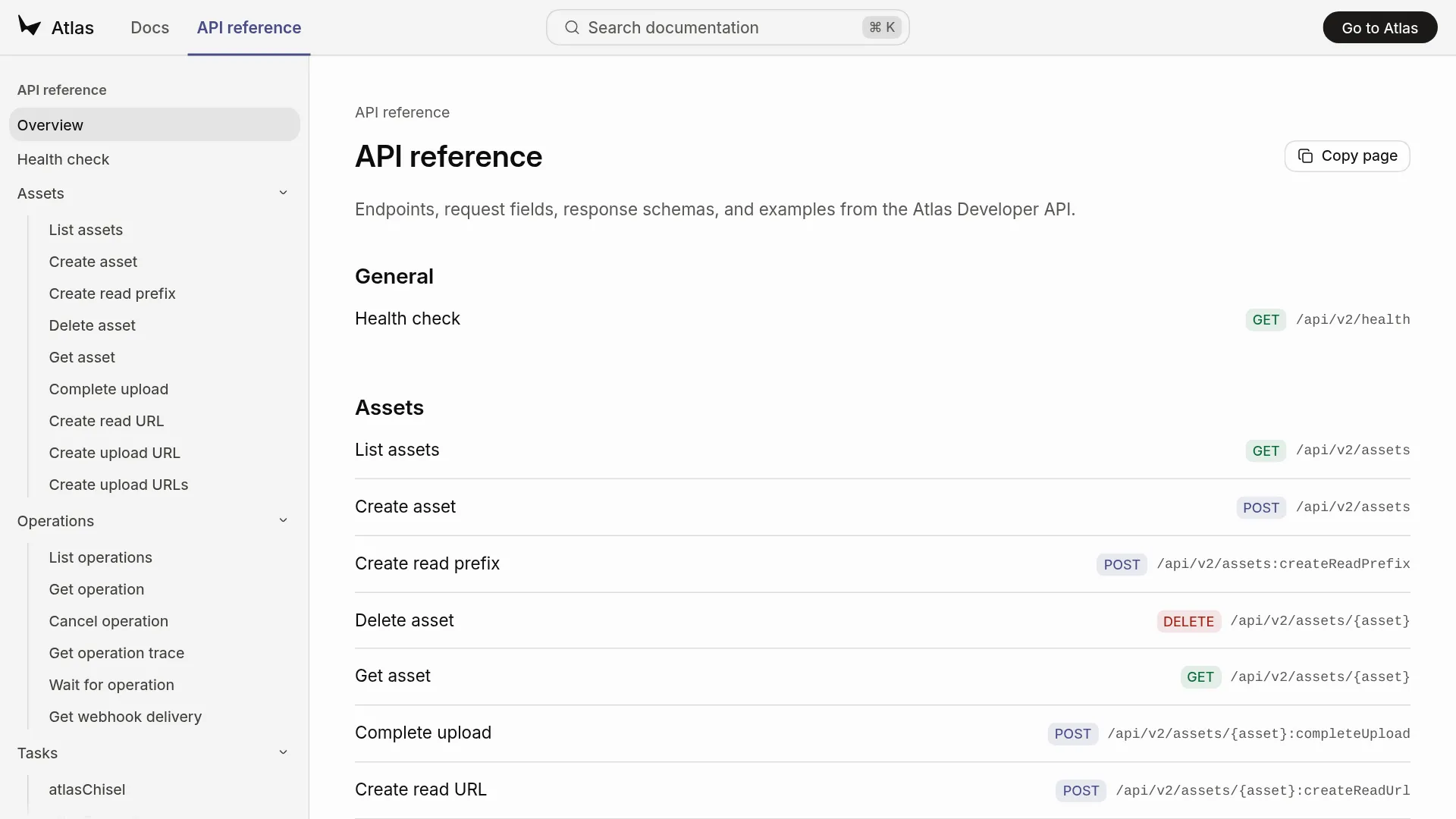
A minimal integration path looks like this:
- Create a World Labs project and generate an API key from the developer platform.
- Send the key as a project-scoped header
WLT-Api-Key: YOUR_API_KEYon every call. - Upload source assets first (images, video, camera data), then start a task such as text-to-image, camera-controlled generation, RGBD reconstruction, splat generation, or splat-to-mesh conversion.
- Save the returned operation ID and poll the operation endpoint with growing intervals until
doneis true. - Fetch CDN-hosted outputs (images, video, splats, meshes, panoramas, captions) and run exports such as high-quality mesh separately where required.
- Keep keys server-side in a secrets manager; keys control a prepaid balance and must not ship in browsers or mobile bundles.
Two integration shortcuts avoid manual key handling. The Atlas MCP server lets Claude and other MCP clients run Atlas tasks through OAuth, and the official worldlabsai/skills repository ships Codex and Claude Code plugins plus Blender workflows. Use MCP for assisted runs and direct REST calls for repeatable pipelines with job queues, retries, and progress UX.
Expect async behavior throughout: in the Marble-era World API pattern documented in this independent API guide, generation takes minutes rather than seconds, progress is state-based rather than a percentage, and failed operations should surface the service error, log the operation ID, and re-check the credit balance instead of assuming a full charge. Exact Atlas endpoint paths are intentionally not hardcoded here because the beta reference remains the source of truth.
What Atlas costs and what is still undisclosed
World Labs publishes no Atlas price page, quota table, or rate-limit schedule on the Atlas product page. Do not budget Atlas work from Marble numbers below; they describe the older public World API pattern and are included only so existing World Labs developers recognize the billing shape.
| Item | Public figure | Status for Atlas |
|---|---|---|
| Atlas per-image / per-second / per-world price | None published | Undisclosed |
| Atlas quotas, rate limits, max resolution | None published | Undisclosed |
| Atlas commercial-use and data-retention terms | No license page found | Confirm in partner or platform terms before commercial deployment |
| Marble World API reference point | $1 buys 1,250 credits; $5 minimum; Marble 1.1 world 1,500 credits (~$1.20); draft 150 credits (~$0.12); high-quality GLB mesh export 3,500 credits (~$2.80) | Platform pattern only, not Atlas pricing |
| Model weights and self-hosting | Not published | Closed product plus API; no open-weight license |
The practical budgeting move is a capped pilot: run one Viewfinder reconstruction, one camera-path render, and one splat-to-mesh export on representative inputs, then record elapsed time, output sizes, and any usage events before estimating per-scene cost. Neither the product page nor the beta docs reviewed for this guide publish commercial rights, training-data use, retention, safety controls, or availability targets, so get written answers before commercial deployment.
FAQ
Do I still need an invite or waitlist for Atlas?
No. World Labs opened Viewfinder, Chisel, and API access to everyone on November 12, 2026 with registration. Frameboy remains the separate free preset demo.
Is World Labs Atlas open source?
No. Atlas is a closed product with hosted apps and API access. No public weights, checkpoint, training dataset, or open-weight license have been published.
How is Atlas different from Marble and the World API?
Marble powered the earlier public World API with documented keys, billing, and integration examples. Atlas is the newer omni world model for camera-controlled generation, reconstruction, and explicit 3D; World Labs positions Atlas as the technology that will power future Marble versions, not as a renamed Marble endpoint.
Can Atlas outputs be used commercially?
World Labs has not published Atlas commercial-use terms on the product page reviewed for this guide. Treat commercial rights, ownership of generated assets, and training-use policy as unconfirmed until they appear in platform terms or a signed agreement.
Should you build on Atlas this week?
Use Atlas now for camera-consistent previz, virtual sets, explorable design reviews, and navigation-oriented sim environments where plausible infill beats exact measurement. The combination of native camera control, splat output, and mesh export is hard to assemble from a text-to-video model plus separate photogrammetry.
Hold off where wrong geometry is expensive: as-built surveys, architectural documentation, manipulation training, and any claim that Atlas alone simulates contact physics or plans actions. By product taxonomy Atlas renders the world cameras see and drafts spatial state, but the world that moves under contact still needs separate validation.
Related reading: Best AI Video Generation API 2026 and Seedance 2.5 API Guide.