 AIREITER
Paying for the wrong video model is expensive fast: Kunavo's October 9, 2026 table prices the same 8-second 720p clip from $0.18 on Veo 3.1 Lite to $3.03 on Seedance 2.5, a 16.8x spread (kunavo.com). The same duration on Revana's October 19 catalog math implies roughly $1.68 for Seedance 2.5 at 720p, which shows provider routes disagree by nearly 2x before retries. The best AI video generation API in 2026 is the cheapest model that clears your hard requirements, because duration billing, audio surcharges, and retry waste move the ranking more than demo quality.
What changed in November 2026
- OpenAI shut down Sora 2 and the Videos API on September 24, 2026, so current Sora migration paths point to Veo, Kling, Seedance, Hailuo, and Pika (modelslab.com).
- Kling 4.0 extended single generations to about 30 seconds with keyframe and Omni Reference controls, while Vidu Q4 stays a preview centered on image-to-video and reference-to-video rather than text-first generation (vidau.ai, orcarouter.ai).
- Seedance 2.5 keeps the community quality reputation for dialogue and complex motion at the top of per-second price tables (r/StableDiffusion).
The 7 video generation APIs at a glance
This video generation API comparison covers seven model families developers wire into products: Google Veo 3.1, ByteDance Seedance 2.5 and 2.0, Kuaishou Kling, Alibaba Wan, MiniMax Hailuo, and Vidu Q4. Vidu pricing and endpoints are documented on the official Vidu model directory. Rates below name their source catalog and resolution because the same model costs different amounts on different providers.
| Model | Max single clip | Resolutions listed | Native sound | Reference inputs | Reported rate |
|---|---|---|---|---|---|
| Seedance 2.5 | 30 sec | 480p / 720p / 1080p | Yes, one rate | Up to 30 images | ~$0.09/sec at 480p; ~$0.21/sec at 720p (Revana, Oct 19) |
| Seedance 2.0 | 15 sec | 480p / 720p / 1080p / 4K | Yes, one rate | Up to 9 images | ~$0.08/sec at 480p; ~$0.15/sec at 720p (Revana, Oct 19) |
| Veo 3.1 family | 8 sec | 720p / 1080p / 4K | Yes, tiered | Up to 3 images on Fast/Lite | $0.18–$1.60 per 8s clip (Kunavo, Oct 9) |
| Kling 3.0 / 4.0 | 15–30 sec | 720p / 1080p / 4K | Yes, silent rate cheaper | Omni Reference, keyframes | ~$0.09/sec 3.0 (Revana); 4.0 not catalog-listed, confirm with provider |
| Wan 3.0 | 30 sec | 480p / 720p / 1080p | Yes, one rate | Up to 10 images | ~$0.04/sec at 480p; ~$0.07/sec at 720p (Revana, Oct 19) |
| Hailuo 2.3 | 10 sec | 768p / 1080p | Not listed | Not stated | ~$0.06/sec (Revana, Oct 19) |
| Vidu Q4 preview | ~16 sec (reported) | Up to 4K (reported) | Yes, incl. reference voice (reported) | Images plus audio reference (reported) | Confirm with provider |
Same-model test routes on this site: Kling 4.0, Seedance 2.5, Veo 3.1, Wan 3.0, Vidu Q4.
What a minute costs in practice
Veo bills per fixed 8-second clip while Seedance and Wan bill per generated second, so the cheaper billing shape depends on duration (kunavo.com). With Revana's 720p math, Veo Lite implies roughly $0.40 per 8 seconds against Wan 720p at about $0.07 per second, putting the crossover near six seconds; with Kunavo's $0.18 Veo Lite clip the crossover drops to about two to three seconds. Compute it from your catalog, resolution, and audio state. Sound moves the total too: a 60-second 720p Veo 3.1 bill roughly doubles from $12 silent to $24 with sound, while Seedance and Wan hold one rate with sound included (revana.si).
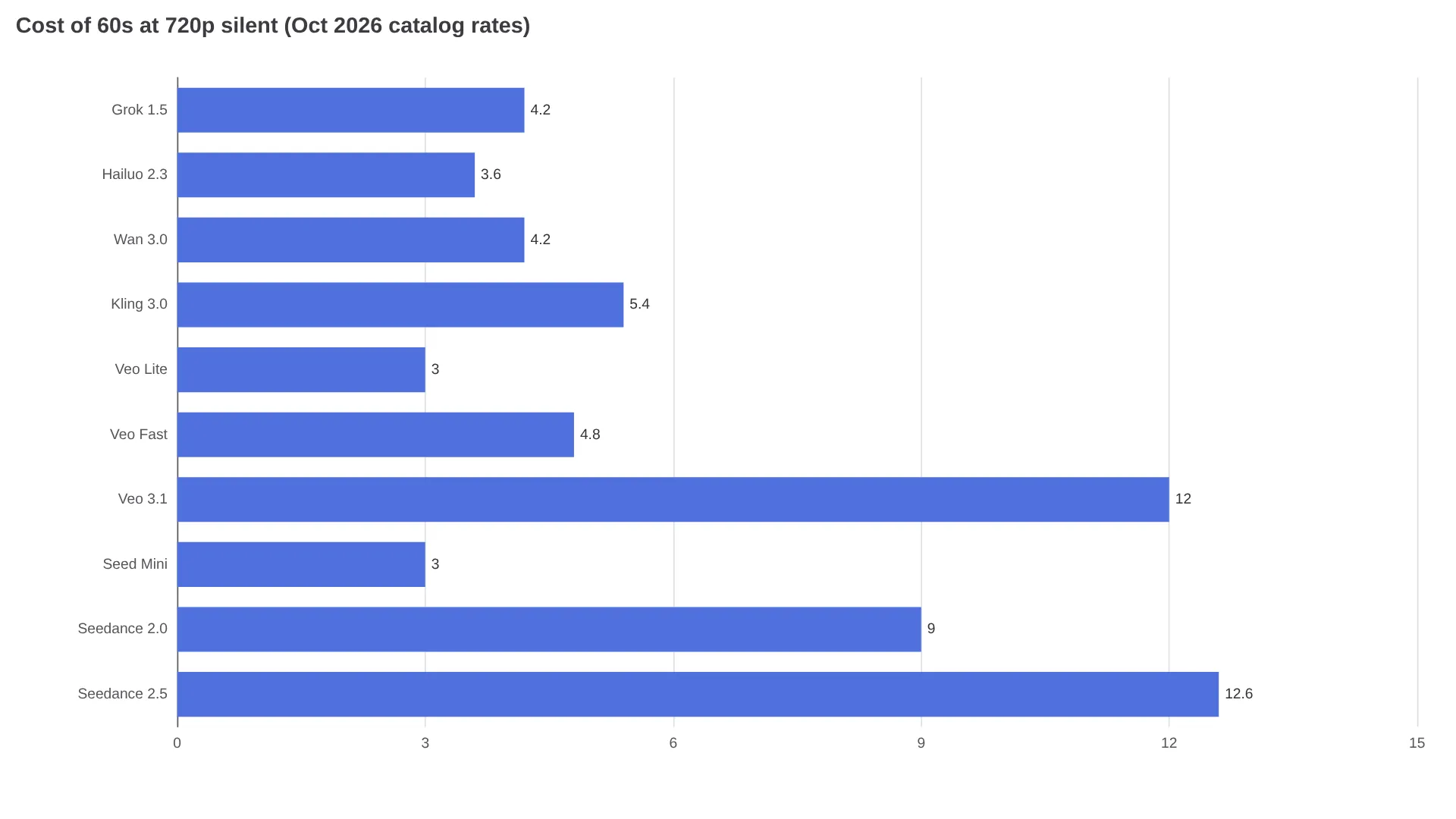
The chart plots Revana's October 19, 2026 silent 720p catalog rates, with Seedance Mini and Grok Imagine included as low-cost draft routes outside the core seven. Real bills run higher because headline rates exclude retries, rejected prompts, resolution multipliers, and audio add-ons.
"You pay only for jobs that succeed." — Revana catalog policy note, October 2026 comparison (revana.si)
Only some gateways state they bill successes alone, so verify failed, blocked, timed-out, and moderated-generation handling before scaling. Developers also report default-duration settings inflating bills several-fold when output stretches toward 30 seconds, including one Seedance case where the same image billed about $1.31 at 5 seconds and $7.84 at 30 seconds (@swordBluesy). Hard-code duration, resolution, and sound flags, and budget by cost per accepted clip after retries rather than cost per request.
Same model, different provider: why output changes
Providers may expose different tiers, parameters, post-processing, or moderation, so compare identical settings and refund behavior before ranking outputs. In one Runway thread, developers comparing the same models across native endpoints and aggregators report visible differences in color, sharpness, and motion, with one commenter noting a Seedance render looked washed out on one platform versus another.
"I tested Seedance on both Runway and Higgsfield with the same prompt, and the Runway result was definitely more washed out. Seems like most platforms add their own post-processing to the base model, whereas Runway appears to leave it pretty much untouched." — u/thatguythatdude777, in a thread on same-model output differing by provider (r/generativeAI)
Published comparisons rarely state whether Veo was Fast or Pro, whether audio was on, whether reference assets matched, or whether the endpoint applied its own cleanup. Kunavo's guide concludes that no provider offers a free production video API, arguing a single clip consumes tens of seconds of GPU time, so unlimited or free claims usually proxy another provider or carry data-use trade-offs (kunavo.com).
Which model for which job
My editorial takeaway from the threads and catalogs is this split: Seedance for cinematic or complex shots, Kling for cheaper iteration and sequence assembly, Veo for short premium clips, Wan and Seedance 2.0 Mini for drafts and volume (r/KLING, revana.si).
Long single takes
Seedance 2.5 and Wan 3.0 reach about 30 seconds in one generation, Kling 4.0 is reported near 30 seconds, Vidu Q4 preview is reported near 16 seconds, and Veo 3.1 caps at 8 seconds. Long takes matter because stitching short clips can introduce visible transitions and drifting faces, a failure developers specifically report when assembling longer sequences (@Arnold20064).
Dialogue and generated sound
Seedance, Veo, Kling, Wan, and Vidu Q4 all list sound generation, while Hailuo 2.3 has no sound listed in current catalogs. Kling and Veo publish separate cheaper silent rates, so mute product shots should use the silent route rather than paying the audio premium.
Stitching short clips into usable long video
If no single generation covers the scene, storyboard first and generate each shot from locked first and last frames. In long-form threads, builders report Kling handles first-frame and last-frame assembly more forgivingly than Seedance for story workflows, while Seedance keeps an edge on single complex shots (r/KLING). A common pattern is Seedance for hero shots and Kling for connective shots, with a consistency review and selective re-shoots.
4K delivery
Seedance 2.0, Veo 3.1 tiers, Kling 3.0, and Vidu Q4 (reported) list 4K, while Seedance 2.5, Wan 3.0, Hailuo, and Grok Imagine top out lower in current catalogs. The economical workflow is drafting at 720p and rendering only the accepted take at 4K, because Seedance 2.0 jumps from about $0.15 per second at 720p to about $0.83 at 4K (revana.si).
Character and product consistency
Reference-image caps decide consistency work: Seedance 2.5 allows up to 30 references, Wan 3.0 up to 10, Seedance 2.0 up to 9, and Veo Fast and Lite up to 3 each (revana.si). Kling answers with Omni Reference and keyframes for shot control. Start and end frames remain the fallback when reference caps or moderation block a direct identity lock.
Production checklist before you commit
- Confirm async behavior: webhook versus polling support, task timeout and retry semantics, and recovery for missed callbacks.
- Confirm concurrency and rate limits, queue behavior at peak, and whether an enterprise SLA changes routing.
- Confirm billing edge cases: failed, blocked, timed-out, and moderated generations, since only some gateways state they bill successes alone.
- Confirm input rules and link expiry: public-URL requirements, pixel bounds, aspect-ratio windows, file caps, first-frame mode locks, and tail-frame links that can expire quickly.
- Confirm moderation behavior on your category before committing, since testers describe Seedance and Grok moderation as strict enough to rule out some commercial uses (r/StableDiffusion).
- Measure latency yourself per endpoint: published figures are estimates without a shared method, with one comparison listing Veo at roughly 15–25 seconds, Kling at 15–30 seconds, and Seedance 2.0 at 45 seconds or more (atlascloud.ai). Record submit-to-ready timestamps across 10 identical prompts, split queue wait from render time, and retest at shipping resolution with audio on.
Test any two APIs in one afternoon
- Define hard requirements first: duration, resolution, sound, aspect ratio, and input types that would disqualify a model outright.
- Run 10 to 20 real prompts, including hands, on-screen text, fast action, dialogue, and your own product or character.
- Generate drafts at the lowest resolution, then have someone who did not write the prompts pick blind winners.
- Calculate cost per accepted clip: per-second rate times expected generated seconds, including retries and alternates.
- Test the fallback path: fail one route over, confirm webhook or polling recovery, and verify refund behavior on a blocked prompt.
FAQ
What is the cheapest AI video API right now?
Kunavo lists Veo 3.1 Lite at about $0.18 per 8-second clip, the cheapest 8-second baseline in its October 9 table; Revana lists Seedance 2.0 Mini near $0.03 per second at 480p, best for very short clips (revana.si).
Am I charged for failed generations?
It depends on the provider: some gateways bill only successful jobs, others bill attempts, so verify failed, blocked, timed-out, and moderated-generation handling before scaling.
What replaces Sora for API builds?
Shortlist Veo, Kling, Seedance, and Wan or Hailuo, then test two with identical prompts.
The trade-off to decide yourself
If the clip must survive customer scrutiny, pay for Seedance or Veo and test moderation early; if the product needs many usable minutes per week, build on Kling or Wan with a strict accepted-clip budget and keep Seedance as the hero-shot fallback. Recheck prices at build time: the cited Sept-Oct 2026 catalogs already disagree with each other on several routes.
Related reading: Kling 4.0 API Pricing: fal Cost vs Seedance and Vidu, Vidu Q4 API Pricing Review 2026.