 AIREITER
GPT Image 2.6 wins on turnaround and complex typography, Seedream 5 Pro wins on predictable billing, with tester reports leaning its way on portrait texture — unless you need layered files, in which case Seedream is the only answer. I ran the same MORA poster prompt through both API families and reconciled the token math with linked third-party runs.
What 2.6 actually changed
Images 2.6 launched November 4, 2026, in ChatGPT and Codex across all tiers. The API split into two models: GPT-Image-2.6 Flare for speed and Sunburst for detail and edit consistency. OpenAI claims 50% faster generation than before and as little as 6 seconds for Flare at low quality. No benchmark scores accompany the announcement.
The practical additions matter more than the speed claim:
- Two-model split. Flare drafts, Sunburst finals. Same token rate card, different latency and consistency.
- Markup editing in the API. Draw on the image to mark where the change goes, previously a ChatGPT-only feature (image generation guide). Use the last approved image as input, state the one change plus what must stay fixed. Markup cannot be combined with a mask or the prompt rewriter.
- SVG and GIF output. SVG suits logos and icons for web and print; GIF covers mascots, product loops, and pre-video storyboards (pricing notes on output tokens). SVG generation can bill a second authoring model, so check usage fields.
- Complexity separate from quality. Quality controls detail; complexity controls planning. OpenAI recommends low complexity for most edits and medium or high for crowded scenes with many constraints.
Leaderboard context is preliminary: a seven-model comparison read November 5 notes 2.6 entries used Medium quality with only ~3,000 votes and trailed 2.5 Sunburst, and that Artificial Analysis had not listed 2.6. Treat ranks without dates as stale.
What each image really costs
OpenAI does not sell a fixed per-image price. Both Flare and Sunburst bill the same token rates: $5 per million text-input tokens ($1.25 cached), $8 per million image-input tokens ($2.00 cached), and $30 per million image-output tokens. Your dimensions, quality, references, and streaming decide the bill.
Seedream uses fixed output prices by resolution tier, plus reference and layer fees:
| Item | Seedream 5.0 Pro rate |
|---|---|
| Per image up to 2.61 MP / above | $0.045 / $0.09 |
| References | First input free, +$0.003 each extra |
| Layer decomposition | From $0.0225 per layer |
Rates per BytePlus ModelArk pricing and ModelArk docs; failed or moderated outputs are not billed. Capability details including up to 10 references and layered output are documented in the ModelArk model list.
Measured same-prompt costs tell the story better than rate cards:
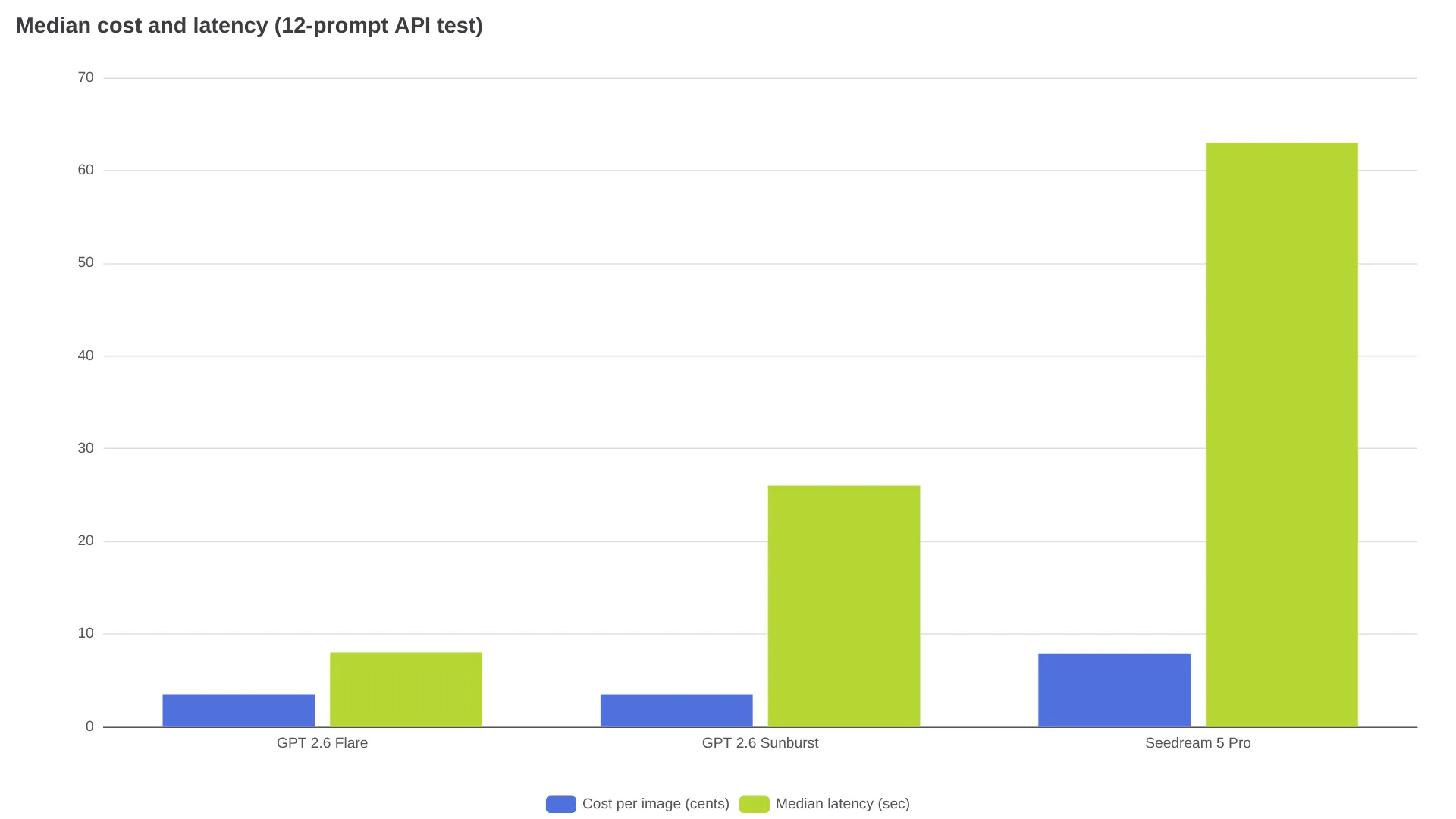
In a 12-prompt five-model run through one API with no rerolls, Flare Medium and Sunburst Medium each averaged $0.035 per image while Seedream 5 Pro averaged $0.079 — more than double. GPT's token total at 1K/medium stayed small, which reverses the sticker impression from list prices.
Campaign math uses a different unit. One four-asset workflow test (packshot, lifestyle, poster, $18-to-$16 revision, three first-take repetitions) settled at 236 versus 156 site credits per accepted set for Sunburst and Seedream. A three-edit chain test quoted 495 versus 150 site credits. Site credits are each vendor's settlement units, not dollars, so cross-vendor credit totals are not exchangeable — the comparable finding is directional: per single generation GPT was cheaper; per accepted set with all steps counted Seedream was cheaper.
"A model's cheapest image is rarely the number you need." — Orylia product-photo test
Measure tokens at your dimensions and quality, count a full accepted set including one reroll, then compare.
Speed you feel in production
Flare is the throughput leader by a distance. Figures below are third-party workflow waits including submission, queueing, and polling, not silicon-only rendering:
| Configuration | Median per image | Chain total (3-4 steps) |
|---|---|---|
| GPT Image 2.6 Flare Medium | 8s | 49.8s median (45.9–101.7s) |
| GPT Image 2.6 Sunburst Medium | 26s | 91.8s median (82.8–141.1s) |
| Seedream 5 Pro | 63s | 204.1s median (203.8–225.1s) |
Per-image medians and chain totals from the 12-prompt run and the three-edit chain test. A second batch with different polling measured Sunburst at 20.5s median per call versus 75s for Seedream, sequences in 80–82s versus 298–367s. Ordering held across batches: Flare first, Sunburst second, Seedream last by 2–4x.
Flare's slowest chain took 101.7s, more than double its fastest, driven by one 56.5s step. When you promise a delivery slot, Seedream's narrow 203.8–225.1s range partly offsets its latency.
Where quality visibly splits
Illustrative, not a Sunburst benchmark — the linked test is the controlled source, and Flare's visuals remain unmeasured there. My pair used one aggregator key, same MORA prompt, one image per model.
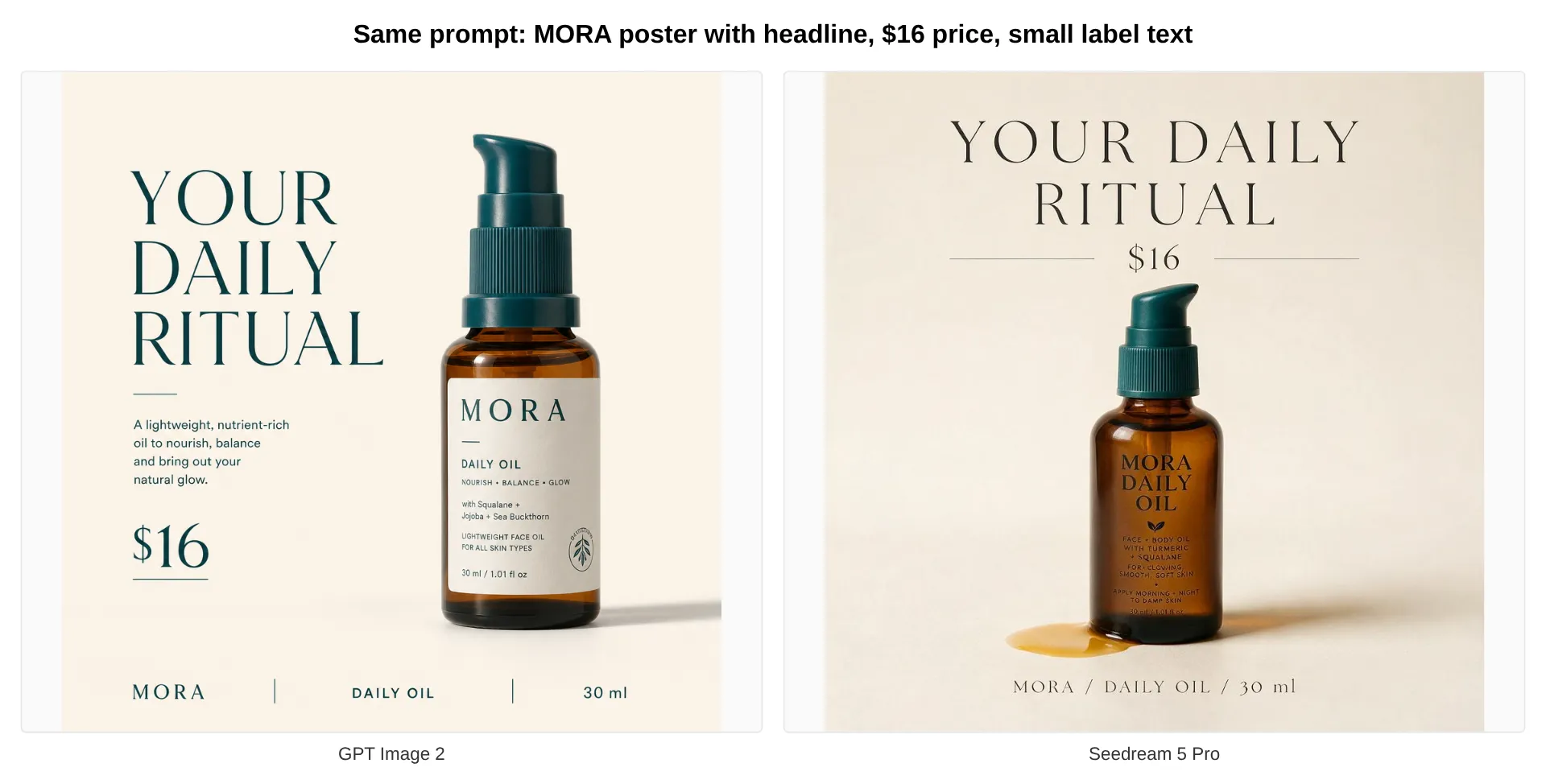
Both kept headline and price readable. The split matched larger tests: GPT held tiny label text more legibly at 1K, while Seedream rendered a quieter layout with softer gradients but a smaller bottle label that needs full-resolution inspection. Open the original file before approving either.
Controlled five-task results:
| Test | GPT-2.6 Sunburst | Seedream 5 Pro |
|---|---|---|
| Polish milk-bar menu with diacritics | Every word and diacritic correct | Spelling correct, text too small to use |
| Four-panel comic with exact dialogue | Exact dialogue, added unwanted laptop logo | Added unwanted thought bubble |
| Coastal map, 10 towns in order | Winner: correct order and local labels | English title, less local |
| Fisherman portrait | Cinematic lighting, clean hands | Clean anatomy, added unwanted cap insignia |
| Brewery brand sheet | Complete three-variant sheet, accents correct | Complete sheet, accents correct |
Every model invents details: logos, bubbles, insignias, duplicated towns. For text-heavy layouts, infographics, and maps, start with GPT 2.6. For beauty and lifestyle work where testers preferred softer skin rendering, consider Seedream first and inspect GPT faces at 100%.
Does Sunburst fix edit drift?
Partly. Short revisions pass: the price-only revision test changed $18 to $16 while keeping layout three times out of three for both models, and the three-step chain kept NOMA / DAILY SERUM / 30 ml readable in all nine finals. Sunburst visibly retained layout without pixel-identical guarantees.
Longer threads report accumulated drift over many corrections:
"Distorted faces, smeared textures, muddy details, and identities constantly drifting away from the reference images." — u/jcchimaera, r/ChatGPT launch thread
"Wake me up when images edits don't change the colors. That's my biggest frustration with GPT Images." — u/Lazy_Rate_381, r/ChatGPT launch thread
One high-volume user test reported "220 prompts + 160 edits. Quality: same. Price at medium: 3.3x" (@MikoSavin), plus pose and symmetry misses on portraits (@PeterWang83707). Seedream has its own continuity complaints — some users rate 5 Pro below 4.5.
Edit protocol that survives both models:
- Define usable before generating, including label legibility at full size.
- Keep the approved product reference attached to every asset.
- For a local fix, feed the last approved image, name the single change, and list what must not change.
- Use low complexity for simple edits, medium or high only for crowded scenes.
- Recheck bottle, label, and colors after every revision even when the requested text is right.
- Typeset legal or promo copy in a layout tool when exactness matters.
Which to call for your job
| Job | Start with | Why |
|---|---|---|
| Drafts and fast iteration | Flare Medium, low complexity | 8s median, cheapest per single in tests |
| Finals with heavy text, maps, comics | Sunburst Medium/High | Best diacritic and dialogue reliability |
| Product photos on a budget | Seedream 5 Pro 1K | Lowest per accepted set in workflow tests |
| Layered design and many references | Seedream 5 Pro with decomposition | Up to 10 references, up to 16 alpha layers |
| OpenAI pipeline, markup edits, SVG/GIF | GPT-Image-2.6 | Markup layer, vector and animation output |
If you live in OpenAI tooling, 2.6 is the natural upgrade; if your pipeline consumes alpha layers, Seedream stays regardless of ranks.
Related reading: GPT Image 2.6 API pricing, Seedream 5 Pro vs GPT Image 2, Seedream 5 Pro prompt guide.
FAQ
Flare or Sunburst?
Flare for drafts, Sunburst for finals; same rate card, so speed versus revision risk.
What does one image actually cost?
No fixed GPT number — dimensions, quality, and references decide. Measured 1K/medium averaged $0.035 versus $0.079 for Seedream, while accepted sets favored Seedream; budget per approved set with one reroll.
Which is faster?
Flare ~8s per image and ~50s per chain, Sunburst ~26s and ~92s, Seedream ~63s and ~204s across cited batches; absolutes shift with queueing, order rarely does.
When does Seedream win?
Fixed per-image pricing by resolution tier, softer portrait rendering in tester reports, and layered output: up to 10 references and 16 alpha layers at a $0.045 base that is easier to forecast than token math.
The trade-off you can't prompt around
Pick the billing model that matches your reroll habit, then pick the model. Rerolls decide which lead survives.