 AIREITER
GPT Image 2.6 API pricing looks unchanged on the rate card, but cheap drafts got much more expensive. OpenAI lists identical token rates for gpt-image-2.6-flare and gpt-image-2.6-sunburst, yet measured low-quality output use is 4.2x higher than GPT Image 2.5. Setting quality explicitly prevents additional cost surprises.
One 1:1 image costs $0.025 to $0.211, low quality stopped being cheap
GPT Image 2.6 cost per image at 1:1 spans roughly $0.025 at low quality to $0.211 at max quality when tokens are measured on the same prompt. TrezaLabs rendered the same 1:1 prompt at five quality levels on November 5, 2026 and billed $0.00003 per output image token.
| Quality | Measured output tokens | Approx. cost per 1:1 image |
|---|---|---|
| Low | 824 | $0.025 |
| Medium | 1,449 | $0.043 |
| High | 1,756 | $0.053 |
| Extra high | 3,122 | $0.094 |
| Max | 7,024 | $0.211 |
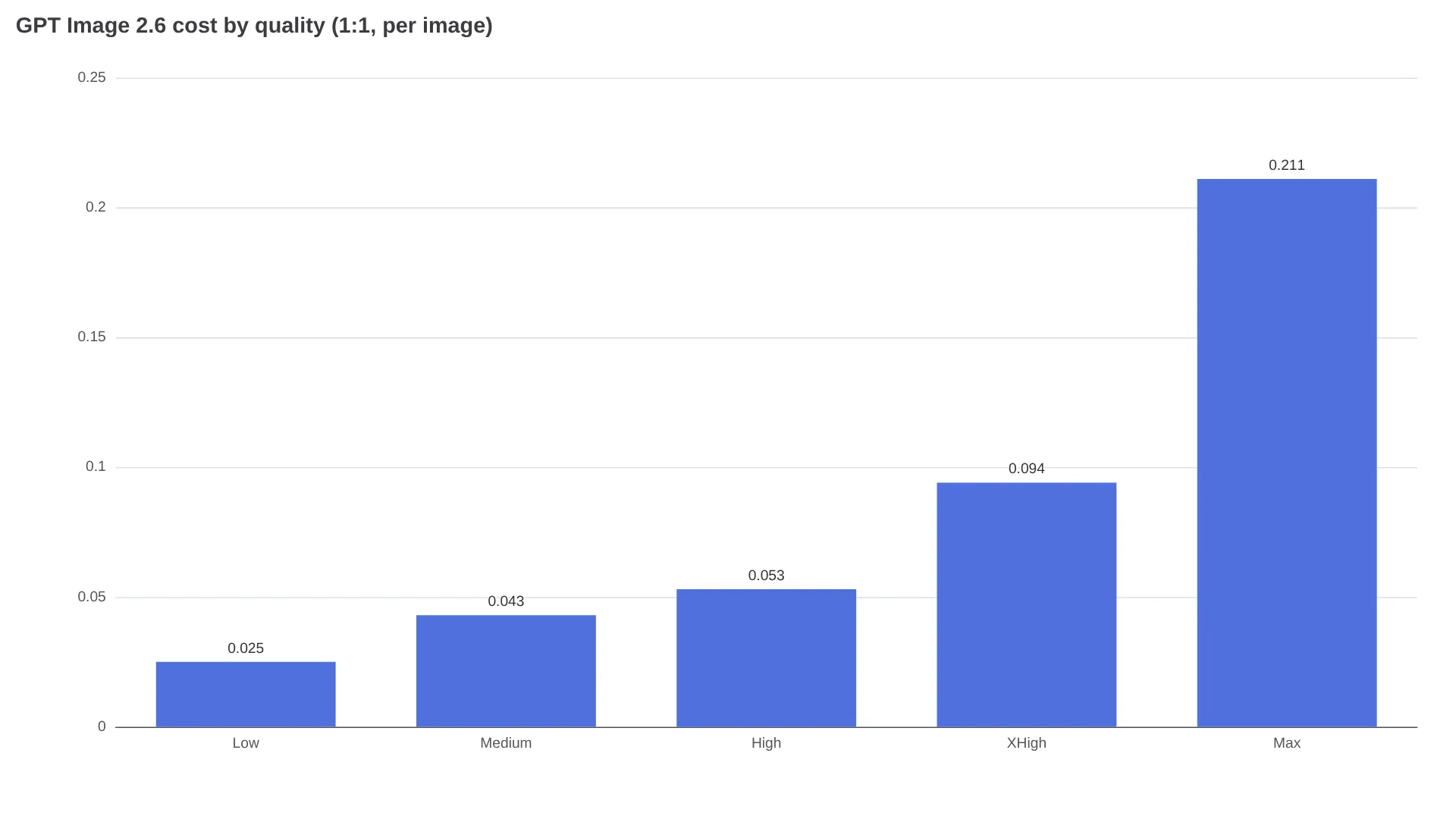
The trap is upgrading without changing quality. GPT Image 2.6 low quality is no longer the sub-cent draft tier that GPT Image 2.5 offered. Budget 100 low drafts as $2.47 in output charges plus inputs, and 100 max finals as about $21, not as the same line item.
Official token rates, and why three price tables disagree
OpenAI API pricing lists the same standard rates for GPT Image 2.6 Flare and Sunburst: $5 per 1M text-input tokens, $1.25 per 1M cached text-input tokens, $8 per 1M image-input tokens, $2 per 1M cached image-input tokens, and $30 per 1M image-output tokens. The official pricing page is the authority when rates change. OpenAI model pages for Flare and Sunburst confirm the same token prices.
Three pricing lenses circulate, and they measure different things:
- Official token rates tell you the unit price, not the per-image total. Measured output use varies with quality and size; references separately add image-input tokens.
- Measured token billing converts one fixed prompt to dollars. TrezaLabs measured 824 to 7,024 output tokens across low to max at 1:1, plus a small text-token charge. Mockingbird measured about 1,600 output tokens for a high-quality 1088x1360 ad, or about $0.048 of output cost before inputs.
- Third-party fixed per-image grids simplify planning. HiAPI publishes a 15-cell grid from $0.023 for low 1K to $0.636 for max 4K. Yir estimates about $0.0367 to $0.2227 for 1K low to max on the official route.
Use official rates for contracts, measured tokens for your own prompt and size, and fixed grids only for rough capacity planning. A fixed $0.04 per-image quote assumes a specific quality, resolution, and reference count that may not match your pipeline.
Quality tiers are low, medium, high, xhigh, max, plus auto. Resolution is 1K, 2K, or 4K. Higher quality buys more internal detail rather than more pixels: TrezaLabs received 1024x1024 for each 1:1 quality level. complexity (low/medium/high, default high) controls planning effort, not visual detail, and carries no separate fee.
Why your GPT Image 2.5 budget breaks on 2.6
GPT Image 2.6 uses the same per-token price as GPT Image 2.5. In TrezaLabs cited 1:1 measurements, 2.6 used more output tokens at low and medium quality on the same 1:1 format.
| Quality | GPT Image 2.5 tokens | GPT Image 2.6 tokens | Cost effect |
|---|---|---|---|
| Low | 196 | 824 | ~4.2x more |
| Medium | 439 | 1,449 | ~3.3x more |
| High | 1,756 | 1,756 | unchanged |
| Extra high | 3,122 | 3,122 | unchanged |
| Max | 7,024 | 7,024 | unchanged |
Low quality rose from under $0.01 on 2.5 to about $0.025 on 2.6, medium from about $0.013 to about $0.043. The r/codex billing thread corroborates the 4.2x low-quality jump (thread), so keep GPT Image 2.5 for bulk cheap drafts and set quality explicitly to avoid auto variability (TrezaLabs).
Flare vs Sunburst: same price, different clock
Flare and Sunburst share official token rates and matched within 3% in small tests, so treat tier choice as latency first and benchmark your own workload. TrezaLabs found identical token counts except for a two-token difference at high quality. Mockingbird found Flare used about 3% more output tokens on ads, leaving per-image cost within $0.001.
Speed is where the tiers split. TrezaLabs timed the same prompt across qualities on November 5, 2026, with one render per level, which is directional rather than a formal benchmark.
| Quality | Flare wall-clock | Sunburst wall-clock |
|---|---|---|
| Low | 6 sec | 17 sec |
| Medium | 10 sec | 27 sec |
| High | 10 sec | 50 sec |
| Extra high | 23 sec | 82 sec |
| Max | 41 sec | 166 sec |
Mockingbird high-quality 1088x1360 ads took 16-26 seconds on Flare versus 51-55 seconds on Sunburst 2.6, at $0.089-$0.108 versus $0.088-$0.107. OpenAI claims 50% faster generation and as little as six seconds for Flare at low quality (announcement); Mockingbird confirmed the Flare speedup but found Sunburst 2.6 slower than Sunburst 2.5 in its two ad tests. OpenAI positions Flare for fast iteration and Sunburst for detail consistency (announcement).
Early user threads skew skeptical about the quality-for-speed trade, as the r/singularity discussion and r/OpenAI threads show:
I really wish they'd fix the model to stop injecting this ugly mottling.
— u/lyeeedar, r/OpenAI GIF test thread
GIF, SVG and reference images carry their own surcharges
Extra outputs bill outside the base quality-tier grid. Each format has one billing rule and one main constraint.
| Feature | Added cost | Billing rule | Main constraint |
|---|---|---|---|
| GIF | $0.070 low to $0.598 max (HiAPI) | Quality only, not resolution; 2-16 frames, default 9, 20-2,000 ms per frame | Sheet limits: 3840 px max side, 8,294,400 px max area, 3:1 max ratio |
| SVG | +$0.030 over tier price (HiAPI) | Fixed surcharge; low 1K $0.053, max 4K $0.666 | Text-to-image only; image-to-image stays on PNG, JPEG, WebP |
| Reference images | Example +$0.012 each; varies by tokens | Base tier price + $0.012 x count in cited example, 1-16 refs (HiAPI) | One product photo used 1,523 input tokens (TrezaLabs); 16 refs add $0.192 in that example |
mask and markup layers carry no extra fee (HiAPI).
Batch and Responses gaps that change what you pay
GPT Image 2.6 runs on the Images API generations and edits endpoints only, with no Responses API and no Batch API at launch (comparison). GPT Image 2.5 retains Responses and Batch access, including a $15 per 1M Batch output rate.
- No Batch 50% discount exists for 2.6, so high-volume teams cannot schedule overnight 2.6 batches at half price.
- Responses-based agents must stay on 2.5 or split stacks between Responses reasoning and Images API calls, with separate retry accounting.
- ChatGPT subscriptions do not cover API usage. ChatGPT and Codex include Images 2.6 across tiers including free (announcement), but API calls bill per token, and ChatGPT offers no documented Flare/Sunburst selector, so set the model ID explicitly for reproducible tests.
A cost-controlled workflow that still ships
A cost-controlled GPT Image 2.6 workflow drafts on Flare at low quality and reserves Sunburst at high or max for finals.
- Draft 100 variants on Flare low 1:1 at about $2.47 in output charges, plus inputs. Judge composition, not texture.
- Promote 10 survivors to Flare high at about $0.053 each in output charges, or about $0.53 for the round. Check text, hands, and product labels.
- Finish 2-3 assets on Sunburst high or max. Two max 1:1 finals cost about $0.42 in output charges.
- Cap references. Six unused mood boards add about $0.072 to every render in the cited example, more than a low 1:1 image itself.
- Set
qualityandcomplexityexplicitly; OpenAI recommends low complexity for focused edits (Mockingbird).
| Workload | Setting | Approx. 100-image output cost |
|---|---|---|
| Bulk drafts | Flare low 1:1, measured | $2.47 |
| Near-final review | Flare high 1K, measured 1:1 proxy | ~$5.30 |
| Paid finals | Sunburst max 1:1, measured | $21.10 |
Reserve GPT Image 2.6 for legible menus, labels, posters, and product-preserving edits where its text rendering justifies $0.05-$0.21 per image.
FAQ
Do Flare and Sunburst cost the same?
Yes. OpenAI lists identical token rates for gpt-image-2.6-flare and gpt-image-2.6-sunburst. Measured output tokens matched within 3% across testers, so per-image cost differs by about $0.001. Choose by speed and edit consistency, not price.
Why is there no fixed per-image price?
OpenAI bills $30 per 1M image-output tokens plus input tokens, but output tokens per image range from about 824 to 7,024 at 1:1 depending on quality. Any fixed dollar figure assumes a quality, resolution, and reference count.
Is GPT Image 2.6 more expensive than GPT Image 2.5?
At low and medium quality, yes: about 824 versus 196 tokens at low and 1,449 versus 439 at medium. At high and above, measured tokens are identical. Draft-heavy pipelines should keep 2.5 for cheap variants.
How are GIF and SVG billed?
GIF billing follows quality only, from about $0.070 at low to $0.598 at max for 2-16 frames. SVG adds about $0.030 on top of the tier price and works for text-to-image only.
Which tokens actually move the bill?
Image-output tokens at $30 per 1M dominate; a 1,000-token text prompt costs $0.005 at $5 per 1M. Cached text ($1.25) and image inputs ($2) help repeated edits with shared references, but output tokens are not cached.