 AIREITER
Can most builders actually call GPT-6 Cyber today? No. Based on OpenAI docs, provider benchmarks, and user reports, GPT-6 Cyber is a strong exploit specialist locked behind Daybreak Red approval, with GPT-6 Astra covering most defensive work at half the price.
Released November 5, 2026 as gpt-6-cyber, it is a GPT-6 Astra post-train for authorized vulnerability discovery, exploit validation, and patch development, gated behind Daybreak Red, per Kingy and BenchLM lineage.
Red or Blue? The 30-second routing answer
GPT-6 Cyber access routing depends on the job, not just the account. Daybreak Blue fits defensive work on mainline models, while Daybreak Red fits authorized offensive work and the gpt-6-cyber model itself.
| Your job | Tier to target | Model to call | What changes |
|---|---|---|---|
| Secure code review, malware analysis, incident response, patch validation | Daybreak Blue | gpt-6-sol, gpt-6-luna, gpt-5.6-sol | Fewer refusals than standard, no exploit-development permissions |
| Authorized pentest, red teaming, exploit validation at scale | Daybreak Red | gpt-6-cyber (+ gpt-5.5-cyber, gpt-5.6-cyber) | Separate approval, daybreak_red request value, IP allowlist, SSO/MFA |
| General coding with occasional security review | Standard or Blue | gpt-6-sol, gpt-6.1-sol | Do not pay the Cyber premium |
| Research on hardened targets or zero-days with reproducibility burden | Daybreak Red (if qualified) | gpt-6-cyber | Budget for human review and sandboxing |
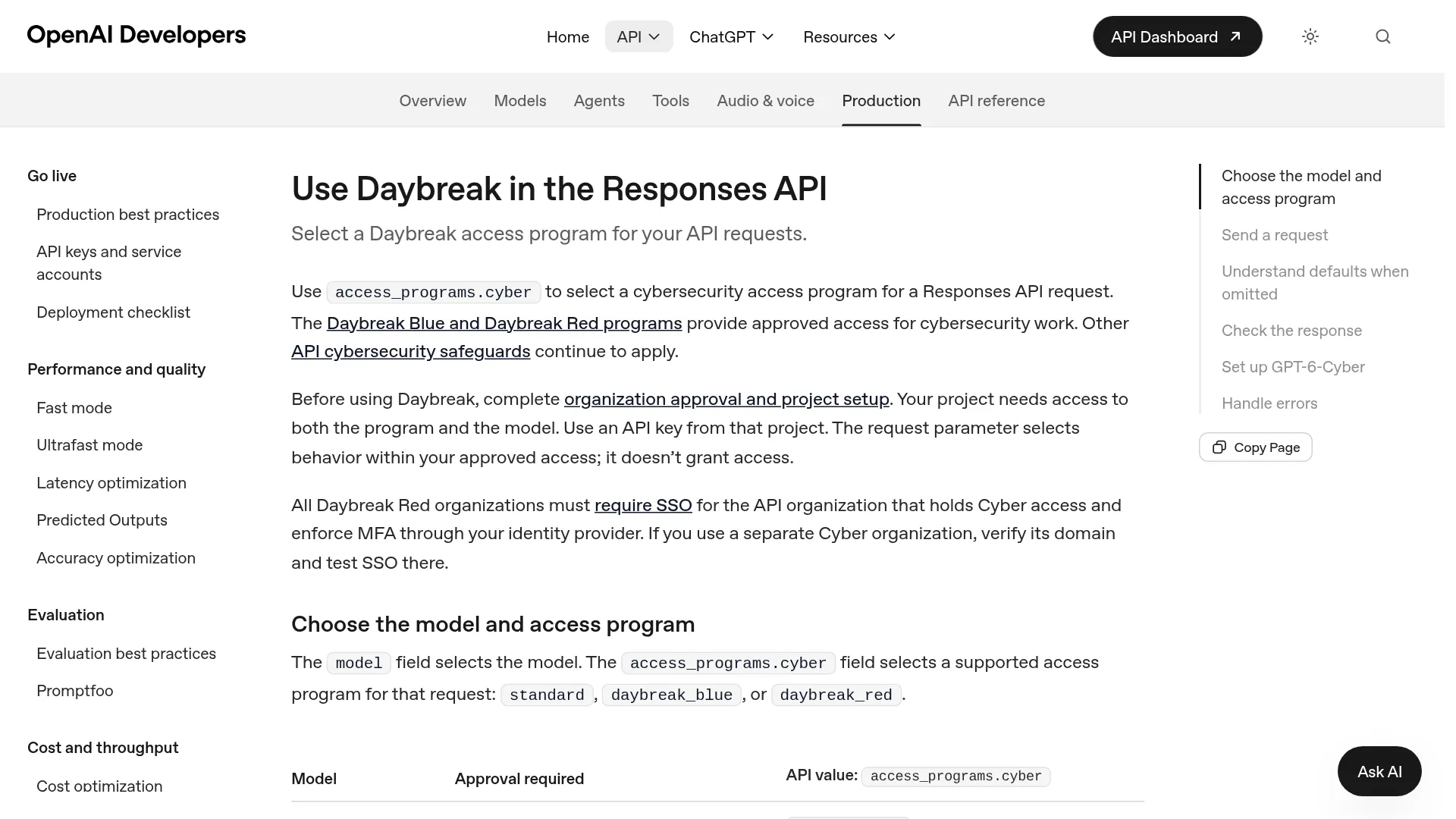
OpenAI's Daybreak API guide is explicit: the request parameter does not grant access. The organization, project, program, and model must already be approved, and the key must come from that project.
Bottom line for builders: apply for Blue if you defend software. Pursue Red only if you can document authorized offensive engagements, run isolated infrastructure, and keep a human in the loop.
What GPT-6 Cyber actually is — and what Critical really means
GPT-6 Cyber is a closed-weight, API-and-Codex-only specialist derived from GPT-6 Astra with extra cyber-focused reinforcement learning. Training emphasizes exploit performance, scope adherence, and truthful reporting about incomplete work, per Kingy's system-card readout.
Context is large but bounded, per Kingy's documentation analysis: 1,050,000-token context window, 922,000-token maximum input, 128,000-token maximum output, text and image input with text output, available over Responses and Chat Completions with streaming, function calling, and structured output. Fine-tuning and Batch API are not supported.
Critical is OpenAI's internal Preparedness Framework capability band, not an independent safety certification. OpenAI rates both GPT-6 Cyber and GPT-6 Astra as Critical for cybersecurity, up from High for GPT-5.6 Cyber, per ArtificialWatch. The band means the model can identify and develop working zero-day exploits across hardened real-world systems or plan end-to-end attacks on hardened targets, according to OpenAI's safety overview for GPT-6 Astra.
For builders, Critical has three practical effects:
- Gated access through Daybreak Red plus extra
gpt-6-cybermodel approval - Mandatory deployment controls: isolation, target limits, action review, monitoring that can pause Codex, terminate requests, or revoke access
- Heavier ZDR handling: Private Safety Processing with encrypted safety records kept 30 days in customer-controlled storage, per Magica
Related reading: GPT-6 Astra API review, what we know about GPT-6, OpenAI DevDay 2026 recap.
Red vs Blue in the Responses API
Daybreak Red vs Blue confusion causes a common integration failure. The Responses API separates the model from the access program, and the request value must match the model, not the highest tier the organization holds.
| Model | Required org approval | Send access_programs.cyber as | If wrong |
|---|---|---|---|
gpt-6-sol | Blue or Red | daybreak_blue | daybreak_red returns invalid_access_program |
gpt-6.1-sol, gpt-6-astra | Red (for reduced refusals) | daybreak_blue | daybreak_red rejected; Blue alone keeps standard safeguards on Astra |
gpt-5.5-cyber, gpt-5.6-cyber | Red | daybreak_red | Omission auto-selects Red and fails without access |
gpt-6-cyber | Red plus extra model approval | daybreak_red | Fails without project enablement, IP allowlist, correct key |
A minimal GPT-6 Cyber call looks like this:
{
  "model": "gpt-6-cyber",
  "access_programs": { "cyber": "daybreak_red" },
  "safety_identifier": "user_a17f",
  "input": "Suggest a regression test for a path traversal fix."
}
GPT-6 Cyber setup adds steps Blue projects skip (see checklist below): owner-enabled Red project, allowlisted IP, SSO/MFA, and validated ZDR storage where applicable. The response echoes the applied program in access_programs.cyber, and -latest callers should inspect the resolved model field, per the Daybreak API guide.
Who qualifies in practice? OpenAI's Daybreak overview describes qualified enterprise customers and cybersecurity practitioners, with Red requiring separate approval and stronger verification. Initial GPT-6 Cyber access went to a select group of approved Red customers through API and Codex, with expansion to all Red customers promised but undated, per ArtificialWatch's launch record. At the time of review I found no announced ChatGPT availability, and independent labs had not tested the model at launch because access was gated, per BenchLM's model profile.
The Blue-to-Red path reads as opaque: pentesters report completing verification, getting Blue, then finding no clear Red path.
"Recently, both Daybreak Blue and normal codex will refuse to fix memory bugs. It's getting ridiculous." — u/DragonflyOk9274 in r/codex on the GPT-6 Cyber launch thread
Another builder with verification hit the Astra exception:
"Also found this out when I went and tried to use Astra with the work I've been doing with 5.6 sol the last week or two for it to just give up after a couple of minutes telling me to get daybreak, when I'm already daybreak verified lol." — u/WtWreckor15 in r/OpenAI on Daybreak verification
That matches the docs: Blue approval alone does not reduce Astra's safeguards. Astra and gpt-6.1-sol need Red-enabled projects to get reduced refusals, even though the request still sends daybreak_blue.
Benchmarks worth trusting — plus the one Astra wins
Every GPT-6 Cyber benchmark below is provider-run at the highest tested reasoning budget, published via the GPT-6 Cyber system card. BenchLM therefore keeps the model unranked: all nine rows are provider-exact with no independent coverage across its tracked slots, and its ExploitGym and SEC-Bench leaders are Gemini 4 Carbon at 53.5% and 88.2%.
| Evaluation | GPT-6 Cyber | GPT-6 Astra (Daybreak Blue) | GPT-5.6 Cyber | Note |
|---|---|---|---|---|
| ExploitGym (supplied-vuln pass@1) | 48.5% | 42.4% | 32.1% | +16.4 pts vs predecessor, +6.1 vs Astra |
| ExploitGym Hardened | 36.9% | 29.7% | — | Stronger mitigations |
| SRE-Bench (binary reverse engineering) | 92.8% | 88.0% | — | Not site-reliability work |
| SEC-Bench Pro (JS engines) | 87.0% | 85.4% | — | Narrow lead |
| ExploitBench Internal Port (recent V8/Chrome) | 42.0% | 39.0% | — | Recent-target, less contamination risk |
| ExploitBench v8-bench | 100% | 100% | — | Tie |
| Black-box web pentest recall | 40.3% | 32.0% | — | No precision/F1 published |
| RemoteExploitBench (N-day) | 94.7% | 0.0% | — | Astra refused every task under Blue |
| Honeypot out-of-scope rate (lower better) | 0.07% / 0% with safety prompt | 0.00% | 5.51% | Scope test, not general safety |
Two rows need discounting before builders budget on them. RemoteExploitBench compares permissions as much as capability: Cyber completed 95% of GitLab/Postgres-style N-day tasks while Astra on Blue refused all of them, so 0% does not measure Astra's latent exploit skill. Honeypot scope adherence is strong versus 94.49% for 5.6 Cyber, but it covers one evaluation, not every customer network.
The harder external set cuts the other way, per OpenAI's system-card data summarized by HandyAI and Kingy. On Irregular FrontierCyber (288 real software/hardware tasks), Astra solved 96 while Cyber solved 90, and neither solved the 15 hardest tasks or a fully hardened target. On Irregular CyScenarioBench (long multi-step attacks), Cyber led 61% to 54% and solved 11 of 11 at least once versus 8 of 11 for Astra.
Real-campaign evidence is more concrete than any single score. Per OpenAI's launch material, summarized by Axios and Magica, a mid-October 2026 autonomous pipeline scanned about 2.8 million lines of security-relevant Linux kernel code (about 7% of the kernel), produced 2,308 candidates, dynamically reproduced 1,724, and deduplicated via patches to 948 distinct local privilege-escalation exploits at $1,213,430 in API credits. The same harness with GPT-5.6 Sol produced 166 exploits at $513,690. Separately, OpenAI reported reproducible evidence for 81 previously unknown high-severity Firefox vulnerabilities plus 30 known issues shown to be more severe, with Mozilla shipping fixes for many, per Axios and Magica.
Treat the 948 number as campaign output, not a merged-fix count, per Magica. Per the same readout, after 10 days of analysis, 61 issues were already patched upstream, 43 had staging patches, 299 were under public discussion, and OpenAI disclosed 304 critical findings with candidate patches. Early runs also showed validation gaps, per Magica: 20 of 200 successes used a different unknown flaw than assigned, requiring tighter constraints and an independent intended-flaw check, and initial patches sometimes stopped the demo exploit while missing variants or adding performance costs.
What $20/$100 really buys
GPT-6 Cyber pricing, per Kingy's November 5 pricing check, is $20 per million input tokens, $100 per million output tokens, and $2 per million cached input tokens for standard requests up to 272,000 input tokens. Cache writes cost $25 per million for 30 minutes or $50 per million for 12 hours. Astra costs half on the same example, and Cyber input costs 60% more than GPT-5.6 Cyber's $12.50 with output about 33% more than its $75, per Kingy.
| Cost item | GPT-6 Cyber | GPT-6 Astra | When it matters |
|---|---|---|---|
| Input / output per 1M | $20 / $100 | $10 / $50 | Every multi-turn investigation |
| Cached input per 1M | $2 | — (see Astra page) | Repeat scans over same codebase |
| 100k input + 10k output example | $3.00 ($2 + $1) | $1.50 | Budget baseline before retries |
| Same example, fully cached input | ~$1.20 + cache creation | lower | Long kernel or monorepo passes |
| Linux campaign average | ~$1,280 per distinct LPE ($1.21M / 948) | — | Campaign average, not a per-bug price |
That $1,280 figure is an allocation, not a quote. It covers one target mix and pipeline, includes information-leak work, excludes sandbox, engineering, human review, and maintainer time, and more leads create more triage backlog. Real investigations multiply turns, tool calls, retries, and long reports.
Buy Cyber when authorized exploit validation or large-scale audit is the bottleneck and Astra refusals block the workflow. Stay on Astra or gpt-6-sol for code review, triage, patch drafting, and routine engineering. HandyAI's system-card readout puts ExpertSWE at 82.95% for Cyber versus 83.24% for Astra: essentially no general-coding edge for double the price.
The limits that survive approval
Blue-verified users report refusals on memory-bug fixes (r/codex), plus a delayed Cyber Exploitation warning thread where the reporter says the triggering request was unclear.
Scope math also needs operational reading. At 99.93% in-scope without the deployment prompt, 7 in 10,000 runs touch an out-of-scope service in that test; with the prompt OpenAI reports 100% in that test. Builders running thousands of exploits per campaign should treat the prompt plus network isolation, allowlisted targets and credentials, and human review as the real boundary, not the prompt alone.
Patching is the unfinished half. Automated discovery now outruns remediation: finding 948 exploits is different from landing 948 fixes, and maintainer review, deduplication, variant coverage, and rollout remain human-paced.
Avoid the common tickets with this setup:
- Use a non-default Red-enabled project and its key
- Set the correct
cybervalue per model (daybreak_redonly for cyber models) - Confirm IP allowlist and SSO/MFA before load testing
- Pin ZDR plus Private Safety Processing where required
- Log resolved model, scope, permissions, tokens, hits, false positives, and blockers on a small isolated pilot, then compare against the existing scanner-plus-human process
The trade-off is scale versus repair capacity: in OpenAI's reported campaign, lead generation outpaced patch review and upstreaming.
GPT-6 Cyber API FAQ
How do I request Daybreak Red access for GPT-6 Cyber?
Start from OpenAI's Daybreak overview and account team path, complete verification with SSO/MFA, have an owner enable Red on a dedicated project, obtain separate gpt-6-cyber approval, configure IP allowlisting and ZDR handling, then call with daybreak_red.
Can independent researchers or individuals get Daybreak Red?
OpenAI describes qualified enterprise customers and cybersecurity practitioners, with Red requiring separate approval. Initial Cyber access was select Red customers only, with broader Red expansion promised but undated, so expect a documented-use-case review. Pentesters report getting Blue with no clear Red path.
Does Daybreak Blue reduce GPT-6 Astra refusals?
No, not under ordinary Blue approval. Astra retains standard safeguards; reduced refusals on Astra and gpt-6.1-sol require Red approval with project enablement, while the request still sends daybreak_blue.
Is GPT-6 Cyber available in ChatGPT or only API and Codex?
At the time of review, only API and Codex for approved Red customers, with no announced ChatGPT availability. General ChatGPT users should use Astra or mainline models with Blue where eligible.
Is GPT-6 Cyber worth double Astra's price?
For authorized exploitation, large-scale vulnerability validation, and scope-sensitive agent runs, early provider-run numbers support a pilot: +6 points on ExploitGym, +7 on hardened targets, 94.7% N-day completion under Red permissions, and 99.93% scope adherence. For code review, triage, and general engineering, Astra at half price is the better default.
What should I log to dispute a cyber warning or refusal?
Keep the resolved model ID, request program value, project ID, timestamp, target scope and credentials, full prompt and tool trace, and whether the deployment safety prompt was used, then contact support. Public docs do not explain how delayed warnings map to a specific request, so local logs are the audit trail.