 AIREITER
A model ID can be changed in one line; an agent migration cannot. GPT-6 Astra is worth testing as an escalation lane for long, tool-heavy work, but it is not a safe drop-in default for every API call.
This API review covers contract changes, migration risks, and economics; benchmark figures are provider-reported rather than independently reproduced.
The API verdict before you migrate
GPT-6 Astra makes the strongest case when one successful run can replace several retries, manual interventions, or brittle tool loops. It makes the weakest case for short, repetitive, high-volume work where $10 per million input tokens and $50 per million output tokens buy more capability than the task needs.
| Workload | Review decision | Evidence or reason |
|---|---|---|
| Long-horizon browser, terminal, or computer-use agent | Pilot Astra | OpenAI reports 72.6% on OSWorld 2.0 versus 65.7% for GPT-5.6 Sol; your browser and permissions still need testing. |
| Difficult repository repair or multi-module debugging | Pilot beside the current model | OpenAI reports 74.1% on DeepSWE v1.1 versus 72.7% for Sol, a signal to test rather than a full-cutover case. |
| Routine extraction, classification, rewriting, or support chat | Keep a cheaper route | High per-token output cost is difficult to justify on predictable tasks. |
| Fine-tuned, audio, or video workflow | Do not assume compatibility | The model page marks fine-tuning unsupported and lists audio/video as unsupported modalities. |
| High-volume automation with strict latency targets | Use only after cost and latency tests | Reasoning is required; Fast mode is a separate premium lane. |
The benchmark signals are useful for deciding which workloads deserve a trial. OpenAI reports a 96.3% MRCR v2 result at 512K–1M tokens versus 73.8% for Sol, which supports a long-context evaluation; it does not make sending a whole repository economical.
Read the API contract, not the launch slogan
The official model reference lists GPT-6 Astra’s API properties: a 1,050,000-token context window, 128,000 maximum output tokens, an April 30, 2026 knowledge cutoff, text and image input, and text output.
| API property | GPT-6 Astra |
|---|---|
| Model ID | gpt-6-astra |
| Context window | 1,050,000 tokens |
| Maximum output | 128,000 tokens |
| Input | Text, image |
| Output | Text |
| Reasoning effort | low, medium, high, xhigh, max |
| Features | Streaming, function calling, structured outputs |
| Responses tools | Web search, file search, image generation, code interpreter, hosted shell, Apply Patch, Skills, computer use, MCP, tool search |
| Fine-tuning | Not supported |
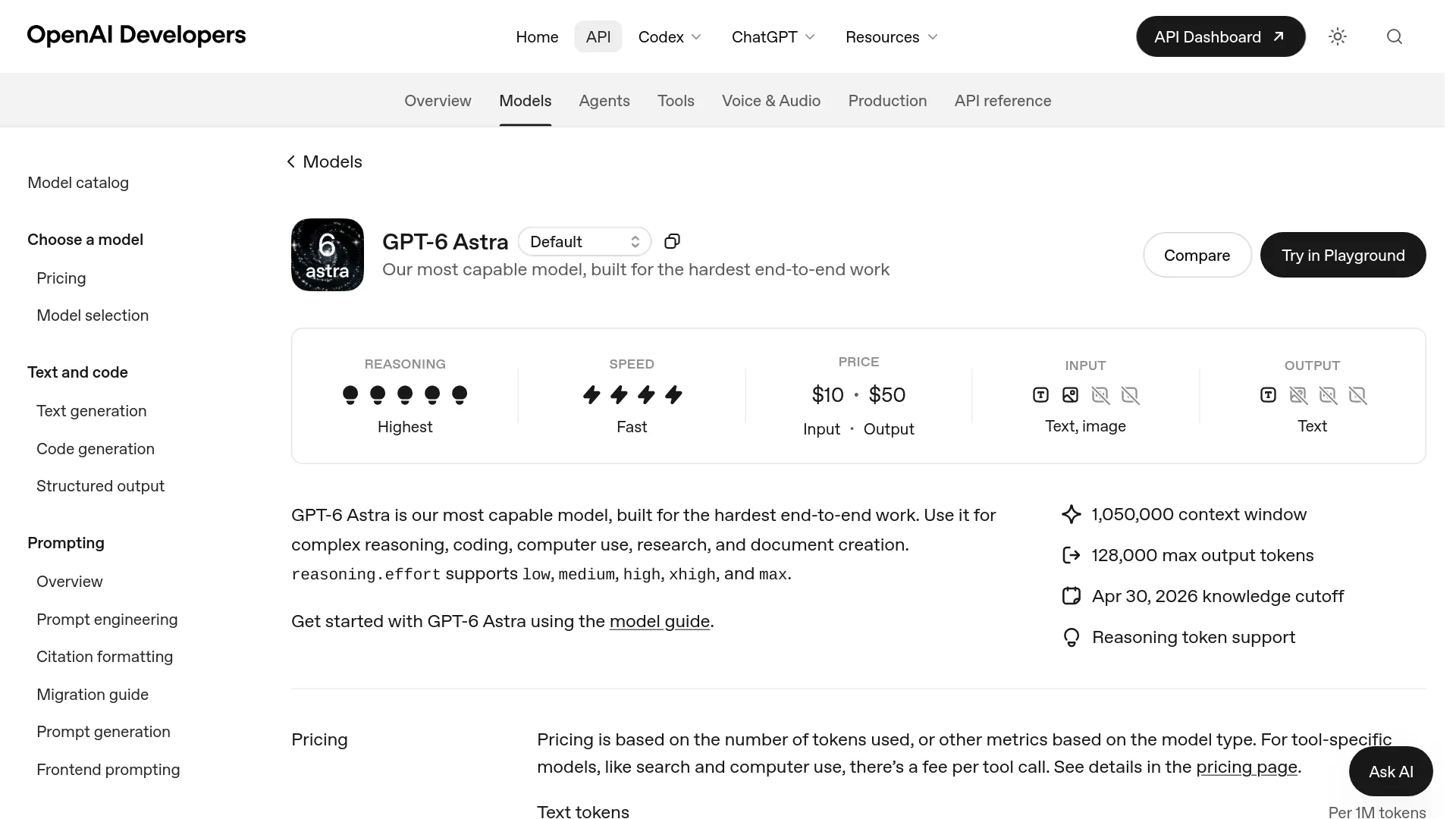
OpenAI’s model page lists GPT-6 Astra at $10 per million input tokens and $50 per million output tokens. Checked September 7, 2026.
What the endpoint choice changes
For plain text, GPT-6 Astra can be approached through Chat Completions or Responses. OpenAI’s latest-model guidance makes Responses the starting point for Astra and its tool workflows.
The newer interface features matter operationally:
- Async tool calling lets the model continue reasoning while your application runs a delayed tool, then attaches the result to the original
call_id. - Mid-turn steering lets an application send a correction while the model is working over a WebSocket connection.
- Mid-conversation effort changes can raise or lower reasoning effort without rewriting the original prompt prefix, which can preserve cache reuse.
Those features do not execute tools for you; your application still owns authorization, argument validation, timeouts, retries, side-effect approval, and state storage between turns.
The migration traps that look like application bugs
GPT-6 Astra migration has three common failure surfaces: endpoint choice, parameter compatibility, and instruction files.
Use this order when moving an existing integration:
- Pin the exact model ID. Set
modeltogpt-6-astraand log it with every evaluation run. Do not treat a model picker or a paid ChatGPT plan as proof that the API project has entitlement. - Move tool workflows to Responses. Keep Chat Completions for simple text calls only after confirming that your chosen features do not require the Responses path.
- Remove legacy sampling controls. OpenAI’s migration guidance says to audit
temperature,top_p, and log-probability settings before sending Astra traffic. Do not silently translate a removed control into a different setting and call the behavior equivalent. - Replace
noneor legacyminimaleffort. The same guidance documentslow,medium,high,xhigh, andmax; start withlowand measure upward. - Fix hard-coded validators. TypeScript unions, Pydantic
Literaltypes, Zod schemas, JSON Schema enums, and database constraints that stop athighwill rejectxhighandmax. - Recheck prompt caching. Follow the current caching guidance rather than copying legacy fields, and keep stable instructions at the front of the prompt.
- Audit AGENTS.md and skill files. OpenAI’s guidance warns that Astra is more sensitive to instructions contained in skills and other accessible files. Make user-instruction precedence and action boundaries explicit.
A minimal Responses call looks like this:
from openai import OpenAI

client = OpenAI()
input_text = "Inspect the failing test and propose the smallest safe fix."

# Pseudocode: replace with the tokenizer used for your deployed model.
if estimate_tokens(input_text) > 260_000:
    raise ValueError("Route or trim the request before the long-context pricing lane")

response = client.responses.create(
    model="gpt-6-astra",
    reasoning={"effort": "medium"},
    input=input_text,
)

print(response.output_text)
The token check is an application guardrail, not an OpenAI API setting. For a tool-using application, persist response state, validate every tool argument, handle incomplete output, and make resumed actions idempotent.
The million-token window has an API bill attached
The official model reference lists a 272,000-input-token threshold: a request above it receives 2× input and cached-input rates and 1.5× output rates for the full request.
| Standard direct API lane | Up to 272K input | Above 272K input |
|---|---|---|
| Input / 1M tokens | $10.00 | $20.00 |
| Cached input / 1M tokens | $1.00 | $2.00 |
| Cache write / 1M tokens | $12.50 | $25.00 |
| Output / 1M tokens | $50.00 | $75.00 |
A simple comparison shows why an agent needs a token guardrail:
| Request | Token charge before tools or retries |
|---|---|
| 100K input + 10K output | $1.50 |
| 300K input + 30K output | $8.25 |
The second request is not priced as 272K at the standard rate plus 28K at a surcharge. The whole request enters the long-context lane. In a loop, tool results and retries can move a previously safe session across that boundary without an application error.
Direct API versus gateway economics
A gateway quote is not an OpenAI invoice. OmniaKey’s GPT-6 Astra review lists its own gateway rates as $0.70 per million input tokens, $0.07 per million cached tokens, and $3.50 per million output tokens across its listed context range. Those figures may change the arithmetic, but the gateway owns the account terms, access policy, usage records, and any routing or retry behavior.
| Route | Published basis | Verify before production |
|---|---|---|
| Direct OpenAI API | $10 input / $50 output per 1M tokens; long-context multipliers apply | Project entitlement, tool charges, rate limits, data controls, and token billing |
| OmniaKey gateway | $0.70 input / $3.50 output per 1M tokens on its reviewed page | Exact model ID, Responses-tool support, cache accounting, limits, retention, and fallback behavior |
Prompt caching helps, but it does not remove the threshold. A cache hit is billed as cached input; creating the cache is a separate write charge. Batch and Flex are listed at 50% of Standard rates, while Fast mode is 2× the applicable rates. For the complete direct-API pricing matrix, regional details, usage tiers, and worked examples, see GPT-6 Astra API pricing.
My practical rule is to cap routine agent requests below the threshold, count tokens before sending, and allow long-context exceptions only when the task has enough human or business value to pay for them.
The reliability cost is more than tokens
GPT-6 Astra’s operating cost includes pauses, retries, permission reviews, and human correction time. OpenAI’s model guidance describes Astra as more likely to ask a focused question when an ambiguity could change the result, while also recommending prompts that bias the model toward action when the user has already authorized the work.
That behavior can be helpful in a consequential workflow and expensive in a batch job. A coding agent that asks before a destructive action is safer; an appointment or document pipeline that stops on every missing preference needs an explicit default policy.
Early user feedback points at the same trade-off from the other side of the invoice:
“First impressions: GPT-6 Astra is great but burns through the usage limits. 20 minutes of code audit work burned around 60% of the 5-hour limit... Input/output/cache: 300K/50K/5.8M tokens, total ~6M, Cost: ~$10. Astra is definitely expensive.” — @cedric_chee, September 5, 2026
The post does not establish whether ~$10 was a direct API invoice, a client-plan usage estimate, or an unverified user calculation. Treat it as an early signal to measure your own traces, not as a reproducible API rate.
Build a fallback for refusals or interruptions, checkpoint meaningful work, require approval for irreversible actions, and distinguish a safety refusal from a transient provider error. OpenAI’s guidance documents asynchronous misalignment monitoring, while the launch announcement says some advanced cybersecurity requests may be refused or stopped.
API availability and client availability are separate; test the exact project, workspace, client, or gateway path you intend to deploy. The FAQ below links OpenAI’s ChatGPT rate card because subscription access is not an API invoice.
A seven-day canary that can produce a yes or no
Astra should earn production traffic through the same acceptance criteria used for the current model. A short canary reveals completion quality, cost, latency, and intervention burden together.
- Select 25–50 real tasks. Include successful work, known failures, long-context cases, tool calls, and one task that needs a permission denial.
- Pin the environment. Keep the same starting commit, instructions, tools, permissions, retry policy, and acceptance command for the baseline and Astra.
- Run Astra at
mediumfirst. Comparelow,medium, andhighonly when the task fails or the quality difference matters. Reservexhighandmaxfor deliberately measured hard cases. - Capture the complete trace. Record pass/fail, first-attempt acceptance, input tokens, cached tokens, reasoning tokens, visible output tokens, time to first token, total latency, tool calls, retries, safety interruptions, provider errors, human correction minutes, and billed cost.
- Test the threshold. Include one workload below 272K input tokens and one that would cross it. Confirm that your meter and alert fire before the expensive lane begins.
- Set the promotion rule. Promote Astra only if accepted-task rate or saved human time offsets the extra model cost at the target latency. Otherwise keep it as an escalation route.
- Keep a fallback. Persist checkpoints before meaningful side effects and make resumed operations idempotent. A long-running agent should degrade to a cheaper model or a human queue instead of failing the whole job.
The result should be a routing policy, not a single global answer: Astra for hard tickets, a cheaper model for routine work, and an explicit budget ceiling for long context.
GPT-6 Astra API review FAQ
Should I use Chat Completions or the Responses API?
Chat Completions can serve straightforward text calls, but OpenAI’s latest-model guidance makes the Responses API the starting point for GPT-6 Astra and its tool workflows. Use Responses when you need hosted tools, function orchestration, async calls, or mid-turn steering.
Can GPT-6 Astra be fine-tuned or used for audio and video?
Do not plan on it from the current model contract. The model page marks fine-tuning as unsupported and lists audio and video as unsupported modalities; verify any specialized endpoint separately before designing around it.
Does ChatGPT Plus access include GPT-6 Astra API credits?
Do not assume so. ChatGPT subscription access and Platform API billing are separate product surfaces, as reflected in OpenAI’s ChatGPT rate card. Model access can also depend on the exact project or rollout, so test the API path you intend to use.
Should I move all GPT-5.6 Sol traffic to Astra?
No. Keep a cheaper model for short, stable, high-volume work unless the canary shows a measurable completion or correction-time advantage. Use Astra first where tool failures, long context, or human review are the expensive part.
For a general capability verdict, use the GPT-6 Astra review; for the full billing details, use GPT-6 Astra API pricing.