 AIREITER
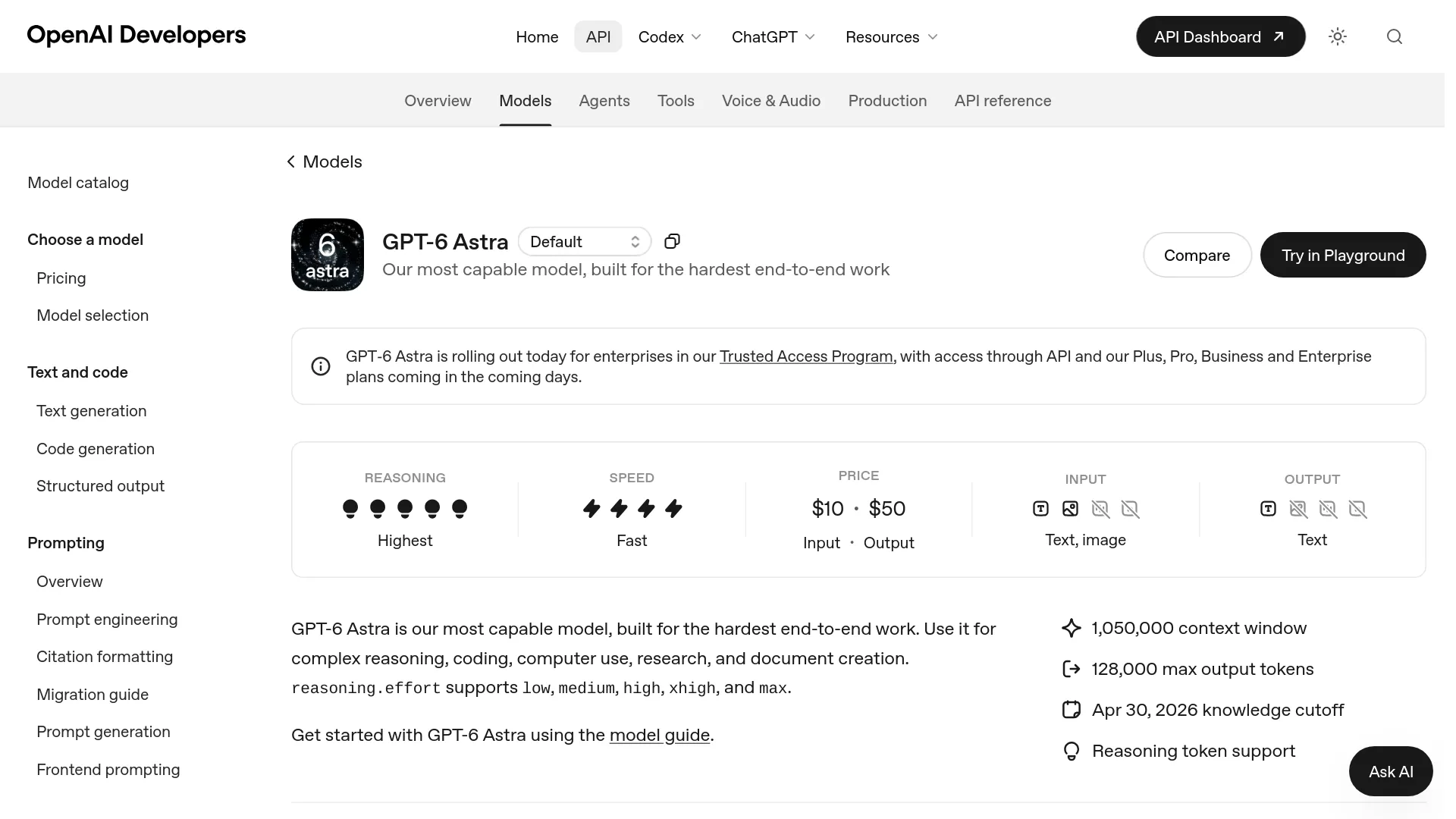
Budget beyond the headline $10 per million input tokens and $50 per million output tokens. Requests above 272,000 input tokens enter a higher rate for the full request, and GPT-6 Astra access is still rolling out, so documentation alone does not guarantee that an account can call it.
GPT-6 Astra API pricing at a glance
The rate card below is from OpenAI’s official model page. Cached prompts, long-context requests, and Fast mode shift the real cost significantly.
| Item | Current detail |
|---|---|
| API model ID | gpt-6-astra |
| Standard input | $10.00 / 1M tokens |
| Cached input | $1.00 / 1M tokens |
| Cache writes | $12.50 / 1M tokens |
| Standard output | $50.00 / 1M tokens |
| Context window | 1,050,000 tokens |
| Maximum output | 128,000 tokens |
| Knowledge cutoff | April 30, 2026 |
| Input/output | Text and image input; text output |
| Free API tier | Not supported |
| Current availability | Rolling out to Trusted Access enterprises; wider API and paid-plan access is listed for the coming days |
These figures come from the GPT-6 Astra model page, not from a pre-release estimate. OpenAI’s model guidance says tool calling requires the Responses API.
Three pricing rules that change the bill
GPT-6 Astra has four token categories plus service-mode rules. Treating it as a simple $10 in / $50 out endpoint understates cache creation, long prompts, and low-latency processing costs.
Standard, cached input, and cache writes
Standard input costs $10 per million, cached input $1 per million, and cache writes $12.50 per million. Reuse can be cheap after the initial write.
| Token category | Standard rate | What it represents |
|---|---|---|
| Uncached input | $10.00 / 1M | New input processed by the model |
| Cached input | $1.00 / 1M | Previously processed input served from cache |
| Cache write | $12.50 / 1M | Input added to the prompt cache |
| Output | $50.00 / 1M | Generated response tokens |
Do not multiply the context window by the input rate. A 1.05M-token context window is a capacity limit, not a promise that all tokens receive base-rate billing.
The 272K input threshold applies to the whole request
When a request contains more than 272,000 input tokens, OpenAI lists 2x input and cache rates and 1.5x output rates for the full request. That makes the long-context lane $20 per million uncached input, $2 per million cached input, $25 per million cache writes, and $75 per million output.
| Request lane | Input | Cached input | Cache write | Output |
|---|---|---|---|---|
| At or below 272K input | $10 | $1 | $12.50 | $50 |
| Above 272K input | $20 | $2 | $25 | $75 |
For a 300K-input request, all applicable input, cache, and output tokens use the higher long-context rates; the first 272K is not billed at the standard lane.
Batch, Flex, Fast, and regional deployment choices
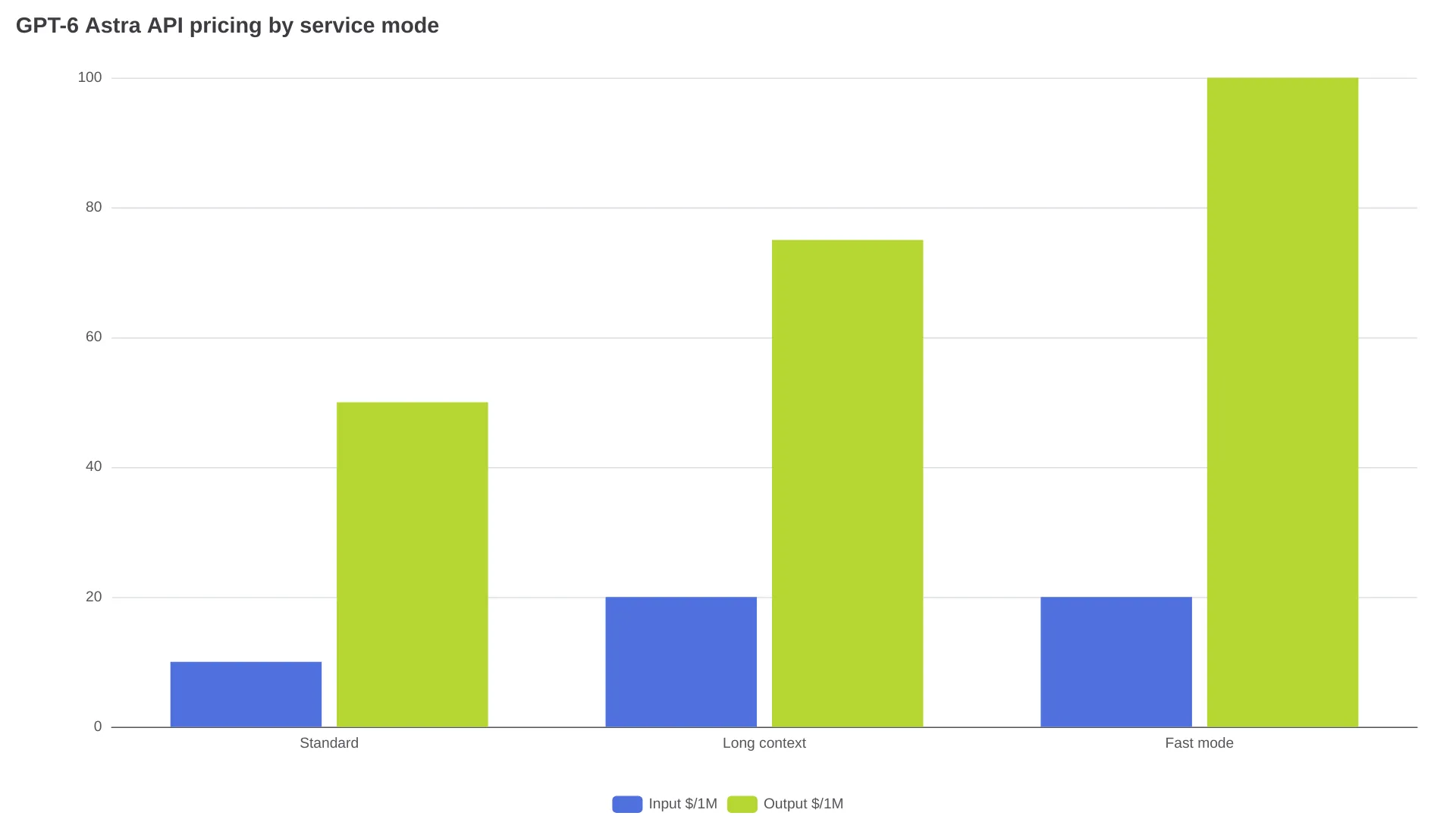
OpenAI prices Batch and Flex at 50% of the applicable rates. Its model guidance says Fast mode costs 2x the applicable rates, has no latency SLA, and is unavailable with EU data residency; Priority processing is also unavailable with EU data residency.
| Mode | Standard input | Standard output | Practical reading |
|---|---|---|---|
| Standard | $10 / 1M | $50 / 1M | Default direct-API lane |
| Batch or Flex | $5 / 1M | $25 / 1M | Half of the applicable Standard rate |
| Fast | $20 / 1M | $100 / 1M | Twice the applicable Standard rate |
| Long-context Standard | $20 / 1M | $75 / 1M | Applies above 272K input |
| Long-context Fast | $40 / 1M | $150 / 1M | 2x the long-context rates |
The table shows uncached input and output only. Cache-read and cache-write rates also follow the applicable service-mode multiplier.
Microsoft Foundry has a separate published deployment table. Its GPT-6 Astra announcement lists Global Standard short-context rates of $10 input, $1 cached input, $12.50 cache writes, and $50 output. U.S. Data Zone Standard is $11, $1.10, $13.75, and $55. Its long-context table lists $20/$2/$25/$75 for Global and $22/$2.20/$27.50/$82.50 for U.S. Data Zone. Do not copy the direct OpenAI rate card into an Azure budget.
What a real Astra request costs
The examples use direct OpenAI Standard pricing, exclude tools and retries, and classify tokens as uncached or cached exactly as stated.
| Example request | Calculation | Estimated token charge |
|---|---|---|
| 100K uncached input + 10K output | 0.1 × $10 + 0.01 × $50 | $1.50 |
| 200K cached input + 20K output | 0.2 × $1 + 0.02 × $50 | $1.20 |
| 300K uncached input + 30K output | 0.3 × $20 + 0.03 × $75 | $8.25 |
Test the 272K guardrail before adopting long-context workflows; retrieval or compaction may reduce model cost but add application work.
Writing 200K tokens costs $2.50, while a later 200K cache hit costs $0.20; caching pays back based on reuse frequency.
For Microsoft Foundry, a 100K-input and 10K-output request in the Global short-context table also costs $1.50 before tools or retries. The U.S. Data Zone version is $1.65: 0.1 × $11 + 0.01 × $55.
OpenAI’s guide says Astra may produce a lower estimated cost per completed task than earlier models, but that guidance is not an independent production-cost benchmark. Measure input tokens, cache hits, output tokens, tool calls, retries, and human corrections in your own trace.
Access, quotas, and the ChatGPT/API split
GPT-6 Astra is rolling out to enterprises in the Trusted Access Program, with API and Plus, Pro, Business, and Enterprise access coming in the coming days. The OpenClaw OpenAI provider documentation likewise says account catalog discovery determines whether an account has Astra access; adding the model name to configuration does not grant access.
One user described the rollout delay this way:
“It’s almost 2 AM and I’m going to bed pissed off. I waited ALL DAY for Astra. ... And then I find out: I CAN’T EVEN USE IT.” — @buildwithrajath, X
The model page lists these API limits by usage tier:
| Tier | RPM | TPM | Batch queue limit |
|---|---|---|---|
| Free | Not supported | Not supported | Not supported |
| Tier 1 | 500 | 500,000 | 1,500,000 |
| Tier 2 | 5,000 | 1,000,000 | 3,000,000 |
| Tier 3 | 5,000 | 2,000,000 | 100,000,000 |
| Tier 4 | 10,000 | 4,000,000 | 200,000,000 |
| Tier 5 | 15,000 | 40,000,000 | 15,000,000,000 |
The Astra rate card is API-only; ChatGPT plan access does not include API credits in the cited documentation, so budget Platform API usage separately.
Migration checks for existing agents
OpenAI’s model guidance covers three migration checks:
- Model and API: set
modeltogpt-6-astra, verify the account catalog exposes it, and use the Responses API for tool calling. - Request parameters: choose
low,medium,high,xhigh, ormax; Astra does not supportnone. Remove unsupported sampling and log-probability parameters. - Caching and region: replace
prompt_cache_retentionwithprompt_cache_options.ttl: "30m"when following OpenAI’s older-model migration guidance, then recheck Fast and Priority settings for EU data residency.
Budgeting decision: route by trace, not token price
GPT-6 Astra is easiest to justify when a task is long, tool-heavy, expensive to fail, or blocked by software that does not expose a clean API. It is a poor default for short, routine prompts when the $50 per million output rate is not buying fewer retries or better completed work.
- Test Astra first on long-context research, computer-use, complex coding, and multi-application workflows where failure creates review or rework cost.
- Keep a cheaper model as the default for short classification, extraction, simple drafting, and predictable transformations.
- Use Batch or Flex when latency is not important and the workload is compatible with a 50% rate.
- Avoid Fast by default. At $20 input and $100 output per million tokens before any long-context multiplier, it needs a measurable throughput benefit.
- Set a hard 272K guardrail. Alert before a request crosses the threshold because the premium applies to the entire request.
Judge cost per accepted task from your own trace log, not token price alone. For adjacent budgeting work, compare the assumptions in the GPT-5.6 pricing guide and OpenRouter pricing guide rather than transferring their rate-card rules to Astra.
GPT-6 Astra API pricing FAQ
How much does GPT-6 Astra cost per 1M tokens?
Standard pricing is $10 per million uncached input, $1 per million cached input, $12.50 per million cache writes, and $50 per million output tokens.
What happens above 272K input tokens?
Input and cache rates double, and output rises by 50%: $20 input, $2 cached input, $25 cache writes, and $75 output per million tokens for the full request.
Is cached input the same as a cache write?
No. Cached input is a cache hit billed at $1 per million in the Standard lane; a cache write creates or updates the cached prefix and costs $12.50 per million.
Does Batch or Flex halve GPT-6 Astra pricing?
OpenAI lists Batch and Flex at 50% of the applicable Standard rates, including the applicable long-context rate when that threshold is triggered.
Is Fast mode worth the extra cost?
Fast mode costs 2x the applicable rates and has no latency SLA, so use it only when your trace shows enough throughput or user-value improvement to offset the premium.
Can I use GPT-6 Astra through the API today?
Access is rolling out rather than universally open; OpenAI lists initial Trusted Access enterprise availability and says wider API access is coming in the coming days, so the account catalog is the final check.
Does ChatGPT Plus include GPT-6 Astra API credits?
The model documentation does not promise API credits with a ChatGPT plan. Treat paid-plan model access and usage-based Platform API billing as separate until your account’s explicit billing terms say otherwise.
What API changes are required for GPT-6 Astra?
Set model to gpt-6-astra, use the Responses API for tool calling, select a supported reasoning effort, remove unsupported sampling and log-probability parameters, and review cache TTL and regional Fast-mode rules. Before making Astra the default, log tokens, cache behavior, tools, retries, and human corrections for one representative run.