 AIREITER
OpenRouter bills itself as "one API key for 400+ AI models" with transparent, no-markup pricing. But when Reddit users complain about "weirdly high costs" and "$10 turning into $10.55," the reality is messier than the marketing.
I've spent real money on OpenRouter — testing models for development, chat, and content generation — and this guide breaks down what you'll actually pay, where the hidden costs are, and whether BYOK is worth it for your use case.
Quick Answer: How OpenRouter Pricing Works
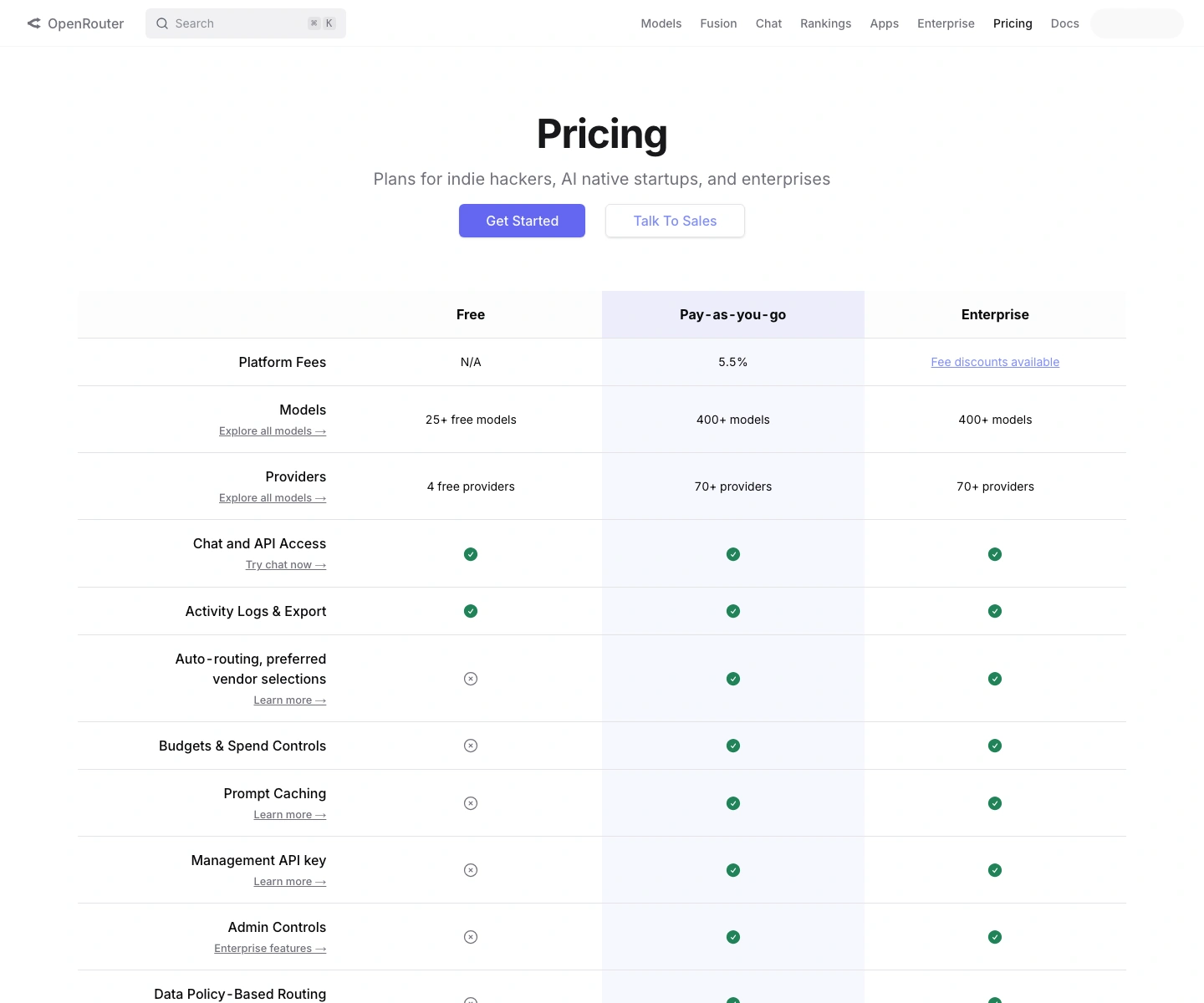
OpenRouter has three tiers:
Plan | Platform Fee | Models | Best For |
|---|---|---|---|
Free | $0 | 26 free models | Testing, hobby projects |
Pay-as-you-go | 5.5% on credits | 339+ models | Most users, development |
Enterprise | Discounted rates | All models | Teams needing SLA/SSO |
The key number: 5.5% fee on every credit purchase. OpenRouter claims "no markup on provider pricing," which is technically true — the per-token rates match the original providers. But that 5.5% surcharge on your balance is the cost of convenience.
The 5.5% Surcharge: What $10, $50, $100 Actually Gets You
This is the part most guides gloss over. When you load $10 onto OpenRouter, you don't get $10 of API credits — you get $10 worth of purchasing power, but the actual charge to your card is higher. Here's the real math:
Spending Power You Want | 5.5% Fee | Total Charged to Card |
|---|---|---|
$10.00 | $0.55 | $10.55 |
$50.00 | $2.75 | $52.75 |
$100.00 | $5.50 | $105.50 |
$500.00 | $27.50 | $527.50 |
Let me clarify, because this is where confusion lives. The 5.5% is added on top of your desired spending power — it's not deducted from your balance. If you want $10 worth of API calls, your card gets charged $10.55, and you receive $10.00 in spendable credits. Your $10 buys $10 of tokens, not $9.45.
According to OpenRouter's official pricing page and Reddit users confirming the "$10 costs $10.55" experience, this is how it works in practice.
Per-Model Pricing: How Much Top Models Cost
OpenRouter passes through provider pricing with no markup. Here are the current rates for popular models (per million tokens), pulled from OpenRouter's live model API on June 24, 2026. You can verify every number yourself by visiting openrouter.ai/models.
Model | Input (per 1M) | Output (per 1M) | Context | OpenRouter vs Direct |
|---|---|---|---|---|
GPT-5.5 | $5.00 | $30.00 | 1M | Same as OpenAI |
GPT-5.4 | $2.50 | $15.00 | 1M | Same as OpenAI |
GPT-4.1 | $2.00 | $8.00 | 1M | Same as OpenAI |
Claude Opus 4.7 | $5.00 | $25.00 | 1M | Same as Anthropic |
Claude Opus 4.6 | $5.00 | $25.00 | 1M | Same as Anthropic |
Claude Sonnet 4.6 | $3.00 | $15.00 | 1M | Same as Anthropic |
Claude Haiku 4.5 | $1.00 | $5.00 | 200K | Same as Anthropic |
Gemini 3.5 Flash | $1.50 | $9.00 | 1M | Same as Google |
DeepSeek R1 | $0.70 | $2.50 | 164K | Same as DeepSeek |
The per-token rates are identical to going direct. Your only overhead is the 5.5% credit surcharge. So the real question isn't "is OpenRouter more expensive per token" — it's "is 5.5% worth the convenience of one API key."
What Does a Typical Request Actually Cost?
Let's make this concrete. Say you're using Claude Sonnet 4.6 ($3/M input, $15/M output) for a coding assistant:
A short coding question: ~2,000 input tokens, ~1,500 output tokens
Cost: $0.006 input + $0.0225 output = $0.029 per request
A complex refactoring task: ~15,000 input tokens, ~3,000 output tokens
Cost: $0.045 input + $0.045 output = $0.09 per request
A full afternoon of heavy coding (100 complex requests): ~$9.00
Add the 5.5% surcharge and that afternoon costs ~$9.50. Scale to a team of 5 developers doing this daily, and you're at $1,400+/month.
BYOK: When Bringing Your Own Key Saves Money
OpenRouter's BYOK (Bring Your Own Key) mode lets you plug in your own provider API keys (Anthropic, OpenAI, etc.) while still using OpenRouter's routing, fallback, and unified interface.
BYOK pricing:
First 1,000,000 requests/month: free
After that: 5% fee on usage
The Break-Even Calculation
Here's the question: at what request volume does BYOK beat the standard 5.5% model?
Scenario | Standard (5.5%) | BYOK (5% after 1M free) | Winner |
|---|---|---|---|
< 1M requests/month | 5.5% on all | 0% (free tier) | BYOK wins |
1M-2M requests/month | 5.5% on all | 2.5% effective (half free, half 5%) | BYOK wins |
3M+ requests/month | 5.5% on all | ~3.3% effective | BYOK wins |
Pure cost comparison | Always 5.5% | Capped near 5% at scale | BYOK always wins on % |
BYOK is almost always cheaper on a percentage basis. The catch:
You still pay the provider directly (separate billing accounts)
You lose OpenRouter's credit pool — if your Anthropic key hits a rate limit, you need your own fallback strategy
You manage multiple billing relationships instead of one
When BYOK makes sense: You're a heavy user doing 500K+ requests/month and already have direct relationships with providers.
When standard mode makes sense: You want simplicity, one bill, automatic fallback across providers, and your volume is low enough that 0.5% difference doesn't matter.
Free Models: What 50 Requests/Day Actually Gets You
OpenRouter offers 26 free models with zero token cost (we tested the best ones for coding in our best free OpenRouter models for programming guide). The limits:
50 requests/day (free plan)
1,000 requests/day if you've loaded ≥$10 (still using free models)
20 requests/minute rate limit
What Can You Do With 50 Free Requests?
Use Case | Tokens Per Request | What 50 Requests Gets You |
|---|---|---|
Quick Q&A (Llama 3.3 70B) | ~500 in, ~500 out | 50 short questions answered |
Code review (DeepSeek R1 free) | ~2,000 in, ~1,000 out | 50 function reviews |
Text summarization | ~3,000 in, ~500 out | 50 article summaries |
Chatbot testing | ~1,000 in, ~800 out | A full conversation of ~50 turns |
Free models are genuinely useful for prototyping and testing. The 50/day limit is the real constraint — once you're in production, you'll burn through that in minutes.
Free Models Worth Knowing
Model | Context | Good For |
|---|---|---|
DeepSeek R1 (free) | 164K | Reasoning, math |
Llama 3.3 70B (free) | 128K | General chat, coding |
Gemma 4 31B (free) | 262K | Lightweight tasks |
Nemotron 3 Ultra (free) | 1M | Long-context tasks |
Routing Variants: :floor, :nitro, and the Cost Trap
OpenRouter lets you append variants to model names that change routing behavior. This is where costs can silently increase.
Variant | What It Does | Cost Impact |
|---|---|---|
| Routes to the cheapest available provider | Cheapest — can save 10-30% |
| Routes to the fastest provider | More expensive — prioritizes speed over cost |
| Adds web search capability | Most expensive — Reddit users warn it's "expensive and sucks" |
(default) | Auto-selects by price | Baseline |
The trap: When you use the default routing and a provider goes down, OpenRouter's fallback may route you to a more expensive provider without warning. One Reddit user discovered their costs spiked because fallback kept hitting premium endpoints.
My recommendation: Use :floor for cost-sensitive workloads (batch processing, testing) and reserve :nitro only for latency-critical production paths.
My Experience: Fast and Stable, With a Caveat
After a month of daily use, my overall impression is straightforward: OpenRouter is fast and stable. My go-to model is DeepSeek V4 Flash — I use it primarily for translation work via the API, and the results are solid. At $0.0003-0.0006 per request, it's practically free for batch translation tasks.
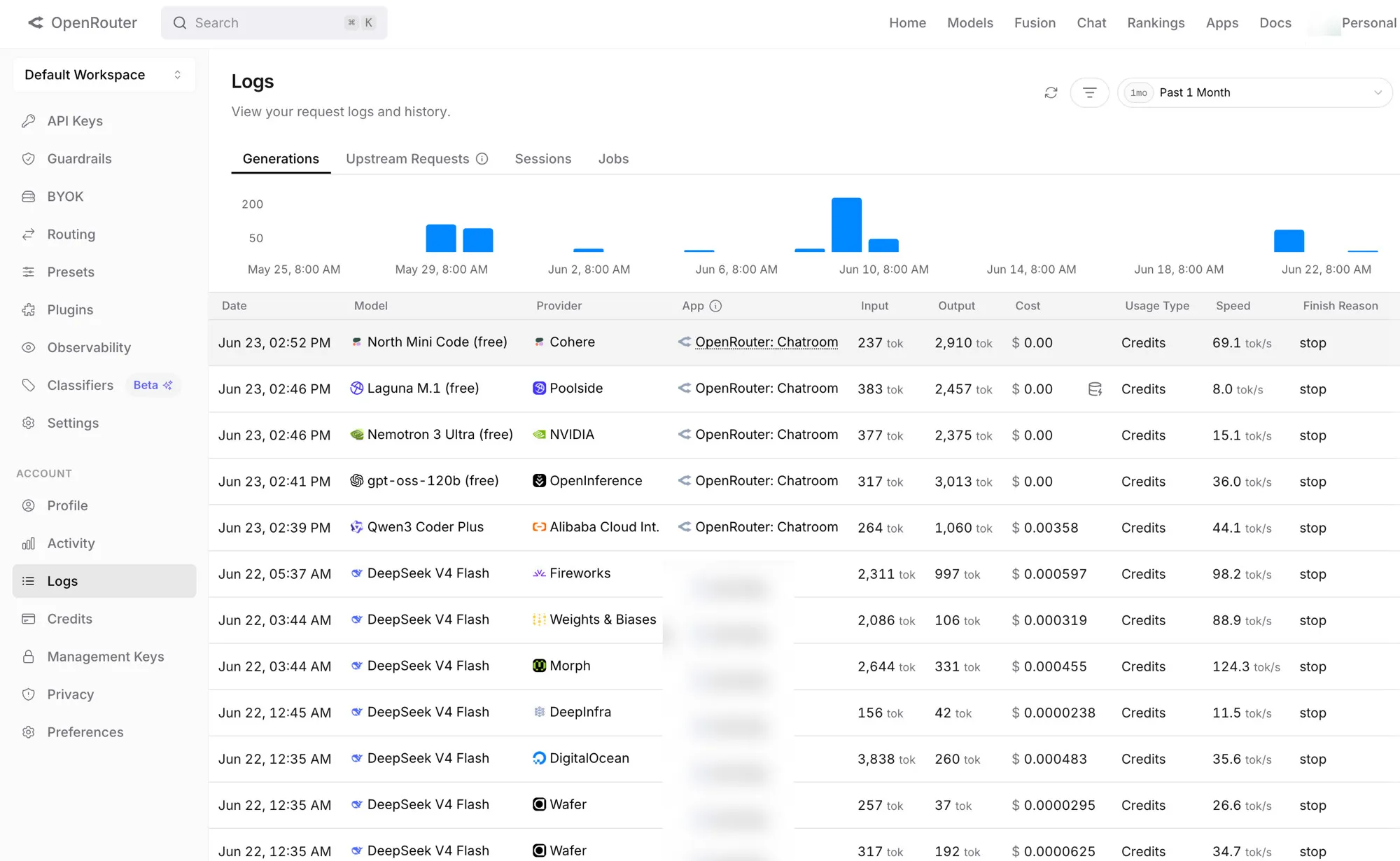
Speed-wise, it feels about the same as hitting the direct API. The real advantage isn't speed — it's redundancy. OpenRouter routes across multiple providers, so if one goes down, your requests keep flowing. Looking at my logs, DeepSeek V4 Flash gets routed to Fireworks (98.2 tok/s), Morph (124.3 tok/s), Wafer (34.7 tok/s), and others. Same model, 3x speed variance depending on which backend you hit — but the point is, if Fireworks is down, you're automatically on Morph without changing a line of code.
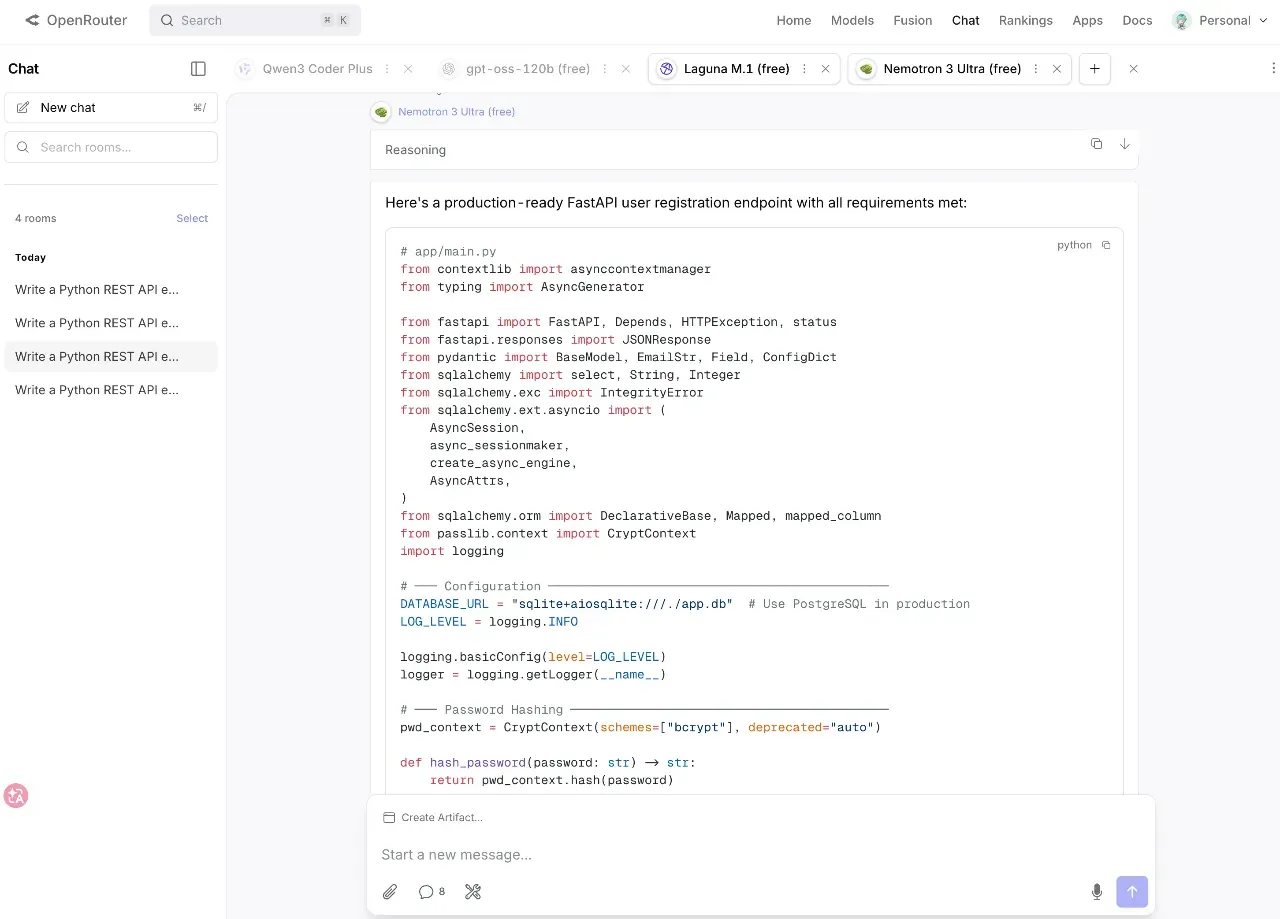
The free models are surprisingly usable for quick tests. North Mini Code from Cohere clocked 69.1 tok/s, and gpt-oss-120b hit 36.0 tok/s — both at zero cost. For prototyping, that's hard to beat.
OpenRouter vs Direct API: Is 5.5% Worth It?
The honest comparison:
Factor | OpenRouter | Direct API |
|---|---|---|
Per-token price | Same as provider | Same |
Overhead | 5.5% surcharge | $0 |
API keys needed | 1 | 1 per provider |
Automatic fallback | ✅ | ❌ (you build it) |
Unified billing | ✅ | ❌ |
Provider SLA | Via OpenRouter | Direct |
Batch API / caching | ❌ (not supported) | ✅ |
Model variety | 339+ in one call | Limited per provider |
OpenRouter is worth it when:
You need to switch between models frequently (testing, A/B comparison)
You want automatic failover without building it yourself
You're managing multiple providers and want one bill
Direct API is better when:
You use a single model in production and need maximum cost efficiency
You need provider-specific features that OpenRouter doesn't support — Anthropic's prompt caching can cut input token costs by 90% on repeated prefixes, and OpenAI's batch API offers 50% off for non-real-time workloads. These savings are unavailable through OpenRouter and can outweigh the 5.5% surcharge difference
You need a direct SLA for enterprise compliance
Your volume is high enough that 5.5% adds up to significant money
Cost Comparison: $100/month Scenario
If you spend $100/month on Claude Sonnet 4.6:
Direct from Anthropic: $100 buys $100 of tokens
Via OpenRouter: To get $100 of tokens, you pay $105.50 (5.5% added on top)
That ~$5.50/month difference buys you: one API key, automatic fallback, 339+ models, and zero infrastructure. For most individual developers, that's a fair trade. For a team spending $5,000/month, that $275/month surcharge deserves serious consideration.
"$20: How Long Does It Last?"
Based on real usage patterns:
User Type | Models Used | Daily Requests | $20 Lasts |
|---|---|---|---|
Hobbyist | Free models + occasional Haiku | 5-10 | 2-3 months |
Light developer | Sonnet 4.6 for coding help | 20-30 | 3-4 weeks |
Active developer | Sonnet/Opus for daily coding | 50-100 | 1-2 weeks |
Heavy agent user | Opus 4.7 for autonomous agents | 200+ | 3-5 days |
One Reddit user put it well: "I drop $20 on OpenRouter and chat all month, even using some of the more expensive models." That works if you're a light user. If you're running AI agents that make hundreds of calls per task, $20 evaporates fast.
Enterprise Pricing: What You Get
For teams, OpenRouter offers custom enterprise plans with:
Fee discounts (negotiated below 5.5%)
5M free BYOK requests/month (vs 1M on PAYG)
Optional dedicated rate limits
SSO/SAML authentication
Contract-grade SLA
Invoice and purchase order billing
Shared Slack channel support
Pricing is usage-based with volume commitments. If you're spending $1,000+/month, it's worth reaching out for a custom quote — the fee discount alone could save $50+/month.
Practical Cost Optimization Tips
Start with free models for prototyping — DeepSeek R1 free and Llama 3.3 70B free handle 80% of development tasks
Match model to task complexity — Don't use Opus ($5/$25) for simple classification; use Haiku ($1/$5)
Use
:floorrouting for batch jobs — Can save 10-30% by picking the cheapest providerSet up spending alerts — OpenRouter's dashboard tracks per-key spending; use it
Create separate API keys per project — Set individual credit limits to prevent runaway costs
Consider BYOK at scale — If you're past 500K requests/month, the 0.5% savings compounds
Trim your context — Every token in your system prompt costs money on every request; prune aggressively
FAQ
Is OpenRouter still free?
Yes — OpenRouter offers 26 free models with 50 requests/day (1,000/day if you've loaded $10+). The free tier has rate limits and isn't suitable for production, but it's genuinely free for testing and light use.
How does OpenRouter compare to OpenAI's $20/month subscription?
OpenAI's $20/month ChatGPT Plus gives you a flat-rate chat experience with usage caps. OpenRouter is pay-per-token with no caps — you pay for exactly what you use. If you're a light user ($5-10/month of tokens), OpenRouter is cheaper. If you're a heavy chat user hitting ChatGPT's caps, the subscription offers better value. OpenRouter's advantage is API access to 339+ models, not a ChatGPT replacement.
Can I get a refund on unused OpenRouter credits?
OpenRouter's terms indicate credits are non-refundable once purchased. However, credits do not expire, so you can use them indefinitely. If you're unsure about usage, start with a small amount ($10) to test before loading larger sums.
Is OpenRouter cheaper than OpenAI?
Per-token, OpenRouter charges the same as OpenAI. With the 5.5% surcharge, OpenRouter is slightly more expensive than going direct. The value is in convenience: one API key, automatic fallback, and access to 339+ models.
What's the minimum I can spend?
There's no minimum. You can start with free models at $0, or load as little as you want. The $10 threshold matters because it unlocks higher rate limits (1,000 free requests/day instead of 50).
Is BYOK worth it?
If you're doing under 1M requests/month, BYOK is free (within the free tier) and cheaper than the 5.5% standard fee. The trade-off is managing multiple provider keys and bills. For most individual developers, standard mode is simpler; for teams at scale, BYOK pays off.
The Bottom Line
OpenRouter's pricing is transparent — you pay exactly what the provider charges plus a 5.5% convenience fee. For most developers, that's a fair price for unified access to 339+ models, automatic fallback, and a single billing relationship.
Where costs sneak up on you: fallback routing to expensive providers, :nitro and :online variants that prioritize speed over cost, and the simple reality that 5.5% compounds at scale. Use :floor routing, match models to task complexity, and monitor your per-key spending, and OpenRouter stays one of the most cost-effective ways to access the full AI model landscape.
Looking for alternatives? Check out our Kie AI review — another API aggregator worth comparing.