 AIREITER
GPT-6 Astra is OpenAI’s flagship model for difficult, end-to-end work, but the practical verdict is narrower than the launch claims: it earns its premium for long, tool-heavy tasks, not for routine prompts or unlimited ChatGPT use.
What GPT-6 Astra gives you
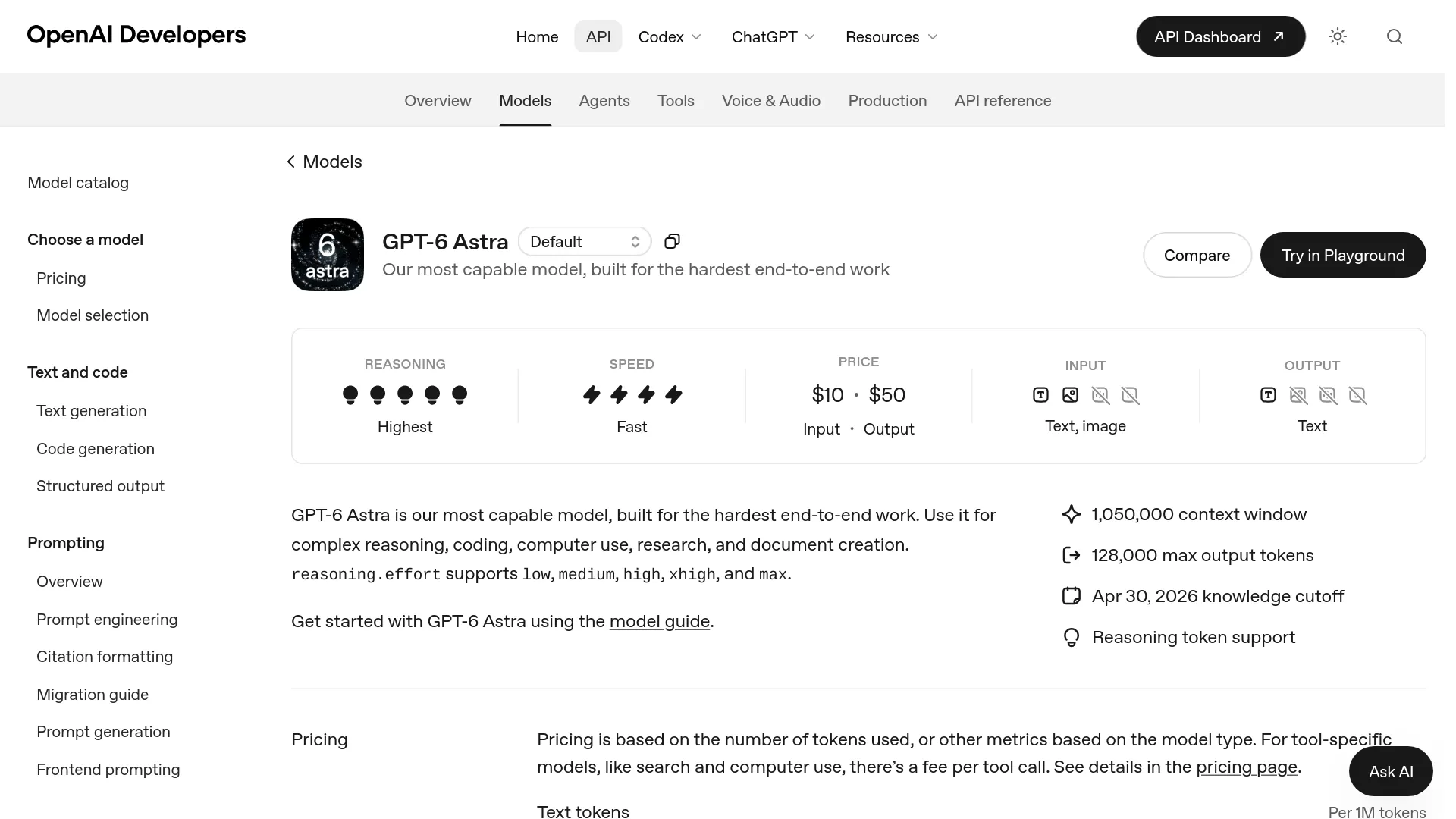
GPT-6 Astra targets reasoning, coding, research, document creation, and computer use. The API listing gives it a 1,050,000-token context window, a 128,000-token maximum output, and five reasoning settings from low through max.
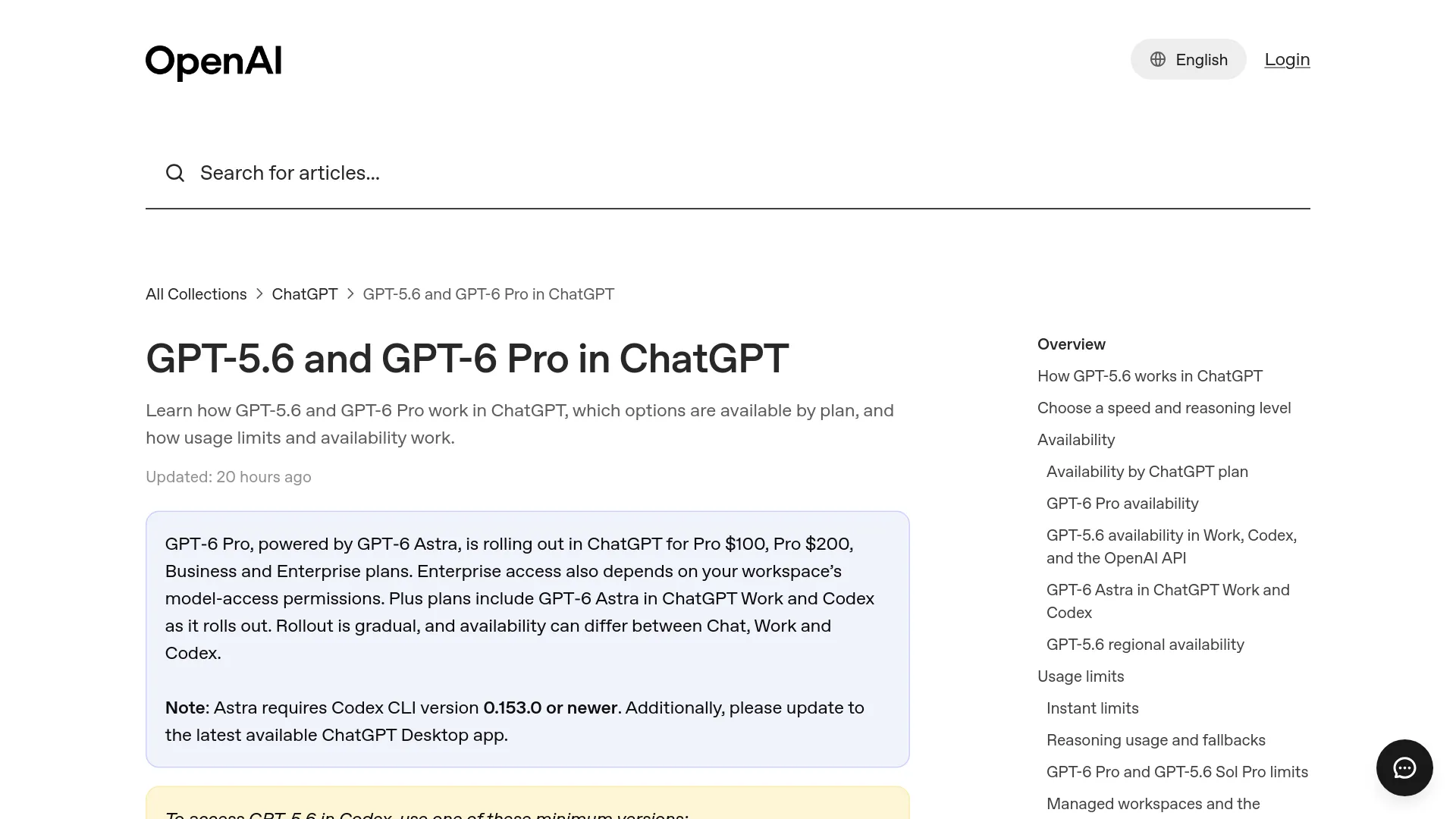
The important distinction is between the API model and the ChatGPT product label. OpenAI’s Help Center describes GPT-6 Pro in ChatGPT as powered by GPT-6 Astra. The same Astra model can appear in Work and Codex without appearing in ordinary Chat for the same account.
Astra is the model; GPT-6 Pro is the ChatGPT label
The OpenAI API model page lists gpt-6-astra as the model identifier. It supports streaming, function calling, structured outputs, image input, and Responses API tools such as web search, file search, code interpreter, hosted shell, computer use, MCP, and Apply Patch.
Astra does not support audio or video input, and the API page says fine-tuning is unavailable. Its knowledge cutoff is listed as April 30, 2026, so current information still requires web access or supplied context.
Available does not mean available everywhere
OpenAI announced GPT-6 Astra on September 3, 2026. The release is real, but access is split by plan and product rather than arriving as one universal ChatGPT switch.
| Where you want Astra | Current access described by OpenAI | Practical qualification |
|---|---|---|
| OpenAI API | gpt-6-astra is listed as available | API billing and usage tiers apply |
| ChatGPT ordinary Chat | GPT-6 Pro for Pro $100, Pro $200, Business, and Enterprise | Enterprise access can depend on workspace permissions |
| ChatGPT Work | Astra rolling out to Plus and higher plans | Work usage rules are separate from Chat |
| Codex | Astra rolling out for eligible paid plans | Codex CLI 0.153.0 or newer is required for Astra-related access |
The current OpenAI Help Center guidance explicitly warns that availability can differ between Chat, Work, and Codex. Plus access to Astra in Work or Codex should not be read as guaranteed access to GPT-6 Pro in ordinary Chat.
This split has caused user confusion, so check the model picker in the exact product you plan to use before upgrading a subscription or changing a production workflow.
The useful part is the computer, not the benchmark trophy
GPT-6 Astra’s strongest product case is long-horizon work that combines reasoning with tools. That includes a coding agent that must inspect a repository, make changes, run checks, and recover from errors; a research workflow that gathers and reconciles documents; or a computer-use task that has to navigate software instead of merely explaining it.
Best-fit tasks: long-horizon, tool-heavy work
The API documentation confirms support for computer use, shell access, code execution, file search, web search, MCP, and patch application in the Responses API. These capabilities make Astra more than a text generator, but they also make the cost and failure surface larger than a normal chat completion.
The early review evidence points in the same direction. Matt Shumer’s hands-on GPT-6 Astra review describes unattended fixes to a broken service, browser work inside email and advertising interfaces, and multi-agent coordination through Codex. The author’s judgment is favorable for engineering and general computer work, but he calls Astra slower than he would like and still prefers Claude Fable for visual taste and some 3D tasks.
Independent early users reported similarly strong results on specialized work. @anshuc said Astra built a 3D game in about 45 minutes, while @tomkrcha described reconstructing a steam train in Blender as thousands of editable objects. These are useful signals about what people are attempting, not controlled benchmarks: the prompts, assets, software versions, and amount of human steering differ.
Creative-software claims need a tighter boundary. A monitored early test ran Illustrator, After Effects, Figma, and Photoshop, but the reviewer noted that those applications were not among the officially documented examples at the time. Treat those workflows as experiments to validate in your own environment, not guaranteed integrations. (Promptslove review)
Where the upgrade is hard to justify
Astra is a poor default for high-volume rewriting, simple extraction, ordinary customer support, or short coding edits that a cheaper model already handles reliably. The premium only has a chance to pay back when fewer human interventions, better tool use, or a higher completion rate offsets the token bill.
Quota friction also appears quickly in real use. @datmicahfr reported:
“So apparently GPT 6 Astra (low) burned through my entire 5 hour limit in 2 minutes flat on a simple prompt. Wow, that's complete dookie.” — @datmicahfr, X
That is an anecdote, not an OpenAI service limit. It is a warning to measure full agent runs, because one short instruction can trigger many tool calls, reasoning tokens, and long outputs.
Read the benchmark card as a buyer
OpenAI’s launch messaging reported roughly 98% on FrontierMath Tier 4, 99.9% on ARC-AGI 3, and 100% on ExploitBench. Those numbers support the claim that Astra is a frontier reasoning and cybersecurity model. They do not prove that it is the best choice for every coding repository or business workflow.
Strong signals from the launch material
| Reported result | What it tells a buyer | What it does not tell you |
|---|---|---|
| ~98% FrontierMath Tier 4 | Strong performance on difficult mathematical reasoning | Whether everyday answers justify the premium |
| 99.9% ARC-AGI 3 | Very high performance on the reported abstraction evaluation | Whether the harness is comparable to every independent run |
| 100% ExploitBench | Explains the model’s “Critical” cybersecurity classification | That unrestricted offensive-security automation is available |
| 72.6% OSWorld 2.0 in reproduced launch tables | A concrete computer-use signal | How Astra performs in your browser, desktop, or CRM |
| 74.1% DeepSWE v1.1 in reproduced launch tables | Evidence for agentic software engineering | A direct SWE-bench ranking against other models |
The official release posts from OpenAI and Sam Altman are the primary launch evidence. The OSWorld and DeepSWE figures above are reported in early review coverage, including the CodingFleet benchmark review, rather than independently measured here.
Three comparisons that need a label
- ARC-AGI 3: the 99.9% figure is setup-dependent, so treat it as a reported provider-adapter result rather than a universal score.
- OSWorld: do not compare Astra and Fable percentages across different OSWorld releases or evaluation harnesses.
- DeepSWE: 74.1% is agentic-coding evidence, not a direct SWE-bench Verified or SWE-bench Pro ranking.
Treat the launch card as a capability map for where to A/B test, not a production guarantee. Use the same tasks, tools, permissions, and time limit when comparing Astra with Sol or another frontier model.
Budget GPT-6 Astra as two separate products
GPT-6 Astra has an API price and a ChatGPT allowance. They are different purchasing decisions, and confusing them is the fastest way to underestimate the cost.
API economics
The official API pricing table lists the following standard rates:
| API usage | GPT-6 Astra price |
|---|---|
| Input | $10 per 1M tokens |
| Cached input | $1 per 1M tokens |
| Cache write | $12.50 per 1M tokens |
| Output | $50 per 1M tokens |
| Batch or Flex | 50% of Standard rates |
| Fast mode | 2× applicable rates |
For requests containing more than 272,000 input tokens, OpenAI applies 2× input and 1.5× output pricing to the entire request. That makes context management important even with a 1.05-million-token window.
A simple example shows the shape of the bill. A request with 100,000 input tokens and 10,000 output tokens costs about $1.50 before tools and caching: $1.00 for input plus $0.50 for output. The same token mix repeated 20 times costs about $30. If the input is cacheable, the cached-input portion can reduce that number; if an agent generates long outputs or crosses the 272,000-token threshold, it rises quickly.
ChatGPT limits are a product decision
OpenAI’s Help Center currently describes these included GPT-6 Pro allowances:
| ChatGPT plan | GPT-6 Pro allowance | Relationship with GPT-5.6 Sol Pro |
|---|---|---|
| Pro $200 | 200 messages per week | Sol Pro also has its own allowance, with a combined daily cap described by OpenAI |
| Pro $100 | 50 messages per week | Shared with GPT-5.6 Sol Pro |
| Business Standard | 15 messages per month | Shared with GPT-5.6 Sol Pro |
| Business Premium | 50 messages per week | Shared with GPT-5.6 Sol Pro |
These are message allowances, not a measure of equal token consumption. A long computer-use run can do considerably more work than a short question, and Work or Codex credits are separate from ordinary Chat usage. OpenAI also says support does not reset exhausted limits; users must wait for the reset or switch to another available model.
GPT-6 Astra review verdict by workload
GPT-6 Astra is worth adopting as a premium escalation lane, not as a blanket replacement for every cheaper model. Its evidence is strongest where the work is long, tool-heavy, and expensive for a human to supervise manually.
Use Astra now if...
- You are building computer-use or browser agents and can measure task completion, intervention time, and cost per successful run.
- Your coding workflow involves large repositories, long debugging sessions, multiple tools, or delegation between agents.
- You run research or document workflows where a million-token context and strong retrieval/tool use can avoid repeated summarization.
- You need a high-end reasoning model for a relatively small number of consequential tasks rather than a cheap model for millions of calls.
Stay with GPT-5.6 Sol or a cheaper route if...
- Your traffic is mostly short answers, classification, extraction, rewriting, or routine code completion.
- The application cannot tolerate a $50-per-million-output-token list price or unpredictable long agent loops.
- You need audio, video, or fine-tuning: the Astra model page lists those capabilities as unsupported.
- Your team has no human review or rollback path for computer actions.
The cheaper GPT-5.6 Sol API model is listed at $4 per 1M input tokens and $20 per 1M output tokens. That is not a direct quality comparison, but it is enough to make Sol the rational baseline for a migration test.
A safe migration test
- Select 25–50 representative tasks, including failures and long-context cases rather than only showcase prompts.
- Run the same tasks through GPT-5.6 Sol and GPT-6 Astra with isolated test credentials, scoped tool permissions, approval gates for consequential actions, and fixed retry rules.
- Record successful completion rate, human intervention minutes, elapsed time, input/output tokens, and total cost.
- Promote Astra only when saved intervention time or higher completion covers the price difference.
- Keep a fallback model for routine traffic and a hard stop for irreversible computer actions.
This test gives you a workload decision without pretending that a vendor benchmark is a production guarantee.
FAQ: GPT-6 Astra availability, limits, and use
Is GPT-6 Astra officially released?
Yes. OpenAI announced GPT-6 Astra on September 3, 2026, and its API documentation lists the gpt-6-astra model. It is released, but ChatGPT availability remains a staged, plan-dependent rollout.
Is GPT-6 Astra in ChatGPT Plus?
Plus users may receive Astra in ChatGPT Work and Codex as rollout continues. The Help Center does not make that equivalent to GPT-6 Pro in ordinary Chat; GPT-6 Pro is listed for Pro $100, Pro $200, Business, and Enterprise plans.
Does GPT-6 Astra have a 1M-token context window?
Yes. OpenAI lists a 1,050,000-token context window and a 128,000-token maximum output. Requests above 272,000 input tokens receive higher whole-request pricing, so the maximum context is not a flat-cost feature.
Is GPT-6 Astra better than GPT-5.6 Sol for coding?
Astra has a stronger published signal for long-horizon agentic coding and tool use, but that is not proof of universal superiority on ordinary repositories. Test both models on your codebase, including review, debugging, test repair, and rollback tasks.
Why does GPT-6 Astra hit limits so quickly?
Agentic sessions can produce many tool calls, reasoning tokens, and long outputs even when the user sends one short instruction. OpenAI’s ChatGPT allowances also differ by plan and product, while API usage is billed by tokens; a short prompt is not the same as a short run.
The decision: buy more autonomy only where it pays
Start with a narrow escalation lane, keep GPT-5.6 Sol for routine traffic, and measure completed work rather than benchmark excitement. GPT-6 Astra earns its premium only when higher completion or saved human time covers $10 input and $50 output per million API tokens, or the limited GPT-6 Pro allowance in ChatGPT.