 AIREITER
Fifteen seconds of 720p on Gemini Omni 1.1 Flash meant roughly $1.50 of video tokens (a 10-second take plus an extension, at ~$0.10/second). On Gemini Omni 1.2 Flash the same 15 seconds as one native clip costs about $1.05.
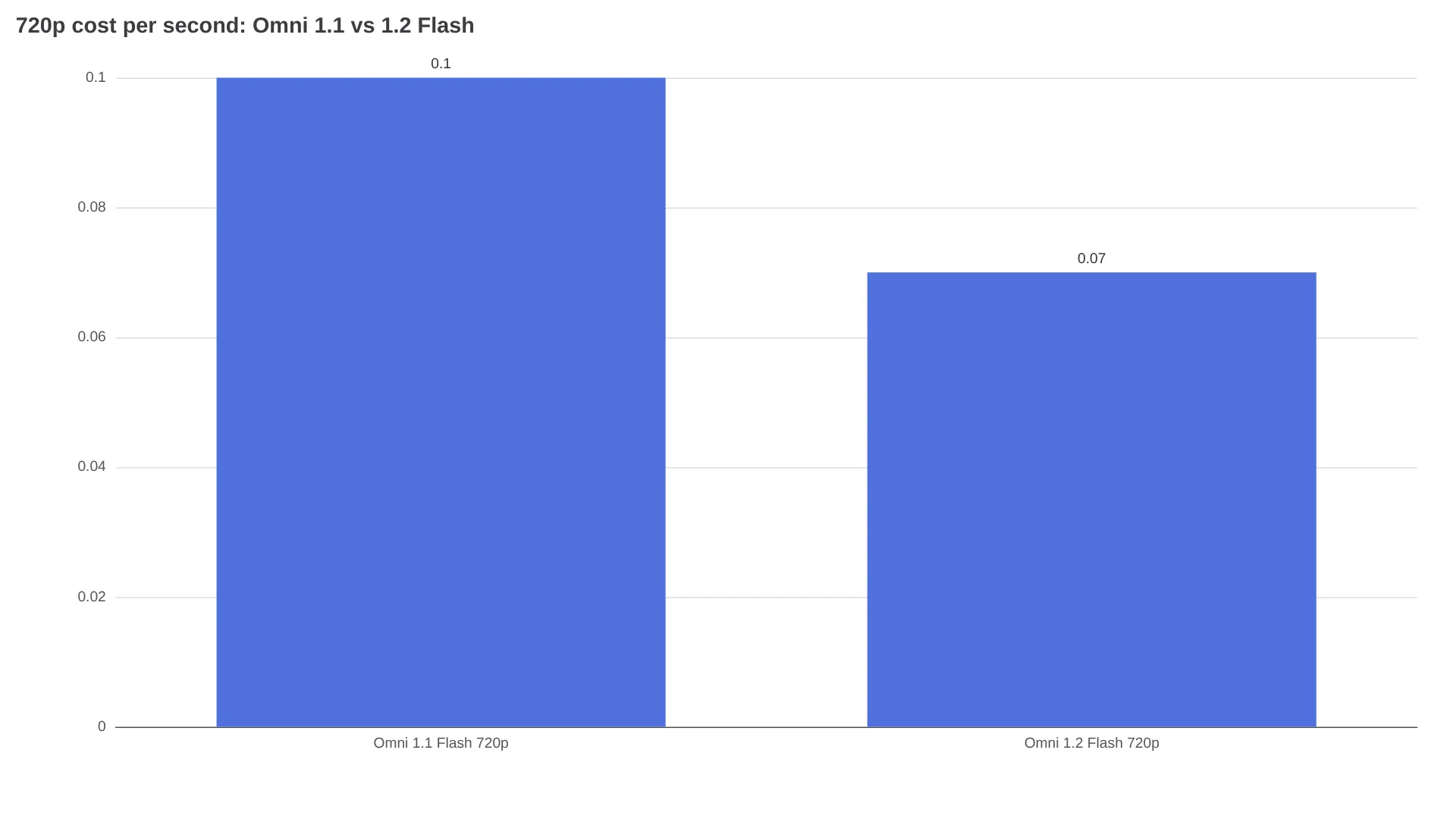
Google released Gemini Omni 1.2 Flash on November 5, 2026: a 30% price cut to $0.07 per second for 720p video, native clips up to 15 seconds in 1-second steps (3–15s), and an editing model that rewards drafting cheap and upscaling only the keepers.
Specs and list pricing below come from Google's announcement by DeepMind product manager Anish Nangia (Google blog); API mechanics come from Runware's 1.2 endpoint docs; 1.1-era token rates come from the 1.1 pricing breakdowns (Omcircle radar, AI Craftbook).
A 15-second clip now costs about a dollar — what changed
Gemini Omni 1.2 Flash is Google DeepMind's multimodal video model for text-to-video, single-image image-to-video, video-to-video transformation, editing, and extension, with native synchronized audio. The model ID to look for is gemini-omni-1.2-flash, following the documented 1.1 pattern gemini-omni-1.1-flash (Omcircle, AI Craftbook); the same gemini-omni-1.2-flash string appeared pre-launch in a Cloud quota sighting reported by OrcaRouter. Routed endpoints show google:[email protected] per Runware.
The three numbers that matter against Omni 1.1:
| Omni 1.1 Flash | Omni 1.2 Flash | |
|---|---|---|
| Max native clip | 10 seconds | 15 seconds, 3–15s in 1-second increments |
| 720p list price | ~$0.10/second | $0.07/second (30% lower, Google list) |
| Editing | Multi-turn editing (AI Craftbook) | Same loop, with stronger reference hold and fewer jump cuts |
At the Google list rate, before prompt tokens and before any platform markup:
| Clip | 720p @ $0.07/s (Google list) |
|---|---|
| 6-second default | $0.42 |
| 10 seconds | $0.70 |
| 15 seconds | $1.05 |
Other resolutions in the wild ($0.02 360p, $0.10 1080p, $0.21 4K on Runware) are reseller reference rates, not Google's list price. Google itself publishes only the 720p figure.
At the 1.1-era input rate of $1.50 per million tokens (Omcircle, AI Craftbook), a 300-token prompt adds about $0.0005; 1.2 input pricing is not separately published, so treat this as an estimate. Budget each revision as a new video render, per AI Craftbook's cost guidance.
The 1.1 token math behind the per-second figures is 5,792 video-output tokens per second of 720p at $17.50 per million video tokens (~$0.101/second), per the same 1.1 breakdowns. A 30% cut to that video-token rate implies an estimated ~$12.25 per million, or ~$0.071/second — consistent with the $0.07 list price, but not a published 1.2 token price.
The extra 5 seconds matter less than the edit loop
The duration bump from 10 to 15 seconds covers a complete social spot or product explainer without an extension pass. The production change is conversational editing: refine the same clip turn by turn instead of re-briefing from scratch.
Three mechanics decide whether you get the full 15 seconds:
- Clean text-to-video and single-starting-image runs get 3–15 seconds. First-and-last-frame workflows, reference-guided runs, and any request with attached media are capped lower — Runware's 1.2 docs put that cap at 10 seconds, and treat adding
durationto an edit request as silently converting it into an extension request. - References are generous but bounded. Per endpoint docs, expect up to 7 reference images and up to 3 short reference videos (Google cites up to 3-second motion clips), plus first/last keyframes and character and voice references.
- Consistency is the claimed leap, with speech and camera worth a test pass. Google's examples stress identity hold and steadier scale; treat these as vendor demos until third-party fixed-prompt tests land.
"Gemini Omni 1.2 Flash in AI Studio > A 15 second 2012 Harajuku street style lookbook video with 15 rapid 1 second hard cut on the beat..." — @HarshithLucky3, with a generated clip attached
Where you can actually call it today
Google says "generally available through the Gemini API and Google Cloud," with the rest rolling out by product and tier. First-day confusion concentrated on one point: the Gemini app's 15-second creation is described as rolling out to Google AI Ultra subscribers, which left Pro users asking whether they were included.
| Surface | Omni 1.2 Flash status at launch |
|---|---|
Gemini API (gemini-omni-1.2-flash) | Generally available; prototype in AI Studio |
| Google Cloud / Vertex | Generally available; enterprise security, Provisioned Throughput, SynthID watermark |
| AI Studio | Available for prototyping |
| Flow | Multi-turn directing and edits, including multi-character dialogue |
| Google Vids | 15-second clips at no additional cost with a Google / Workspace account, per Google |
| Gemini app | Rolling out; 15-second creation flagged for Ultra subscribers |
| Google Ads | Positioned for scaled variants, per Google |
"Pro subscribers left in dark again." — u/lightninbug8684 on r/Bard
If you ship to consumers through the Gemini app, confirm the tier in-app before promising 15 seconds. If you ship through the API, the tier question does not apply.
A lower-cost draft-and-upscale workflow
Google's described workflow is a three-stage spend: draft at 360p or 720p, make conversational edits on the cheap takes, upscale only the winner to 1080p or 4K. Illustratively, using reseller-implied rates, a 15-second 360p draft is ~$0.30 versus $1.05 at 720p and ~$3.15 at 4K, so three discarded drafts plus one keeper at 720p still costs less than a single 4K first attempt.
Concretely:
- Brief at 6 seconds, 360p, one prompt, one seed. Check motion, framing, and text legibility.
- Extend or re-cut to 10–15 seconds only after the 6-second take survives review.
- Push background, lighting, and product swaps as follow-up turns in the same session rather than new briefs.
- Upscale the approved take once. Record seconds and token usage per project and cap daily spend.
Aspect ratios are 16:9 and 9:16 only per endpoint docs. Output defaults to MP4, with WEBM and MOV on routed endpoints per the same docs. Every Google-generated clip carries an invisible SynthID watermark per Google, checkable in the Gemini app, Chrome, and Search per Omcircle's 1.1 breakdown.
What Google admits still breaks
Google's own caveat list is short: fast sports action, rapid script changes, and complex physics remain in development. Add the structural limits:
- The Gemini API has no free tier for video generation per 1.1-era breakdowns (Omcircle, AI Craftbook); no free tier has been announced for 1.2.
- Media-guided workflows top out below the 15-second headline (10 seconds on current endpoint docs).
- 1080p and 4K arrive via upscaling in Google's described workflow, not as separately priced native tiers.
- Per Omcircle's 1.1 breakdown, uploaded-video editing was unavailable in the EEA, Switzerland, and the UK; confirm 1.2 coverage before building there.
- Google's announcement includes no benchmark tables, latency figures, or failure rates; quality evidence at launch is Google demos plus a handful of user clips.
Pick 1.2 when you build on the Gemini API and need short, revisable clips with dialogue or product fidelity. Look elsewhere when a single request must exceed 15 seconds, synchronized audio is contract-critical without a test pass, or you need fixed per-second 4K pricing in writing before production.
Should you move off 1.1 this week?
| Situation | Call |
|---|---|
| New build on the Gemini API | Use the 1.2 model ID for new builds, but still regression-test quotas, billing, and output behavior |
| Shipping 10-second 1.1 clips that already pass QA | Finish the batch on 1.1, then re-run 5–10 fixed reference prompts on 1.2 and compare framing, motion, and lip-sync before switching |
| High-volume 720p short-form (ads, try-ons, variants) | Switch early — the 30% cut compounds fastest here; a hundred 10-second clips drops from ~$100 to ~$70 |
| Consumer Gemini-app dependency, Pro tier | Wait for an in-app 15-second confirmation; API availability does not imply app-tier availability |
| Regulated-region editing or 4K-fixed-budget work | Hold on 1.1 until 1.2 docs confirm your path |
Fifteen seconds may remove an extension pass, but each edit still renders anew for budgeting purposes; track keeper rate as well as cost for the first month.
FAQ
How much does Gemini Omni 1.2 Flash cost per second?
$0.07 per second for 720p video, per Google — 30% below Omni 1.1's ~$0.10. Other resolutions are not on Google's list price; routed providers quote roughly $0.02 (360p), $0.10 (1080p), and $0.21 (4K).
How much does a 15-second 720p clip cost?
About $1.05 at list, plus fractions of a cent for the text prompt. A 10-second clip is about $0.70.
What is the API model ID for Omni 1.2 Flash?
gemini-omni-1.2-flash on the Gemini API (routed endpoints may show google:[email protected]). Prototype in AI Studio; production through the Gemini API or Google Cloud.
Is there a free API tier or trial?
No free tier on the Gemini API for video generation. Consumer surfaces vary — Google Vids cites 15-second creation at no additional cost with a Google/Workspace account, while Gemini-app 15-second creation is rolling out to Ultra subscribers.
Do Pro subscribers get 15 seconds in the Gemini app?
Unclear at launch. Google names Ultra for the app rollout; Pro availability was a top unanswered question on day one. API users are unaffected.
Are 1080p and 4K generated natively or upscaled?
Google describes drafting at 360p/720p and upscaling winners to 1080p/4K. If native 4K matters contractually, get it in writing for your endpoint before bidding the job.
Related reading: Gemini Omni Flash pricing guide for the 1.1-era token math, and Gemini Omni Flash vs Veo 3.1 for the Veo migration context.