 AIREITER
A 594B-parameter model that only activates 17B per token sounds like a free lunch. Inkling 2 Small is cheap to call at $0.30 per 1M input tokens, but it is Tinker-only today and loses the coding crown to DeepSeek-V4.1-Flash-1017, so the buy case is narrower than the launch post suggests. This assessment is based on the launch report and Tinker pricing; independent latency and output testing was not yet possible.
What Inkling 2 Small actually is
Inkling 2 Small is Thinking Machines Lab's second-generation small Mixture-of-Experts model, announced November 5, 2026. Inkling 2 Small combines a 594B total parameter count with 17B active parameters, text-plus-image input, and variable reasoning effort for long-horizon agent work (Thinking Machines Lab).
| Spec | Inkling 2 Small |
|---|---|
| Architecture | Mixture-of-Experts |
| Total / active params | 594B / 17B |
| Input modalities | Text + image (no audio) |
| Reasoning control | Variable effort (benchmarked at 0.99 / xhigh) |
| Vision encoder | 292M params, 20x20 patches, 2x2 pooling |
| Number format | NVFP4 on NVIDIA GB300 NVL72 |
| Training context | 256K tokens with compaction (benchmark trajectories up to 1M) |
| Artificial Analysis Index | 31 (per announcement) |
Tinker prices it like a small model despite the 594B total weight footprint.
How to try it today: Tinker-only, weights next week
Inkling 2 Small is available today only through Thinking Machines Lab's Tinker platform (Playground, fine-tuning, and sampling). The downloadable weights are not out yet: full checkpoints are promised under Apache 2.0 next week, contingent on external safety testing and red-teaming (Thinking Machines Lab).
Practically, that means three things:
- The launch announcement provides only Tinker access and does not announce official Hugging Face or GGUF releases, with no third-party provider route announced there.
- Early checkpoints were tested publicly under the name Fledge-Alpha through OpenCode (Thinking Machines Lab), so community traces labeled Fledge-Alpha refer to this model family.
- Anyone planning self-hosting should wait: the cited launch materials provide no throughput or time-to-first-token figures, and no official VRAM guidance or quantization recipe is published.
What it costs on Tinker, and the comparison that matters
Serverless inference for Inkling 2 Small costs $0.30 per 1M input tokens, $0.03 per 1M cached input, and $1.00 per 1M output tokens at 256K context. Those are the cheapest serverless output and cached-input rates among Thinking Machines Lab's three hosted models (Thinking Machines Lab).
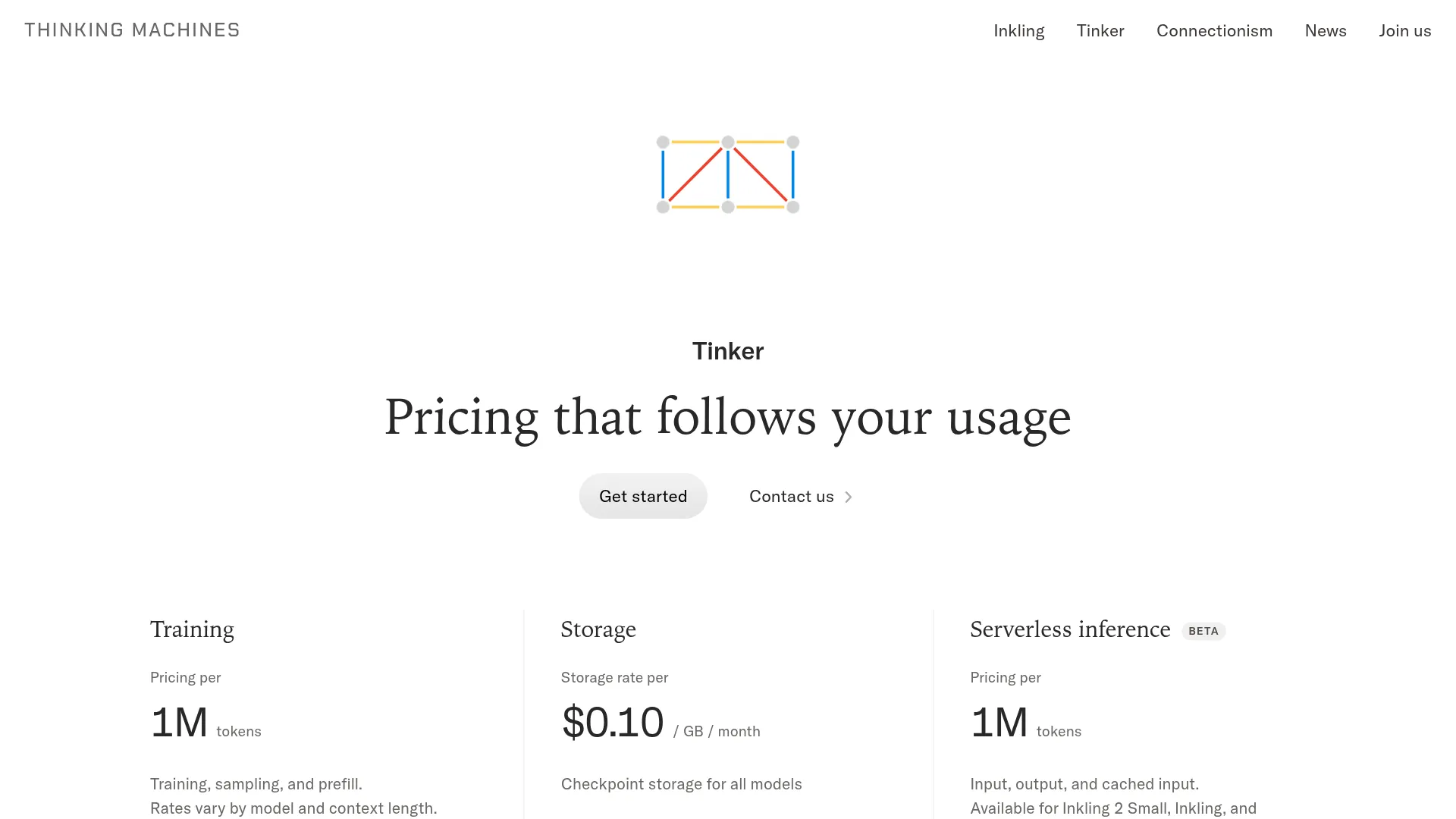
| Model (serverless, 256K) | Input / 1M | Cached / 1M | Output / 1M |
|---|---|---|---|
| Inkling 2 Small | $0.30 | $0.03 | $1.00 |
| Inkling-Small (gen 1) | $0.30 | $0.06 | $1.20 |
| Inkling (flagship) | $1.00 | $0.17 | $4.05 |
At 80% cache hits, 1M input tokens cost about $0.084 (200K x $0.30 plus 800K x $0.03). Long compaction rollouts benefit most: the vendor reports median 43K rollout tokens and p99 at 1.5M for this training regime (Thinking Machines Lab).
Benchmarks: where it leads and where DeepSeek Flash beats it
Scores below come from the vendor's report card, which discloses losses alongside wins (Thinking Machines Lab).
| Benchmark | Inkling 2 Small | Best rival in table |
|---|---|---|
| FrontierCode v2.0 | 25.4% | 28.5% DeepSeek-V4.1-Flash-1017 |
| DeepSWE v1.1 | 72.1% | 77.0% DeepSeek-V4.1-Flash-1017 |
| SWEBench Pro v2 Hard | 86.3% | 88.2% Kimi K3 |
| Vibe Code Bench v1.1 | 81.6% | 87.7% DeepSeek-V4.1-Flash-1017 |
| HLE-Diamond | 28.7% | Leads group (Kimi K3 26.9%) |
| LongBench v2 | 70.6% | Leads group (Kimi K3 69.0%) |
| AA-Omniscience (score / non-hallucination) | 16.1 / 73.3% | Highest non-hallucination in group |
| DesignArena Web snapshot | 1,340 (3rd) | 1,366 Muse Wonder (leader) |
| JobBench / Vals Legal / Vals Finance | 70.5% / 73.9% / 61.5% | Lead displayed groups |
| Terminal Bench Science | 5.7% | 12.9% DeepSeek-V4.1-Flash-1017 |
LongBench v2 (70.6%) supports the long-context claim and HLE-Diamond (28.7%) leads as difficult reasoning evidence. Enterprise scores for CoreCraft (71.8%) and DAYJOB Finance (14.3%) lead their displayed groups alongside JobBench and Vals. Caveats: DiligenceBench 58.1% trails Muse Spark Open's 59.0%, kernel autoresearch shows 6.02x vs Claude Opus 5.5's 18.80x, and the lab admits verbosity, uneven organization, imperfect tool selection, and overrefusal (FORTRESS 20.4 vs GLM-5.3's 3.2).
What changed from Inkling-Small
Total parameters more than double from 276B to 594B (active 12B to 17B), hallucination behavior improves, and audio input is gone. The new model takes text and images only, while generation-one accepted 16 kHz WAV (Thinking Machines Lab).
The factuality picture looks better on the vendor's numbers, though the generations report different metrics. Generation-one posted SimpleQA Verified around 20.6% with a negative Omniscience score (eesel AI). Inkling 2 Small's 73.3% non-hallucination rate leads its group, though the lab still warns about verbosity and overrefusal (Thinking Machines Lab).
First-generation self-host reports are context, not v2 evidence:
"Gave it a try in Unsloth Studio, at Q4K_XL. It's doing very well in multi-lingual conversation." — u/VotZeFuk on the first-gen Inkling-Small release thread (Reddit)
Gen-one's 89 GB 2-bit floor came from community Unsloth builds (eesel AI); at 594B total, v2 requirements remain unknown until weights and recipes ship.
Should your agent call Inkling 2 Small?
The routing decision depends on workload shape, not aggregate benchmark rank.
| Your workload | Call Inkling 2 Small? | Why |
|---|---|---|
| Long-horizon coding agents with visual feedback | Trial via Tinker | Compaction training plus visual iteration loops match this shape |
| Enterprise research, finance, legal drafting with retrieval | Trial first | Leads JobBench, Vals Legal/Finance, DAYJOB Finance in vendor tables; verify on your docs |
| Fine-tuning on summarization-style tasks | Trial (vendor test only) | Reached gen-one final quality in 75 steps in the vendor's 200-step test (Thinking Machines Lab) |
| Pure SWE-bench-style coding at lowest error rate | No, DeepSeek-V4.1-Flash-1017 | 72.1% vs 77.0% DeepSWE, 25.4% vs 28.5% FrontierCode |
| Factual Q&A without retrieval or guardrails | No, not yet | 16.1 overall Omniscience trails the best rival; keep RAG plus confidence routing |
| Multi-provider failover needs | No, wait | Single-vendor Tinker route, no third-party routes announced |
Alignment scores improved over predecessors (internal misbehavior 14.9 vs 66.8 to 75.2, lower better) yet trail GPT-6.1 Sol's 0.8 (Thinking Machines Lab).
Inkling 2 Small FAQ
Is Inkling 2 Small open weights yet?
No, closed-weights on Tinker as of November 5, 2026; Apache 2.0 weights are promised next week pending safety tests.
How is it different from Inkling-Small?
594B/17B vs 276B/12B, no audio input, 73.3% non-hallucination, $1.00 vs $1.20 output per 1M.
What does the API cost per 1M tokens?
$0.30 input, $0.03 cached input, $1.00 output at 256K context on Tinker serverless.
Can I run it locally?
Not yet; no weights, recipes, or VRAM guidance are published.
Related reading: DeepSeek-V4.1-Flash-1017 coding review and Kimi K3.1 Pro API pricing.