 AIREITER
Moonshot's Kimi K3.1 Pro is a strong coding and agent model on paper, with 1M-token context at $2 per million input tokens and $10 per million output tokens. For the launch-week workloads reported below, pay-as-you-go API usage was far cheaper than the $39 subscription.
What Kimi K3.1 Pro actually is
Kimi K3.1 Pro is Moonshot AI's first K3.1-series model, released October 23, 2026 as a post-trained successor to Kimi K3. Moonshot describes it as a 3T-class mixture-of-experts model for long-horizon coding, 3D and CAD tool workflows, financial document analysis, and multi-step agents.
The context window is 1,048,576 tokens, shared across input, reasoning tokens, and output, not 1M in plus another 1M out. Inputs can be text, images, and video through Moonshot products; the API returns text, code, and tool calls, with external software (Blender, game engines, PDF tools) producing the visual artifact. Reasoning is always on, with reasoning_effort levels low, high, and max defaulting to max.
Moonshot promised open weights by November 4, but TheQuery's October 24 check had not verified a downloadable checkpoint or final license, and ArtificialWatch likewise listed the license as unknown. Plan hosted API use until a checkpoint and license are published.
Pricing, decoded: standard vs Highspeed
Standard Kimi K3.1 Pro costs $2 per million uncached input tokens and $10 per million output tokens on the Kimi API platform. Kimi K3.1 Pro Highspeed costs double for metered tokens, $4 input and $20 output, while keeping the same $0.20 cached-input read rate. The same $2/$10 and $4/$20 split is listed by ArtificialWatch and the AI/ML API pricing table.
| Operation (per 1M tokens) | Kimi K3.1 Pro | Kimi K3.1 Pro Highspeed |
|---|---|---|
| Uncached input | $2.00 | $4.00 |
| Output (including reasoning) | $10.00 | $20.00 |
| Cached input read | $0.20 | $0.20 |
| Cache write, 5-minute lifetime | $2.00 | $4.00 |
| Cache write, 1-hour lifetime | $4.00 | $8.00 |
Three billing details matter more than the sticker price. First, pricing is flat across context lengths, and the default cache lifetime is five minutes. Reuse a prompt prefix inside that window and you pay $0.20 instead of $2.00. Second, reasoning tokens bill at the output rate, so max effort on a long agent trace can dominate the bill. Third, API charges are separate from Kimi memberships and Kimi Code subscriptions, and TheQuery's check of the Batch API guide found K3.1 Pro unlisted, so do not assume a batch discount applies.
At those rates a fixed-token example is cheap: 100,000 uncached input tokens ($0.20) plus 10,000 output tokens ($0.10) totals $0.30 before cache writes, tools, retries, and taxes.
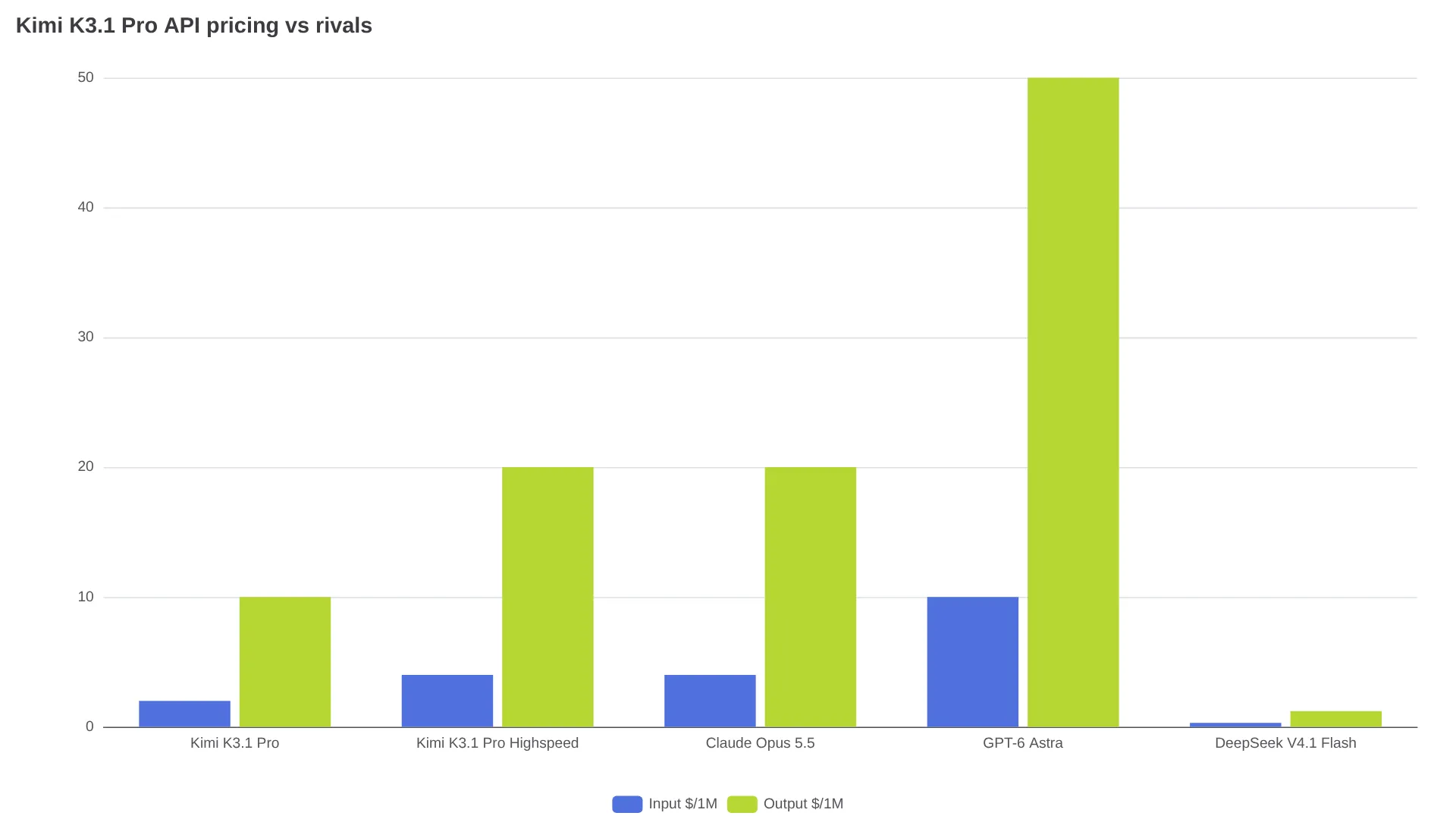
Against rivals, standard K3.1 Pro is 33% cheaper than Kimi K3 pricing ($3/$15), half the price of Claude Opus 5.5 ($4/$20), and one-fifth of GPT-6 Astra ($10/$50) per the comparison in ArtificialWatch. DeepSeek V4.1 Flash undercuts all listed rivals at $0.30/$1.20 per the AI/ML API pricing table, but its benchmark scores in the next section trail by a wide margin. Highspeed matches Opus 5.5 pricing exactly, so it only makes sense when its 2-3x claimed speedup shortens a latency-bound task enough to offset double token cost.
Why the $39 subscription burns out and the API does not
The API price looked fair on launch day; the subscription did not. Multiple paying users reported their 5-hour quota vanishing after one or two prompts, with monthly quotas consumed by a single coding task.
"Kimi K3.1 Pro is the best open model in the world right now. No contest. But it's practically unusable on its own subscription. I was on the $39 plan. I built the ship test... it ate 11.6% of my monthly quota. That means I can build something like this about 8 times a month... Worst subscription out there... The bottleneck isn't quality. It's compute." — @Da7_Tech, user-reported quota consumption
"absolutely disgusting and shameful usage limits on Kimi K3.1 Pro. My 5-hour limit was DONE after exactly 1 min into the prompt, and nothing was built!" — @MiaAI_lab, $39-plan subscriber
One user reported spending $400 on subscriptions for four prompts and estimating the same work at $29 via API, while another reported a single animation task consuming most of a 5-hour quota. For developers the implication is direct: evaluate K3.1 Pro through pay-as-you-go API (Moonshot, OpenRouter, Vercel AI Gateway) where 100k input plus 10k output costs $0.30 before retries and tools, not through a subscription quota that meters the same reasoning far more aggressively.
Benchmarks, with the vendor caveats attached
All headline scores below are Moonshot-reported unless noted, run at maximum reasoning effort with temperature 1.0 and top-p 0.95. Treat small gaps as setup-dependent, because rival scores were collected with different harnesses (Kimi Code for Kimi, Claude Code for others, Codex for GPT-6 Astra on OfficeQA), as documented by AI/ML API.
| Evaluation | Kimi K3.1 Pro | Claude Opus 5.5 | GPT-6 Astra | DeepSeek V4.1 Flash 1017 |
|---|---|---|---|---|
| Terminal-Bench 4.0 | 65.7% | 66.4% | 58.2% | 42.3% |
| SWE-Marathon v1.1 | 51.7% | 46.3% | 42.5% | 40.0% |
| Agents' Last Exam v1.1 | 43.2% | 42.6% | 32.8% | 37.7% |
| OfficeQA Pro v2 | 64.4% | 62.2% | 54.4% | 40.4% |
| BenchCAD with tools | 92.7% | 96.2% | 95.9% | 81.6% |
Kimi leads three of five, and trails by 0.7 points on Terminal-Bench, a gap TheQuery notes is smaller than Anthropic's reported 2.6-point standard error for Opus. BenchCAD's 92.7% is voxel overlap on a 1,000-case open-model subset, and Claude's figures are system-card imports rather than a uniform rerun, per AI/ML API's methodology notes.
On factuality, Moonshot's internal Kimi Hallu Bench reports 5.4% claim-level error for K3.1 Pro on the standard set versus 4.2% for GPT-6 Astra, and 8.3% versus 5.5% on the Hard with-tools set, per the AI/ML API Hallu table. That is a 65% relative reduction from K3's 23.4% hard rate, but Astra still leads both splits, so keep Astra on the shortlist where a single wrong claim ruins the output. All are adversarial stress tests, not everyday error probabilities.
The one independent data point available at launch came from Artificial Analysis, which scored K3.1 Pro 55 on its Intelligence Index and ranked it #4 overall, behind Claude Opus 5.5, Sonnet 5.5, and Muse Wonder Full. That placement supports the "near-frontier at half price" claim without relying solely on vendor runs.
Calling it without overpaying
Kimi K3.1 Pro is OpenAI-compatible, so migration is a base-URL and model-ID change. The official base is https://api.moonshot.ai/v1 with model IDs kimi-k3.1-pro and kimi-k3.1-pro-highspeed, per TheQuery's endpoint check and the AI/ML API setup guide. Third-party gateways use namespaced IDs such as moonshot/kimi-k3.1-pro on Requesty or moonshotai/kimi-k3.1-pro on Vercel.
The quickstart fixes generation settings at temperature 1.0 and top-p 0.95 and advises omitting them rather than tuning, per TheQuery's API behavior notes. Control cost with reasoning_effort instead: start at low for probes, step up to high when a task fails, and reserve max (the default) for the final run. An 8,192-token max_completion_tokens budget can return a much shorter visible answer because hidden reasoning consumes the same budget at $10 per million.
Cost control checklist, per the AI/ML API tool-use and token guidance:
- Preserve the complete assistant message between tool steps, including
reasoning_contentwhen streaming, and return tool results before the next call. - Reuse prompt prefixes inside the 5-minute cache window to drop repeat input to $0.20 per million.
- Measure cost per accepted result, not per token.
- A cheaper per-token model that retries twice is not cheaper.
from openai import OpenAI
client = OpenAI(
    base_url="https://api.moonshot.ai/v1",
    api_key="YOUR_KIMI_KEY",
)
resp = client.chat.completions.create(
    model="kimi-k3.1-pro",
    messages=[{"role": "user", "content": "Refactor this module with tests"}],
    extra_body={"reasoning_effort": "low"},
    max_completion_tokens=8192,
)
print(resp.choices[0].message.content)
A $1 top-up unlocks access subject to tiered rate limits, and enterprise access is off by default pending administrator enablement, per TheQuery's API behavior check. On privacy, Opper's audit of the Moonshot route reports content retained and customer data used for training by default with no zero-data-retention option on that route. Do not send confidential or regulated data through that route without contractual safeguards.
Should you use it: the one trade-off to price in
| If you need | Pick | Why |
|---|---|---|
| Cheapest frontier-class coding runs | Kimi K3.1 Pro API | Leads SWE-Marathon at half Opus price, 1M shared context |
| Lowest latency | Kimi K3.1 Pro Highspeed | 2-3x claimed speedup, but exactly 2x token cost |
| Fewest factual errors | GPT-6 Astra | 4.2% vs 5.4% standard Hallu, at 5x the price |
| Cheapest tokens, weaker scores | DeepSeek V4.1 Flash | $0.30/$1.20 but lowest on four of five listed benchmarks |
| Self-hosting | Wait | Weights promised by Nov 4 with unknown license |
If Moonshot publishes full weights under a permissive license by November 4, self-hosting could reset the quota-versus-API math. Developers comparing long-context coders should also check the best LLM for coding agents in 2026 before committing.
Kimi K3.1 Pro API FAQ
How much does the Kimi K3.1 Pro API cost?
Standard Kimi K3.1 Pro costs $2 per million uncached input tokens and $10 per million output tokens, with cached-input reads at $0.20 per million. Highspeed doubles input, output, and cache-write rates while keeping the same $0.20 cached-read price.
What is the difference between K3.1 Pro and Highspeed?
Highspeed advertises the same intelligence at 2-3x serving speed for double the input/output price ($4/$20 vs $2/$10). Vercel's live provider table lists lower latency and higher throughput for Highspeed, but Moonshot's speedup claim lacks an independent task-completion comparison.
What are the API model IDs?
Use kimi-k3.1-pro and kimi-k3.1-pro-highspeed on the official Kimi API, or namespaced equivalents such as moonshot/kimi-k3.1-pro on third-party gateways. Existing K3 integrations must switch IDs explicitly.
Is API usage included with a Kimi membership?
No. API charges are separate from Kimi memberships and Kimi Code subscriptions, and launch-week users found subscription quotas far more restrictive than pay-as-you-go tokens for the same work.
Can reasoning be turned off?
No. Kimi K3.1 Pro always reasons; low, high, and max only reduce deliberation, with max as default. Short non-reasoning requests should use a different model.
Is the API OpenAI-compatible?
Yes. Point an OpenAI SDK client at https://api.moonshot.ai/v1 (or a gateway base URL), set the model ID, and stream with stream=True. Temperature 1.0 and top-p 0.95 are fixed by the quickstart. Tune reasoning_effort and max_completion_tokens instead.