 AIREITER
MiniMax M3.1 Flash open weights went live on October 23, 2026, and the practical headline is narrower than the launch buzz: a downloadable 428B checkpoint that almost no single-GPU setup should try to run. The repository at MiniMaxAI/MiniMax-M3.1-Flash holds about 252 GB across 48 shards with no approval gate, while the MiniMax Community License still conditions commercial use on attribution, a one-time notice, and prior authorization above $20M annual revenue.
The 252 GB checkpoint, in one verdict
MiniMax M3.1 Flash is a native multimodal mixture-of-experts model with roughly 428 billion total parameters and about 23 billion activated per token. It accepts text, image, and video input, produces text, and supports up to 1,000,000 tokens of context, with MiniMax Sparse Attention throughout and a bundled DSpark speculative-decoding draft head. The weights are downloadable today from Hugging Face and via a ModelScope mirror, but "Flash" describes inference economics, not small size, and "open weights" does not mean open source.
| Fact | Verified value |
|---|---|
| Total / active parameters | ~428B total, ~23B per token |
| Context window | Up to 1,000,000 tokens |
| Inputs / output | Text, image, video in; text out |
| Checkpoint size | ~252 GB, 48 safetensors shards + DSpark draft head |
| Quantization | MXFP8 config; NVFP4 on the routed MoE path |
| Inference settings | Temperature 1.0, top-p 0.95, reasoning_effort low / medium / high / xhigh / max |
| Serving recipes | SGLang, vLLM, TokenSpeed; FlagOS for multi-chip |
| API price | $0.15 input / $0.60 output / $0.015 cached per 1M tokens |
| Measured task cost | ~$0.22 per agentic task (Artificial Analysis via TPS Report) |
| License | MiniMax Community License; commercial use conditional |
Teams with multi-GPU infrastructure fit, as do agent workloads where the $0.15/$0.60 API already beats the current bill. Laptop or single consumer-GPU setups do not fit, nor does any commercial product that cannot carry the required attribution line. My read: use the API first, self-host only when volume or data control justifies the hardware.
Download and verify the official weights
The official checkpoint lives at MiniMaxAI/MiniMax-M3.1-Flash on Hugging Face, with MiniMax's October 23 announcement post pointing to Hugging Face and ModelScope downloads. alfw.ai's weight-release analysis reports the payload at roughly 252 GB with no download gate: 48 weight shards plus a separate DSpark draft head alongside tokenizer and config files.
hf download MiniMaxAI/MiniMax-M3.1-Flash --local-dir MiniMax-M3.1-Flash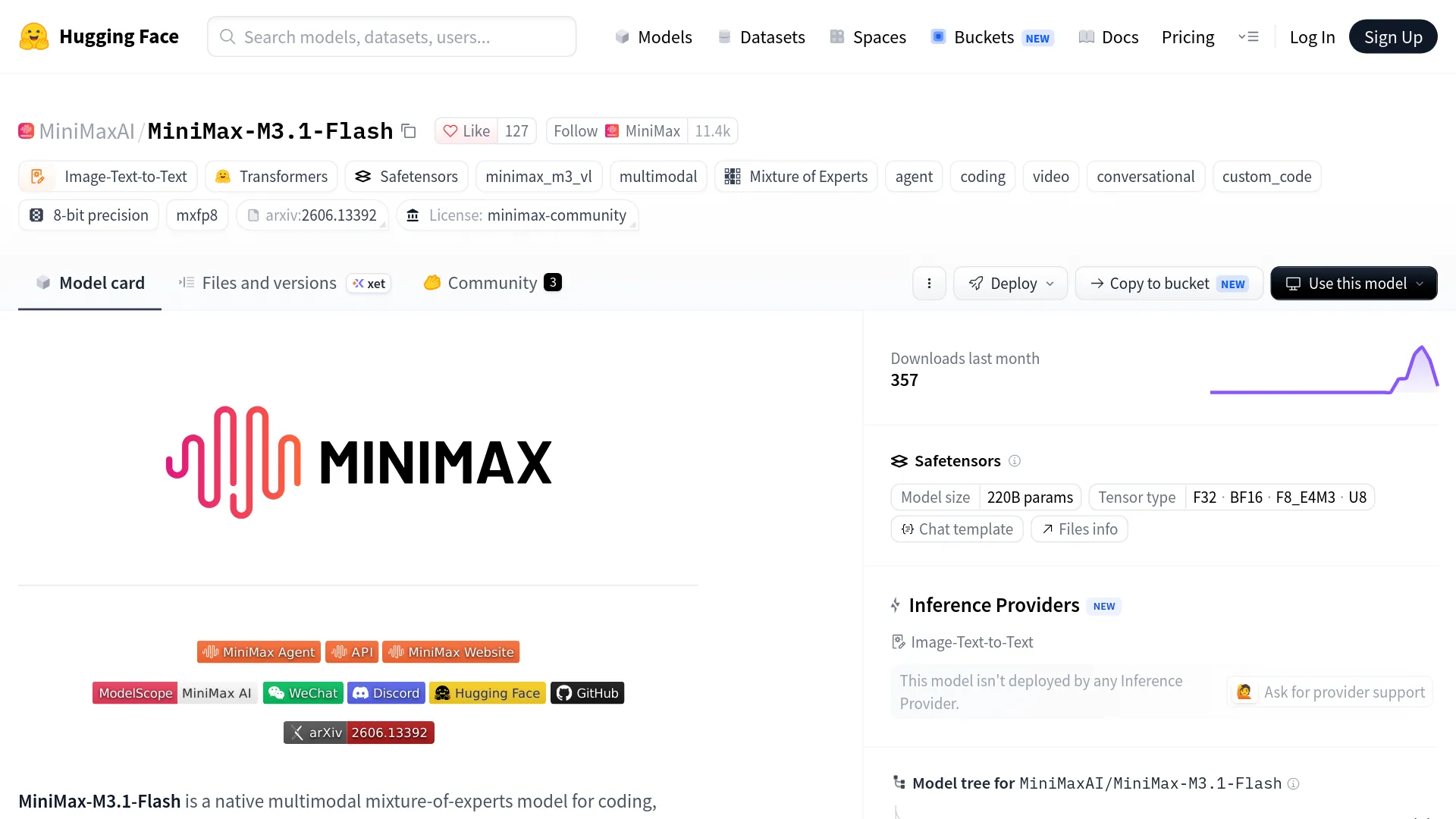
Before budgeting hardware, verify three things on the repo page itself. First, confirm the file list shows all 48 shards plus the draft head rather than a partial mirror. Second, check the license field reads minimax-community, not MIT or Apache, and ignore stale pre-release labels on aggregator pages. Third, remember the card's own warning: published scores apply to the official weights, and third-party quantizations may behave differently, so treat any EXL3 or repack floating around this week as unverified until it names its base commit.
Can you self-host it? Do the hardware math first
A 428B model does not shrink because only 23B activates per token, and this is where most "can I run it locally" threads go wrong. Active parameters set inference cost per token; total parameters set what you must store and hold in memory. At BF16, 428 billion parameters times 2 bytes implies about 856 GB of weights alone, while a generic 4-bit representation implies roughly 214 GB. The actual 252 GB repository reflects its trained quantized layout plus tokenizer, config, and draft-head files, before runtime buffers and KV cache.
"MiniMax-M3.1-Flash open weights are now LIVE 🔥🔥 428B params, 23B active." — @MiaAI_lab, noting the ~252 GB download alongside a TensorFold recipe and EXL3 quantization work
The hardware threshold is high even for teams. @perry_weijie notes personal machines basically cannot run it and self-builds fit teams with spare cards, while one day-0 measured bring-up I found, TP4 on 4x DGX Spark from @majewskizby, reported about 39.7 tok/s prose decode and 62.2 tok/s structured decode at 262K context with NVFP4/MXFP8 paths and Triton sparse attention. That is a day-0 data point, not a vendor slide, and it still assumes four high-end nodes working together.
Your realistic routes, in order of effort:
- SGLang with the linked cookbook, including the Docker pattern (
--shm-size 32g, port 30000, HF cache mount) from the model card. - vLLM with the linked recipe (
vllm serveon port 8000 in the card's example). - TokenSpeed with its linked recipe for the efficiency-focused path.
- FlagOS for multi-chip deployment.
Two setup pitfalls already bite. Reasoning effort defaults to maximum, which inflates bills and latency if you never touch the low through max control. The independent setup notes at minimax-m31flash.org add the classic agent-integration failures: wrong model suffix for long context, environment variables overriding config files, outdated Codex minimum versions, and retired preview model names. Transformers, KTransformers, unsloth, and ATOM integrations were listed as in progress on the card, so check status before planning around them. alfw.ai lists the announced compatibility coverage as 10 chip makers and six clouds, but treat those as compatibility announcements until the provider catalog you actually pay shows the model.
API vs self-host: the task-cost decision
Token prices alone mislead because agent work is dominated by reasoning tokens and cache behavior. MiniMax's flat API is $0.15 per million input tokens, $0.60 per million output, and $0.015 cached input, with no long-context step, unlike MiniMax M3 which doubles past 512K input tokens per minimax-m31flash.org. Artificial Analysis measured about $0.22 per task for M3.1 Flash against $0.26 for DeepSeek V4.1 Flash 1017 in the same suite, with 189M versus 224M output tokens respectively, roughly a 15% task-cost edge from more efficient reasoning rather than raw price cuts.
| Route | Best for | Watch out |
|---|---|---|
MiniMax API (api.minimax.io, Anthropic/OpenAI-compatible per minimax-m31flash.org) | Coding agents, variable load, 1M-context work without hardware | Default max reasoning effort; caching and service-tier config decide the real bill |
| M Plan subscription (Go / Explore / Build tiers per minimax-m31flash.org) | Predictable coding-assistant use inside MiniMax Code | Window-based limits, no plain monthly token bucket; check dollar prices before budgeting |
| Self-host (SGLang / vLLM / TokenSpeed, FlagOS multi-chip) | High sustained volume, data-control needs, fine-tuning base | 252 GB download, multi-GPU memory plus KV cache at long context, no verified minimum spec |
Do the arithmetic for your workload before downloading anything: multiply your monthly input/output split by $0.15/$0.60 with your real cache-hit rate, then compare against reserved GPU cost plus engineering time. In most cases below sustained high volume, the API tends to win on this math; self-hosting can win when the monthly API line crosses amortized cluster cost or when weights must stay inside your boundary.
Benchmarks, separated by who measured them
| Benchmark | M3.1 Flash | Best rival in cited table | Source |
|---|---|---|---|
| Automation-Bench v1.0.6 | 62.8 | 60.5 DeepSeek V4.1 Flash-1017 | MiniMax card (vendor) |
| BankerToolBench | 76.2 | 76.2 Opus 5 (tie) | MiniMax card (vendor) |
| LOCA-Bench 256K | 60.3 | 60.0 GPT-5.6 Sol | MiniMax card (vendor) |
| OSWorld 2.0 | 61.7 | 70.6 Opus 5 | MiniMax card (vendor) |
| CyberGym | 82.2 | 84.5 GLM-5.3 | MiniMax card (vendor) |
| DeepSWE v1.1 | 73.7 | 77.0 DeepSeek V4.1 Flash-1017 | MiniMax card (vendor) |
| Vals Index | 53.78% (16th of 26) | MiMo V2.6 Flash 54.83% (at launch) | Vals AI (independent) |
| Intelligence Index | 42 | 45 DeepSeek V4.1 Flash 1017 | Artificial Analysis via TPS Report (independent) |
| LMArena WebDev | 1587.48 | ranked field | VectorWire (sole independently verified of 10) |
The MiniMax card documents harnesses per benchmark (BankerToolBench on OpenCode 1.17.18 with MiniMax-M2.7 as judge; CyberGym on Claude Code 2.1.263 at 1M context), which beats most launch posts for transparency, but the scores remain vendor-reported. Independent reads are more qualified: Vals AI shows a 26.37-point Vibe Code Bench jump over M3 yet flags long-horizon weakness (Terminal-Bench 25.25%, HLAB-Vals 7.50% in its harness), Artificial Analysis pairs a strong 56% omniscience accuracy with a 93% hallucination rate in that benchmark, and VectorWire rates the evidence too thin to rank any capability. Treat that hallucination rate as a warning to add verification for retrieval, compliance, and customer-facing answers.
The license rules that decide commercial use
The weights are downloadable, but the MiniMax Community License is not an unrestricted open-source license. The grant is framed around non-commercial use, with commercial use allowed only under conditions: products or services must prominently display "Built with MiniMax M3.1-Flash", the user must send MiniMax a one-time notice, and anything generating over $20M in annual revenue needs MiniMax's prior written authorization. Commercial use is defined broadly enough to cover paid hosted access, model APIs, fine-tunes, and modified derivatives. Military uses and intentionally generating harmful false or misleading information are prohibited. alfw.ai's license analysis found no territory restriction in this model's license, though that reading comes from third-party analysis rather than a MiniMax FAQ, so confirm with counsel before shipping. Classification: open weights, not open source.
FAQ
Are the MiniMax M3.1 Flash weights actually downloadable?
Yes. MiniMaxAI/MiniMax-M3.1-Flash appeared on Hugging Face on October 23, 2026 with about 252 GB of files and no approval gate, plus a ModelScope mirror.
What is the official Hugging Face repository?
MiniMaxAI/MiniMax-M3.1-Flash: 48 safetensors shards, DSpark draft head, tokenizer and config, tagged minimax-community license. Use hf download MiniMaxAI/MiniMax-M3.1-Flash --local-dir MiniMax-M3.1-Flash.
Can I use M3.1 Flash commercially?
Conditionally. Display "Built with MiniMax M3.1-Flash", send the one-time notice, and get prior written authorization above $20M annual revenue. Fine-tunes and hosted APIs count as commercial.
Can it run on a consumer GPU or Apple Silicon?
No validated single-consumer-GPU or Apple Silicon deployment is cited here: the full checkpoint is ~252 GB and BF16 math implies ~856 GB of weights alone, which rules out ordinary GPU-memory configurations. Expect multi-GPU servers or a cloud provider; the measured day-zero run cited here used 4x DGX Spark.
Does it work with vLLM, SGLang, or TokenSpeed?
Yes via the official recipes linked from the model card, with SGLang and vLLM as the recommended routes and TokenSpeed as the third recipe. FlagOS covers multi-chip deployment. Transformers-family integrations were still in progress at release.
How does it compare with DeepSeek V4.1 Flash?
Cheaper per task (~$0.22 vs ~$0.26 in the AA suite) with stronger HLE and omniscience accuracy in that snapshot, but behind on aggregate Intelligence Index (42 vs 45) and on DeepSWE (73.7 vs 77.0 for the 1017 build). For cost-efficient agent coding it is worth a task-batch test; where aggregate index and DeepSWE decide, validate DeepSeek on your own tasks. Next step: run one paid API task batch with default-max reasoning effort changed to your setting, then decide whether the download is worth it.