 AIREITER
A 30-second 1080p Kling 4.0 clip costs $7.05 on fal at list price. fal defaults to 1080p, so omitting resolution makes a 30-second request cost $7.05 rather than $4.71 at 720p.
Kling 4.0 launched on October 15, 2026, with the API rolling out from October 21, 2026 (AITamer, SandBase). On fal it is available now through four endpoints (text-to-video, image-to-video, reference-to-video, video-edit/extend), generating 3 to 30 seconds per call at 720p or 1080p with two-channel stereo audio included by default on the reviewed endpoint. There is no 4K on this endpoint, no audio-off switch in the schema reviewed, and generation is asynchronous, so plan for minutes rather than seconds.
What fal actually charges for Kling 4.0
fal's endpoint pages list $0.157 per generated second at 720p and $0.235 per generated second at 1080p for standard generation (text-to-video, image-to-video, and image-only reference jobs). Image-only references do not change the price, and OttoPort states reference audio is unbilled. SeedRouter, SandBase, and OttoPort state failed tasks are not billed. OttoPort lists no subscription or usage commitment, but a $25 minimum top-up.
| Job | 720p | 1080p |
|---|---|---|
| Standard generation (text, image, image-refs) | $0.157/s | $0.235/s |
| With video reference / video edit | $0.094/s on input + output | $0.141/s on input + output |
| 5-second clip, standard | $0.785 | $1.175 |
| 10-second clip, standard | $1.57 | $2.35 |
| 30-second clip, standard | $4.71 | $7.05 |
The 1080p rate is about 1.5x the 720p rate, so 720p is the economical draft tier and 1080p is for delivery when quality justifies the 50% premium. A 5-second 720p test costs $0.785, and six of those cost less than one 30-second 1080p render.
Reseller prices cluster around the same anchor but are not identical. SeedRouter lists $0.1425/s at 720p and $0.2125/s at 1080p (slightly under list), while OttoPort lists a blended $0.196/s. Compare the per-second rate at your target resolution, not the marketing headline.
The input-video rates that bill double the seconds
The $0.094/s (720p) and $0.141/s (1080p) "with input video" rates look like a discount. They are not. Cost follows rate x max(input seconds + output seconds, [2 x output seconds](https://fal.ai/models/kling/v4/reference-to-video)).
| Resolution | Listed input-video rate | Minimum per output second | Minimum 10s cost | Minimum 30s cost |
|---|---|---|---|---|
| 720p | $0.094/s | $0.188/s | $1.88 | $5.64 |
| 1080p | $0.141/s | $0.282/s | $2.82 | $8.46 |
Minimums apply when input duration does not exceed output duration. If the reference video is longer than the output, the bill is input seconds plus output seconds. SandBase's measured edit of a 5.04-second source at 720p billed 10.08 seconds, about $0.95, and output length matched source length in edit mode (SandBase).
Use input-video modes only when the input genuinely carries information (a performance to match, a product to restyle). Input-video costs about 20% more per finished second than standard generation.
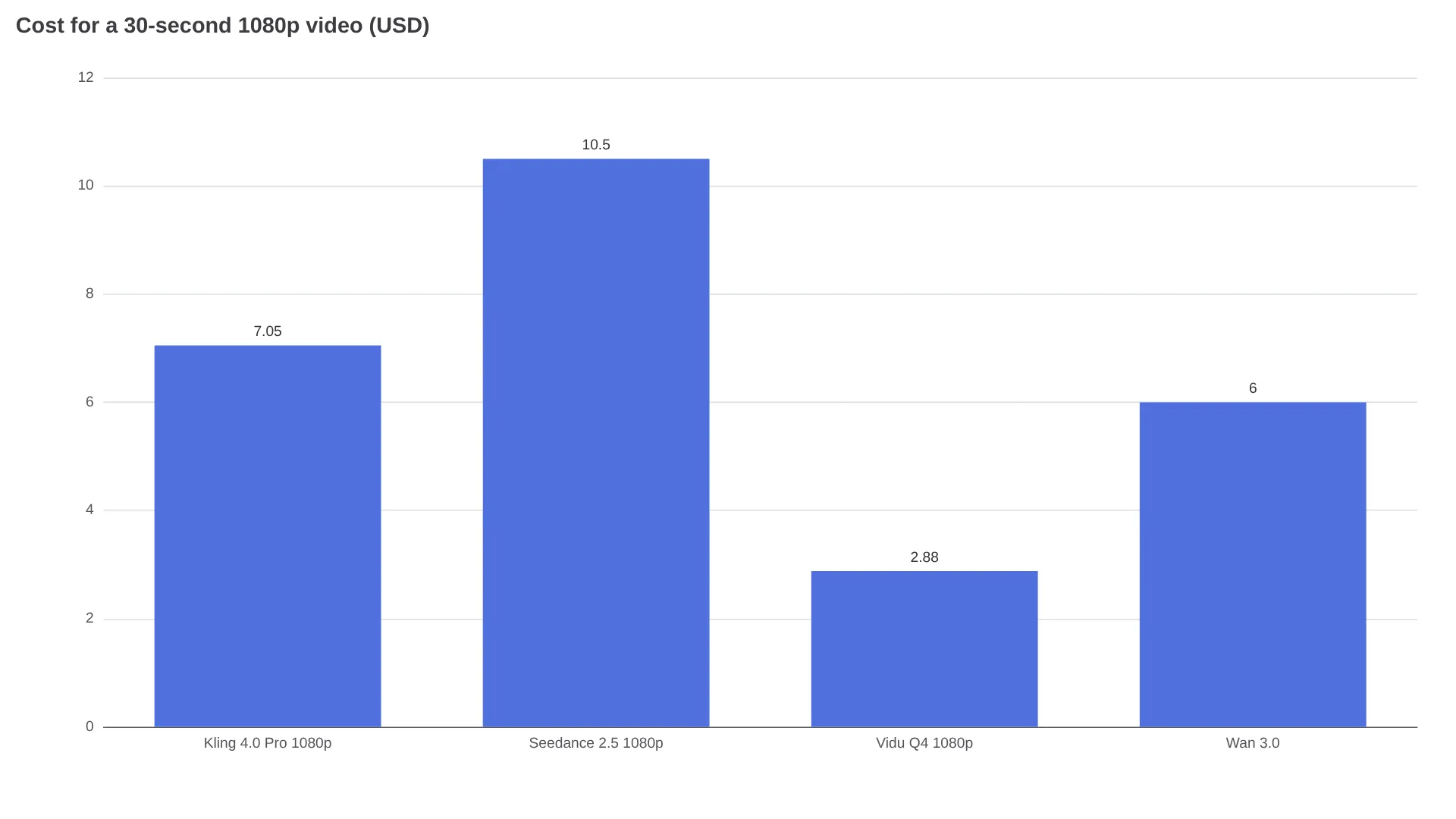
Kling 4.0 vs Seedance 2.5 vs Vidu Q4 on the same 30-second job
The table normalizes list prices to a 30-second 1080p output; duration and input limits still differ. Kling per fal list; Seedance 2.5 at $0.35/s per OttoPort's catalog; Vidu Q4 at $0.096/s per UnificAlly; Wan 3.0 at $0.20/s per OttoPort's catalog (all checked Oct 23):
| Model | 1080p list rate | 30s cost | What the money buys | When the rival wins |
|---|---|---|---|---|
| Kling 4.0 via fal | $0.235/s | $7.05 | 3–30s single take, 15-asset Omni Reference cap (up to 10 images, 5 videos, 7 elements within it, per fal schema), 10 keyframes, multi-shot prompts, native stereo with lip-sync | Default pick for dialogue and long continuous takes |
| Seedance 2.5 (ByteDance) | ~$0.35/s | ~$10.50 | 4–30s, up to 50 mixed references (per UnificAlly) | Wins when you need far more reference assets than Kling's 15-item ceiling |
| Vidu Q4 | ~$0.096/s | ~$2.88 | Up to 16s, 15 image refs, no text-to-video on the compared tier (per UnificAlly) | Wins on pure price for short image-anchored shots under 16 seconds |
| Wan 3.0 | ~$0.20/s | ~$6.00 | Up to 30s from any input (per UnificAlly) | Closest-priced 30s alternative if you do not need Kling's keyframe timeline |
Kling 4.0's 720p no-input rate ($0.157/s) runs about 87% above the comparable Kling 3.0 rate ($0.084/s in Kling's table, via AITamer). Replying to the official rollout post, one builder wrote:
"so expensive and so late" — @blankbraindead
Shipping it on fal: defaults, queue, and audio you cannot switch off
Four things bite first-time integrators (fal schema, SeedRouter tests, SandBase tests).
1. The schema defaults to 1080p. Omit resolution and you are billed at $0.235/s, not $0.157/s. Set it explicitly on every request. One flag is a 50% cost swing.
2. Generation takes minutes. Five 3-second 720p test runs took 2 minutes 41 seconds to 4 minutes 22 seconds (SeedRouter), and SandBase's 30-second 720p test took about 498 seconds, roughly 8 minutes (SandBase). fal uses a queue (IN_QUEUE → IN_PROGRESS → COMPLETED) with polling or webhooks. Persist the task ID before you poll: a client-side timeout does not mean the server-side job stopped, and resubmitting blindly pays twice.
3. Audio is always on and cannot be disabled per request. Every measured output carried a real stereo AAC track, not an empty stream (SandBase). No reviewed host exposes an audio toggle for 4.0. If your pipeline adds its own soundtrack, strip the generated track afterward (for example, ffmpeg -an).
4. Limits are strict and fail fast. Cost-relevant caps: 3–30s duration, 720p/1080p, max 10 reference images, 5 reference videos totaling at most 30 seconds, 10 keyframes total. Unknown fields and illegal mode combinations return HTTP 400 before a task is created (SeedRouter), so nothing is charged until a task is accepted.
Two operational notes: output URLs are temporary, so download to your own storage (SeedRouter), and a request whose source duration cannot be read may be quoted at the 30-second maximum, so keep balance headroom for short edits (SandBase).
Kling 4.0 API pricing FAQ
How much does the Kling 4.0 API cost per second?
$0.157/s at 720p and $0.235/s at 1080p for standard generation on fal. Video-reference and edit jobs use $0.094/s (720p) or $0.141/s (1080p) applied to input plus output seconds.
How much does a 5, 10, or 30-second video cost?
At 720p standard: $0.785, $1.57, and $4.71. At 1080p standard: $1.175, $2.35, and $7.05. Video-reference jobs cost more per finished second: a 30-second 1080p edit starts at $8.46.
Is native audio included in the price?
The reviewed fal endpoint includes stereo audio by default at no separate charge and exposes no per-request switch to turn it off.
Are failed generations charged?
No. SeedRouter, SandBase, and OttoPort state failed tasks are not billed, and schema-validation rejections (HTTP 400) never create a task.
Is there a free tier or trial credit?
UnificAlly reports a $0.50 signup credit on its host, roughly enough for 3 seconds at 720p. Minimum top-ups apply on some hosts ($25 on OttoPort).
Can I extend a video past 30 seconds?
Yes via extend mode: duration means the added seconds, and the returned file contains the original plus the continuation (SeedRouter). Longer two-minute stitched totals are announced but not confirmed live on the API (AITamer).
Which model or Kling mode to use
| Your job | Pay for | Why |
|---|---|---|
| Dialogue or lip-sync shot up to 30s | Kling 4.0 1080p standard or image-ref | Native stereo makes Kling suitable for dialogue and lip-sync; 720p drafts first |
| Product or cast carried across scenes | Kling 4.0 reference-to-video (image-only) | Same $0.157/$0.235 rate, 15-asset ceiling with reusable elements |
| Restyle or targeted edit of footage | Kling 4.0 video-edit | Fastest in SandBase testing (69s for a 5s edit, per SandBase), but budget input + output |
| Cheapest short image-anchored clip | Vidu Q4 | ~$0.096/s, but capped at 16s with no text-to-video |
| Maximum reference capacity | Seedance 2.5 | Up to 50 mixed refs at a steep per-second premium |