 AIREITER
MiniMax M3.1 Flash open weights are downloadable today, while Kimi K3.1 Pro weights are not. Moonshot promises them by November 4, 2026, so if you need a self-hosted checkpoint this week, MiniMax is the only one of the two you can pull from Hugging Face.
Only one of these weights exists on Hugging Face today
MiniMax published the M3.1 Flash weights around October 22–23, 2026 on Hugging Face under the minimax-community license, with ModelScope availability reported by launch coverage (Cocoloop). Kimi's official tech blog says Kimi K3.1 Pro is available through Kimi.com, its apps, Kimi Code, and the Kimi API today, with full model weights arriving by November 4, 2026 (kimi.com).
MiniMax M3.1 Flash vs Kimi K3.1 Pro: the two checkpoints side by side
MiniMax M3.1 Flash open weights are a native multimodal MoE with approximately 428 billion total parameters and 23 billion active per token, accepting text, images, and video and producing text, with up to 1M tokens of context (MiniMax's launch post). Kimi K3.1 Pro is officially described as a 3T-class MoE with a 1M-token context window (kimi.com); the 2.8T total / 104B active figures come from launch coverage (ArtificialWatch, ExplainX), not Moonshot's own parameter disclosure.
| Item | MiniMax M3.1 Flash | Kimi K3.1 Pro |
|---|---|---|
| Total / active params | ~428B / 23B per token | 3T-class; launch coverage reports 2.8T / 104B active |
| Hugging Face repo | MiniMaxAI/MiniMax-M3.1-Flash, live | None as of Oct 24, 2026; due by Nov 4 |
| Download size | Roughly 252 GB | Unknown; at MiniMax's density (~0.59 GB per B params) a 2.8T checkpoint would be TB-class |
| Context | Up to 1M tokens (deployment-dependent) | 1M tokens |
| Inputs / output | Text, image, video in; text out | Multimodal, text output; exact self-hosted modalities unconfirmed |
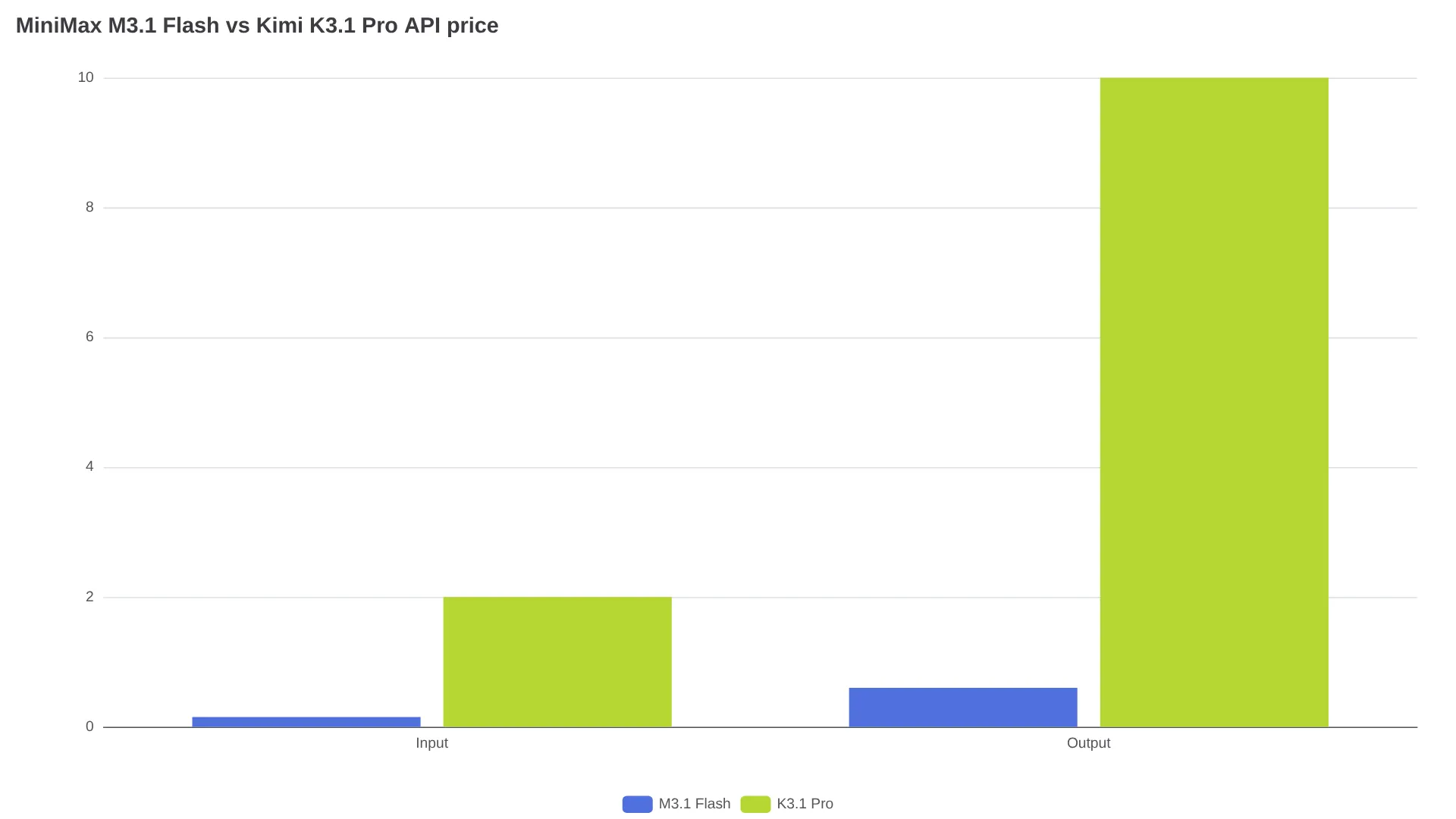
| Official API price | $0.15 input / $0.60 output / $0.015 cached per 1M tokens (MiniMax) | Reported $2 input / $10 output per 1M tokens (ArtificialWatch) |
| Serving recipes | SGLang, vLLM, TokenSpeed; FlagOS for multi-chip | Unannounced; API model IDs kimi-k3.1-pro / kimi-k3.1-pro-highspeed (Kimi docs) |
| Recommended sampling | Temperature 1.0, top-p 0.95; reasoning low–max | Max reasoning effort, temp 1.0, top-p 0.95 per Kimi's benchmark config |
Pull the MiniMax checkpoint with the official command:
hf download MiniMaxAI/MiniMax-M3.1-Flash --local-dir MiniMax-M3.1-FlashVerify you have the full file set plus the DSpark draft head, tokenizer, and config files before benchmarking. MiniMax warns results apply to official weights and third-party quantizations may differ.
On benchmarks, treat each number below as vendor-reported unless marked independent:
| Benchmark | M3.1 Flash (vendor) | Rival cited by vendor |
|---|---|---|
| Automation-Bench v1.0.6 | 62.8 | DeepSeek V4.1 Flash-1017: 60.5 |
| BankerToolBench | 76.2 | Opus 5: 76.2 (tie) |
| LOCA-Bench 256K | 60.3 | GPT-5.6 Sol: 60.0 |
| DeepSWE v1.1 | 73.7 | DeepSeek V4.1 Flash-1017: 77.0 |
| OSWorld 2.0 | 61.7 | Opus 5: 70.6 |
| Terminal-Bench 4.0 | 38.1 | Opus 5: 51.8 |
One cited independent snapshot tracks M3.1 Flash mid-pack at 53.78% (16th of 26) with weak long-horizon scores (Vals). Kimi's own chart claims K3.1 Pro leads on 6 of 14 shown tests including Agents' Last Exam (43.2) and SWE Marathon (51.7), with Terminal-Bench 4.0 at 65.7.
What the 252 GB download costs to host
The repository is roughly 252 GB. At 4 bits per weight, 428B parameters alone are about 214 GB before KV cache and runtime buffers, so plan on several 80 GB-class GPUs before usable context. NVIDIA's RTX Spark account points at a DGX Station or a 4x DGX Spark 128 GB cluster for local runs (X post), and self-hosters on X note a 252 GB pull plus that hardware bar rules out ordinary desktops while the API stays cheap (@bufcapy).
Do the API-side arithmetic first, because the MiniMax API is unusually cheap. At $0.15 input / $0.60 output per 1M tokens, a day of 10M input + 2M output tokens costs 10 × $0.15 + 2 × $0.60 = $2.70, or roughly $81/month.
The breakeven formula is monthly cluster cost divided by API cost per token. At $0.15 per 1M input tokens, every $150/month of rental equals 1B input tokens; at $0.60 per 1M output tokens, every $600/month equals 1B output tokens. Plug in your own rental quote plus engineering time: self-hosting wins only when your monthly API bill at those rates exceeds that total, or when policy requires weights inside your boundary. For Kimi, the contrast is starker: reported API pricing of $2/$10 per 1M tokens makes its hosted route roughly 13x MiniMax on input and about 17x on output, so a future 2.8T-parameter checkpoint would need very high sustained throughput to justify TB-class storage and a multi-node cluster.
What self-hosting gives you on day one
Day-zero framework support is real but partial. The model card names SGLang, vLLM, and TokenSpeed plus FlagOS for multi-chip deployment, with Docker images for SGLang, while Transformers, KTransformers, unsloth, and ATOM integrations were still in progress at release. One deployer noted the vLLM H100/H200 example config targets 256K tokens rather than the full 1M, with video input off and DSpark speculative decoding not enabled (@sancaksofttech). Same download, but not all setups unlock all features.
A recurring r/LocalLLaMA worry is that "Flash" describes inference economics, not small size:
With quantization can it fit on 256GB? Praying — u/BawbbySmith on r/LocalLLaMA
The license clause that decides before hardware does
M3.1 Flash is open weights, not open source. The repository LICENSE (labeled minimax-community, see the LICENSE file) permits noncommercial use freely; commercial use must display "Built with MiniMax M3.1-Flash" prominently and send MiniMax a one-time notice, and organizations or products above $20M in annual revenue need prior written authorization, with military uses prohibited.
That burden is light for internal tools and potentially blocking for commercial hosting, where the badge and revenue gate are hardest to satisfy. Kimi's license is still unknown until the November 4 weights drop, and Moonshot has already disclosed in its tech blog that the open checkpoint will differ from the API model because cyber-related training data was removed from the open weights (kimi.com). Read both LICENSE files before building.
Which one fits your setup
| Your situation | Pick |
|---|---|
| Need weights this week for local eval, fine-tuning base, or air-gapped deployment | MiniMax M3.1 Flash — the only downloadable option of the two |
| Cost-sensitive coding agents with variable load | MiniMax API at $0.15/$0.60 — self-host only past sustained high volume |
| Frontier long-horizon coding and you can wait | Evaluate Kimi K3.1 Pro API now; decide on self-hosting after the Nov 4 weights, license, and real size land |
| Commercial hosted product | Clear MiniMax's attribution + $20M authorization gate with legal first; Kimi is undecidable until its license publishes |
| Consumer GPU or single Mac | No validated single-device recipe cited — use the API unless prepared to test an unsupported setup |
FAQ
Where is the official MiniMax M3.1 Flash weights download?
The official repository is MiniMaxAI/MiniMax-M3.1-Flash on Hugging Face, with a ModelScope mirror; pull it via hf download MiniMaxAI/MiniMax-M3.1-Flash --local-dir MiniMax-M3.1-Flash.
Is there an official Kimi K3.1 Pro Hugging Face repository?
No. As of October 24, 2026 there is no public K3.1 Pro weights repository; Moonshot's tech blog commits to full weights by November 4, 2026.
Can I use MiniMax M3.1 Flash commercially?
Yes, with conditions: display "Built with MiniMax M3.1-Flash," send a one-time notice, and get prior written authorization above $20M annual revenue; military uses are prohibited. Confirm against the repository LICENSE with counsel.
Can it run on a consumer GPU or Apple Silicon?
The cited deployment guidance does not include a validated single-consumer-GPU setup; estimates demand several 80 GB GPUs for quantized weights plus KV cache. NVIDIA points to a DGX Station or 4x DGX Spark 128 GB cluster.
Does it work with vLLM or SGLang today?
Both have day-zero recipes, plus TokenSpeed and FlagOS for multi-chip runs. But example configs may cap context at 256K, disable video input, or leave DSpark off — check the model card's current recipe for your hardware.
Is the full 1M context available when self-hosted?
Advertised maximum is 1M tokens, but usable length depends on GPU memory and serving configuration. Budget KV-cache headroom explicitly for long-context workloads.
Related reading: MiniMax M3.1 Flash Open Weights: Download, Run, Cost Guide, Kimi K3.1 Pro API Pricing Guide, Kimi K3 Open Weights