 AIREITER
Kimi K3 is Moonshot AI's flagship model, available in the Kimi app, CLI, and desktop. It comes in two variants: K3 Max ("Chat & Agent, flagship all-rounder") and K3 Swarm Max ("Massive search, batch processing, and more in one go"), with Agent Swarm as the marquee feature. It is a 2.8-trillion-parameter Mixture-of-Experts model with native vision and a 1-million-token context (gated to higher membership tiers in the app, flat on the API). Moonshot has now published a tech blog with official benchmarks and API pricing ($3/$15 per million tokens), so the spec sheet is real, not a leak. The one thing still pending is the open-weights drop, due by July 27, 2026.
Is Kimi K3 out yet?
Yes. Kimi K3 is Moonshot's current flagship, live in the Kimi app, CLI, and desktop, with kimi.com now leading on "Kimi AI with K3." Moonshot has published a tech blog with official benchmarks and API pricing, so the core numbers are vendor-confirmed. The main thing still pending is the open-weights release, due by July 27, 2026.
Kimi K3 Max and K3 Swarm Max: the two variants
K3 is a family, not a single model. The in-app picker (first-hand screenshot below) lists three options:
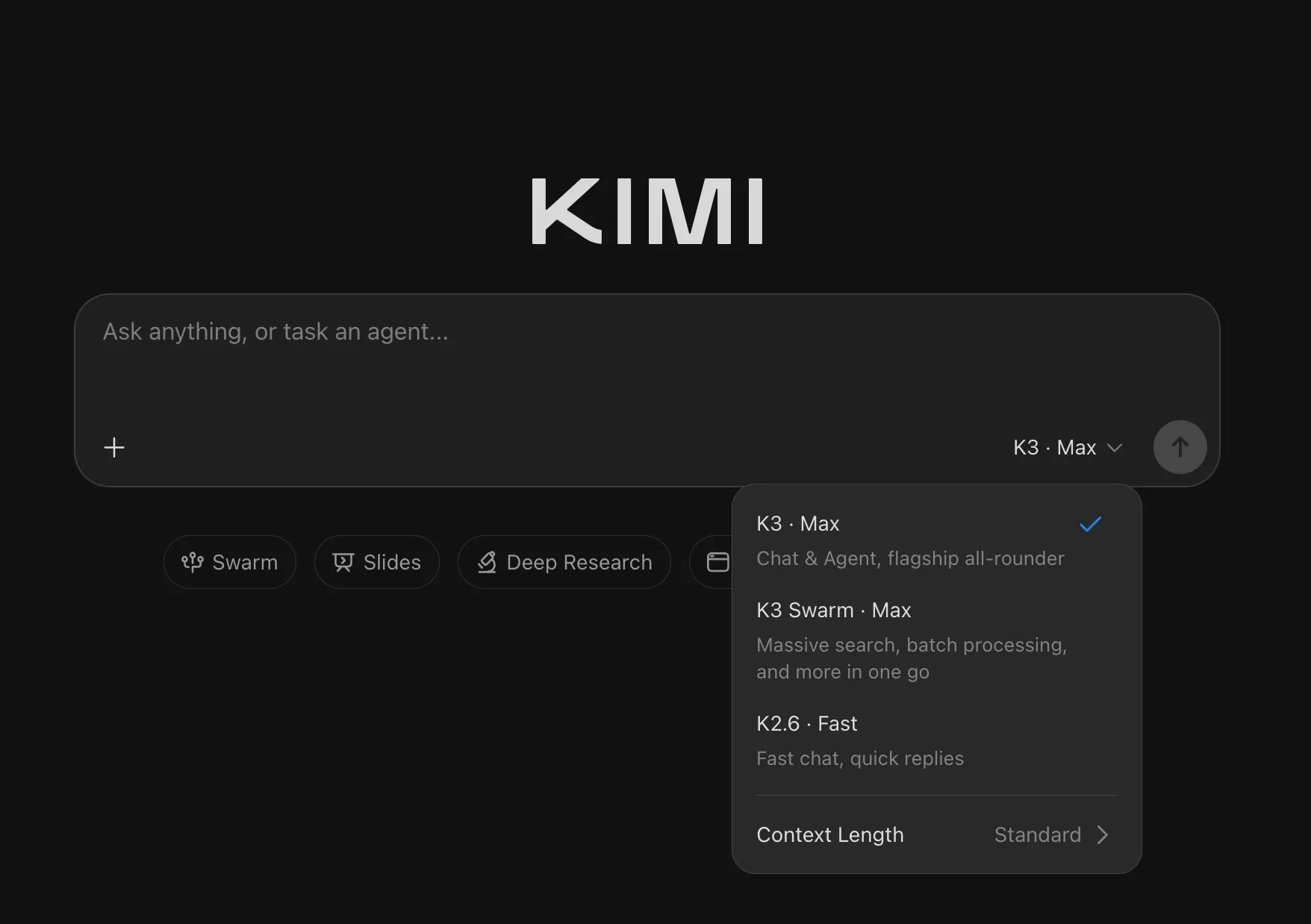
K3 Max, "Chat & Agent, flagship all-rounder," is the default and the pick for most coding, reasoning, and assistant work.
K3 Swarm Max, "Massive search, batch processing, and more in one go," is the heavy variant for complex multi-agent workflows, built to fan one task across many sub-agents at once.
K2.6 Fast stays in the menu as "fast chat, quick replies," so the prior flagship is now the low-latency option.
The dividing line is scale of orchestration: K3 Max runs the everyday agentic loop, K3 Swarm Max runs many agents in parallel over a large workload.
Kimi K3 Agent Swarm
Agent Swarm is K3's identity, not a side feature, which is why the flagship ships a dedicated "Swarm Max" variant. It coordinates massive parallel search and batch processing so a single session completes far more work, extending the swarm system Moonshot shipped with Kimi Work, which already ran on the order of hundreds of coordinated sub-agents.
Context is now a membership tier
The most interesting thing about K3 is not the 1-million-token context itself, but that Moonshot turned context length into a paid membership benefit. The same model gives you a different working memory depending on your plan:
Moderato: 256K tokens
Allegretto and up: 1M tokens
The in-app picker reflects this with a separate "Context Length" control. So the tier you pay for does not change whether you can use K3, it changes how much of a project it can hold in working memory at once.
It is a useful way to think about where AI pricing is heading: the model is the CPU, the context window is the RAM, and your membership tier is the RAM configuration. That also explains why K3 leans so hard on coding, game, and 3D work. A 1M context is not there to chat with you longer; it is there to swallow a codebase, its docs, logs, scene configuration, and task history in one shot and keep working a genuinely large project without losing the thread.
The practical takeaway for buyers: pick the tier by how much your work needs to stay resident. Long single-session coding, large-repo refactors, or multi-file agent runs are what justify the 1M tier; ordinary chat and short tasks sit comfortably inside 256K.
The K3 specs and how much to trust each
With the official tech blog out, most of what circulated as a leak is now confirmed. Here is where each spec stands.
Spec | Source | Status |
|---|---|---|
Two variants (K3 Max, K3 Swarm Max), live in app/CLI/desktop | kimi.com + in-app picker | Confirmed |
2.8T total parameters, 16 of 896 experts active (Stable LatentMoE) | Official tech blog | Confirmed |
Kimi Delta Attention + Attention Residuals | Official tech blog | Confirmed |
Native vision (image + video) | Official docs | Confirmed |
1M context (256K–1M by membership tier in-app; flat 1M on API) | Official docs | Confirmed |
API price $3 / $15 per 1M ($0.30 cached) | Official pricing | Confirmed |
Agent Swarm: massive parallel search + batch | Live product + prior Kimi Work | Confirmed |
Open weights, Modified MIT, full release by July 27, 2026 | Official tech blog | Announced, not yet on Hugging Face |
The honest read: architecture, context, pricing, and benchmarks are all vendor-confirmed now. The one thing left to verify yourself is the weights drop, promised by July 27; until it lands, self-hosting is not yet possible.
Kimi K3 benchmarks
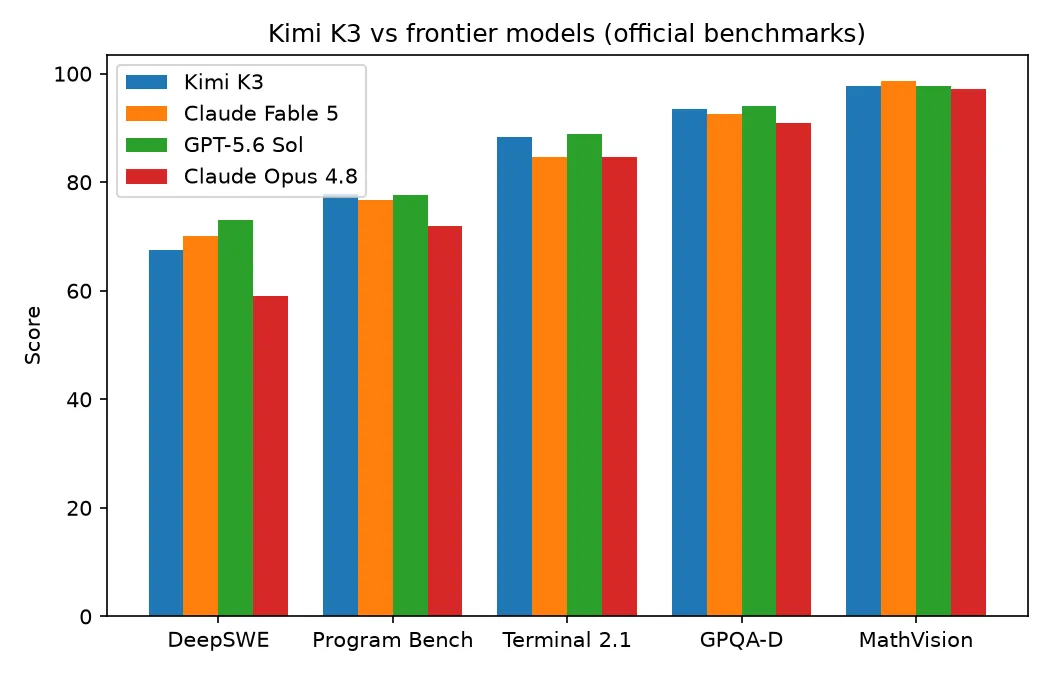
Moonshot published a benchmark table at launch. At max reasoning effort, K3 posts frontier-level scores, edging Claude Opus 4.8 on every published cell while trailing the very top proprietary models, Claude Fable 5 and GPT-5.6 Sol. These are vendor-reported figures.
Benchmark | Kimi K3 | Claude Fable 5 | GPT-5.6 Sol | Claude Opus 4.8 |
|---|---|---|---|---|
DeepSWE | 67.5 | 70.0 | 73.0 | 59.0 |
Program Bench | 77.8 | 76.8 | 77.6 | 71.9 |
Terminal-Bench 2.1 | 88.3 | 84.6 | 88.8 | 84.6 |
GPQA-Diamond | 93.5 | 92.6 | 94.1 | 91.0 |
MathVision (with Python) | 97.8 | 98.6 | 97.8 | 97.1 |
Independently, Artificial Analysis ranks K3 #4 of 189 on its Intelligence Index (57, one point ahead of Opus 4.8 at 56), which confirms the top-tier standing without the vendor framing. On agentic tasks K3 also posted BrowseComp 91.2 (the best published score at release) and 56.0 on Humanity's Last Exam with tools. The full head-to-head is in Kimi K3 vs Claude Opus 4.8.
Two caveats: the table is Moonshot's own, and Artificial Analysis flags K3 as slow and very verbose, so weigh the scores against throughput. The one spec still pending is the open weights, due by July 27, 2026.
Hands-on: what a long K3 run feels like
Based on early hands-on time with K3 Max in the Kimi Code desktop client (July 2026), a few things stand out:
It only runs at max thinking effort right now. There is no lower-effort setting yet, so every response takes a long time to think. The upside is that output quality holds up: on a real coding task it felt around Claude Opus 4.8 tier, which the official benchmarks now back up, with K3 edging Opus 4.8 across Moonshot's suite.
The quota is time-based and generous for heavy work. A four-hour usage window barely moved, about 15% consumed, while running a large task. K3 is clearly built to be left working rather than pinged for one-liners.
It sustains long single runs. Asked to build a native Mac interface for a networking tool, it settled into a job expected to run well over an hour, which is exactly the long-horizon coding K3 is pitched for.
Kimi Code's interface is noticeably nicer than before, down to a small rotating-moon loading animation during those long thinks.
The pattern matches the product design: long thinking, big context, and a time-based quota all point at sustained project work, not quick chat.
Kimi K3 vs DeepSeek V4 Pro, GLM 5.2, and Claude
K3 is a size play. Its 2.8T parameters are pitched against DeepSeek V4 Pro, reported at 1.6T, and Baidu's ERNIE 5.0 at 2.4T. Parameter count is a poor proxy for quality, so a bigger K3 does not automatically win, though it signals Moonshot is chasing the frontier rather than efficiency.
For an open-weight comparison you can act on now, DeepSeek V4 Pro versus DeepSeek V4 Flash and GLM 5.2 against DeepSeek V4 Pro cover the two Chinese open models K3 will be measured against. Against closed frontier models, the reference point is Claude: the Kimi coding builds are already benchmarked against Opus 4.8, and Claude API pricing sets the cost bar K3 will be judged on.
How to access Kimi K3
Kimi's own platforms: K3 Max and K3 Swarm Max run in the app at kimi.com, the CLI, and the desktop client, with the 1M context reserved for higher membership tiers. The paid developer API is on Moonshot's Open Platform, billed at $3 per million input tokens and $15 per million output ($0.30 cached); the full Kimi K3 pricing breakdown covers how that compares to K2.6, DeepSeek, GLM, and Claude.
Open weights: earlier Kimi flagships shipped open weights on Hugging Face under Moonshot's org, and the K3 weights are due there by July 27, 2026; watch the model card.
API aggregators: third-party gateways that expose many models behind one endpoint tend to add new Chinese open models quickly. Platforms like AIReiter already carry DeepSeek V4 and GLM 5.2 through an Anthropic-compatible API, so a K3 with open weights would plausibly follow the same route.
FAQ
What is the difference between K3 Max and K3 Swarm Max?
K3 Max is the general-purpose flagship for chat and everyday agentic tasks. K3 Swarm Max is the heavy variant for massive parallel search, batch processing, and complex multi-agent workflows.
Do I need the 1M context tier?
Only if your work needs a lot resident at once: large-repo coding, multi-file agent runs, or long single sessions. The 256K Moderato tier covers ordinary chat and short tasks. The 1M window is on Allegretto and higher plans.
Are Kimi K3 open weights available?
Announced but not out yet. Moonshot says the full K3 weights (Modified MIT) will be released by July 27, 2026; they are not on its Hugging Face org as of this writing.
What is Kimi K3 Agent Swarm?
K3's headline capability: coordinating many sub-agents to run search and processing in parallel so one session gets far more done. It extends the swarm system from Kimi Work.