 AIREITER
Claude Sonnet 5 for tone, DeepSeek V4 Flash for bulk volume at ~$0.10 per 1,000 tasks, GPT-5.6 Terra as the fastest all-rounder. That's our verdict after testing six models on July 17, 2026.
We sent the same three translation prompts to each model's API and compared the raw outputs. The surprise wasn't quality. All six models translated technical German correctly, and five of six handled a Japanese dialogue with dropped subjects without a single error. The surprise was cost: two "cheap" models burned so many reasoning tokens per request that they ended up 8–10x more expensive per translation than Claude, putting them within striking distance of DeepL's per-character rates.
If you're picking the best LLM for translation in 2026, the decision is less about which model can translate (they all can) and more about which one matches your content type and volume without quietly overcharging you.
Which model for which translation job
| Your workload | Pick | Why | Measured cost per 1,000 tasks |
|---|---|---|---|
| Marketing copy, brand voice | Claude Sonnet 5 | Reads like it was written in the target language, not translated into it | ~$1.06 |
| Bulk volume: product feeds, docs, subtitles | DeepSeek V4 Flash | Correct on all three tests, cheapest by far | ~$0.10 |
| Mixed workloads, lowest latency | GPT-5.6 Terra | 3.0–4.3s responses, cleanest formatting | ~$0.88 |
| Glossary enforcement, CAT-tool workflows | DeepL | Term bases and integrations LLM APIs don't ship | $27.50 per 1M characters |
Costs are averages across our three test tasks (output tokens × official July 2026 rates), extrapolated to 1,000 short translations; the full measurement table is below. One category sits outside the test: for live voice conversation, Google sells a purpose-built Gemini 3.5 Live Translate variant at $3.50/$21 per million tokens, which we reference but did not test.
How we tested
Three prompts, six models, same wording, one run each on July 17, 2026: English→Japanese marketing copy (tests tone), English→German API documentation (tests terminology), and Japanese→English casual dialogue (tests dropped subjects and context, the classic failure mode for CJK pairs). CJK is shorthand for Chinese, Japanese, and Korean, the three languages where machine-translation quality complaints cluster.
The models: GPT-5.6 Terra, Claude Sonnet 5, DeepSeek V4 Flash, DeepSeek V4 Pro, GLM-5.2, and Kimi K2.6. All calls went through the same gateway account with default settings, so latency numbers are comparable to each other but will vary with your region and provider load.
The three source texts, verbatim, so you can rerun them:
EN→JA (marketing): "Ship your ideas faster. Our platform handles the busywork so your team can focus on what matters." EN→DE (technical): "If a request exceeds the rate limit, the API returns a 429 status code. Retry with exponential backoff and honor the Retry-After header. Idempotency keys prevent duplicate charges when a retry succeeds." JA→EN (dialogue): 「昨日の件、もう部長に話した?」「いや、まだ。タイミング見て言うつもりだけど、たぶん怒られるだろうな。」「先に根回ししといたほうがいいって。うちの部長、後から聞かされるの一番嫌がるから。」
Every measurement, per model and task (latency in wall-clock seconds / output tokens from the usage object):
| Model | EN→JA | EN→DE | JA→EN | Avg cost per task |
|---|---|---|---|---|
| GPT-5.6 Terra | 3.0s / 46 | 4.3s / 67 | 3.2s / 63 | $0.00088 |
| Claude Sonnet 5 | 3.5s / 60 | 4.0s / 146 | 3.5s / 111 | $0.00106 |
| DeepSeek V4 Flash | 5.2s / 421 | 4.3s / 371 | 4.7s / 323 | $0.00010 |
| DeepSeek V4 Pro | 16.5s / 769 | 18.0s / 989 | 19.6s / 946 | $0.00078 |
| GLM-5.2 | 30.8s / 1,906 | 29.0s / 1,590 | 35.2s / 1,985 | $0.00804 |
| Kimi K2.6 | 19.6s / 2,849 | 48.5s / 2,235 | 23.6s / 2,413 | $0.01000 |
Cost per task = output tokens × the provider's official output price. Input runs 60–110 tokens per task and adds under $0.0003 even at GPT-5.6 Terra rates; the per-million-character chart further down includes it. All prices are official list rates as of July 17, 2026, not the discounted rates our account was billed.
A three-task spot check can't rank models across 100 language pairs, and we don't claim it does. It can surface the differences that survive even a small sample. Those turned out to be large.
Test 1: English→Japanese marketing copy
The prompt asked for a natural, polite Japanese rendering of a SaaS landing-page line: "Ship your ideas faster. Our platform handles the busywork so your team can focus on what matters."
Claude Sonnet 5 wrote copy:
アイデアを、もっとスピーディーにカタチへ。面倒な作業はプラットフォームにお任せください。
That's the register a Japanese copywriter would use: the stylized カタチ (katakana for "shape") and the comma-separated rhythm are landing-page conventions, not textbook grammar. GPT-5.6 Terra and DeepSeek V4 Pro landed close behind with clean, businesslike renderings (「アイデアを、より迅速に形に。」).
DeepSeek V4 Flash was the most literal of the six: 「アイデアをより速く実現しましょう。当社のプラットフォームが雑務を代行するため…」is grammatically fine, but it reads like a translation. For a product page you'd want a human pass on top. For support articles or internal docs, it's perfectly serviceable.
The gap here is real but narrow: all six models produced usable Japanese. Brand-voice work is where the extra ~$1 per 1,000 tasks for Claude pays for itself; nowhere else in our tests did it matter this much.
Test 2: English→German technical docs
We translated two sentences of API documentation: rate limits, HTTP 429, exponential backoff, idempotency keys. All six models got the technical terms right, and all six used idiomatic German documentation conventions (Ratenlimit, Statuscode 429, exponentielles Backoff, Idempotenzschlüssel).
The only visible difference: GPT-5.6 Terra wrapped Retry-After in code formatting, matching how real German API docs typeset header names. That's a nice touch, not a quality gap.
On standard documentation prose between well-resourced European languages, no model in our sample produced an error; at this generation the quality differences were too small to observe. If this is your whole workload, pick by price and speed, not quality. That makes DeepSeek V4 Flash the default answer at $0.14 input / $0.28 output per million tokens.
Test 3: Japanese→English dialogue with dropped subjects
Japanese routinely omits the subject of a sentence; translators have to infer who does what. Our test dialogue also included 根回し (nemawashi: quietly building consensus before a formal decision), a culture-bound term with no direct English equivalent.
Five of six models handled everything. Subjects were correctly assigned, and nemawashi came out as "lay the groundwork," "sound him out beforehand," or "give him a heads-up," all defensible choices. Claude's version read the most like native dialogue ("he's probably gonna chew me out").
The one real error in all 18 outputs came from DeepSeek V4 Pro. It translated 「先に根回ししといたほうがいい」, advice about what to do next, as "You should've laid the groundwork first," past-tense regret about something already missed. Small words, opposite meaning. If a colleague said one and you heard the other, you'd act differently.
One tense error in one run is a data point, not a verdict on the model (we compare the two DeepSeek tiers in more depth in our DeepSeek V4 Flash vs Pro comparison). But it's a useful reminder that fluent and faithful are different properties: the sentence reads perfectly and means the wrong thing. For contracts, medical content, or anything where a misread tense costs money, budget for human review regardless of which model you pick.
The token burn trap: why the price table lies
Here's the finding that changes the buying decision. Per million output tokens, GLM-5.2 costs $4.40 and Kimi K2.6 costs $4.00, less than half of Claude Sonnet 5's $10. Per translation actually performed, they were 8–10x more expensive.
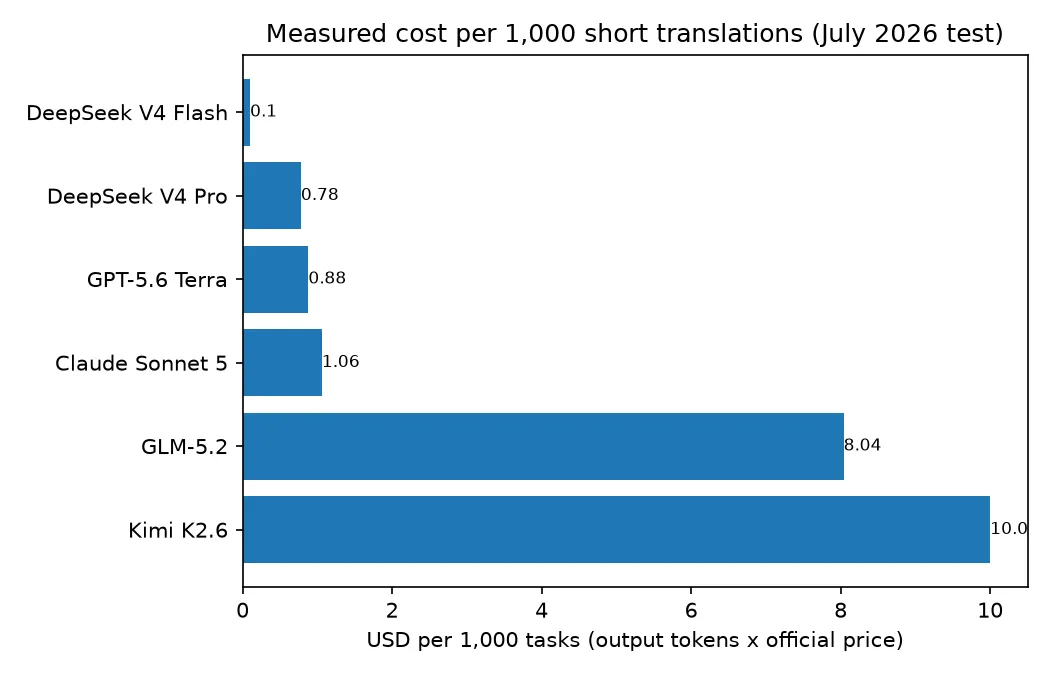
The mechanism: both models run a visible reasoning chain before answering, and reasoning tokens bill as output. Translating one marketing sentence, Kimi K2.6 emitted 2,849 output tokens and GLM-5.2 emitted 1,906, for translations of 40–60 tokens. Claude Sonnet 5 spent 60 tokens on the same task; GPT-5.6 Terra, 46.
Latency followed the same pattern. GPT-5.6 Terra and Claude Sonnet 5 answered in 3–4 seconds on all three tasks. DeepSeek V4 Flash took 4–5s, DeepSeek V4 Pro 16–20s, and GLM-5.2 and Kimi K2.6 ranged from 20 to 48 seconds per request.
Two practical rules fall out of this. First, for short, high-volume tasks like translation, compare models by measured cost per task, not list price: run 20 requests and read the usage field. Second, turn reasoning off (or down) for translation: DeepSeek separates thinking and non-thinking endpoints, and GLM and Kimi expose thinking parameters in the request body. Across our three tasks, the reasoning chain added nothing detectable to output quality.
What translation costs at volume
Scale the measured token burn to one million characters of English source text (roughly 250,000 tokens) and the spread gets dramatic:
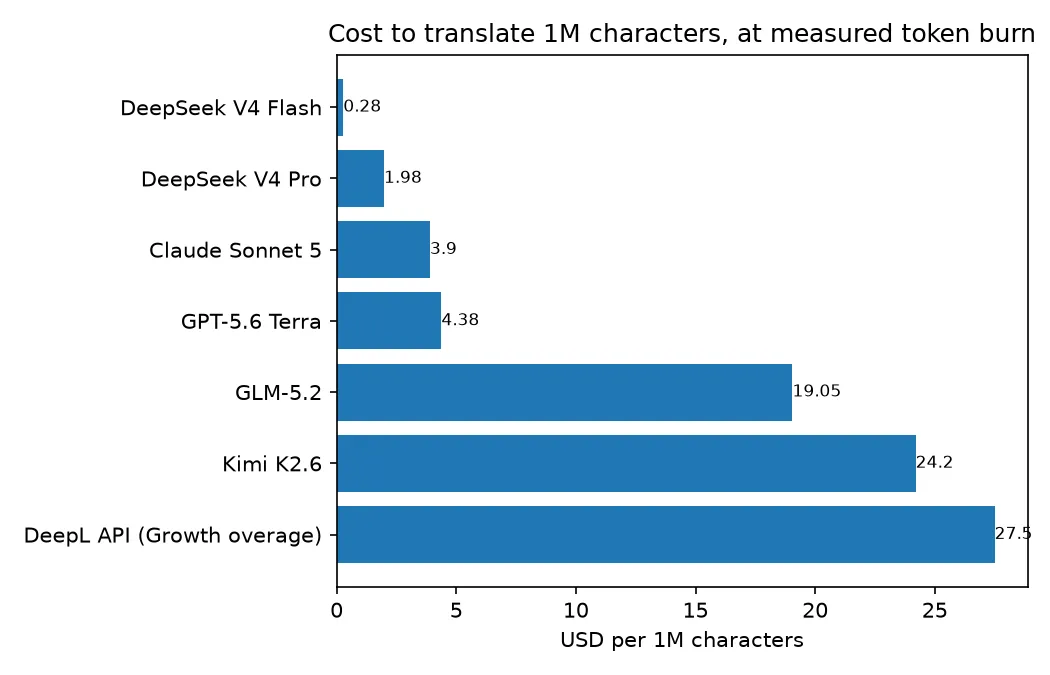
DeepSeek V4 Flash translates a full novel's worth of text for about $0.28. The same volume through DeepL's API costs $27.50 at Growth-plan overage rates, a 98x difference. That matches the direction of a widely-shared r/LocalLLaMA analysis titled "LLMs are 800x cheaper for translation than DeepL", whose bigger multiplier came from smaller self-hosted models.
Note the top of the chart: at measured token burn, the reasoning-heavy open-weight models nearly close the gap with DeepL. Unit price without a token measurement is not a cost estimate.
Three pricing facts worth knowing before you commit, all verified July 17, 2026:
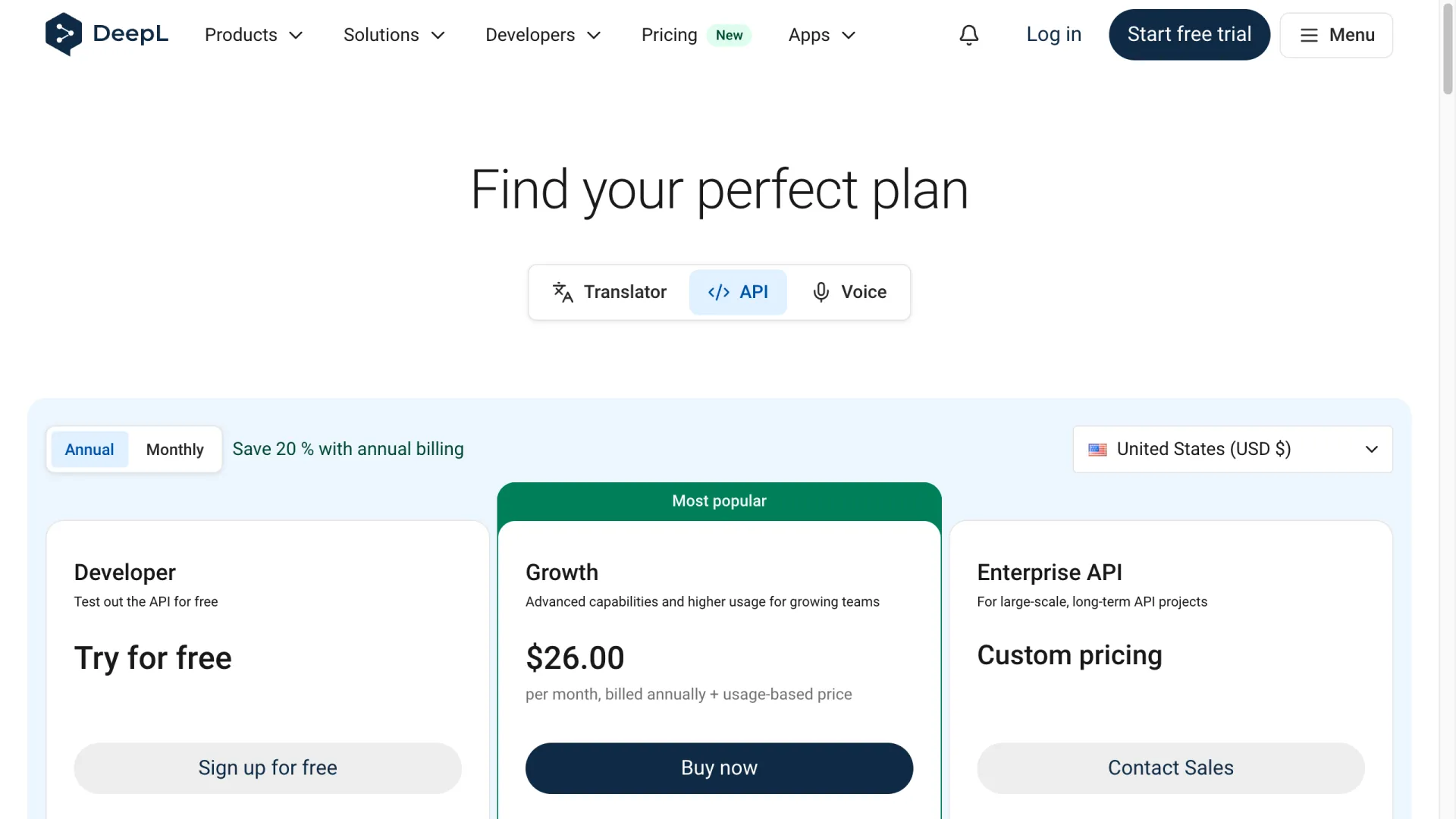
- DeepL's free tier changed. The API Developer plan now grants a one-time credit of 1,000,000 characters, not the monthly 500,000-character allowance you'll still see quoted in older docs and forum answers. Growth runs $26/month (billed annually) with 12M characters/year included, then $27.50 per extra million.
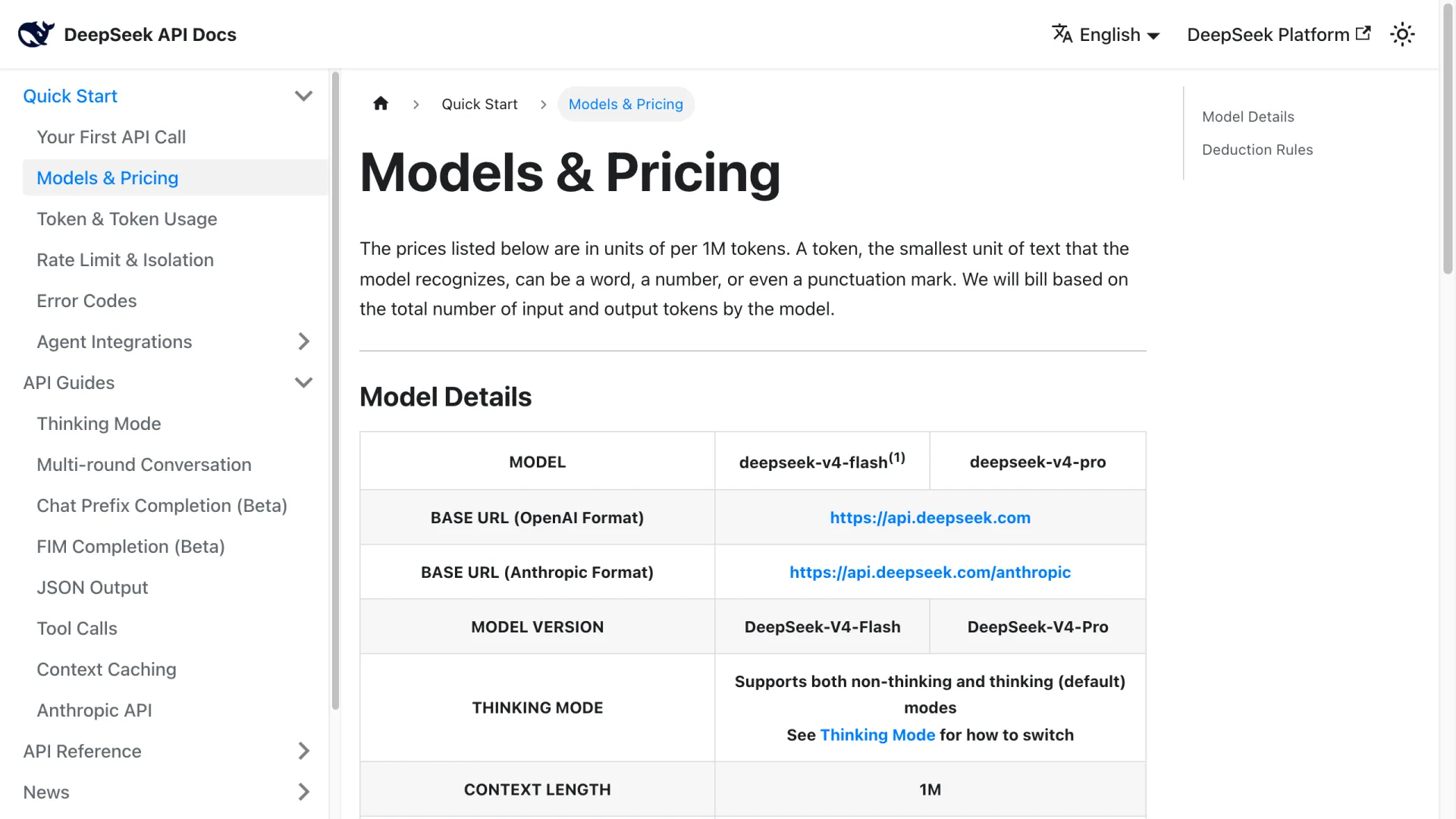
- DeepSeek bills a fraction of everyone else. $0.14 input / $0.28 output per million tokens for V4 Flash, with cache-hit input dropping to $0.0028. The old deepseek-chat model name retires July 24, 2026.
- Claude Sonnet 5 is on introductory pricing. $2/$10 per million tokens through August 31, 2026, then $3/$15. Its newer tokenizer also produces roughly 30% more tokens for the same text, which our cost math includes. Budget for both if you're planning past September.
- Batch APIs cut the bill in half. OpenAI, Anthropic, and Google all offer ~50% discounts for asynchronous batch processing. Translation workloads are usually not latency-sensitive, so this is free money: batch pricing brings GPT-5.6 Terra to ~$2.19 and Claude Sonnet 5 to ~$1.95 per million characters.
When DeepL or Google Translate still wins
Per-character economics favor LLMs, but three requirements still point the other way:
- Enforced terminology. DeepL ships glossaries and term bases that guarantee a term translates the same way every time. With an LLM you'd prompt for it and verify; that's probabilistic, not enforced.
- CAT-tool and pipeline integrations. If your translation memory lives in a CAT (computer-assisted translation) tool, DeepL's connectors plug in directly.
- Sub-second latency at scale. Traditional neural MT engines typically respond faster than general LLMs; for inline UI translation, that matters.
For live voice, neither classic NMT nor a chat LLM is the right shape. Google prices a dedicated Gemini 3.5 Live Translate variant at $3.50/$21 per million tokens with per-minute audio rates, which we covered in our Gemini 3.5 Live Translate breakdown.
For rare and low-resource languages, coverage beats quality rankings: check that your language pair is supported at all before comparing anything else. DeepL supports around 30 languages; large LLMs handle over a hundred with degrading quality toward the tail.
Open-source and local options
Both GLM-5.2 and Kimi's K-series publish open weights, so the token-burn problem above is fixable if you self-host: you control the sampling settings and can suppress reasoning chains entirely.
For single-GPU local translation, Qwen3-30B-A3B is the recommendation that keeps resurfacing in r/LocalLLaMA threads on local translation models for European languages into English, with larger models recommended as the language pair gets more exotic. The motivation is usually privacy (contracts, unreleased products) or zero marginal cost rather than quality; in the same threads, hosted frontier models are still described as translating better.
Worth watching: Kimi K3 shipped with open weights this week at $3/$15 per million tokens hosted. We tested K2.6 because K3 API access was still rolling out; if K3 inherits the K-series token appetite, the same measured-cost caveat will apply.
Running this comparison yourself
Everything above reproduces with about 20 API calls: pick two sentences from your own content, send them to each candidate model, and read the usage object in each response for real token counts. Total cost of our 18-request test run: under $0.15.
The annoying part is holding six API keys from five providers. We ran all six models through one AIReiter account, which resells major-model API access (Claude-family keys at roughly a fifth of list price) behind a single Anthropic-compatible endpoint — one key, same wire format for every model above.
If your translation volume is real, an hour of spot-checking against your own content beats any ranking, including this one. The models are close enough on quality that your language pair, tone requirements, and token measurements should make the call.
FAQ
Is ChatGPT or Gemini better for translation?
In our tests GPT-5.6 Terra was fast, accurate, and format-clean across all three tasks. We didn't run Gemini head-to-head (it wasn't on our gateway), but its published pricing is competitive ($1.50/$9 per million tokens for 3.5 Flash) and it's the only provider with a dedicated live-voice translation model.
What is the most accurate AI translator right now?
For high-resource language pairs, accuracy differences among frontier models are small; all six models we tested translated technical German without an error. Differences concentrate in tone (Claude led on Japanese marketing copy) and in edge cases like dropped subjects and tense, where DeepSeek V4 Pro made our sample's only real mistake.
What is the best open-source LLM for translation?
GLM-5.2 and Kimi K2.6 both publish weights and translated correctly in our tests; self-hosting lets you disable the reasoning chains that make their hosted APIs expensive per task. For consumer hardware, Qwen3-30B-A3B is the common community recommendation.
Can an LLM replace a human translator?
For internal docs, support content, and bulk product text: largely yes, at 1–16% of DeepL's per-character cost depending on the model (DeepSeek V4 Flash ~1%, Claude Sonnet 5 ~14%, GPT-5.6 Terra ~16%). For contracts, medical text, and brand campaigns, the Test 3 tense error is the cautionary tale. Fluent output can still invert meaning, so keep human review where a misreading is expensive.
Is DeepL still worth using in 2026?
Yes in three cases: enforced glossaries, CAT-tool integration, and sub-second latency. Outside those, the per-character math is hard to defend, and note the free tier is now a one-time 1M-character credit, not monthly.