
Two of the three leading AI image models kept our product label pixel-perfect across three ecommerce jobs. The cheapest cost $0.01 per image; freelancers charge $50 for the same shot. Samples below.
If you only need the verdict: Nano Banana Pro is the best AI image model for product photos overall, GPT Image 2 is the budget pick at a fifth of the price, and Seedream 5.0 Pro is the one we'd skip for anything with small label text.
The test: one phone photo, three jobs, three models
Most advice about AI product photography compares apps and subscriptions. But the quality ceiling is set one layer down, by the image model underneath. So we tested the models directly, through their APIs, on July 17, 2026.
The three models are the current flagship image models with reference-image editing APIs from the three biggest providers: Google's Nano Banana Pro, OpenAI's GPT Image 2, and ByteDance's Seedream 5.0 Pro.
The setup: we created one deliberately amateur "seller photo": a serum bottle from NORDVIK, a fictional brand we invented so we could track each label detail, sitting on a cluttered kitchen table. Each model got that same reference image and the same prompt for three jobs every store needs:
1. White-background hero shot (marketplace main image) 2. Lifestyle scene (bathroom shelf, morning light) 3. In-hand scale shot (so shoppers can judge size)
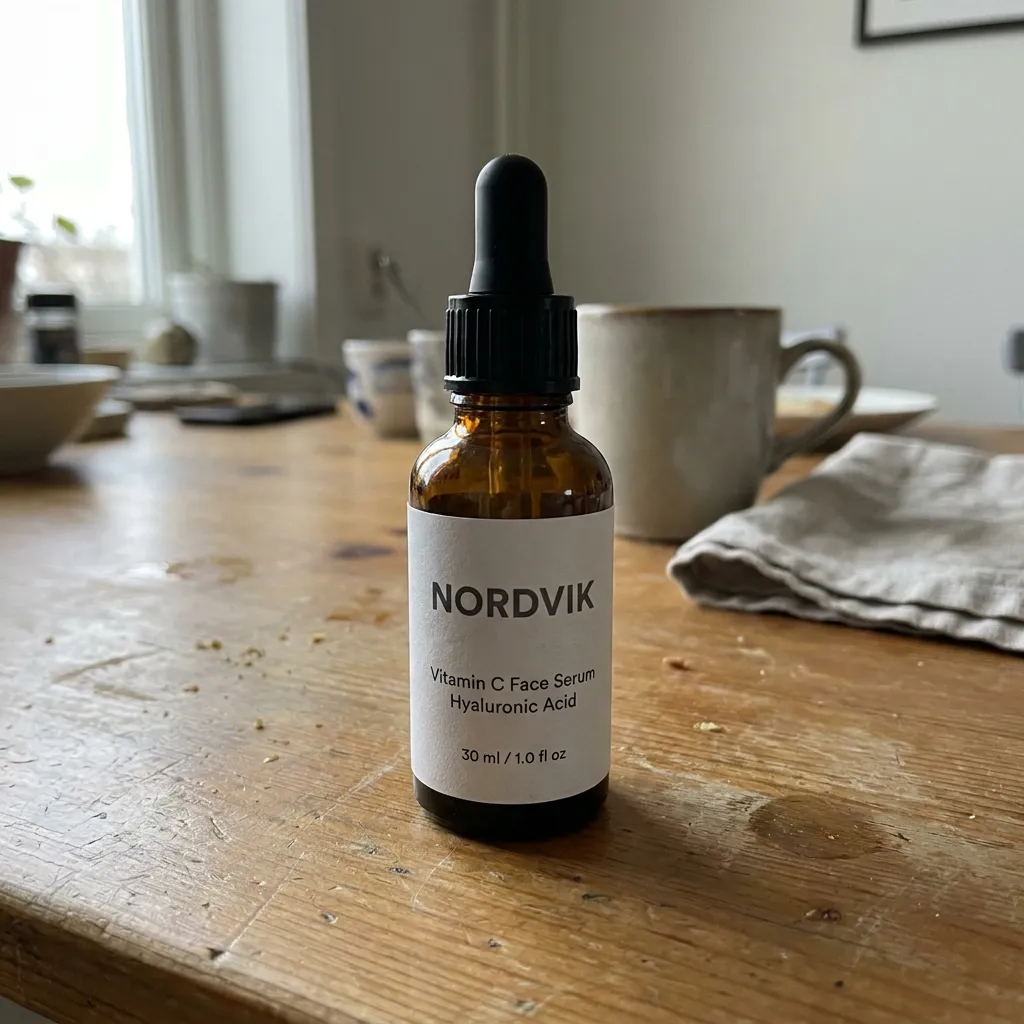
The three prompts, verbatim — only the model changed between runs:
- Hero: *"Using the exact product from the reference image, create a professional e-commerce hero shot: the same amber dropper bottle centered on a pure white seamless background, soft studio lighting, gentle shadow and subtle reflection under the bottle. Keep the label design and all label text exactly identical to the reference image. Amazon main-listing style, photorealistic."*
- Lifestyle: *"Place the exact product from the reference image on a light stone bathroom shelf next to a folded beige towel and a eucalyptus sprig, soft morning window light, shallow depth of field, editorial lifestyle photo for an online skincare store. Keep the label design and all label text exactly identical to the reference image. Photorealistic."*
- In-hand: *"A woman's hand holding the exact product from the reference image toward the camera at realistic scale, neutral softly lit background, natural skin texture, so online shoppers can judge the true size of the 30 ml bottle. Keep the label design and all label text exactly identical to the reference image. Photorealistic."*
All runs used default model settings, square outputs (1024–1408 px), and the first attempt from each model was kept: no retries, no cherry-picking. We scored three things: whether the label survived unchanged (brand name, three lines of small type, volume marking), what each image cost in real API credits, and how long generation took. Nine finished images, one per model per job. That's a small sample, not a benchmark. It is, however, the exact workflow a seller runs, and the failure patterns were consistent across all nine images.
Results at a glance
| Model | Label fidelity | Avg speed | Measured cost/image | Official API list price |
|---|---|---|---|---|
| Nano Banana Pro (Google) | 3/3 exact | ~30 s | $0.06 | $0.134 (1K/2K) |
| GPT Image 2 (OpenAI) | 3/3 exact | ~80 s | $0.01 | $0.053 (medium, 1024²) |
| Seedream 5.0 Pro (ByteDance) | Brand name kept, small type degraded in 3/3 | ~70 s | $0.075 | $0.045 (≤2.36 MP) |
Measured costs are what AIReiter actually deducted per generation (500 credits = $5); official list prices come from each vendor's pricing page, checked July 17, 2026. Relay platforms buy model capacity in bulk and set their own credit rates, which is why the gap runs in both directions: cheaper than list for Nano Banana Pro and GPT Image 2, pricier for Seedream. Speed is wall-clock time from request to downloadable image.
The pattern that matters: label fidelity didn't correlate with price. The cheapest run of the test produced some of the most accurate images.
Job 1: the white-background hero shot
The task: turn the kitchen-table snapshot into a marketplace-ready main image: pure white background, studio lighting, label untouched.
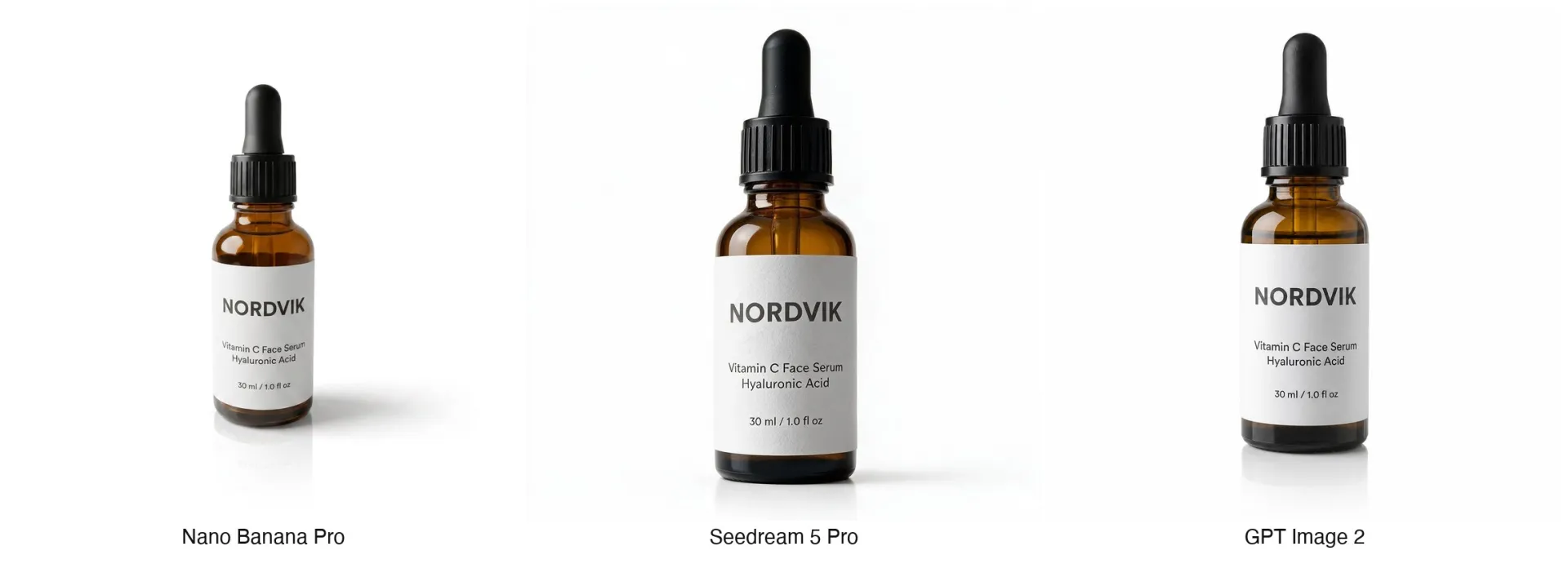
Nano Banana Pro and GPT Image 2 both returned exactly the bottle we gave them. All four lines survived: NORDVIK, "Vitamin C Face Serum," "Hyaluronic Acid," "30 ml / 1.0 fl oz." Zoom into the collage and the type is crisp enough to pass a listing review.
Seedream 5.0 Pro kept the layout and the brand name but redrew the letterforms. "NORDVIK" came back with wobbly strokes, and the two smaller lines look traced rather than printed. It also made the bottle noticeably wider than the reference. On a listing, that breaks the basic requirement that images match the physical product a customer receives.
Job 2: the lifestyle scene
The task: same bottle on a stone bathroom shelf with a towel and eucalyptus, the kind of image brands run in ads and product-page galleries.
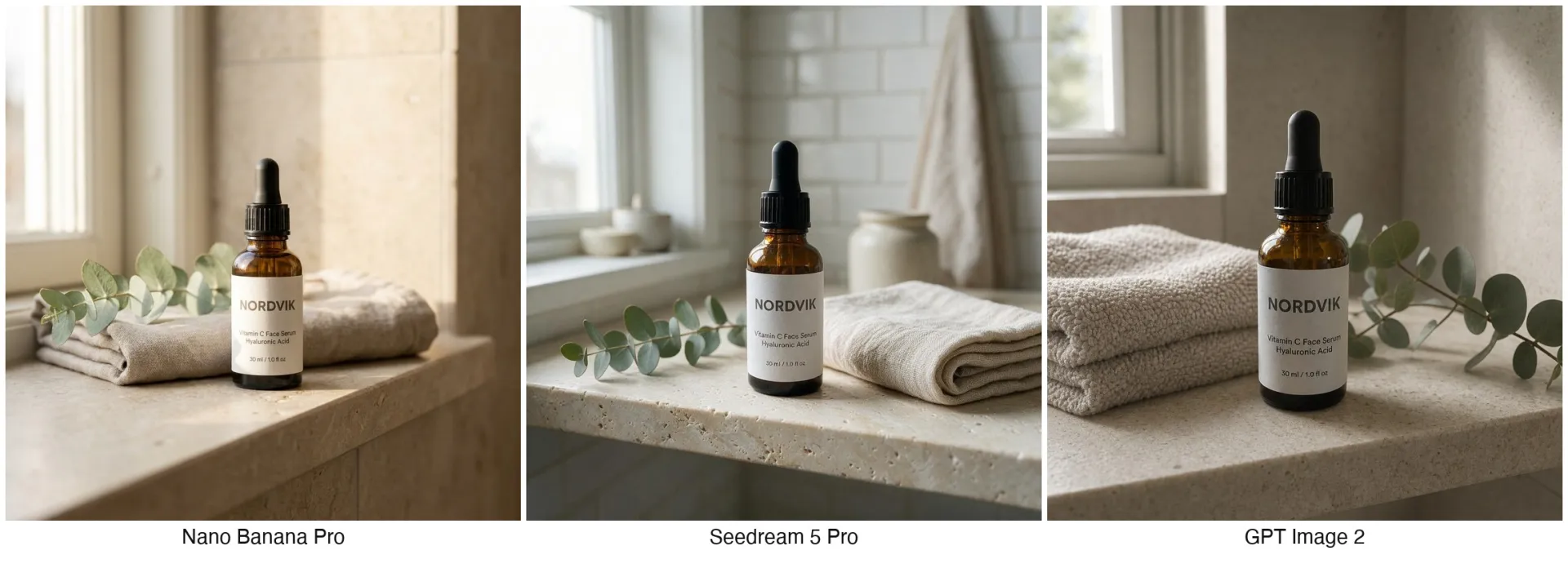
All three produced scenes you could ship. Nano Banana Pro's is the one we'd ship: warm window light, believable travertine texture, label perfect. GPT Image 2 matched it on fidelity with slightly flatter styling. Seedream composed the prettiest shelf, and again smudged the small type ("Hyaluronic Acid" is legible only if you already know what it says).
Job 3: the in-hand scale shot
Size confusion drives returns: a shopper who can't tell a 30 ml bottle from a 100 ml one from photos alone will guess, and some of those guesses come back in the mail. An in-hand shot fixes that, and it's also the hardest of the three jobs: the model has to render a convincing human hand *and* keep the label straight while fingers partially cover the bottle.
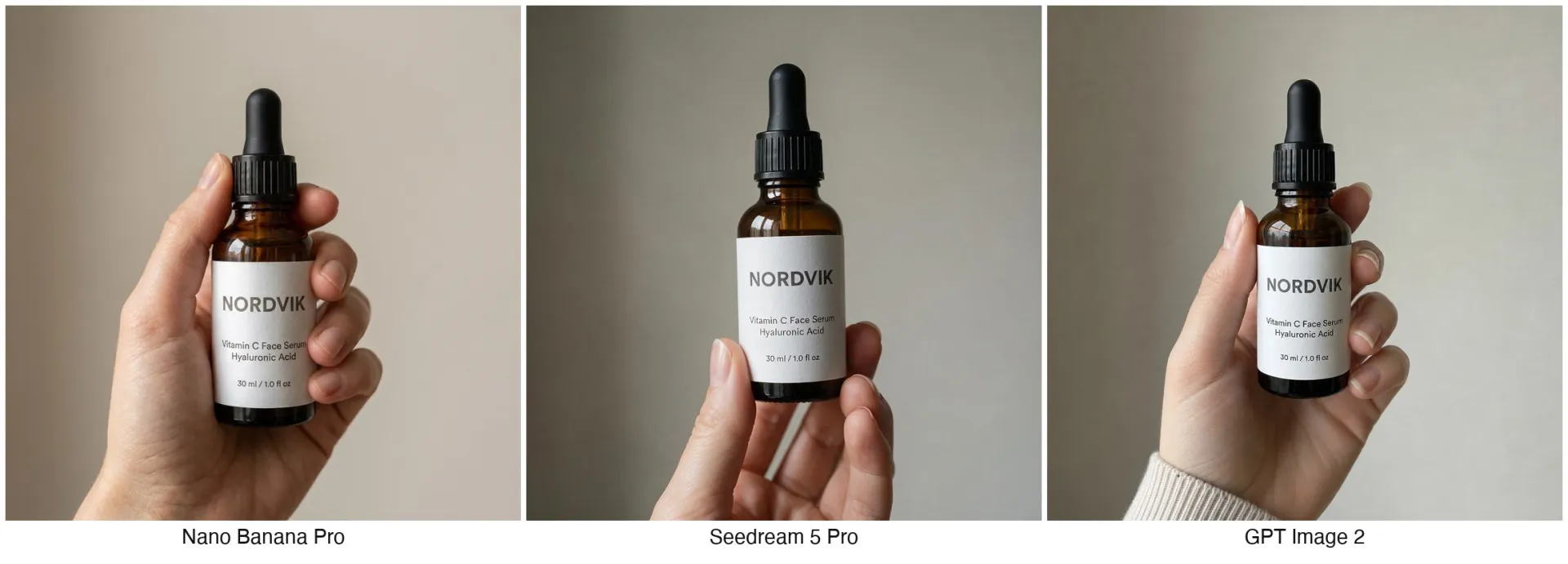
All three cleared the hand problem with natural fingers and no extra knuckles. Nano Banana Pro and GPT Image 2 kept the label exact behind the fingers. Seedream held the brand name but softened the secondary lines once more. The consistent takeaway across our nine images: Seedream's failure mode is the small type, not the scene.
What a product image actually costs
Here's the per-image math, measured from live API calls rather than taken from pricing pages.
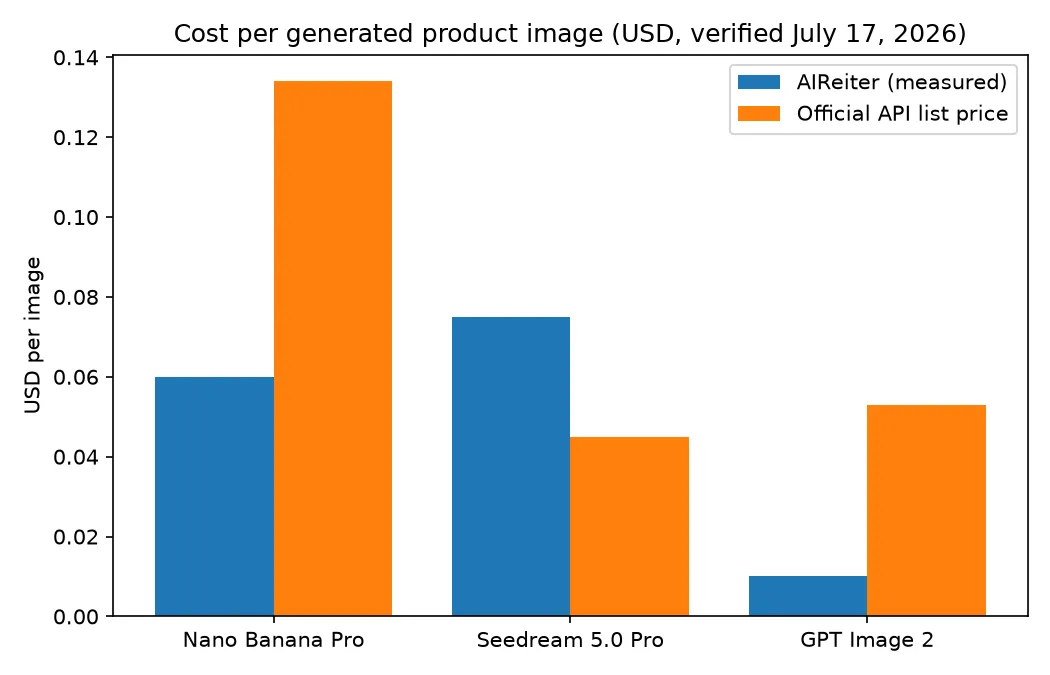
Per image, measured against official list prices: Nano Banana Pro cost us $0.06 through AIReiter versus $0.134 on Google's own API, so the relay was cheaper. GPT Image 2 cost $0.01 versus $0.053 direct from OpenAI at medium quality. Seedream went the other way: $0.075 through the relay versus $0.045 on ByteDance's BytePlus platform, so if you settle on Seedream, going direct is the better deal.
Now scale it to a real catalog. Say you need 30 images, ten products with three shots each:
- API, Nano Banana Pro: about $1.80 and roughly 15 minutes of sequential generation time at ~30 s per image
- API, GPT Image 2: about $0.30, closer to 40 minutes at its slower per-image pace
- Product-photo SaaS tools: Photoroom and Claid bundle generation with editors and templates behind monthly subscriptions with credit caps — worth it for the workflow, not required for the images
- Hiring it out: sellers on r/nanobanana quote $50–100 per AI-generated product image (a second thread prices the same work at $50–80/hour), which puts a 30-image catalog at $1,500–3,000
Those posts sit in the Nano Banana community itself, built on the model measured above at $0.06 per call. Part of that fee buys legitimate work (retouching, revisions, client handling), but the generation step is the part you can take in-house with a sharp reference photo, a tested prompt, and a QA pass.
Which model should you pick?
One scope note before the verdicts: they apply to reference-based product editing at roughly 1K–1.4K output resolution, tested on printed-label packaging. Rerun the test in your own category before betting a catalog on it.
Default: Nano Banana Pro. Only model that combined perfect label fidelity, the best-looking scenes, and ~30-second generations. At $0.06 a shot the cost argument against it barely exists. You can run it in the browser on AIReiter's Nano Banana Pro page or via API.
High volume on a budget: GPT Image 2. Same 3/3 fidelity at $0.01 per image, which prices a 30-image catalog at thirty cents. Two caveats before you batch a thousand SKUs: it was the slowest in our runs (71–90 s per image), and users on r/ChatGPT report a grainy tiling texture on some generations. We didn't hit it in our three, but we'd spot-check any large batch. It's also on AIReiter as GPT Image 2.
Skip for label work: Seedream 5.0 Pro. It degraded small type in all three jobs, and it was the most expensive route we measured. That's a verdict about product packaging, not the model overall — its scene composition was arguably the best of the three, and at $0.045 direct it's priced well for styled imagery with no fine text at stake.
Run the same test on your own product
Your product isn't a serum bottle, and fidelity failures are category-specific: text-heavy packaging is the hardest fidelity test, while apparel, reflective metal, and transparent glass each fail in their own ways. Spending about $0.50 to replicate this test on your own product settles it before you commit a whole catalog.
1. Shoot one honest reference photo. Phone camera is fine. Get the label sharp and fully visible; the models can fix lighting and background, but they can't recover text that isn't visible in the source. 2. Run the three prompts published above across your candidates, changing nothing but the model. The "keep the label design and all label text exactly identical" clause is the part doing the work; don't drop it. 3. Zoom to 100% and check four things: the smallest line of label text, cap/closure geometry, overall proportions against the real product, and material rendering (glass looks like glass, fabric drapes like fabric).
A model that rewrites your label at $0.06 a try will rewrite it at scale. Fail fast, then batch with the one that passes.
FAQ
Is there a free AI image model for product photos?
Free consumer tiers exist, but watermarks and output caps rule them out for listings. At the API prices measured above, an entire catalog costs less than what a freelancer charges for one image.
Why does my product label come out garbled or rewritten?
Two usual causes: the reference image did not reach the model at all (check that your tool or API call passed it; early in this test a misnamed API field silently dropped ours, and each "edit" came back as a random invented product), or the model regenerates text instead of preserving it, which is the Seedream failure pattern above.
Can I use AI-generated product photos on Amazon or Shopify?
Amazon's image requirements, for example, dictate what the image must show (the actual product, on a pure white background for main images) rather than how the file was made. Accuracy is the binding constraint: use real-reference workflows like the ones tested here and verify the label at 100% zoom before uploading.
Do I still need a photographer?
For the reference shot, you are the photographer — one sharp phone photo per product. Studio work still wins for hero campaigns and for categories like apparel, where drape and fit drive purchase decisions.