
The fastest way to reduce Claude Fable 5 token costs is to stop running it on work a cheaper model handles just as well. At $10/$50 per million tokens, Fable is 5× Sonnet 5 — yet in my test both nailed the same task.
Where your Fable 5 spend actually goes
Before optimizing, look at where the money leaks. In a typical agentic request, input tokens dwarf output: a single query can carry 80,000–140,000 input tokens (system prompt, tool definitions, conversation history, file context) against just 1,000–3,000 tokens of output. Even though output is priced 5× higher per token, the sheer volume of input usually makes it the larger line item — which is why caching and context discipline matter more than shorter answers.
Here's the pricing that drives every decision below:
| Model | Input ($/M) | Output ($/M) | Cached input read ($/M) |
|---|---|---|---|
| Claude Fable 5 | $10 | $50 | ~$1 (≈90% off) |
| Claude Opus 4.8 | $5 | $25 | ~$0.50 |
| Claude Sonnet 5 | $2 | $10 | ~$0.20 |
| Claude Haiku 4.5 | $1 | $5 | ~$0.10 |
Prompt caching drops cached input to roughly one-tenth of the base rate, but writing to the cache carries a surcharge ($12.50/M for the 5-minute cache, $20/M for the 1-hour cache). Pricing verified against Anthropic's published rates on July 17, 2026; Sonnet 5's $2/$10 is introductory through August 31, 2026.
We ran the same task on Fable 5, Opus 4.8, and Sonnet 5
The theory — "use a cheaper model when you can" — is easy to state and hard to trust without numbers. So I ran a controlled test. Same prompt to all three models: *write a Python merge_intervals function that handles empty and unsorted input, with three assert-based unit tests.* Then I executed each answer to confirm the tests actually pass.
All three produced correct code that passed every test. The difference was entirely in cost and speed.
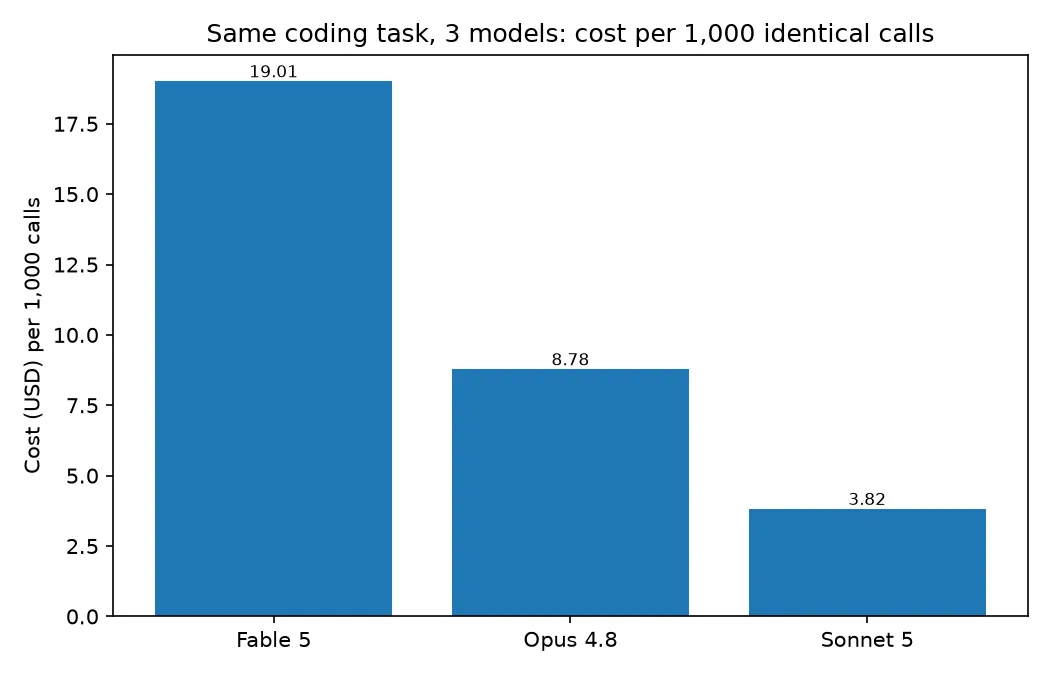
| Model | Output tokens | Latency | Cost per call | Cost per 1,000 calls |
|---|---|---|---|---|
| Fable 5 | 265 | 12.3 s | $0.0190 | $19.01 |
| Opus 4.8 | 236 | 6.4 s | $0.0088 | $8.78 |
| Sonnet 5 | 267 | 3.9 s | $0.0038 | $3.82 |
Same input (576 tokens), near-identical output length, identical correctness — and a 5× spread in price. Sonnet also answered in a third of the time.
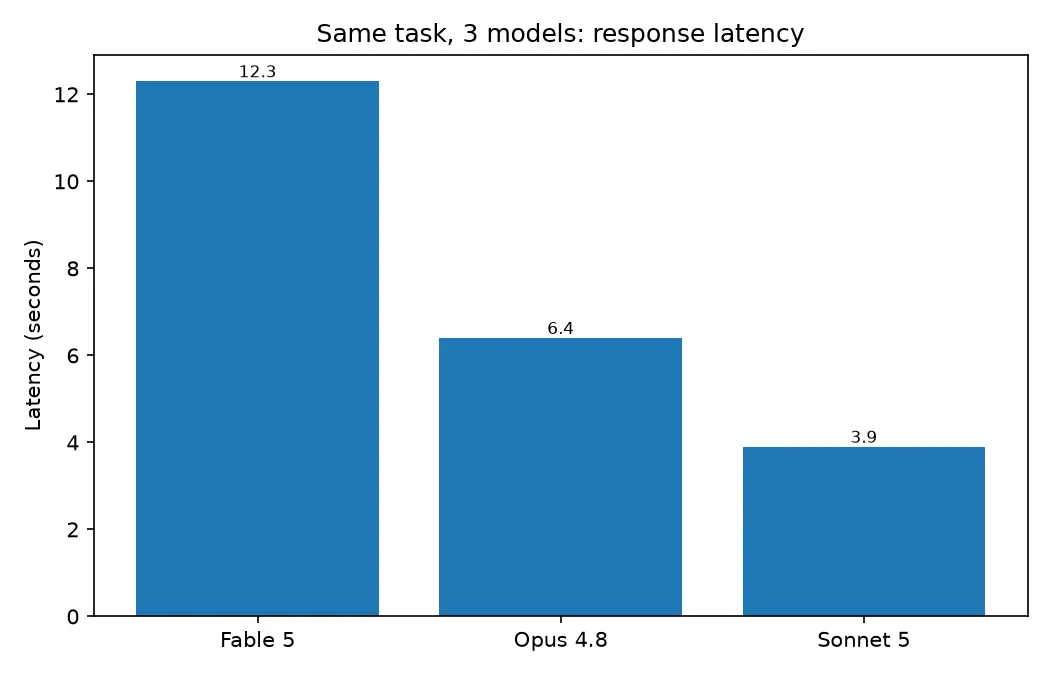
This is a small, self-contained task, not a benchmark — a heavy reasoning problem is exactly where Fable 5 earns its price, and the gap would narrow or invert. But the point holds: for the routine work that fills most sessions, you can be paying 5× for an identical result. Latency numbers are from a third-party API endpoint, so treat them as directional rather than an official SLA.
Lever 1: Match the model to the task
This is the highest-ROI change you can make, and the test above is why. Route by task type: keep Fable 5 for deep multi-step reasoning, hard refactors, and ambiguous specs; send boilerplate, formatting, straightforward edits, and high-volume simple calls to Sonnet 5 or Haiku 4.5. When you're unsure, start on the cheaper model and escalate only if the output is wrong — a failed cheap call still costs a fraction of a Fable call.
A pattern practitioners keep landing on: let Fable 5 plan, and let a cheaper model execute. Fable writes the architecture or breaks the task into steps; Sonnet 5 or Haiku 4.5 does the bulk typing. The team behind the Cline coding agent reported spending over $2,000 in a single day on Fable, then found that cheaper models paired with adversarial review loops reached similar — sometimes better — results at significantly lower cost.
There's a practical wrinkle worth knowing in Claude Code: you can't swap the active model mid-session from the chat. The workaround is to ask for it in plain language — tell Claude to plan the work itself but hand the implementation to a cheaper model, and it spins up a Sonnet 5 subagent to carry out the execution while the expensive model stays in the planning seat. You get Fable-level task decomposition and Sonnet-level per-token cost on the part of the job that burns the most tokens.
Within a single model, the effort setting is the same lever at finer grain, and it's the one I reach for first. Default to low effort for routine work and only step up when a result actually comes back wrong — low skips the reasoning tokens Fable would otherwise burn before answering, and on easy tasks that's pure savings with no quality hit. Keep high or max for problems where the extra reasoning changes the answer. Our breakdown of Fable 5's high vs max effort tiers shows where that line sits, and Sonnet 5 vs Fable 5 covers which tasks safely drop a tier.
Lever 2: Protect your prompt cache
Because input dominates your token count, the ~90% cache discount is the second-biggest lever. The catch: the cache only helps if the prefix stays byte-identical between calls. Change one token early in the system prompt or reorder your tool definitions, and everything after it is a cache miss billed at full price.
To keep the cache intact:
- Freeze the stable prefix. Put your system prompt and tool definitions first and don't mutate them mid-session. Append new context at the end.
- Don't shuffle tool order between requests — agents that rebuild their tool list dynamically silently invalidate the cache.
- Batch reuse inside the cache window. The 5-minute cache is cheap to write; group related calls so they land before it expires.
The break-even is quick: the 5-minute cache write costs 1.25× a normal input token, while each cached read saves 0.9×, so the cache pays for itself after roughly two reuses of the same prefix — trivial for any agent that resends the full conversation every turn, where an intact cache is the difference between paying $10/M and $1/M on the repeated portion.
Lever 3: Send less context
Every token you don't send is a token you don't pay for at any tier. The wins here are unglamorous but compound:
- Clear between unrelated tasks. In Claude Code,
/clearstarts fresh so stale history stops riding along on every subsequent message. - Compact long sessions.
/compactsummarizes the conversation so far; adding an instruction like "focus on code samples and API usage" tells it what to preserve. - Feed docs, not exploration. A dense, pre-written skill or a version-pinned documentation slice costs far less than letting the agent search and read its way to the same knowledge.
- Prefer Markdown over PDF. PDFs carry layout tokens the model doesn't need; plain Markdown of the same content is dramatically leaner.
None of these change your rate, but on a 100k-token context they trim thousands of tokens off every single call.
Lever 4: Cut the per-token rate itself
The levers above reduce how many tokens you spend and at which tier. The last one reduces the price per token. Anthropic's first-party API has no batch or async discount tier for Fable 5, so the rate you see is the rate you pay.
One option is an API aggregator that resells Claude access at a markup below list price. AIReiter, for instance, is Anthropic-API-compatible and prices Claude models at roughly 20% of official rates — which puts Fable 5 near $2/$10 per million instead of $10/$50. The trade-off is the usual one for any reseller: you're trusting a third party's routing and uptime rather than Anthropic directly, so it fits high-volume, cost-sensitive workloads more than latency-critical production paths. Whichever route you choose, the rate is a multiplier on everything else — so it's worth setting once and then focusing on the token-volume levers, which you tune every day.
Which levers actually move the needle
If you do only one thing, do Lever 1 — routing work to the right model is the difference the test measured, and nothing else comes close. Here's the honest ranking:
1. Match the model to the task — up to ~5× on misrouted work. Biggest, most durable win. 2. Protect the prompt cache — up to ~90% off repeated input, which is most of your tokens in agent loops. 3. Send less context — steady 20–50% off token volume, compounding across every call. 4. Cut the per-token rate — a flat multiplier; set once, benefits everything.
The tempting "exploits" — encoding prompts as images, custom tokenizer tricks — tend to break on the next model update. The four levers here are habits, not hacks: they keep working because they align with how the pricing is actually built.
FAQ
How do I reduce token costs in Claude?
Set the effort level to low for routine work, route simpler tasks to Sonnet 5 or Haiku 4.5, keep your prompt prefix byte-stable so caching applies, and clear or compact context between tasks. Model choice and effort level are where the largest savings live.
How much does Fable 5 cost per token?
$10 per million input tokens and $50 per million output — double Opus 4.8 ($5/$25) and five times Sonnet 5 ($2/$10, introductory through August 31, 2026). Prompt caching drops cached input reads to roughly $1 per million.
Why do I run out of Fable 5 tokens so fast?
Usually oversized context (long history or large files attached to every call), retry loops that resend the full context each turn, or running Fable on work a cheaper model could handle. Trimming context and routing tasks fixes most of it.
Is prompt caching worth it for Fable 5?
Yes, whenever you reuse a large stable prefix — it cuts cached input to about 10% of the base rate. It only pays off if the prefix stays byte-identical between calls, so freeze your system prompt and tool definitions.
Does lowering the effort setting hurt quality?
On simple tasks, rarely — low or medium effort skips reasoning tokens the task didn't need. Keep high or max for genuinely hard problems where the extra reasoning changes the answer.