 AIREITER
If you are deciding between Claude Fable 5 high vs max effort, the short answer is: stay on high for almost everything, reach for xhigh on hard coding and agentic work, and treat max as a rare last resort. On most tasks max costs roughly twice as much for a quality gain that is hard to measure, and it can overthink. The part most people miss is that a rung called xhigh sits between high and max, and it is usually the real answer to "should I turn effort up?"
What the effort setting changes on Fable 5
Effort (output_config.effort) has five levels: low, medium, high, xhigh, max. On Fable 5 the default is high, and per Anthropic's effort docs, setting high is identical to omitting the parameter.
Two things surprise people. First, effort is not just a thinking dial: it governs all token spend — visible text, extended thinking, and the tool calls in an agentic loop. Lower effort means fewer, more consolidated tool calls, less preamble, and terser confirmations; higher effort means more calls, more planning out loud, and longer summaries. Second, Fable 5's thinking is always on — you cannot disable it (thinking: {type: "disabled"} errors), so effort is how you control its depth. At high, xhigh, and max Claude almost always thinks deeply; at low and medium it may skip thinking on easy problems.
High → xhigh → max: three rungs, not two
"High vs max" is really a three-rung question, because xhigh sits between them — a finer control point on the reasoning-versus-latency tradeoff. Anthropic engineer Boris Cherny called it "a new level between high and max." It exists only on Fable 5, Mythos 5, Opus 4.8, Opus 4.7, and Sonnet 5; older models like Opus 4.6 and Sonnet 4.6 jump straight from high to max.
The full ladder, with the use case Anthropic assigns each level:
| Level | What Anthropic says it is for |
|---|---|
low | Simple tasks needing best speed and lowest cost, like subagents |
medium | Agentic tasks balancing speed, cost, and performance |
high | Complex reasoning, difficult coding, agentic tasks (the default) |
xhigh | Long-running agentic/coding tasks (30+ minutes), token budgets in the millions |
max | Deepest reasoning, no cap on internal effort (output still bounded by max_tokens) |
So when someone asks about running Fable 5 at max, the honest first question is: have you tried xhigh? For the hardest coding and agentic work, xhigh — not max — is the recommended step-up.
The cost and latency you are trading
Turning effort up does not raise the per-token price. Fable 5 bills a flat $10 per million input tokens and $50 per million output at every level; cost climbs only because the model generates more tokens.
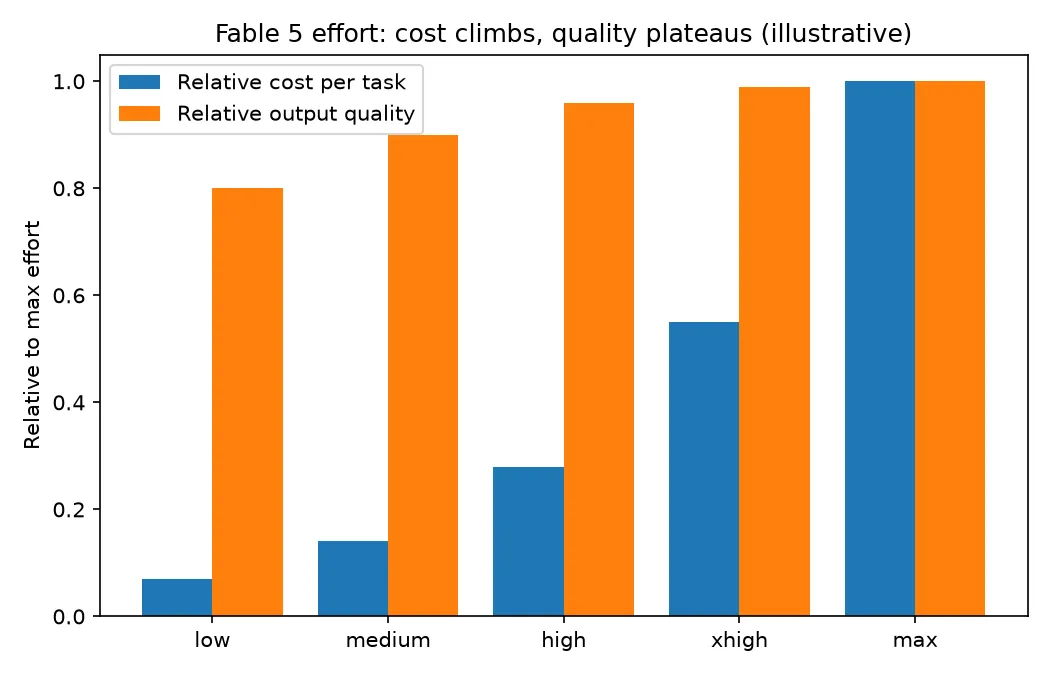
The chart is illustrative, not measured — it plots the shape of the tradeoff described below, normalized so max is 1.0 on each axis. Quality is near its ceiling by high, while cost keeps roughly doubling as you climb.
The gap from xhigh to max is where the math turns against you. Software engineer Ishu Agarwal reported (July 11, 2026) that high → xhigh "can usually be less than 3%" quality gain while costing "30% to 100%" more, with models tending "to overthink at higher effort levels." A widely shared July 14 post claimed Fable 5 scored identically at max and xhigh, "89.0 vs 89.0, at roughly double the cost." Treat those as directional community data, not a controlled benchmark — but the direction matches Anthropic's own note that max "adds significant cost for relatively small quality gains, and on some structured-output or less intelligence-sensitive tasks it can lead to overthinking."
Latency behaves the same way. After testing effort levels (June 11, 2026), product manager Pawel Huryn found "below max, completion time barely moves" while on real work "completion jumps from xhigh up." One more trap: Fable 5's tokenizer (shared with the latest Opus generation) can run up to ~35% higher token counts for the same text than older Claude models, so any cost baseline from a previous model reads low.
A decision rule for high, xhigh, and max
| Task | Effort | Escalate when |
|---|---|---|
| Routine coding, chat, extraction, subagents | low / medium | Output quality visibly drops |
| Most reasoning, everyday coding, agentic work | high (default) | A hard task stalls or needs deeper planning |
| Hardest coding/agentic work, long-horizon runs, heavy tool use | xhigh | xhigh genuinely cannot solve it |
A frontier problem or a bug xhigh failed, correctness over cost | max | (Top of the ladder) |
high is the sweet spot for quality versus token efficiency; xhigh buys real extra deliberation for the hardest work; max is a longshot at what xhigh already failed. Going down is often smarter: per Anthropic, lower effort on Fable 5 still performs well and "often exceed[s] xhigh performance on prior models." CTO Morgan Linton put it bluntly — "about 95% of what I do from a coding perspective only requires Fable 5 Low and Medium," and running everything at high when Low or Medium returns the same output is how you burn through plan limits.
If the model itself is wrong for the job, effort tuning won't fix it — that is a model-choice question, not an effort one.
Three things people get wrong about Fable 5 effort
Higher effort is not a smarter model. Effort decides how much work Claude does before answering — more thinking, more tool calls — not how capable it is. A low answer comes from the same model as a max one; if a task is beyond the model, max just spends more reaching the same place.
Claude Code's default is not the API's default. Claude Code defaults to xhigh; the API defaults to high. That alone explains a lot of "why does it behave differently here" — the same model feels more thorough and pricier in Claude Code purely from the higher default. Set xhigh explicitly if you want the API to match.
ultracode is not an effort level. It appears in Claude Code's menu, but the API accepts only low through max. Ultracode pairs xhigh with standing permission to spin up multi-agent workflows — token-hungry, and not something you can pass to the API.
How to set effort (and a max_tokens note)
Effort lives in output_config, needs no beta header. Because Fable 5's thinking is always on, omit the thinking parameter entirely:
import anthropic

client = anthropic.Anthropic()

response = client.messages.create(
    model="claude-fable-5",
    max_tokens=64000,          # give room at xhigh/max (see note below)
    output_config={"effort": "xhigh"},   # low | medium | high | xhigh | max
    messages=[{"role": "user", "content": "Refactor this module and add tests."}],
)
max_tokens is a hard ceiling on total output — thinking plus response text. At xhigh or max, thinking can eat much of that budget, so set it generously (start around 64,000) or answers truncate mid-thought. Fable 5 supports a 1M-token context and 128K output tokens.
FAQ
What is the difference between high and max effort in Fable 5?
high (the default) spends what it needs for excellent results; max removes all restraint for the deepest reasoning. The meaningful step-up from high is usually xhigh, which sits between them.
Is max effort worth it on Fable 5?
Rarely — it roughly doubles cost over xhigh for little measurable gain and can overthink. Reserve it for a frontier problem or a bug xhigh can't crack.
How do I change the effort level?
Set output_config: {"effort": "..."} with low, medium, high, xhigh, or max. In Claude Code, use its effort menu.
What is the default effort level?
high on the API (identical to omitting the parameter). Claude Code defaults to xhigh.
Does higher effort cost more per token?
No — the rate is flat. Higher effort costs more only because the model generates more tokens.
Is Fable 5 effort the same as Sonnet or Opus effort levels?
Same parameter and names, but xhigh exists only on Fable 5, Mythos 5, Opus 4.8, Opus 4.7, and Sonnet 5, and recommended defaults differ per model. See Sonnet 5 versus Fable 5 if you are choosing between them.