
Claude Sonnet 5 is the best AI model for blog writing right now. In my test it was the only one of three models that held the word count, and its 1,200-word draft cost about $0.03 in API fees.
Below is the full test: what each model wrote, how long it took, what the token bill looked like, and where the cheap option quietly stops being cheap.
Same brief, three models
On July 17, 2026, I sent an identical brief to three models over API: write a roughly 1,200-word blog post on "how to choose a standing desk," with H2/H3 structure, specific numbers (heights in cm, weight capacity, USD prices), one comparison table, a three-question FAQ, first-person voice, and no filler phrases. One run per model, so read this as a spot check with receipts, not a benchmark.
I picked the three engines a blogger is most likely to route through one API account today: Anthropic's Claude Sonnet 5, OpenAI's GPT-5.6 (the sol variant, the full-size writing tier), and Moonshot's Kimi K2.6, the open-weight budget option.
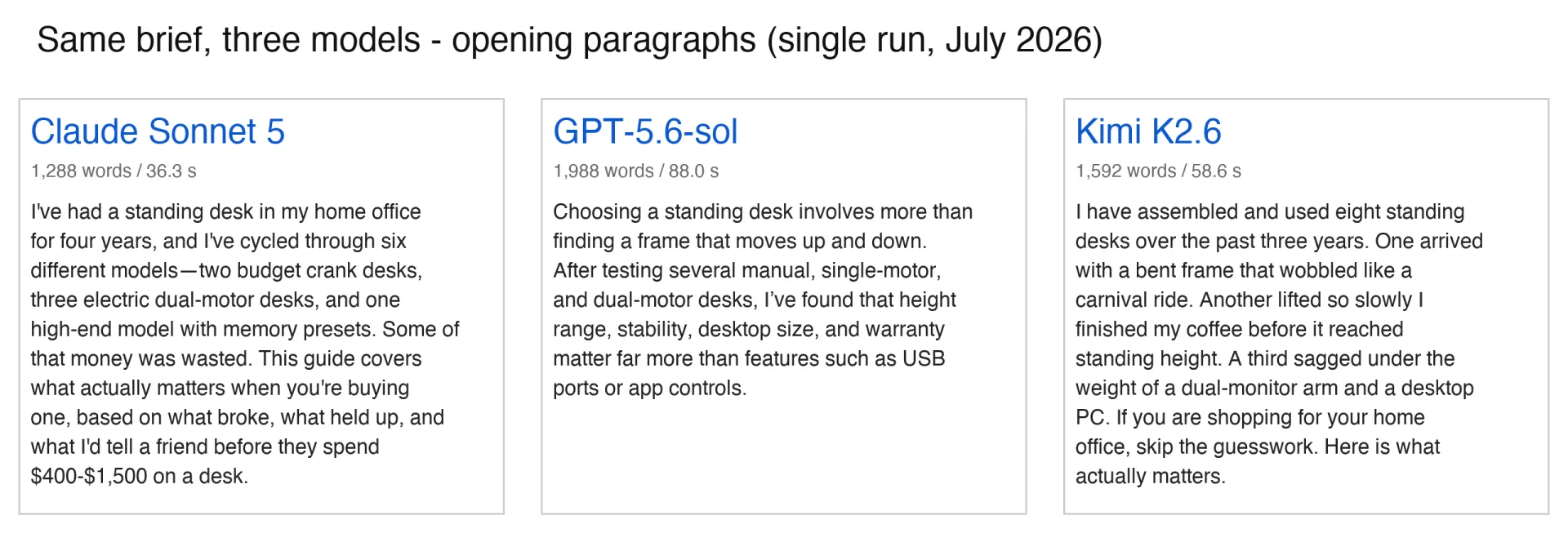
Claude Sonnet 5: the only one that held the brief
Claude returned 1,288 words against the 1,200 target, the only result inside 10% of the ask, and did it fastest at 36.3 seconds. It hit all six brief requirements in one pass.
What stood out was internal consistency. The model invented a tester persona, gave it a height of 165 cm, and derived a standing desk height of 104 cm from it, which matches what the elbow-height rule produces. Fabricated personas usually leak contradictory numbers; this one didn't.
The weakness: 10 em dashes in 1,288 words. Em-dash density is the punctuation readers now flag as machine-written, so a human pass to strip them is still part of the workflow.
GPT-5.6-sol: thorough, but it wrote a manual
GPT-5.6-sol produced 1,988 words, 66% over the target, and took 88 seconds, the slowest of the three. It split the piece into 12 H2 and 13 H3 sections, which reads less like a blog post and more like product documentation.
The content inside those sections was the most rigorous of the test. Its instructions for measuring your own seated and standing elbow height were step-by-step and correct, and it was the only output with zero em dashes. If your editing style is cutting rather than expanding, that trade can work, but at 66% overrun you are paying for a third of a draft you will delete.
Kimi K2.6: vivid writing, and a 4.8x token bill
Kimi wrote the most entertaining draft: a desk that "wobbled like a carnival ride," elbows flaring "like chicken wings." It also packed in the most concrete specs, 92 numeric data points against Claude's 61.
Two catches. First, Kimi name-dropped real products unprompted, recommending the "Fully Jarvis" desk. Fully, the brand, shut down when MillerKnoll closed it; the Jarvis desk itself now sells through Herman Miller's store (verified July 17, 2026). Unprompted brand claims read like expertise but each one is a fact-check you now own.
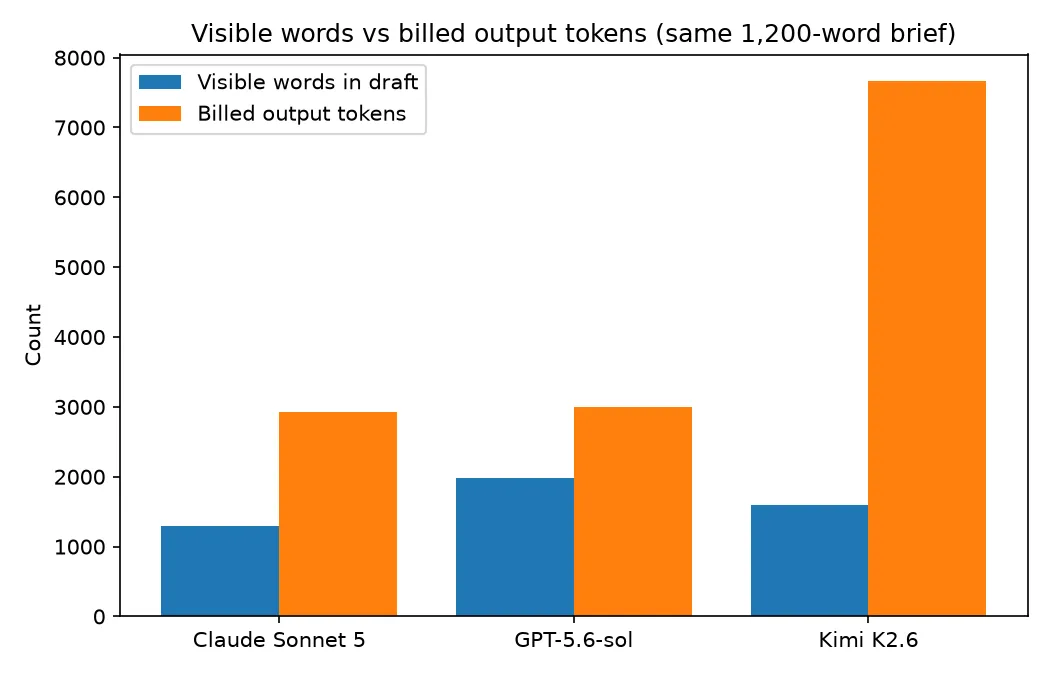
Second, the bill. Kimi's draft showed 1,592 visible words but was billed at 7,662 output tokens: 4.8 billed tokens per visible word, versus 1.5 for GPT-5.6-sol and 2.3 for Claude. Reasoning models think in tokens you pay for but never see, and Kimi's pricing advantage shrinks accordingly.
The numbers side by side
Metric | Claude Sonnet 5 | GPT-5.6-sol | Kimi K2.6 |
|---|---|---|---|
Words delivered (target ~1,200) | 1,288 | 1,988 | 1,592 |
Latency | 36.3 s | 88.0 s | 58.6 s |
Billed input tokens (the brief) | 669 | 104 | 107 |
Billed output tokens | 2,926 | 2,995 | 7,662 |
Billed tokens per visible word | 2.3 | 1.5 | 4.8 |
Em dashes | 10 | 0 | 2 |
Table + FAQ compliance | Yes | Yes | Yes |
Classic AI filler phrases | 0 | 0 | 0 |
A good sign across the board: zero hits on my 25-phrase filler blocklist (the landscape-and-journey openers that defined 2023 chatbot prose) once the brief banned filler. The 2026 fingerprints are subtler: em-dash density, heading fragmentation, and invisible token spend.
What one blog post actually costs
All prices below are the official standard API rates, verified July 17, 2026, applied to the exact token counts from my test (input tokens add under a tenth of a cent per draft; the full counts are in the table above).
Model | Input / Output ($ per 1M tokens) | This draft | Per 1,000 finished words |
|---|---|---|---|
$2 / $10 (intro price through Aug 31, 2026; $3 / $15 after) | $0.031 | $0.024 | |
$5 / $30 | $0.090 | $0.045 | |
$0.95 / $4 | $0.031 | $0.019 |
The sticker prices say Kimi is 2.5x cheaper than Claude per output token. The reasoning-token overhead erases almost all of that: per finished draft they cost the same three cents, and per 1,000 usable words Kimi saves you half a cent. GPT-5.6-sol costs roughly double either one, partly because of its $30 output rate and partly because it wrote 66% more words than asked.
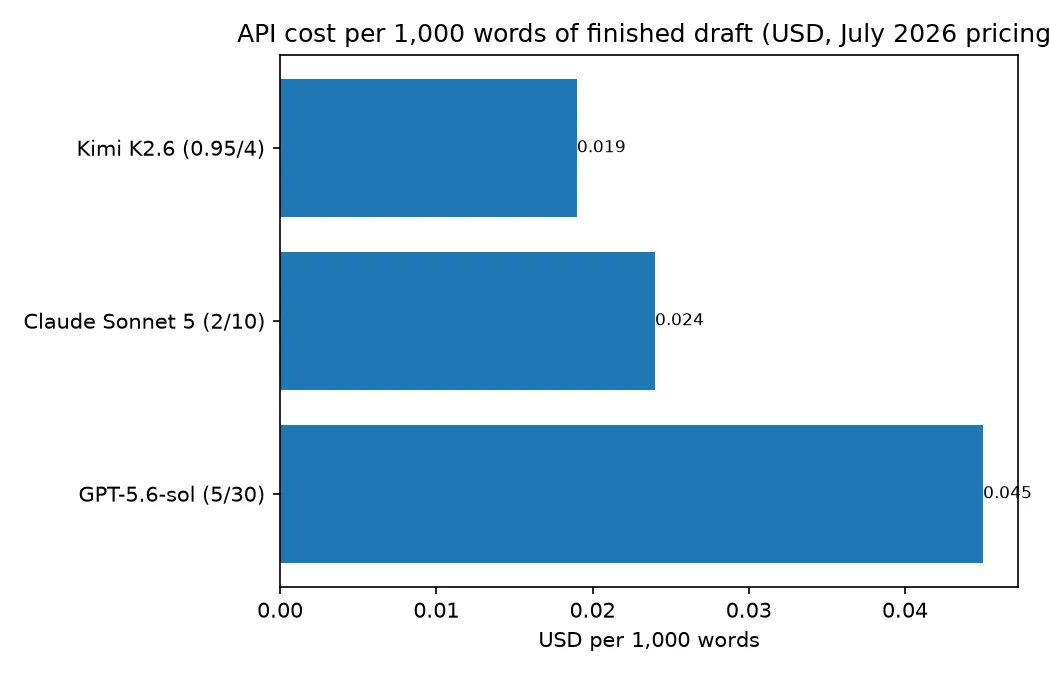
Note the date on Claude's price: the $2/$10 introductory rate expires August 31, 2026, after which the same draft costs about $0.046. Even at the standard rate it stays under a nickel.
Subscription or API: the break-even math
A ChatGPT Plus or Claude Pro subscription runs $20 a month (verified July 17, 2026). Extrapolating from this one draft size, $20 of API credit buys roughly 220 drafts from GPT-5.6-sol or over 600 from Claude Sonnet 5.
So the decision is about what else you use the subscription for. If the chat app is your research assistant, file reader, and image tool, keep it; the drafting is a bonus. If you are producing posts at volume and drafting is the main job, the API is two orders of magnitude cheaper per draft, and it plugs into scripts and CMS automations a chat window can't.
There is also a middle lane on price. Relay platforms resell API access below list rate: AIReiter, for example, advertises up to 70% savings on Claude models (it currently carries the line up to Sonnet 4.6 and Opus 4.6, as of July 17, 2026). Opus 4.6 lists at $5/$25 on Anthropic's page, so a draft the size of my test would bill about $0.075 at list and around $0.02 at that discount. At these numbers, model quality should drive your choice and price should break ties.
How to pick a model without rerunning my tests
Model rankings age in months. These four checks are the ones my test validated, and they work on whatever models exist when you read this:
1. Check the exact model name and date. Vendors publish current lineups (Anthropic, OpenAI, and Google all keep model pages). A recommendation that names only "Claude" or "GPT" with no version and no date can't tell you anything about the model you would call today. 2. Run your real brief once and count the fingerprints. A full-length draft costs single-digit cents on any model here, so there is no reason to test with toy prompts. Count em dashes and headings per 500 words of output; those two numbers predict your editing load better than any quality score. 3. Compare output price and ask about reasoning tokens. The number to compare is dollars per million output tokens, and whether thinking tokens bill as output. One test call and a look at the usage field in the response answers it; my Kimi run billed 4.8 tokens per visible word. 4. Match context window to your real inputs. If you paste brand-voice guides and three old posts into every brief, you need room: Claude Sonnet 5 takes up to 1M tokens with no surcharge, Kimi K2.6 tops out at 262k, and GPT-5.6 charges a higher long-context rate ($10/$45) past the standard window.
FAQ
Which AI model is best for blog writing?
Claude Sonnet 5 is the best AI model for blog writing based on this test: it was the only one that followed the length spec, its facts stayed internally consistent, and a full draft costs about three cents. Kimi K2.6 wins if cost per word is the only metric, and GPT-5.6-sol suits writers who prefer cutting an over-complete draft.
Is Claude better than ChatGPT for blog posts?
For draft discipline and a natural long-form voice, yes in my test, and writer sentiment on X in 2026 leans the same way. GPT-5.6 countered with more thorough how-to detail, so it is the stronger outline and research partner even when Claude writes the final draft.
Can AI-written blog posts rank on Google?
Yes. Google's guidance targets content quality, not how the content was produced. What decides ranking is whether the post contains information competitors don't, which is exactly the part a raw model draft lacks; every output in my test still needed a human pass for verification and original data.
Is a free AI model good enough for blog writing?
Free chat tiers handle outlines and short posts, but they cap message length and daily usage right where long drafts live. Since a paid API draft costs $0.02 to $0.09, the free-versus-paid question matters less than the editing time either way.