
Use DeepSeek V4 Flash for tasks that can be checked automatically and retried cheaply. Use DeepSeek V4 Pro for work where a weak first pass creates expensive rework: multi-file changes, ambiguous requirements, or agent plans with broad side effects.
The models share the same API family and 1M context window. The choice is cost, capacity, and failure tolerance, not basic feature access.
The short decision
Choose Flash for extraction, classification, fixed-schema JSON, batch transformations, and bounded tool calls. Put a parser, schema validator, test suite, or reviewer behind the call. Its official uncached input and output rates are about one-third of Pro's, and its listed concurrency limit is five times higher.
Choose Pro when a bad result is hard to detect or expensive to repair. Typical examples are repository-wide code changes, database migrations, security-sensitive logic, and plans that coordinate several tools. Pro does not replace validation; it reduces the chance that a first pass creates more work.
DeepSeek's V4 release note positions Pro for stronger agentic coding and reasoning. It describes Flash as close in reasoning and comparable on simple agent tasks. That is a practical boundary: start with Flash for observable work, then escalate on a failed check or an expensive failure mode.
Shared API features and the differences that matter
The DeepSeek API model page lists the same 1M context, 384K maximum output, JSON output, tool calls, thinking mode, non-thinking mode, and FIM availability for both V4 models.
Item | V4 Flash | V4 Pro | Decision impact |
|---|---|---|---|
Context length | 1M | 1M | Context size does not choose the tier. |
Maximum output | 384K | 384K | Long artifacts are possible on either model. |
JSON output and tool calls | Yes | Yes | A route can switch model IDs without changing these controls. |
Model ID |
|
| Make the model an explicit route setting. |
Listed concurrency limit | 2,500 | 500 | Flash has more headroom for safe batch work. |
Keep prompts, tools, thinking mode, and validators fixed during a comparison. Change one variable, the model ID, and measure accepted results, retries, latency, and cost.
Price: cache behavior changes the math
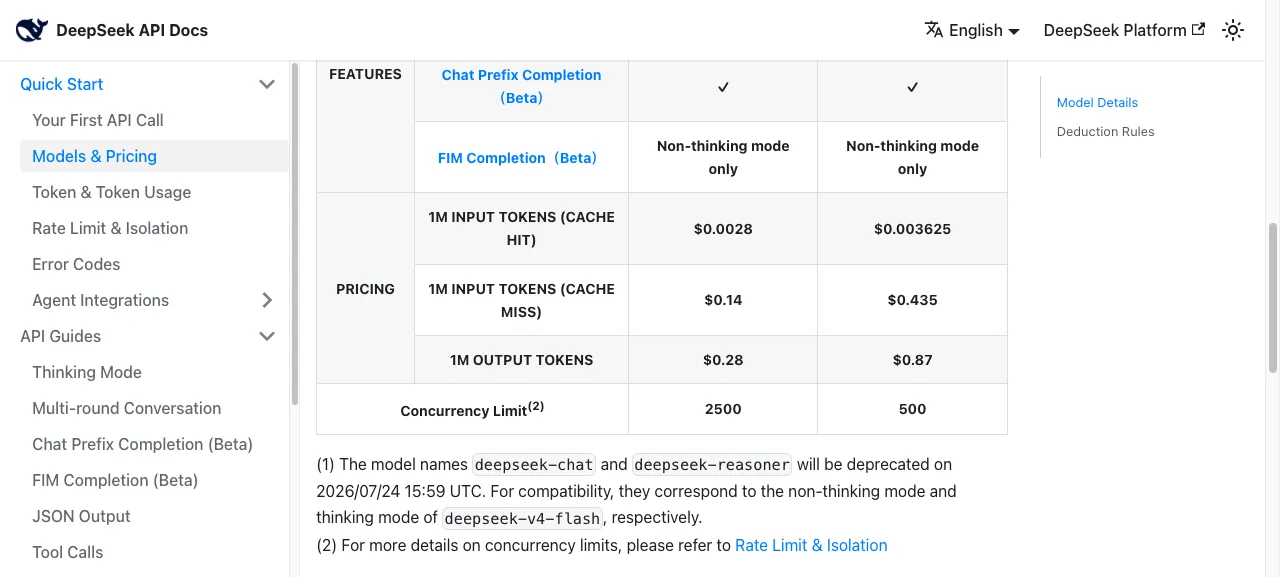
Official rates checked on July 14, 2026 are per 1M tokens. Confirm the live pricing page before budgeting.
Official rate per 1M tokens | Flash | Pro |
|---|---|---|
Cached input | $0.0028 | $0.003625 |
Uncached input | $0.14 | $0.435 |
Output | $0.28 | $0.87 |
For 1M uncached input plus 1M output, Flash costs $0.42 and Pro costs $1.305. For 1M cached input plus 1M output, the totals are $0.2828 and $0.873625. Cached input narrows the absolute gap; uncached input and output create the larger cost difference.
The price question is therefore simple: can Flash retry after a deterministic failure for less than one Pro call, and is that retry safe? If yes, Flash is the sensible default. If no, send the task to Pro first.
Endpoint smoke test: protect structured outputs from token limits
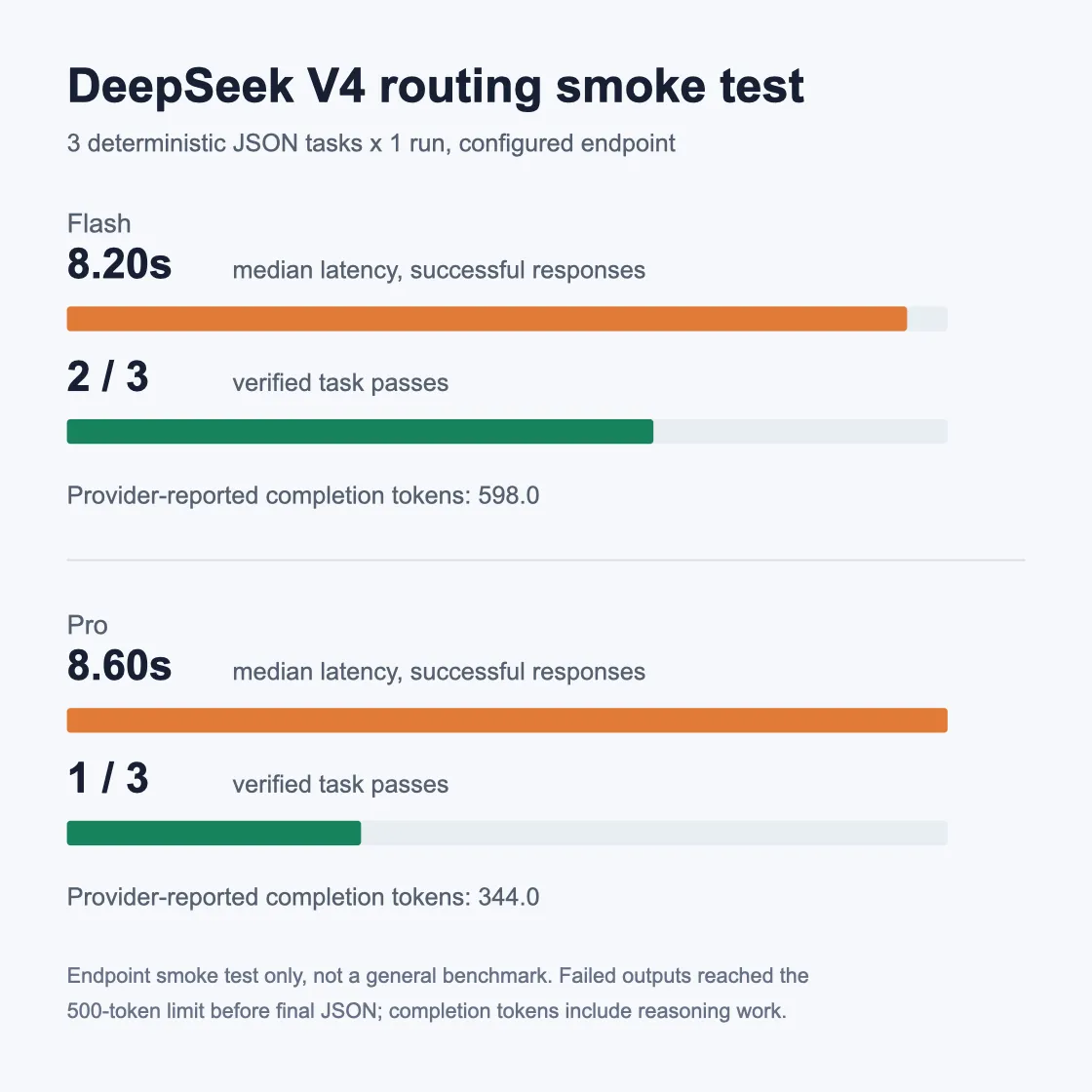
I ran three synthetic JSON tasks once on each model through the configured internal endpoint on July 14, 2026: invoice arithmetic, dependency scheduling, and policy routing. Each response had to parse and meet a fixed assertion. The request used temperature: 0, a 500-token limit, and a thinking-disabled field. This is a six-call configuration check, not a general benchmark.
Result | Flash | Pro |
|---|---|---|
Verified task passes | 2 / 3 | 1 / 3 |
Median latency, successful responses | 8.20s | 8.60s |
Provider-reported completion tokens, successful responses | 598.0 | 344.0 |
Both models stopped on the invoice task before returning final JSON. Pro also stopped on the schedule task. The endpoint returned reasoning_content despite the thinking-disabled field, and its completion-token accounting includes that reasoning work. The test result is operational: a 500-token setting did not reliably leave room for a structured final answer on this endpoint.
Set an output budget for reasoning plus the final artifact. Reject malformed JSON, log finish_reason, and retry or escalate only after a failed validator. The full task definitions, assertions, and raw responses are recorded in this article's research files.
A routing rule that works in production
if the task has a deterministic validator
   and retry cost is lower than manual rework
   and throughput matters:
    call deepseek-v4-flash
    validate the result
    retry once or escalate to deepseek-v4-pro on failure
else:
    call deepseek-v4-pro
Flash routes need explicit checks. Use JSON schemas for extraction, tests for code changes, source requirements for summaries, and allow-listed arguments for tools. Pro routes still need the same controls, especially for financial, authorization, and customer-facing content.
A Kilo coding workflow report found Pro stronger than Flash on one backend task, while both outputs had defects. Treat that as a task-specific data point. It supports validation around both tiers.
Migration notes
Set explicit V4 IDs instead of relying on aliases. The V4 release note says deepseek-chat and deepseek-reasoner are scheduled to retire on July 24, 2026 at 15:59 UTC. During the compatibility period they map to Flash's non-thinking and thinking modes.
Run a canary with representative prompts. Track request count, cached input, output, retries, validator failures, time to first token, total latency, and human correction time by route. The useful metric is cost per accepted task, not cost per token alone.
FAQ
Is DeepSeek V4 Flash cheaper than V4 Pro?
Yes. On the official rates checked for this comparison, Flash costs $0.14 versus $0.435 per 1M uncached input tokens and $0.28 versus $0.87 per 1M output tokens. The cached-input difference is much smaller.
Does Flash have the same context window as Pro?
Yes. Both list a 1M context window and a 384K maximum output. Use task risk and cost to select the model.
Is Pro always more accurate than Flash?
No. Pro is the safer default for complex or costly failures, but output quality depends on the task, prompt, mode, provider, and validation. Measure acceptance and rework on the actual route.
Why did a model return no JSON before the token limit?
Reasoning can consume the endpoint's completion-token budget before the final answer is emitted. The small endpoint test above showed this behavior on both models. Increase the output allowance and validate the final JSON instead of assuming the requested mode was applied.
Bottom line
Flash is the value route for validated work at volume. Pro is the risk-control route for complex work with expensive rework. Use the same API client for both, make the route explicit, and let accepted-task cost decide where each workload belongs.