 AIREITER
Kimi K3 costs $3.00 per million input tokens and $15.00 per million output tokens, with cached input at $0.30, over a full 1-million-token context. That is frontier-tier pricing: the same sticker as Claude Sonnet 5, cheaper than Claude Opus 4.8 or GPT-5.6, but roughly three to four times its own predecessor, Kimi K2.6, and far above open rivals like DeepSeek V4 and GLM 5.2. There are two separate ways to pay for K3, the pay-as-you-go API and a consumer membership, and they price it very differently. This guide covers both, the cache discount that changes the math, and whether the premium is justified.
Kimi K3 API pricing
The developer API bills per token, with a large discount for cache hits. These rates are from Moonshot's official pricing docs.
Kimi K3 ( | Price per 1M tokens |
|---|---|
Input (cache miss) | $3.00 |
Input (cache hit) | $0.30 |
Output | $15.00 |
Context window | 1,048,576 tokens |
Default max output | 131,072 (up to 1,048,576) |
Billing is flat pay-as-you-go: unlike the consumer app, the API does not tier price by context length, and web search calls are billed separately at $0.004 each. K3 always runs with thinking enabled at the max reasoning-effort level, so expect longer, more token-heavy responses than a non-reasoning model, which matters for the output-side cost.
How Kimi K3 pricing compares
Against the current field, K3 lands squarely in the premium bracket. All figures are per million tokens, from each provider's official pricing.
Model | Input | Output | Cached input | Context |
|---|---|---|---|---|
Kimi K3 | $3.00 | $15.00 | $0.30 | 1M |
Kimi K2.6 | $0.95 | $4.00 | $0.16 | 262K |
DeepSeek V4 Pro | $0.44 | $0.87 | ~$0.004 | 1M |
DeepSeek V4 Flash | $0.14 | $0.28 | ~$0.003 | 1M |
$1.40 | $4.40 | $0.26 | 1M | |
Claude Sonnet 5 | $3.00 | $15.00 | ~$0.30 | 1M |
Claude Opus 4.8 | $5.00 | $25.00 | ~$0.50 | 1M |
GPT-5.6 | $5.00 | $30.00 | $0.50 | 1M |
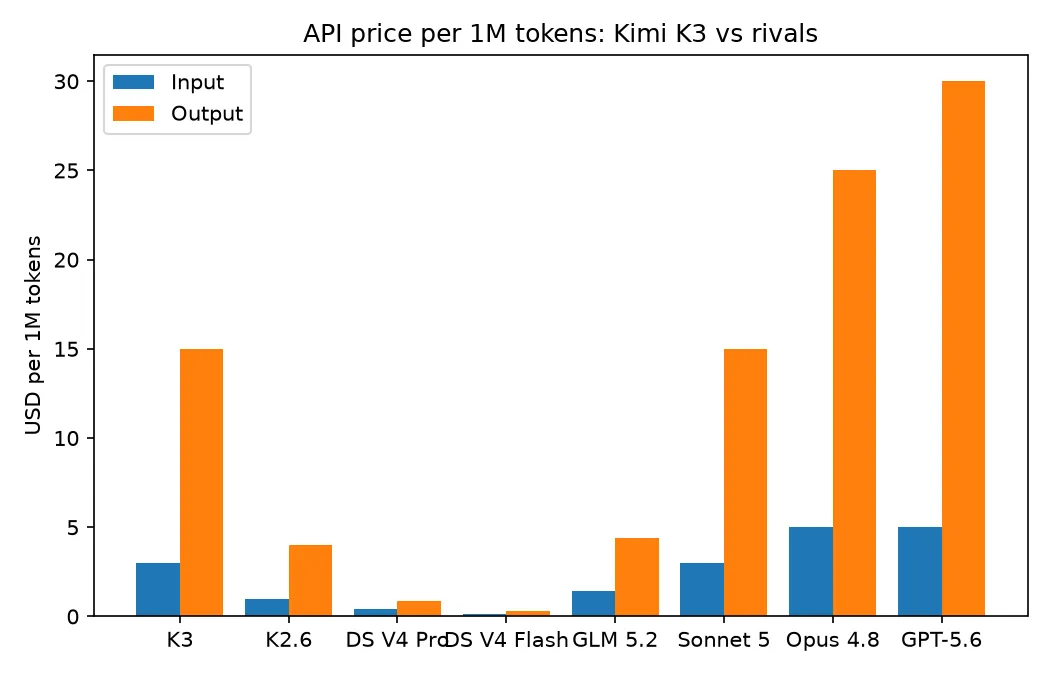
Three things stand out. First, K3 matches Claude Sonnet 5 to the cent and undercuts the top flagships (Opus 4.8, GPT-5.6), so Moonshot is pricing it as a serious frontier model, not a budget option. Second, within the Chinese open-model cohort it is the expensive one: DeepSeek V4 Pro is about a sixth of K3's input cost and GLM 5.2 roughly half, so K3 is a bet on capability over price in that group. If cost is the priority, the DeepSeek V4 Pro and Flash split and GLM 5.2 versus DeepSeek V4 Pro are the cheaper matchups worth weighing first. Third, it is a big step up from Moonshot's own K2.6, about 3x the input and nearly 4x the output, which means "just default everything to the newest Kimi" is now a real cost decision.
The cache discount is the real lever
The number that changes the math is the cache-hit input price: $0.30 versus $3.00, a 90% discount. Cached input applies when you resend the same context, and that is exactly the shape of the work K3 is built for. In a long agentic loop or a coding session over a large repository, the system prompt, the codebase, the docs, and the task history get sent again on every turn. With prompt caching, that repeated context bills at a tenth of the rate.
A concrete turn makes it obvious. Say an agent turn resends 100K tokens of repo and history, adds 2K of new input, and returns 3K of output. Without caching that is 102K input at $3 plus 3K output at $15, about $0.35 per turn. With the 100K cached at $0.30 and only the 2K new input at $3, plus the same output, it drops to about $0.08 per turn, roughly 77% cheaper. Multiply across a long session and caching is the difference between K3 being expensive and being reasonable.
The practical implication: K3's headline $3 input looks steep, but for cache-friendly workloads the effective input cost trends toward $0.30 as the conversation grows. If your usage is one-shot prompts with fresh context each time, you pay the full $3 and K3's premium bites hardest. (K2.6's cache hit is even cheaper at $0.16, so the same logic rewards it too.)
API vs membership: two ways to pay
The API rates above are one way to use K3. The other is a Kimi consumer membership, which prices access by tier rather than by token.
Plan | Monthly | Context | Notable |
|---|---|---|---|
Adagio | Free | — | Entry access |
Moderato | $19 | 256K | K3, Deep Research, Kimi Code, Slides |
Allegretto | $39 | 1M | Full 1M context unlocked |
Allegro | $99 | 1M | Agent Swarm up to 300 sub-agents |
Vivace | $199 | 1M | Largest quotas |
Two details matter here. Context length is a membership benefit on the consumer side: 256K on Moderato, the full 1M from Allegretto up, which is the opposite of the API's flat, un-tiered context. And the membership runs on a time-based quota rather than per-token metering; in hands-on use, a four-hour window was only about 15% consumed by a large task, so heavy single projects are viable on a plan without watching a token meter.
Rule of thumb: if you are building an app or agent, use the API and its cache discount. If you are working interactively in the Kimi app, CLI, or Kimi Code, a membership is simpler and the quota is generous for sustained sessions.
How to access the Kimi K3 API
Direct API: the model ID is
kimi-k3at base URLhttps://api.moonshot.ai/v1. The endpoint is OpenAI-SDK compatible, so pointing an existing client at that base URL with aMOONSHOT_API_KEYis enough to call it.Kimi CLI / Kimi Code: Moonshot ships an official CLI (Node/npm), where
/loginconnects either a Kimi Code OAuth session or a platform API key.Aggregators: K3 is also listed on OpenRouter as
moonshotai/kimi-k3at the same $3/$15. Multi-model gateways are handy if you route several models through one endpoint; platforms like AIReiter expose Chinese open models such as DeepSeek V4 and GLM 5.2 through an Anthropic-compatible API on the same pattern.
Note on weights: Moonshot lists K3 as open-weight (Modified MIT) with the full release due by July 27, 2026, but they are not on its Hugging Face org yet, so self-hosting is not an option until they land.
Is Kimi K3 worth the premium?
The scores now back the price. Artificial Analysis ranks K3 #4 of 189 on its Intelligence Index (57), one point ahead of Claude Opus 4.8 (56), and on Moonshot's own suite K3 edges Opus 4.8 across the board on coding and reasoning. So you are paying a frontier-tier price ($3/$15) for confirmed frontier-tier capability, and it still undercuts Opus 4.8 ($5/$25) and GPT-5.6 ($5/$30). That lines up with hands-on impressions, where K3 felt around Opus 4.8 tier on a real coding task; the full comparison is in Kimi K3 vs Claude Opus 4.8.
The catch is throughput: K3 is slow and verbose, and runs only at max reasoning effort, so per-task cost and latency can climb even at the lower per-token rate. So the value call: K3 earns its price on hard, long-horizon work, large-repo coding, multi-file agent runs, and tasks where the 1M context and cache discount pay off. For quick chat, short tasks, or high-volume simple calls, K2.6 at roughly a third of the cost, or a much cheaper DeepSeek V4, is the rational default.
FAQ
How much does the Kimi K3 API cost?
$3.00 per million input tokens and $15.00 per million output tokens, with cached input at $0.30, over a 1M-token context. Web search calls add $0.004 each.
Is Kimi K3 cheaper than Claude or GPT?
It matches Claude Sonnet 5 ($3/$15) exactly and undercuts Claude Opus 4.8 ($5/$25) and GPT-5.6 ($5/$30). It is more expensive than open rivals DeepSeek V4 and GLM 5.2.
How much more does K3 cost than K2.6?
About 3x the input ($3.00 vs $0.95) and nearly 4x the output ($15.00 vs $4.00). K2.6 remains the cheaper choice for routine work.
Does the K3 API price change with context length?
No. The API is flat pay-as-you-go regardless of context. Context tiering (256K vs 1M) applies only to consumer memberships.
Are Kimi K3 open weights available to self-host?
Not yet. K3 is open-weight (Modified MIT) with the full release due by July 27, 2026, but the weights are not on Moonshot's Hugging Face org yet, so self-hosting is not possible until they land.