 AIREITER
A coding agent loop that reads files, runs tests, and iterates burns 50,000 to 200,000 tokens per resolved issue. At GPT-5.6 Sol's $30/M output rate, a single task costs $1.50 to $6 in output tokens alone. DeepSeek V4 Pro lists at $0.87/M output—roughly 1/34th the cost—though its multi-step reliability has not been independently benchmarked at the same depth as Claude or GPT. Below, six models are compared by published coding benchmarks, verified API pricing, context limits, and best-fit agent workflow.
The 2026 Lineup: Six Models for Coding Agents
Each entry pairs benchmark numbers from official or leaderboard sources with API pricing verified in August 2026. Where the exact ranked model lacks a published score, the closest available variant is cited and labeled as a proxy.
1. Claude Opus 5 — The Quality Ceiling
Claude Opus 5 continues the Claude family's lead on the official SWE-bench Verified leaderboard. Claude 4.5 Opus (the predecessor) scored 76.8% under the mini-SWE-agent harness—a useful proxy for Opus 5's expected tier, though Opus 5-specific SWE-bench Verified scores are not yet published. Opus 5 offers a 1-million-token context window and 128K-token maximum output. At $5/M input and $25/M output, it is the most expensive mainstream option here. For agent workflows where a failed multi-file refactor costs more in human time than token spend, Opus 5 is the right call. For high-volume routine edits, it is not.
2. GPT-5.6 Sol — The Terminal-Task Specialist
GPT-5.6 Sol (model ID gpt-5.6-sol) is priced at $5/M input and $30/M output with a 1.05-million-token context window. On xAI's published benchmark comparison, GPT-5.6 Sol Max leads the field on Terminal-Bench v3.0 at 34.6% (vs. Grok 4.6's 26%) and on DeepSWE v1.1 at 73%. Those are the benchmarks most relevant to terminal-driven agent loops. The trade-off: at $30/M output, Sol is the priciest model in this lineup. OpenAI also reports SWE-bench Pro scores of 64.6% for Sol and 63.4% for Terra (the mid-tier variant), useful if you want a cheaper OpenAI option for less demanding tasks.
3. Grok 4.6 — The Long-Running Agent Value Play
Grok 4.6, released August 12, 2026, is designed for long-running agent workflows. Per xAI's announcement, it ties GPT-5.6 Sol Max on the Artificial Analysis Intelligence Index at 61 and beats it on CursorBench v3.2 (69.9% vs. 67.2%), FrontierCode v1.1 (61.3% vs. 60.6%), and APEX-Agents (57.5% vs. 56.7%). At $2/M input and $6/M output, it delivers benchmark performance comparable to GPT-5.6 Sol Max at roughly one-fifth the output cost. Its weak spot is raw terminal execution: Terminal-Bench v3.0 scores 26%, well behind Sol Max's 34.6%. If your agent workflow is IDE-centric (Cursor, Grok Build) rather than terminal-first, Grok 4.6 is the strongest quality-per-dollar option in this list. A "fast" variant doubles pricing to $4/$12 for lower latency. Context window is 500K tokens.
4. DeepSeek V4 Pro — The Budget Workhorse
DeepSeek V4 Pro is the cheapest frontier-tier model available via API: $0.435/M input and $0.87/M output, with cached input dropping to $0.003625/M. A 1-million-token context window and 384K-token maximum output make it viable for repository-scale tasks. No published multi-step agent benchmark evaluates DeepSeek V4 Pro against Claude or GPT at equal harness depth, so tool-call reliability in extended sessions should be validated in your own setup before committing to it for complex refactoring. For budget-constrained teams or as a first-pass model in a routed setup, the economics are strong. For the hardest multi-file refactors where reliability matters more than token cost, expect to escalate.
5. Gemini 3.1 Pro — The Large-Context Reader
Google's Gemini 3.1 Pro Preview is priced at $2/M input and $12/M output for prompts under 200K tokens (rising to $4/$18 above that threshold). Its standout capability is context capacity: Gemini's 2-million-token context window is the largest among models listed here, making it suitable for whole-repository reads where you load an entire codebase in one pass. As a proxy for 3.1 Pro's expected tier, Gemini 3 Flash scored 75.8% on SWE-bench Verified in a June 2026 snapshot by Tembo, second only to Claude 4.5 Opus. Gemini's tool-calling consistency in extended agent loops has not been benchmarked at the same depth as Claude or GPT; test it in your harness before deploying for multi-step workflows.
6. Kimi K3 — The Open-Weight Agent Option
Kimi K3 from Moonshot AI scored 70.8% on SWE-bench Verified in the same June 2026 snapshot—below GLM-5 (72.8%) and MiniMax M2.5 (75.8%) among open-weight models. As an open-weight model, it can be self-hosted for teams whose code cannot leave their network. Moonshot's hosted API offers K3 as well; specific pricing depends on deployment configuration. For local agent setups with adequate GPU hardware, K3 paired with a lightweight harness like OpenCode provides a capable coding agent without per-token API cost.
API Pricing and Cost per Completed Task
Per-token prices only tell half the story. What matters is cost per completed task—how much you spend to resolve one real GitHub issue through an agent loop.
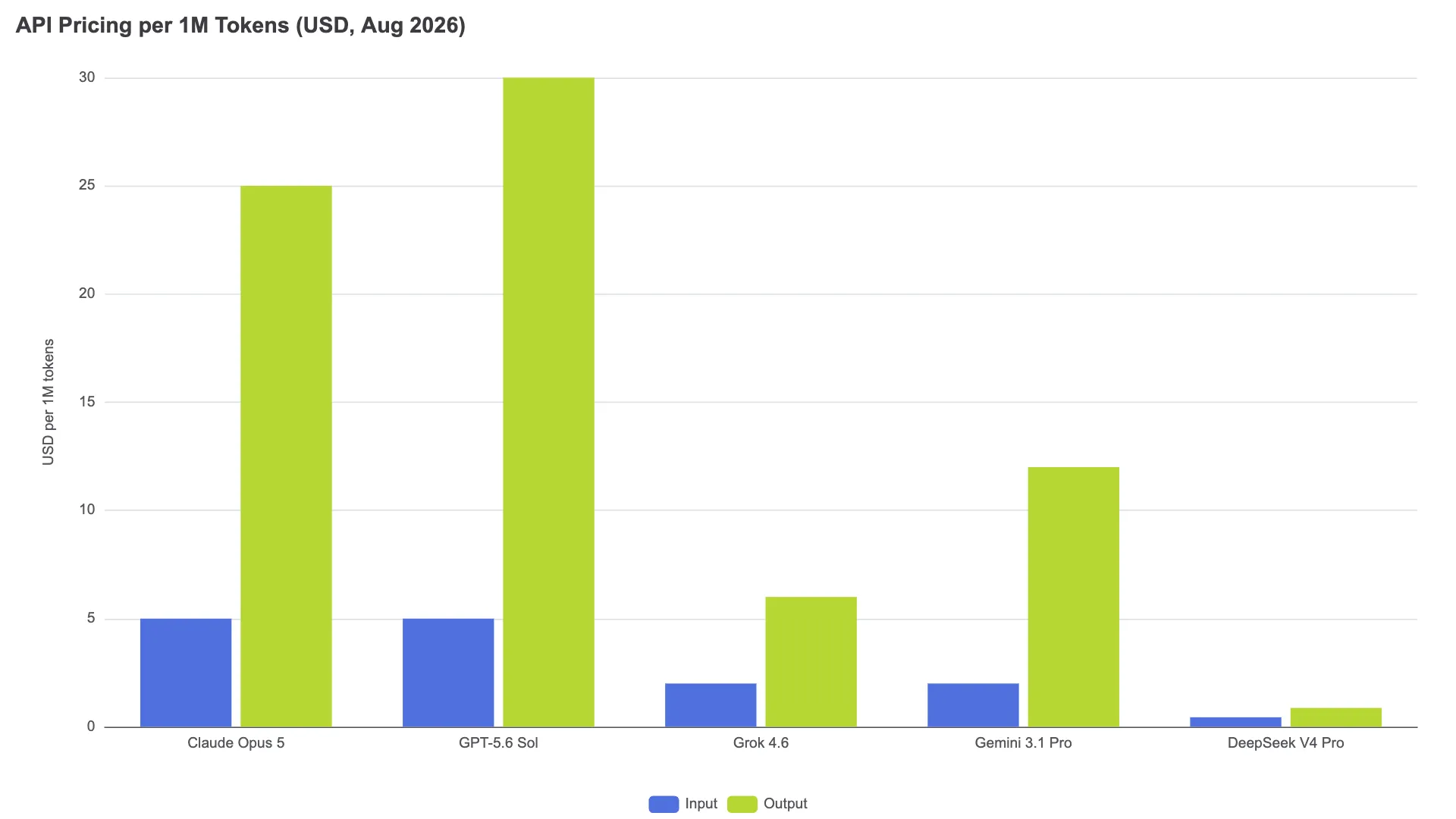
A typical agent loop (read files, plan, edit, run tests, fix failures) consumes roughly 50K–200K tokens per resolved issue, with output representing 30–50% of total tokens. These figures are industry estimates drawn from agent-loop analyses by Tembo and others; your actual consumption depends on repo size, test suite length, and harness efficiency. Using the midpoint of 125K total tokens (75K input, 50K output), here is what one resolved issue costs per model:
| Model | Input Cost | Output Cost | Total per Task |
|---|---|---|---|
| Claude Opus 5 | $0.375 | $1.25 | $1.63 |
| GPT-5.6 Sol | $0.375 | $1.50 | $1.88 |
| Grok 4.6 | $0.15 | $0.30 | $0.45 |
| Gemini 3.1 Pro | $0.15 | $0.60 | $0.75 |
| DeepSeek V4 Pro | $0.033 | $0.044 | $0.077 |
Kimi K3 is omitted from this table because its cost depends entirely on whether you use Moonshot's hosted API or self-host on your own GPUs; there is no single list price to compare. Grok 4.6 sits in a sweet spot at $0.45, matching GPT-5.6 Sol Max's Artificial Analysis Intelligence Index score at roughly one-quarter of Sol's per-task cost.
These estimates exclude retries, cached-token discounts, tool-call overhead, and infrastructure. A model that needs more retries or human corrections per task will cost more in practice than its per-token price suggests. That is why routing—sending routine work to DeepSeek or Grok and escalating hard refactors to Opus—can outperform committing to a single model.
Best Pick for Each Coding Agent Workflow
No single model fits every workflow. Here is which model to wire into which agent job.
Fast loops and routine edits. Use Gemini 3.5 Flash ($1.50/$9 per M tokens) or Claude Sonnet 5 for high-frequency, low-stakes work: error explanations, small function additions, test stubs, documentation updates.
Deep refactoring and architecture. Claude Opus 5 is the pick when the task involves multi-file changes, cross-module dependencies, or architectural decisions where a wrong guess costs hours of debugging. Its instruction-following precision and sustained context coherence over long sessions are the primary differentiator.
Long-running autonomous agents. Grok 4.6 was designed for exactly this use case. Per xAI's announcement, its development focused on sustained agent trajectories with self-checking behavior. At $0.45 per task, you can afford to let it run longer without the cost pressure that GPT-5.6 Sol's $1.88-per-task rate creates. For terminal-heavy workflows, GPT-5.6 Sol's Terminal-Bench lead (34.6%) makes it the safer choice.
Budget and self-hosted. DeepSeek V4 Pro via API is the default for cost-sensitive teams at $0.077 per task. For organizations that cannot send code to external APIs, self-host an open-weight model like Kimi K3 (70.8% SWE-bench Verified) or MiniMax M2.5 (75.8%). The open-weight field has narrowed the gap with closed-weight leaders to within a few percentage points on SWE-bench Verified.
The Harness Problem: Your Agent Tool Can Cap the Model
The harness your agent uses—Claude Code, Codex CLI, Cursor, or an open-source tool like OpenCode—controls four things the model cannot: context management (when to compact, what to retain), tool definitions and routing, error recovery patterns, and review/approval flows. As Tembo's analysis notes, a model's benchmark score under a controlled harness like mini-SWE-agent may not reflect its real-world resolution rate in a differently configured setup. This is why benchmarks that hold the harness constant are more useful for model comparison than vendor-published scores that conflate model and harness gains.
Before swapping models, audit your harness. Check whether your agent compacts context effectively, whether tool definitions are clean, and whether error recovery retries sensibly instead of looping.
FAQ
Which LLM is cheapest for coding agents?
DeepSeek V4 Pro at $0.435/M input and $0.87/M output is the cheapest frontier-tier option, costing roughly $0.08 per resolved agent task.
How do I test coding-agent models on my own repository?
Select 20–30 representative issues from your actual backlog—mix bug fixes, features, and refactors. Run each model through your chosen harness on the same tasks. Track three metrics: resolution rate (did the agent's patch pass your tests?), token consumption per task, and time to completion. This repo-specific evaluation is more predictive than any public benchmark.