 AIREITER
GPT Image 2 is the model people tend to reach for when a prompt is dense with small text — InfluencerStudio's comparison calls it the better pick for text-heavy commercial creative. Seedream 5.0 Pro (Seedream 5 Pro), launched July 8, 2026, claims major text improvements of its own. We ran the same four text-and-realism prompts through both models, kept the first generation from each, and compared. This is an image-quality comparison, not a price or speed benchmark (we did not measure those). For launch and API details, see our Seedream 5.0 Pro preview.
How We Ran the Battle
Test date: July 9, 2026.
Seedream 5.0 Pro: through the Jimeng app (Dreamina's Chinese consumer client). Pro's API is brand new and was not yet wired into third-party relays at test time, so the consumer app was our access path.
GPT Image 2: through the AIReiter relay, model
gpt_image_2.Method: same four prompts, verbatim (quoted under each round below), English, single generation each, first result kept, no rerolling, no negative prompt, default quality.
Aspect ratios: magazine and label at 3:4 on both; coffee at 4:3 on GPT Image 2 and an ultrawide default on Pro (Jimeng does not expose the same ratio control), so Round 3 is less controlled than the others; comic at 16:9 on both.
Output dimensions: Pro magazine and label at 1760×2352 px; GPT Image 2 magazine and label at 1086×1448 px. We did not recompress the outputs shown.
Two different access paths means platform-level differences (compression, defaults) may sit alongside model differences. This is a four-prompt snapshot, not a controlled benchmark. Treat the verdicts as indicative, and judge the side-by-side images and crops for yourself.
Round 1: The Magazine Cover
Generate a realistic glossy technology magazine cover. Masthead "BYTELINE" in bold letters at the top. Large main cover line "THE AI CHIP WARS". Four smaller cover lines stacked on the left: "Why Nvidia's next GPU matters", "Inside the TSMC roadmap", "The startup beating the giants", "What analysts got wrong". Include issue date "July 2026", issue number "No. 142", cover price "$8.99", and a small barcode in the bottom-right corner. Photorealistic, glossy print look, every word spelled correctly and crisp.
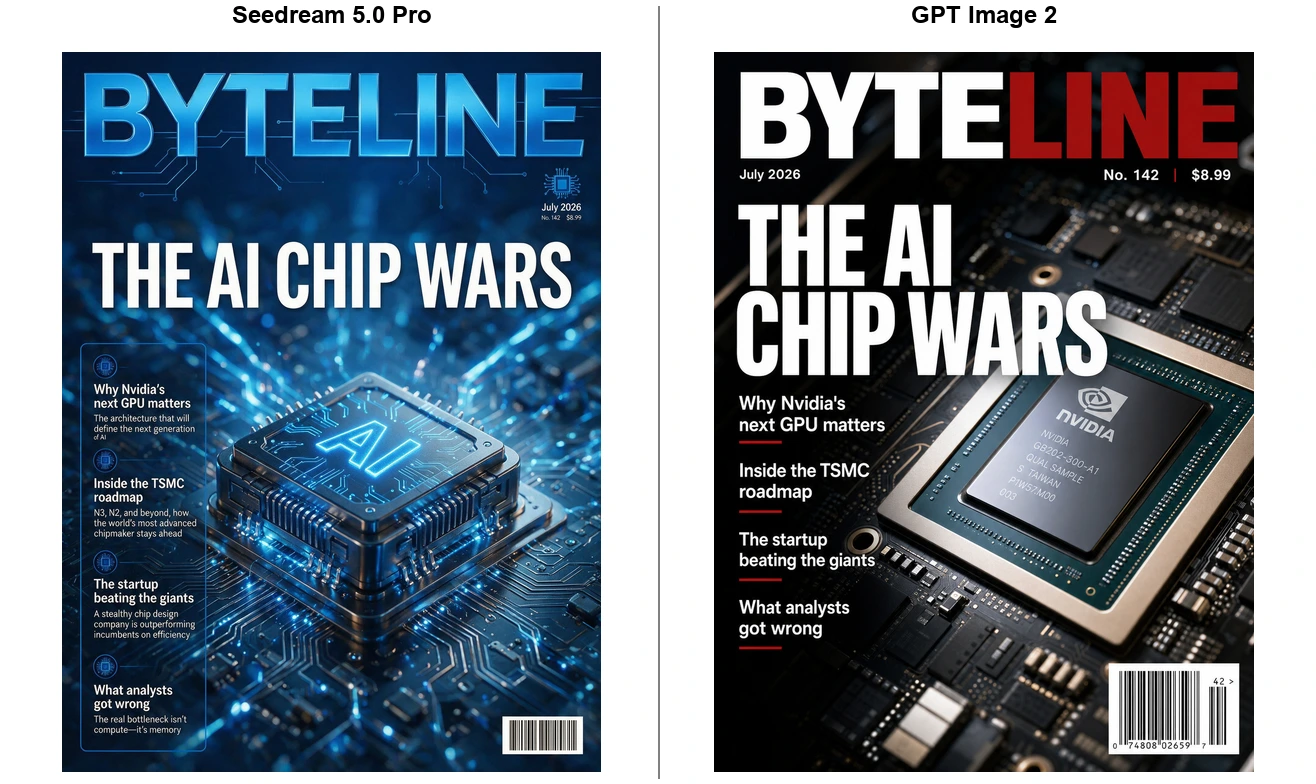
Both rendered every required element: masthead BYTELINE, the main line THE AI CHIP WARS, all four cover lines spelled correctly, No. 142, July 2026, $8.99, and a real-looking barcode. Zero text errors on either side.
The difference is in feel. Pro went beyond the prompt, writing body copy under each cover line ("The architecture that will define the next generation of AI", "N3, N2, and how the world's most advanced chipmaker stays ahead"), so the cover reads like a real magazine. GPT Image 2 kept the four headlines as clean, disciplined stand-alone lines, with a marginally crisper barcode.
Verdict: On small-text sharpness, GPT Image 2 (9/10) edges Pro (8/10). On editorial richness, Pro did more. If you want the cleanest type, GPT Image 2; if you want a cover that looks written, Pro. Round to GPT Image 2 on points.
Round 2: The Supplement Facts Label
Generate a "Supplement Facts" nutrition label. A clean bordered white panel with black text. Header "Supplement Facts". Below: "Serving Size 2 Capsules" and "Servings Per Container 30". Then a two-column table of rows: "Vitamin C 500mg 555%", "Vitamin D3 25mcg 125%", "Zinc 15mg 136%", "Magnesium 200mg 48%", "Omega-3 1000mg" with a dagger. Footnote: "Daily Value not established." All numbers and percentages must be accurate and legible.
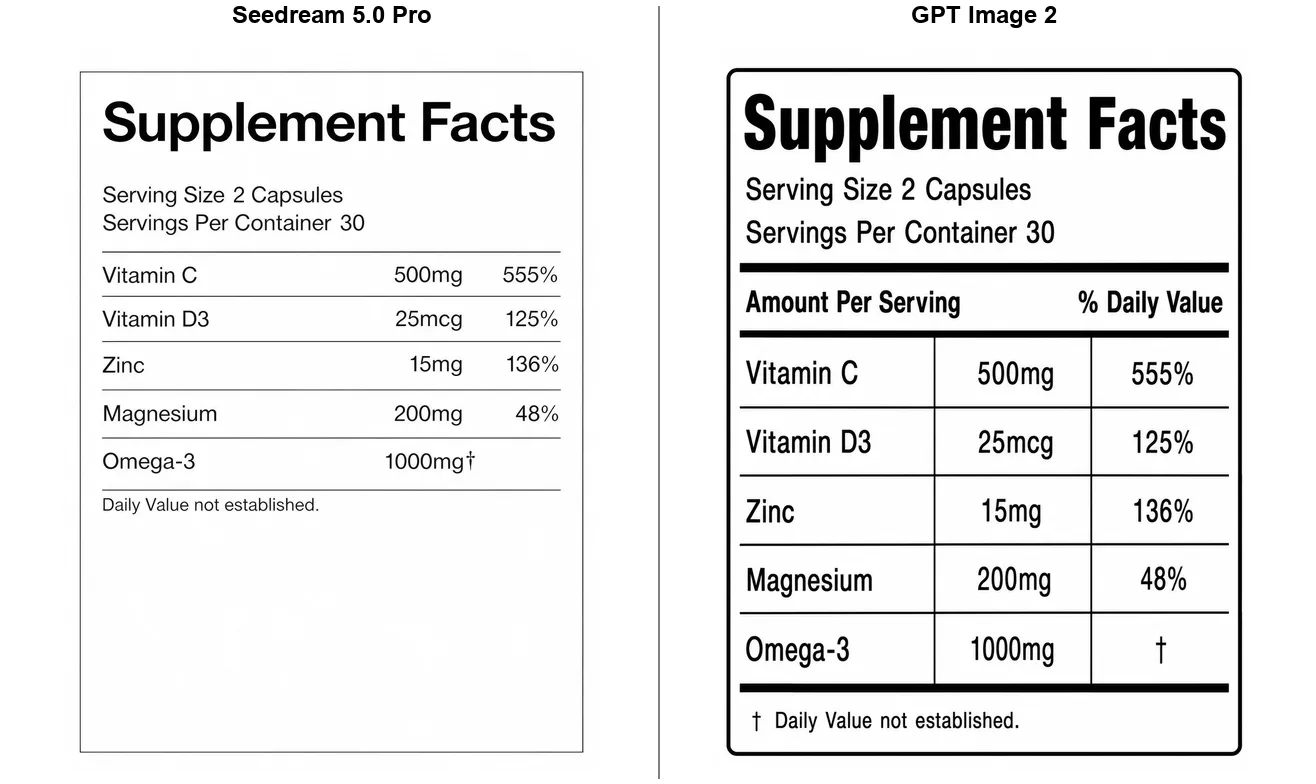
Both got every row exactly right: Vitamin C 500mg 555%, Vitamin D3 25mcg 125%, Zinc 15mg 136%, Magnesium 200mg 48%, Omega-3 1000mg, plus the serving size, the servings count, and the "Daily Value not established" footnote. No invented numbers, no swapped digits, no garbled percentages. Dense tabular data is where older image models usually break, and neither did.
GPT Image 2's panel reads as slightly more like a real pharmaceutical label, with tighter spacing and cleaner rule lines. Pro's is correct but looser in layout. Zoom in, though, and Pro's individual digits are just as crisp, so the gap here is in overall label polish, not in the numbers themselves.
Verdict: A dead heat on accuracy (both 10/10). GPT Image 2 wins on label authenticity (9 vs 8), but the digit-level sharpness is effectively tied. Round to GPT Image 2, narrowly.
Round 3: The Night Coffee Shop
A photorealistic photo of a cozy coffee shop storefront at night. A glowing pink neon sign reads "OPEN LATE". Painted on the front window: "Espresso Pour Over Cold Brew Pastries". A chalkboard A-frame on the sidewalk shows a price list: "Latte $4.50, Cappuccino $4.00, Cold Brew $4.75". Warm interior light spilling onto a wet sidewalk with reflections. All text accurate and readable.
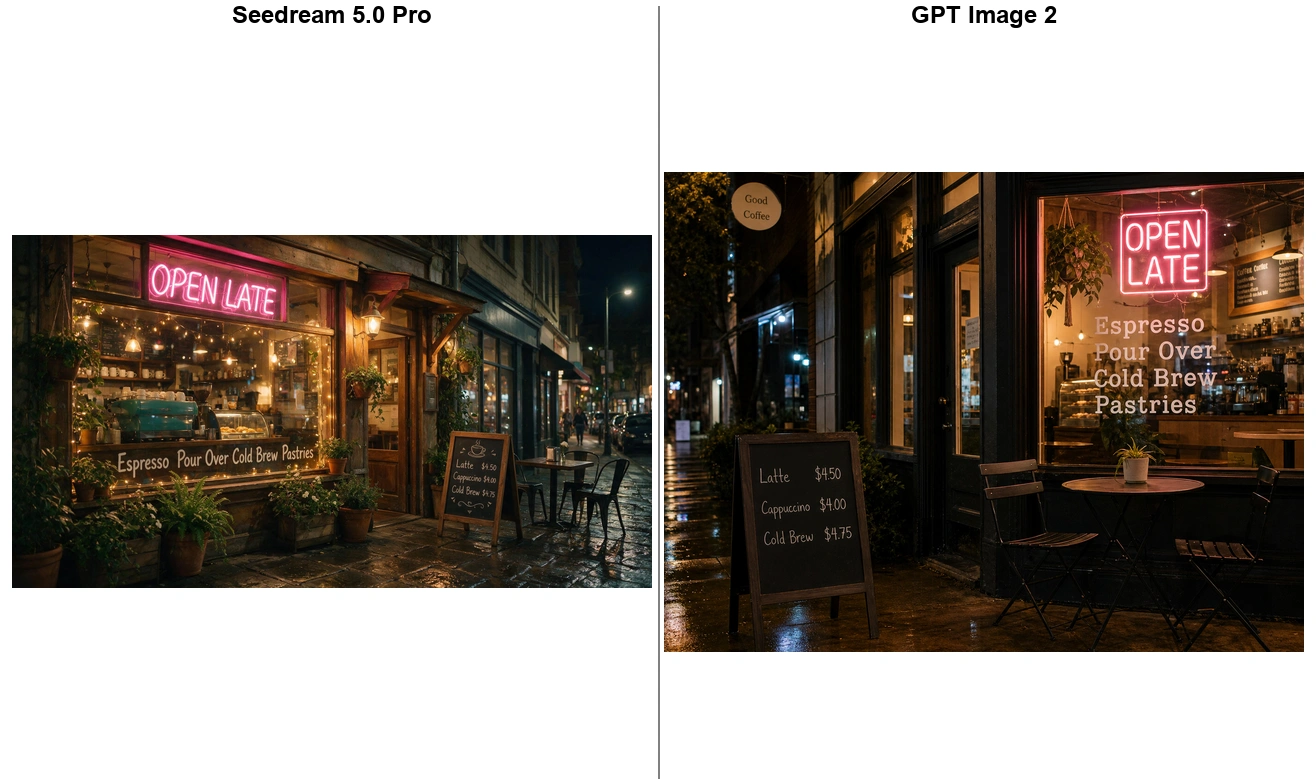
Both rendered the pink OPEN LATE neon, the window text (Espresso · Pour Over · Cold Brew · Pastries), and all three chalkboard prices ($4.50, $4.00, $4.75) correctly and legibly. Note Pro's frame is wider (Jimeng default) than our 4:3 setting for GPT Image 2, so this round is less controlled on framing.
GPT Image 2's scene reads as more photographically real: the neon has a softer bloom, the wet-pavement reflections are richer, and the interior glow sells the "open late" mood. Pro's is clean and correct but flatter, closer to an illustration than a photo.
Verdict: GPT Image 2 on realism (9 vs 8). Round to GPT Image 2.
Round 4: The Four-Panel Comic
A 4-panel black-and-white comic strip laid out as a wide horizontal strip, four panels side by side, about a robot learning to cook. Panel 1: robot holds a cookbook titled "COOKING FOR BEGINNERS". Panel 2: robot cracks an egg and makes a mess, speech bubble "Oops!". Panel 3: robot reads a page labeled "STEP 4: STIR GENTLY". Panel 4: robot serves a perfect pancake, speech bubble "Nailed it!". Clean line art, each panel numbered 1 to 4, every word spelled correctly.
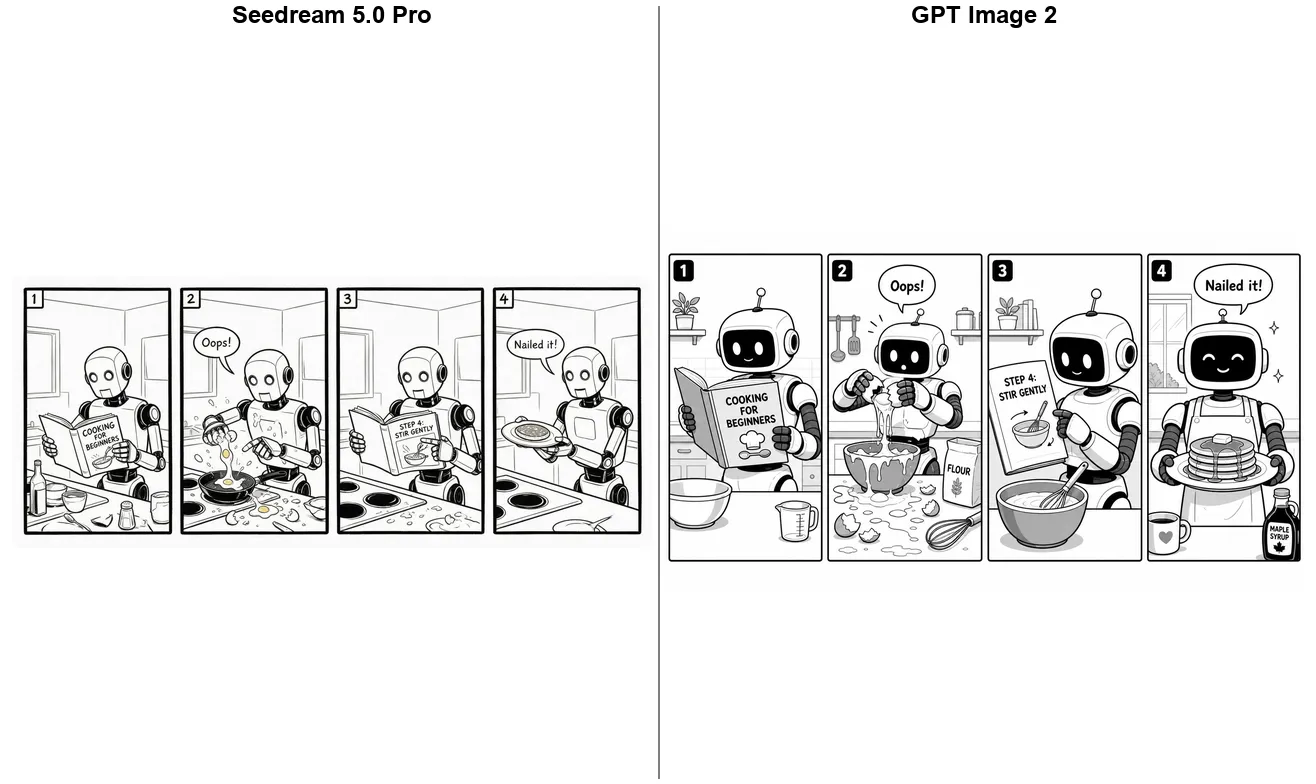
Both produced four numbered panels with every speech bubble and book label spelled correctly: COOKING FOR BEGINNERS, Oops!, STEP 4: STIR GENTLY, Nailed it!. No garbling in any panel.
GPT Image 2's strip reads more coherently: the robot's story (study, mess up, follow the step, succeed) flows, and the line art is cleaner. Pro's beats are all present, but the jump from "egg mess" to "stir gently" feels slightly abrupt, and the inking is heavier.
Verdict: GPT Image 2 on coherence and craft (9.5 vs 8.5). Round to GPT Image 2.
The Scorecard
Round | Accuracy | Rendering (our judgment) | Winner |
|---|---|---|---|
1. Magazine cover | Tie (both perfect) | Pro 8 / GPT Image 2 9 | GPT Image 2 (Pro richer content) |
2. Supplement label | Tie (both perfect) | Pro 8 / GPT Image 2 9 | GPT Image 2 (narrow; digits tied) |
3. Night coffee shop | Tie (both perfect) | Pro 8 / GPT Image 2 9 | GPT Image 2 (less controlled) |
4. Four-panel comic | Tie (both perfect) | Pro 8.5 / GPT Image 2 9.5 | GPT Image 2 |
How to read the numbers. Accuracy is binary per element (a word or number is right or wrong). For the rendering score we weigh four things together: text sharpness, layout fidelity, realism, and prompt adherence. On that scale, 10 = flawless and publication-grade; 9 = sharp and polished, minor quibbles only; 8 = clean and correct, with visible softness or flatness; below 8 would mean a noticeable defect.
GPT Image 2 swept the rendering points, but only by about one point per round, and Seedream 5 Pro matched it on accuracy everywhere. If your bar is "did it spell every word and get every number right," Pro cleared it on all four.
So Who Should You Actually Pick?
The scorecard can mislead. GPT Image 2 won four rounds of rendering polish; that is not the same as being the right model for you. The decision flips on what else you need. Here is the buyer view in one table (untested cells are marked, not guessed):
Factor | Seedream 5.0 Pro | GPT Image 2 |
|---|---|---|
Text accuracy (our 4-prompt test) | Perfect (4/4) | Perfect (4/4) |
Small-text crispness (our test) | 8/10 | 9/10 |
Photorealism (our test) | 8/10 | 9/10 |
CJK / multilingual | Native strength (per separate test) | Comparatively weaker |
Pinpoint editing | Official Pro feature, not tested here | Limited |
Transparent-layer export | Official Pro feature, not tested here | No |
API availability | Brand new (Jul 8, 2026) | Established on relays |
Per-image price | Not yet settled on relays | Established relay rates |
Speed | Not benchmarked | Not benchmarked |
Best for | CJK, editing, layers, ecosystem | Text and realism polish |
Pick GPT Image 2 if your output lives or dies on small-text crispness and photoreal finish (magazine covers, product mockups, ad creative) and you do not need editing or layers.
Pick Seedream 5.0 Pro if you work in Chinese or other CJK languages, you need post-generation editing or transparent-layer separation, you are already in the Seedream/Dreamina or AIReiter relay ecosystem, or a roughly one-point rendering gap does not justify switching platforms.
The CJK and editing advantages are official Seedream 5 Pro strengths, not something this four-prompt test measured; we link our separate multilingual test and the official feature page above.
FAQ
Is GPT Image 2 better than Seedream 5 Pro at text?
Only on first-pass rendering sharpness, and only narrowly (about 9 to 8 in our test). On accuracy, spelling, and data, the two tied with zero errors.
Does Seedream 5 Pro add text the prompt didn't ask for?
Sometimes. On the magazine cover it wrote body copy under each cover-line headline. That reads as richer and more magazine-like, but if you need the exact copy from your prompt verbatim, it is a thing to check for. GPT Image 2 stuck closer to the literal prompt on that round.
Which is better for Chinese / CJK text?
Seedream 5 Pro. CJK rendering is a Seedream native strength. We did not run a dedicated CJK round in this test, but Pro's four-language rendering was clean in our separate infographic test.
What about price, speed, and switching?
We did not benchmark price or speed. GPT Image 2 has established per-image relay rates; Seedream 5 Pro's API launched July 8, 2026, and relay pricing is still settling (see our preview for access). Switch from GPT Image 2 to Pro only if you need CJK strength, editing, layer separation, or ecosystem fit. For Pro against its own cheaper sibling, see Seedream 5 Pro vs 5 Lite.