 AIREITER
LongCat 2.5 API pricing looks like a steal at $0.30 per million input tokens, but that rate is a limited-time promo with no end date, while preview users report loops that make cheap tokens expensive. I would run a small cache-heavy trial, not a production migration, until you measure cost per accepted result.
Production fixed the price, not the trust problem
LongCat 2.5 shipped officially. Meituan published the LongCat-2.5 blog November 1, 2026 and enabled LongCat-2.5 on the API platform November 2, 2026, with OpenAI Chat Completions, OpenAI Responses, and Anthropic Messages endpoints.
The trust problem survives release. Preview testing in OpenCode was rough enough that production buyers still ask whether November 2 fixed looping and destructive edits. The honest answer from public evidence is unproven. Nearly all detailed failure reports cover LongCat-2.5-Preview from late September to October, and no independent lab had rerun the production checkpoint as of November 3.
"I tested LongCat 2.5: strong on paper, one real crack in my tests." — @prompt48, after a Christmas-tree HTML test where ornaments scattered outside the tree on the free chat page.
That quote matches the Reddit pattern. Real OpenCode users describe a different failure mode in agent runs, not chat demos:
"Used it for setting up a VM and it kept going in loops when performing simple ls commands on multiple occasions." — u/Such_Competition8263 on r/opencode
"It changed code completely unrelated to the task in the most random way." — u/Avernite on the same thread.
What you buy: API-only model with Coming-soon weights
LongCat 2.5 purchase reality is API-only access to a very large mixture-of-experts model with no downloadable weights. LongCat 2.5 totals 1.6 trillion parameters with about 48 billion active per token, accepts text plus image and video input, and emits text only across a 1,048,576-token context with up to 262,144 output tokens. Short version: huge context, text out.
Multimodality is native, not bolted on. Images convert to discrete tokens in the same sequence as text, with up to 100 images per request at 10 MB each in PNG, JPG, JPEG, WebP, or GIF, plus up to 10 videos by public URL at 100 MB and under 3,600 seconds each. Thinking budget caps at 262,144 tokens and returns as reasoning_content, with temperature locked at 1.0 when thinking is on and 0.7 when thinking is off.
Preview Sep 25 vs production Nov 2: what changed
LongCat-2.5-Preview versus LongCat-2.5 distinction explains most confusing search results. LongCat-2.5-Preview went live September 25, 2026 with 1M context and image understanding, then production LongCat-2.5 shipped November 1 to 2 with video input, Trajectory2Task+ training from failed agent runs, and 4-bit W4A4 serving claiming 43.3% higher prefill throughput than 8-bit.
Weights did not follow the model. GitHub and Hugging Face buttons still read "Coming soon" after launch, while LongCat-2.0 remains the largest downloadable LongCat model under MIT. At 1.6T total parameters, self-hosting is not a near-term option for most teams.
What $0.30 per million costs for LongCat 2.5 API pricing
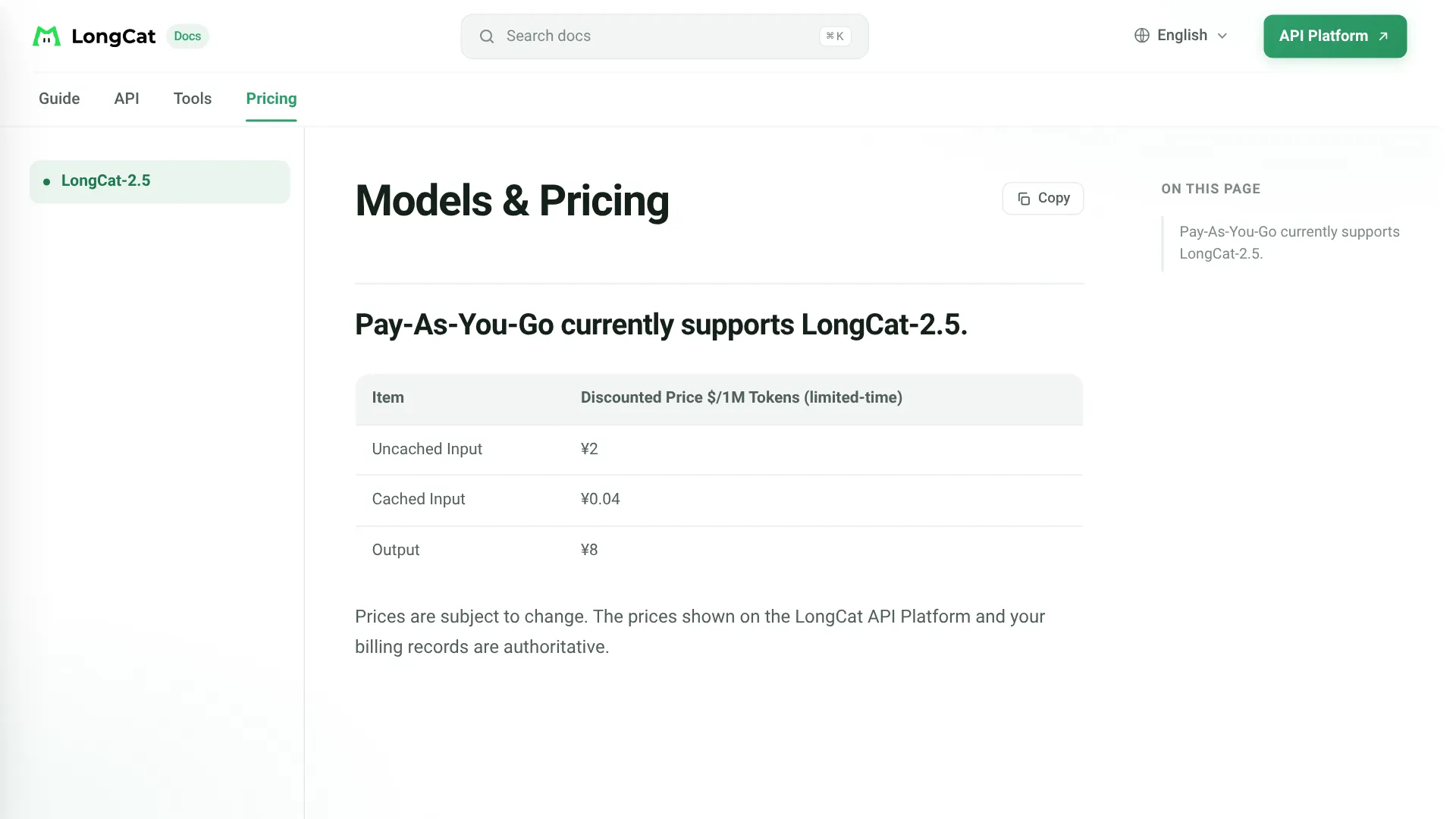
LongCat 2.5 API pricing has three promo rates and one expensive counterweight.
| Token type | Promo rate per 1M | Multiple |
|---|---|---|
| Uncached input | $0.30 | 1x |
| Cached input | $0.006 | 0.02x |
| Output | $1.20 | 4x input, 200x cached |
The billing formula is (uncached input x 0.30 + cached input x 0.006 + output x 1.20) / 1,000,000. Reasoning tokens count inside output, not as a separate charge. For 1 million input tokens at 80% cache hit, input cost drops from $0.30 to $0.0648. That is a 78.4% input saving, not 98%, because the 98% discount applies only to cached tokens themselves.
Two workloads at promo rates show why output dominates. A 20,000-input plus 2,000-output summary costs $0.0084, or $8.40 per thousand. A repeated-context agent request with 200,000 uncached plus 800,000 cached plus 40,000 output costs $0.1128, or $112.80 per thousand.
Failed-tool retries, overlong responses, and unusable-but-billable HTTP 200s inflate the bill. Measure cost per accepted result as total billed cost across all attempts divided by accepted results.
Promo has no end date: budget past the discount
LongCat 2.5 promo pricing limitation is temporal, not technical. Meituan labels $0.30/$1.20/$0.006 as limited-time with no announced end date and no published regular price. Meituan reserves the right to change prices with platform billing records authoritative.
Clues point to a large step-up later. ZenMux showed a pre-discount Preview price of $0.75 input and $2.95 output, and Artificial Analysis listed LongCat-2.0 at the same $0.75/$2.95. That is about 2.5x the promo, implying promo is roughly 40% of a possible regular price. Meituan's Chinese pricing page, via Hokai's Nov 3 check, lists CNY 2 uncached, CNY 0.04 cached, and CNY 8 output per million tokens.
Token Packs and enterprise tiers
| Spend per month | Enterprise discount |
|---|---|
| $75+ | 10% |
| $300+ | 20% |
| $1,200+ | 30% |
| $6,000+ | 40% |
- Token Packs: fixed quota, 30-day validity, flash-sale windows, quota consumed first, cache hits free, misses and output burn quota, unused auto-refunded.
- Pay-as-you-go: balance does not expire, card and Google Pay, failed 401/403/429/500 unbilled.
- Enterprise tiers reset monthly and exclude Token Pack usage and promo credits.
Provider routes compared: same rates, different risks
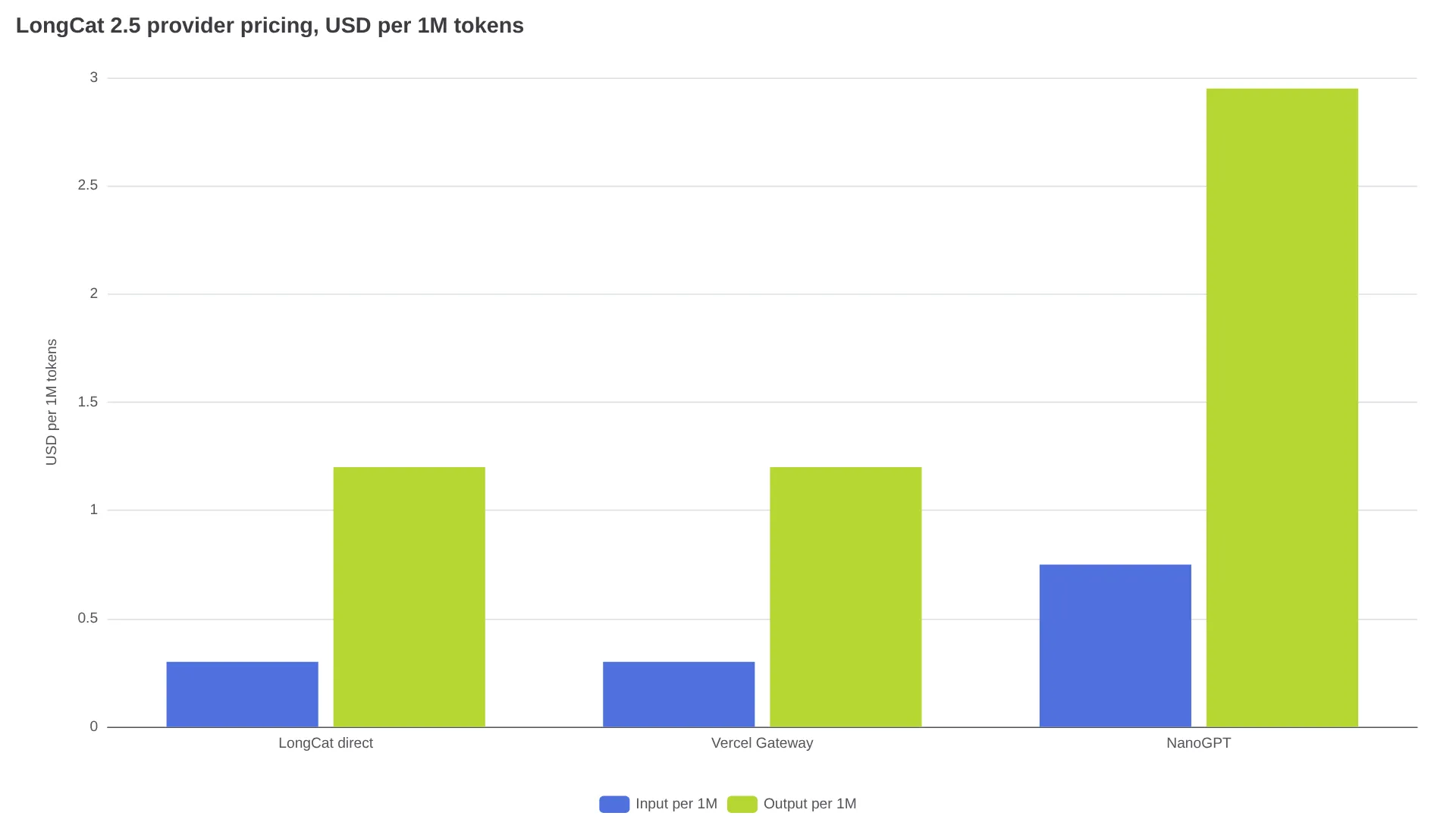
LongCat 2.5 provider pricing comparison looks flat until quality and terms enter.
| Route | Input / 1M | Cached / 1M | Output / 1M |
|---|---|---|---|
| LongCat direct | $0.30 | $0.006 | $1.20 |
| Vercel AI Gateway | $0.30 | $0.006 | $1.20 |
| NanoGPT | $0.75 | $0.015 | $2.95 |
LongCat official API is the first-party route with direct cache reporting and Token Pack access. Vercel adds gateway credits, routing, limits, and provider terms on top of matching token rates. OpenCode's free Preview window was a separate client promo, not proof the first-party API is free.
Blended math favors heavy cache users, until it does not. TokenPricing blends 3:1 input-to-output with half input cached to $0.4147 per million, while Hokai blends 3:1 without cache to $0.525 and ranks LongCat-2.5 #27 of 94 peers against a $1.63 median. Either blend collapses if your harness reports low cache hits or generates long reasoning traces.
Check three things before picking a route. Confirm whether the listed model ID is LongCat-2.5 versus a preview alias. Confirm whether cache hits appear in usage payloads. Confirm whether data terms, output caps, and retry policies match the official LongCat API docs.
Benchmarks are vendor-run: read them like this
LongCat 2.5 benchmarks assessment requires discounting the source. All LongCat-2.5 scores in Meituan's table are vendor-run. Some rival scores come from public reports and others were rerun by Meituan as indicative only. Neither Artificial Analysis nor OpenRouter listed LongCat-2.5 as of November 3.
| Benchmark | LongCat-2.5 | Best cited rival |
|---|---|---|
| Terminal-Bench 2.1 | 88.4 | 90.6 DeepSeek V4.1 Flash |
| Terminal-Bench 4.0 | 38.5 | 53.9 Opus 5 |
| DeepSWE 1.1 | 64.6 | 74.2 DeepSeek Flash |
| NL2Repo | 60.5 | 75.3 Opus 5 |
| BrowseComp | 91.9 | 91.5 DeepSeek Flash |
| VideoMME | 85.2 | 90.0 Kimi K3 |
The pattern is near-parity on the older Terminal-Bench release and BrowseComp, with clear gaps on deeper terminal, repo, and program-development suites. The comparison also omits newer rivals like Kimi K3.1 Pro, GPT-6 Astra, and Claude Opus 5.5.
The terms teams miss: data reuse, temperature lock, no SLA
LongCat 2.5 data and ops terms decide company-code suitability faster than benchmarks. API terms grant LongCat a free worldwide license to use inputs, outputs, and feedback for service optimization, brand promotion, and marketing unless an enterprise or separate written agreement changes that. API servers may sit in Frankfurt, Hong Kong, and mainland China under Singapore law and SIAC arbitration.
- Fixed sampling removes low-temperature reproducibility; audio input and image generation absent.
- No retention period or SLA published; self-hosting waits on undated weights release.
- Failed auth, rate-limit, and server errors unbilled; successful yet useless responses bill normally.
"I have to say, the 1m token context window is beastly cool. been working with LongCat2.5, it's a good bug hunter with that context window for sure." — @alexokita
That bug-hunter framing is the safe way to use the 1M window: tightly scoped error-code fixes with human review, not unsupervised refactors.
Should your agent call LongCat 2.5
LongCat 2.5 fit decision comes down to supervision tolerance and confidentiality. The model suits cost-sensitive Claude Code, Codex, or OpenCode users running cache-heavy long agents, screenshot-to-code frontend work, and browse-plus-build research where visual input saves a description step.
| Use LongCat 2.5 when | Look elsewhere when |
|---|---|
| Repeated large context drives high cache hits | Regulated or highly confidential code without enterprise terms |
| Task is a bounded bug fix from a clear error code | Task is an autonomous multi-file refactor |
| You can review diffs and measure cost per accepted result | You need fixed low temperature, SLA, or immediate self-hosting |
The unresolved trade-off is promo versus proof. At $0.30/$1.20 with $0.006 cache, LongCat-2.5 undercuts Claude Opus pricing at $5/$25 by about 16x on input. Opus 5 still leads the harder terminal and repo suites in Meituan's own table. Run a metered trial on your harness, compare accepted-result cost against DeepSeek V4.1 Flash and GLM-class cheap runners, and only then decide whether the discount outweighs the supervision tax.
Related reading: DeepSeek V4.1 Flash 1017 review for coding, GLM 5.3 benchmarks and pricing, Kimi K3.1 Pro API pricing guide.
LongCat 2.5 API pricing FAQ
How much does LongCat 2.5 API cost?
LongCat 2.5 API costs $0.30 per million uncached input tokens, $0.006 per million cached tokens, and $1.20 per million output tokens on promo. Output costs 4x uncached input, so long reasoning traces dominate the bill.
Is the $0.30 rate permanent?
No. Meituan labels LongCat 2.5 pricing as limited-time with no end date and no regular price. Budget against the $0.75/$2.95 Preview-era reference as a possible step-up scenario.
Is LongCat 2.5 open source or API-only?
LongCat 2.5 is API-only as of early November 2026. GitHub and Hugging Face show Coming soon with no date or license, while LongCat-2.0 stays the downloadable MIT option.
Can LongCat 2.5 run in Claude Code and OpenCode?
Yes. LongCat 2.5 supports OpenAI Chat Completions, OpenAI Responses, and Anthropic Messages with model ID LongCat-2.5. Point base URL and model name at LongCat direct or a gateway, then verify cache reporting on your route.
Is LongCat 2.5 safe for company code?
LongCat 2.5 company-code safety depends on contract terms, not benchmarks. Default API terms allow input and output reuse for optimization and marketing, so regulated or confidential work needs an enterprise agreement with data-use carve-outs.
Is production LongCat 2.5 different from Preview?
Yes. Preview shipped September 25 with image understanding, while production shipped November 1-2 with video input and retrained agent behavior. Public failure reports mostly cover Preview, so production reliability still needs independent reruns.