 AIREITER
Anthropic now positions Claude Opus 5.5 as the default for knowledge work on paid plans, and the evidence mostly backs that call — with one catch that dominates real user reports: quota disappears faster than expected on Pro, Max, and Team.
Opus 5.5 launched September 22, 2026 as the first model in the Claude 5.5 family, with Anthropic claiming performance at the level of Claude Fable 5.1 for most work while costing 40% less to run than Opus 5 (anthropic.com). On November 12, 2026, Anthropic's daily-driver guide made the positioning explicit: start with Opus 5.5 at Medium effort for research, analysis, writing, reports, spreadsheets, and presentations, and only escalate from there (claude.com). This review synthesizes that official guidance, independent benchmarks, and user quota reports — it is not a first-party lab test.
The 30-second verdict: keep it as default, lock it to Medium
Leave Opus 5.5 selected. Run it at Medium effort for ordinary knowledge work. Raise effort before you switch models, and drop to Sonnet 5.5 or Haiku 5.5 when speed or volume matters more than judgment.
The reason is arithmetic, not loyalty. Opus 5.5 at Medium matched or beat Opus 5 at High on Anthropic's coding and knowledge-work evaluations, and Factory — quoted in Anthropic's daily-driver guide — reported Medium matching Opus 5 at High while using 20–25% fewer output tokens. Medium is also the default in Claude apps and Claude Code, so most subscribers get this behavior without touching a setting.
The qualifier: subscription quota is the binding constraint, not API list price. API pricing is $4 per million input tokens and $20 per million output tokens, down from $5/$25 on Opus 5, with cache reads at $0.20 per million. But higher-priced models consume subscription limits faster, per Anthropic's daily-driver guide, and real users report 5-hour windows emptying in 15–30 minutes on heavy sessions plus weekly limits draining far earlier than during the September honeymoon.
What the November default switch actually changed for Pro, Max, and Team
What matters for subscribers is the quota mechanics under the new default. Anthropic said at launch it was increasing five-hour usage limits on Pro, Max, Team, and seat-based Enterprise plans and giving subscribers a savable rate-limit reset (anthropic.com), despite late-October user reports of faster drain detailed below. Anthropic's guide notes that Pro and standard Team and seat-based Enterprise seats generally do not include Fable 5.2 within normal limits outside launch offers — Fable draws on usage credits instead. Plan for Opus as the included workhorse and Fable as the metered exception.
Where the daily-driver claim holds: research, analysis, writing
Research memos that survive an every-figure audit
The strongest test is a sourced company-performance report where the earnings release was deliberately hard to find and any invented figure or quotation failed the whole report. Opus 5.5 passed 16 of 18 reports across effort settings; Anthropic says neither Fable 5.1 nor Opus 5 cleared the same bar in any attempt (claude.com). Walleye Capital's external check, also reported in Anthropic's launch post, adds color: Opus 5.5 largely solved its suite at the lowest effort setting and at higher effort caught an off-by-one indexing error in the evaluator's own instructions — which Walleye said no previously tested model had caught.
What this means for daily use: delegate open research with a defined deliverable and sources attached, then audit figures rather than prose.
Analysis: spreadsheets, merger math, and dense charts
In a fictional merger of two HR-software companies, both Opus 5 and Opus 5.5 built an Excel model and an executive presentation and reached the same deal conclusion. Opus 5.5 finished in 63 minutes versus 93 minutes, cost a reported 50% less to produce, shipped a more thorough model, and made fewer minor errors (claude.com). On finance workflows more broadly, Hebbia reported 86.6% criteria coverage for Opus 5.5 versus 60.3% for Opus 5, and Rogo reported beating Opus 5 at High on BigFinance Bench with about 60% fewer output tokens, per Anthropic's launch post.
Vision is part of the same story. Anthropic calls Opus 5.5 its best Opus model for vision — dense documents, chart values, screenshots, diagrams — and reports that Opus 5.5 at its lowest effort read dense charts more accurately than Opus 5 at its highest (claude.com). The published Chartography score is 64.4% without tools at the highest evaluated setting (claude.com) and 89.0% with tools on the launch scorecard, and GDPval-AA professional-work Elo is 1846 versus 1735 for Fable 5.1 and 1708 for Opus 5 (anthropic.com).
Practical takeaway: ask for the finished spreadsheet or slide deck directly, attach the chart image instead of transcribing values, and state the stopping condition in the first message.
Writing: finished docs and decks, not outlines
The writing claim is narrower than "better style" — it is instruction following plus auditability. Anthropic says Opus 5.5 stays in scope, leads with conclusions, uses less jargon, follows supplied style rules, and explains what it did, what it found, and what input it still needs. Independent boards align directionally: Hayz Labs scores Opus 5.5 at 100 for writing and 100 for coding with research at 94, ranking it first for WebDev and agents and second for creative writing on Arena as of its October check.
The honest limit: exact house-style matching still takes iteration.
The effort dial is the price tag
Opus 5.5 has five effort levels — Low, Medium, High, Very High/Extra High, Max — per eesel's effort breakdown, and thinking cannot be disabled, per Hayz Labs. The per-token price barely moves the bill compared with this dial.
Task math reported by eesel's summary of Artificial Analysis figures puts the same difficult task at roughly $0.55 on Low, $1.34 on Medium, and $5.98 on Max, with Intelligence Index scores of about 42, 51, and 58 respectively. A Max run can emit on the order of 119,000 output tokens, which at $20 per million output is where the money goes. Hayz Labs' Pareto view lands nearby: about $1.61 median per agent task over 14 days ($1.76 main-table median), with High around $1.82.
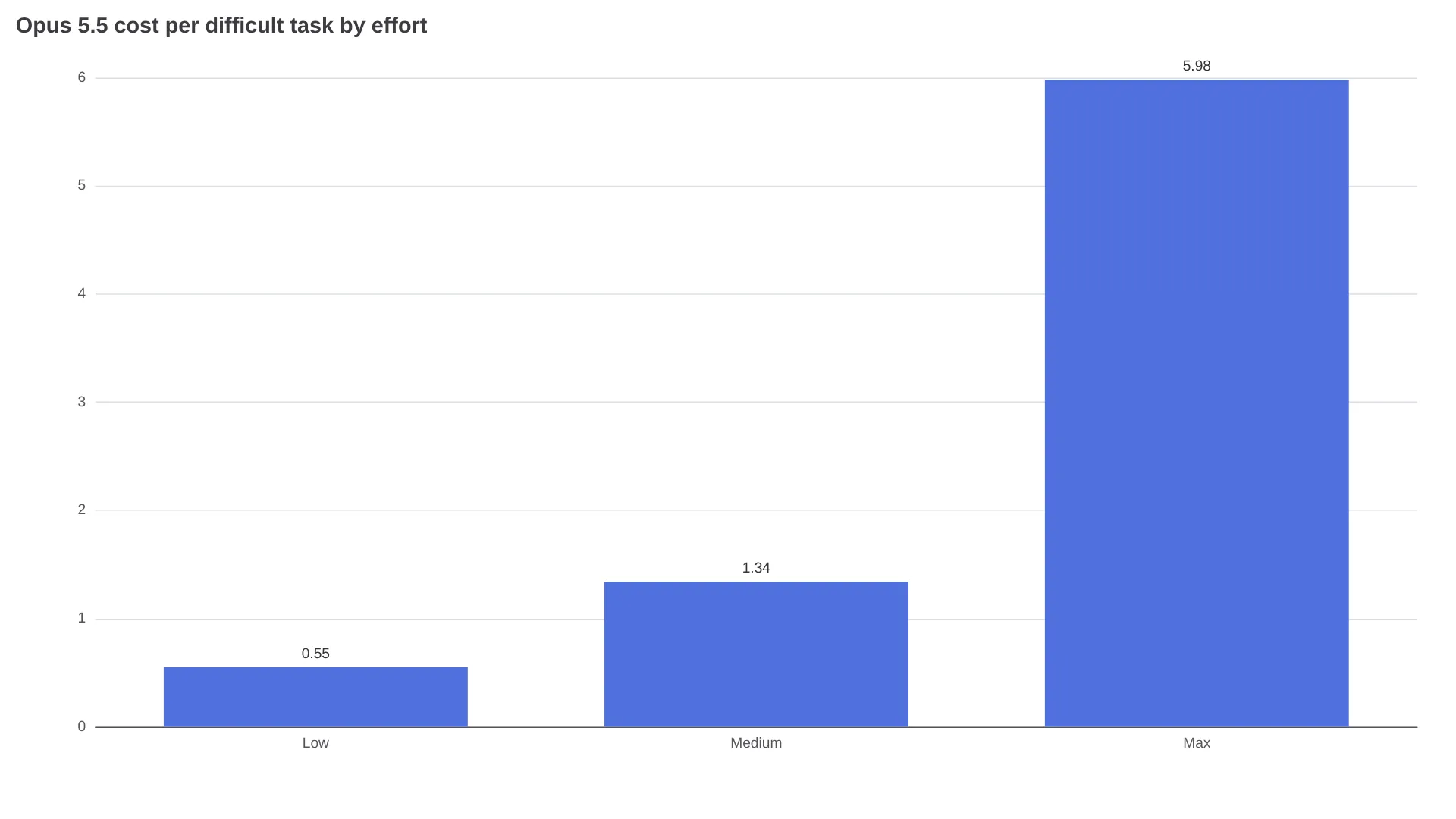
Higher effort takes longer and costs more without always improving the result. Anthropic's own advice is to strip phrases like "think hard" — reasoning is already on, and the effort setting plus the task determine depth — and only step up when Medium demonstrably stalls.
Context window is 1 million tokens with up to 128,000 output tokens (300,000 in Batch) and native vision, per eesel's spec sheet. There is no long-context surcharge, per eesel's pricing review, which matters for the audit-long-documents workflow.
Four-model routing: Opus 5.5 vs Sonnet 5.5 vs Haiku 5.5 vs Fable 5.2
Anthropic's November guide plus independent cost analysis converge on one rule: adjust effort first, switch models second. Prices below are per Anthropic's daily-driver guide pricing table.
| Model | API price per 1M (in/out) | Use it for | Switch away when |
|---|---|---|---|
| Haiku 5.5 | $0.10 / $0.50 up to 100K tokens | Quick lookups, summaries, sorting, high-volume narrow work | Analysis gets extended or judgment-heavy |
| Sonnet 5.5 | $2 / $10 | Clear well-scoped tasks, polishing docs, slides from a defined brief | You reach Extra High or Max effort routinely |
| Opus 5.5 | $4 / $20 | Most research, analysis, financial work, finished documents | Medium stalls after a genuine retry at High |
| Fable 5.2 | $8 / $40 | Open-ended technical work, science, coding, finance with long-running subagent teams | Ordinary knowledge work — usually excessive |
The crossover to memorize: Sonnet 5.5 pushed to Extra High or Max can cost nearly as much per task as Opus 5.5 while still trailing it on judgment. Coding-plan users report the same mechanic from the subscription side: avoid parking Sonnet above Medium and move the task to Opus 5.5 on Low instead (see e.g. @cupid25157). That matches the official "effort before model" ladder and the per-task cost math.
Fable is the ceiling, not the competitor. Anthropic's November Fable 5.2 thread frames Fable and Mythos for the most ambitious open-ended technical work and Opus 5.5 as the strongest daily driver for most coding and knowledge tasks (@claudeai). In subscription terms the distinction is sharper: standard Pro/Team seats often bill Fable to credits, so casual Fable use can convert a "better model" impulse into a credits bill.
Quota survival: why the 5-hour window melts and how to stop it
This is the section official benchmarks skip and user reports obsess over. The most concrete complaint is quota consumption, not capability.
"Opus 5.5 limits are getting DESTROYED tonight !! Multiple people report 5-hour quotas burning out in ONLY 15-30 minutes on normal sessions. Weekly limits are draining WAY faster" — @TekonBurns, reporting Claude Code session burn
Some users describe the shift as a sudden honeymoon end — @kgauravnm writes that "the Claude Opus 5.5 honeymoon phase is officially over," citing lazy behavior and fast weekly burn — while Team-seat reports such as @ps_ios_dev describe Medium-effort usage "racing" even after the free weekly reset. One caveat worth keeping: a 67,000-message Claude Code log analysis by @sonuv_dev found tool calls, failure rates, and complaint rates roughly flat — "basically zero evidence of a nerf" — which suggests at least part of the pain is heavier default usage plus pricier reasoning, not a secret downgrade. And model choice matters at the ceiling: @mohitsharmadl reports a case where Fable 5.2 at Medium cleared bugs Opus 5.5 High could not, so "Opus for everything" wastes quota on the wrong ceiling.
A quota playbook that reflects both the official guidance and what users say works:
- Default everything to Opus 5.5 Medium; treat High as a diagnosed step-up, not a personality setting.
- Split by subtask: Haiku for retrieval and sorting, Sonnet for scoped drafting and polish, Opus for judgment, audit, and final sign-off.
- Never park Sonnet above Medium habitually — price the crossover and move the task to Opus Low/Medium instead.
- Attach files and connect repositories rather than pasting the same context repeatedly; re-sent long context adds tokens every turn, which increases measured usage.
- Save the rate-limit reset for a real deadline week instead of burning it on experimentation.
- Reserve Fable for the narrow class it wins (long-horizon, multi-agent, open-ended technical) and confirm whether the seat bills it to credits first.
FAQ: daily-driver questions people actually ask
Is Claude Opus 5.5 good enough to use as a daily driver?
Yes for research, analysis, and writing workloads where judgment and auditability matter. Hayz Labs ranks it first for agents and WebDev with top writing scores, and enterprise checks quoted by Anthropic point the same way. Keep a cheaper model wired for volume work alongside it.
Is Opus 5.5 better than Sonnet 5.5 for everyday work?
For ambiguous or high-consequence work, yes. For clear, well-scoped, high-volume tasks, Sonnet at Low or Medium is faster — Anthropic rates Sonnet Fast versus Opus Moderate (claude.com) — and roughly half the token price. The mistake is running Sonnet at Extra High or Max by default — that erases the savings.
When should I use Opus 5.5 instead of Fable 5.2?
Use Opus for most knowledge work and standard coding tasks. Escalate to Fable for open-ended, long-running, or heavily agentic technical projects where Opus at High still stalls — and check plan billing first, since standard Pro/Team seats often bill Fable to credits.
Does the 1-million-token context work reliably for long documents?
For audit-style work with attached files it is the strongest Opus configuration Anthropic has shipped, including the 16-of-18 sourced-report result. Very long jobs still consume subscription quota quickly, so keep retrieval on Haiku and judgment on Opus rather than running everything on the largest context.
The trade-off to watch
Opus 5.5 is the right default for knowledge work at Medium effort; the open question is whether the late-October quota tightness users report is the new normal, in which case more of each week still runs on Sonnet than launch messaging implied.
Related reading: Claude Opus 5.5 pricing review, Claude Opus 5.5 High review, Claude Opus 5.5 vs GPT-6.1 Sol.