 AIREITER

Opus 5.5 wins on quality, GPT-6.1 Sol wins on list price, but only while your requests stay under 272K input tokens each. Cross that line and Sol's long-context surcharge erases most of its edge, and several Codex users say Sol feels slower on the wall clock anyway.
Both models are live today. Anthropic shipped Claude Opus 5.5 on September 22, 2026 as the first Claude 5.5 model, and OpenAI shipped GPT-6.1 Sol on September 29, 2026 with API ID gpt-6.1-sol. Spec tables alone skip the three things that decide the bill: the long-context cliff, the effort setting, and subscription quota behavior.
The 30-second answer
Pick Claude Opus 5.5 when a wrong or bloated patch costs more than tokens: long-running migrations, multi-repo audits, and unattended agents. Pick GPT-6.1 Sol when you run high-volume, well-scoped work under 272K input tokens per request: ticket automation, PDF extraction, and business workflows.
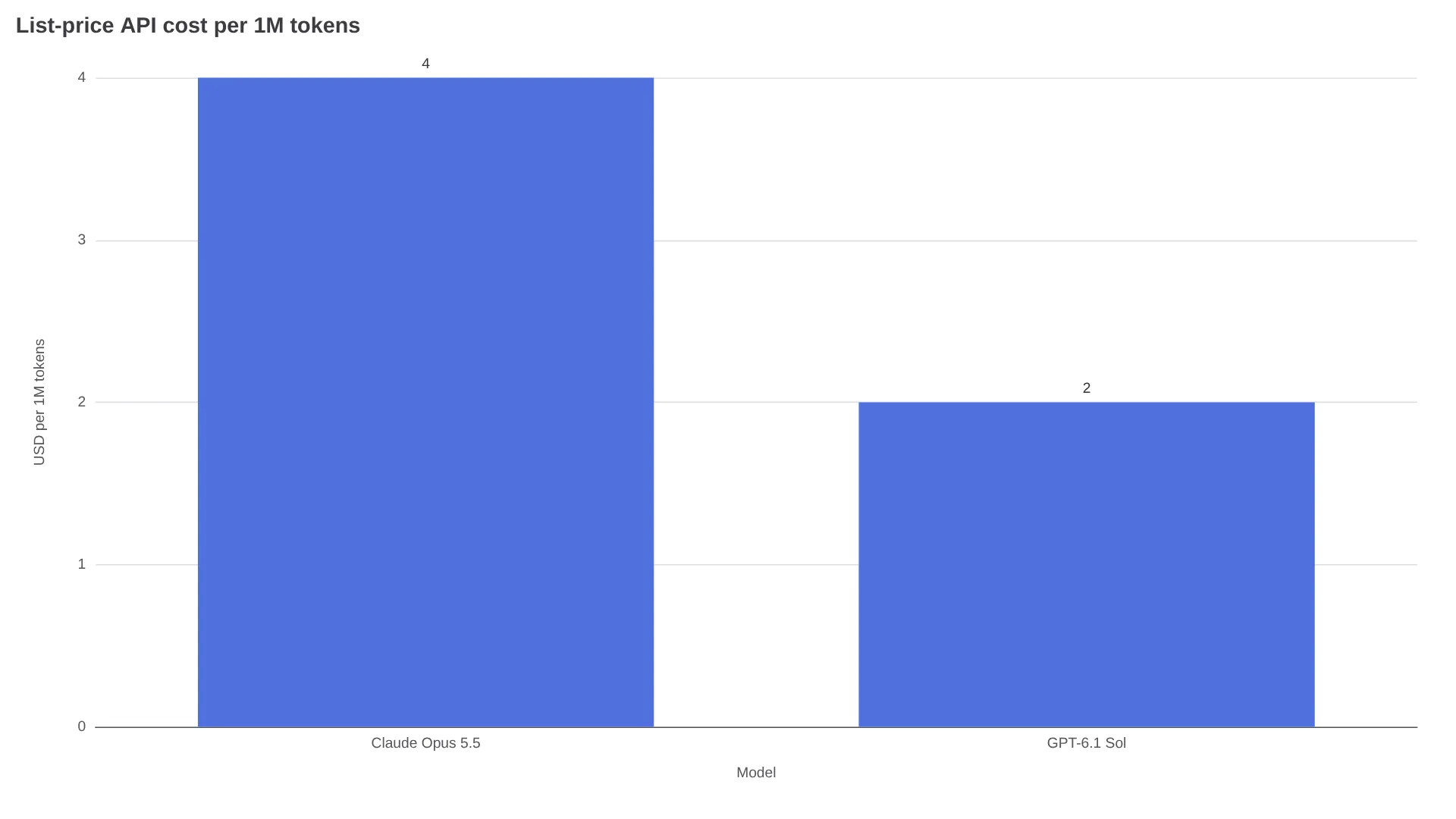
The spec gap is narrow on paper: 1M vs 1.05M context, 128K max output on both, $4/$20 vs $2/$10 per million input/output tokens. The behavior gap is wider: Opus 5.5 posts higher agentic-coding numbers (66.4% Terminal-Bench 4.0, 54.4% FrontierCode v1.1, 57.8% CursorBench 4.0), while Sol answers with roughly half the list price and a documented win on AutomationBench at one-third the task cost. Subscription users add a twist: Reddit quota tests show Sol draining allowance faster than its API price predicts.
Price, context, and where to call it
| Claude Opus 5.5 | GPT-6.1 Sol | |
|---|---|---|
| Provider | Anthropic | OpenAI |
| Released | September 22, 2026 | September 29, 2026 |
| API ID | claude-opus-5-5 family on most gateways | gpt-6.1-sol |
| Input / output per 1M | $4.00 / $20.00 | $2.00 / $10.00 |
| Cached input read per 1M | $0.20 | $0.10 |
| Context window | 1,000,000 tokens | 1,050,000 tokens |
| Max output | 128K tokens | 128K tokens |
| Fast tier | Fast mode $8 / $40, up to 2.5x speed | Ultrafast up to 8x in Codex, ~2x list rates |
| Available via | Claude Code, API, Bedrock, Vertex, Foundry, OpenRouter | Codex, ChatGPT Work, API, Azure, Bedrock, OpenRouter |
| Not in | — | Regular consumer Chat at launch |
Both switch with a model-string change. AIReiter routes both from one console without managing two vendor keys.
What you actually pay on real workloads
Headline rates say Sol is 50% cheaper. Real workloads depend on per-request size and cache.
OpenAI's surcharge applies per request above 272K input tokens: 2x input and cache rates plus 1.5x output for that whole request. Anthropic lists the full 1M window at the same rates, with no per-request surcharge disclosed. Cached reads are $0.20 vs $0.10, so cache-heavy loops preserve part of Sol's edge.
| Workload | Opus 5.5 | GPT-6.1 Sol | Gap |
|---|---|---|---|
| Balanced assistant: 1M in / 250K out, requests under 272K each | $9.00 | $4.50 | Sol 50% cheaper |
| Retrieval, requests under 272K: 10M in / 1M out | $60 | $30 | Sol 50% cheaper |
| Retrieval, every request over 272K: 10M in / 1M out | $60 | ~$55 | Sol only ~8% cheaper |
| Cache-heavy loop: 100K prefix written once, then 1,000x (5K fresh + 100K cached read + 1K out) | ~$60.50 | ~$30.25 | Sol ~50% cheaper |
Totals are list-rate math before tokenizer differences. Sol's advantage is strongest for short, high-volume requests and weakest for giant single-shot retrievals.
Subscription math diverges from API math. One user-run 128-prompt comparison of GPT-6.1 Sol vs GPT-6 Sol vs Opus 5.5 on fixed prompts found Sol-family subscription consumption higher than token price implied, and a follow-up commenter put it bluntly:
"my chatgpt just cited this. anyways they may be a match usage-wise but opus is way faster on the wall clock and i regret swapping this month." — u/ebrbrbr, r/ChatGPT quota test thread
Another Codex user reported the same drain:
"I wouldn't mind using GPT 6.1 Sol if the usage was decent, but man, even though it's more 'efficient' I'm still getting drained on usage. It's unbelievable." — u/Longjumping_Stop6269, r/codex
Budget rule: if your median request exceeds 272K, model the surcharge before you migrate. If you live on a $20 or $100 seat, track quota share per merged PR, not tokens per dollar.
Coding and agents: benchmarks plus two task tests
Third-party runs below are directional; harnesses and effort levels differ. Sources: Anthropic, OpenAI, DataCamp build test, OpenRouter throughput, SpringPrompt benchmark rollup.
| Benchmark | Opus 5.5 | GPT-6.1 Sol | Note |
|---|---|---|---|
| Terminal-Bench 4.0 | 66.4% | not published | Anthropic-run, xhigh |
| FrontierCode v1.1 Main | 54.4% | matches Fable 5.1, no number | Different reporters |
| CursorBench 4.0 | 57.8% | not published | Anthropic-run |
| DeepSWE v1.1 | not published | matches Astra, +6.4pp over GPT-6 Sol | OpenAI-run, max effort |
| AutomationBench (47 tools) | 40.0% | +2.2pp over Opus at medium, ~1/3 cost | Independent-run, no fallbacks, per Anthropic account of Zapier test |
| OSWorld 2.0 partial | 81.8% | ~60.5% offline set | Different subsets, vendor-run |
| GDPval-AA v2.1 | 1,846 Elo | Sol beats Opus-with-fallbacks on GDP.pdf at <1/2 cost | Cross-vendor claim from OpenAI |
Opus 5.5 posts the fuller published agentic-coding set; Sol's best documented wins are business workflows and document analysis at lower task cost. Anthropic says its scores were taken with production safeguards on.
Two third-party task tests add texture:
- Single-file Tetris build (DataCamp, OpenCode, same prompt, high effort, one attempt). Both passed the hard gravity-flip logic. Sol scored 5.0 vs 4.3 on mechanics, completeness, and feel; Opus finished in 3 turns and 2 tool calls vs 6 turns and 9 calls, but cost $0.87 vs $0.26 after spending 22.5K reasoning tokens to Sol's 8.1K.
- 128-prompt quota test (Reddit, fixed prompts, quota plus timing logged). Sol consumed more subscription allowance than GPT-6 Sol on the same workload while Opus finished faster on the wall clock.
One recurring user report is restraint:
"The biggest win with Opus 5.5 for me isn't even raw coding speed, it's that it doesn't over-engineer simple fixes. Previous models would rewrite 4 files when you asked for a 3-line patch; 5.5 respects the existing architecture" — u/food_fatherr, r/ClaudeAI
One extreme over-generation report cuts the other way: one developer reported Sol writing 30,000 tests for a pixel-perfect request, then deleting only 25 when asked to trim.
Speed you feel vs speed you read
Spec sheets favor Opus on decode: ~96 vs ~53 tokens/sec on Artificial Analysis via SpringPrompt, 74 vs 29 median throughput on OpenRouter, with Sol slightly ahead on time-to-first-token per SpringPrompt (1.71s vs 6.89s at low effort). The cited Codex reports describe the opposite on end-to-end waits, including multi-minute simple tasks and long document jobs.
Both can be true: tokens/sec measures decode after the first chunk; wall-clock adds reasoning, queueing, and harness overhead.
- Opus Fast mode costs $8/$40 (2x) for up to 2.5x speed; Sol Ultrafast promises up to 8x in Codex at ~2x rates.
- The cited Codex and Work reports focus on latency, not API decode. One 40-minute PDF job used only 6% of a 5-hour window in a single anecdote, not a typical rate.
- If your loop is interactive (Cursor, Claude Code, Codex CLI), test three real tickets on each before committing.
The settings that decide the bill
Defaults matter more than the badge:
- Start Opus on Medium or High. The cited user reports suggest Extra High and Max burn quota with little gain on ordinary patches.
- Thinking locks differ. Opus thinking cannot switch off, forced tool use is rejected, and edited context on newer accounts can throw a 400 (DataCamp API notes). Sol scales from
nonetomaxand can change effort mid-conversation without invalidating cache (DataCamp reasoning controls), friendlier for cost-capped loops. - Guardrails reroute work. Most Opus cybersecurity tasks reroute to Opus 4.8 outside the Cyber Verification Program; biology work needs the Life Sciences program (Anthropic). Expect fallback-related quality and quota surprises on those tasks.
Which one for your workload
| If you are doing… | Pick… | Why |
|---|---|---|
| 200K-line migration, multi-repo audit, 9-hour agent run | Opus 5.5 | Higher agentic scores, fewer unwanted rewrites, flat 1M pricing |
| 10K tickets a day under 272K each, RAG with small chunks | GPT-6.1 Sol | Half list price, strong AutomationBench and GDP.pdf per-dollar |
| Giant single-shot retrieval over 272K per request | Opus 5.5 or chunk for Sol | Sol surcharge collapses its lead to ~8% |
| PDF-heavy finance and legal Q&A | Test Sol first | Claimed win over Opus-with-fallbacks at <1/2 task cost; verify on your docs |
| $20-seat subscriber, interactive CLI | Test both; cited reports favor Opus | Users report Sol drains faster than token math predicts and feels slower |
No universal winner. Sol is the efficiency play, Opus the restraint-and-autonomy play. A practical split is Opus for planning and review with Sol on bulk execution.
Opus 5.5 vs GPT-6.1 Sol FAQ
Which is cheaper through the API?
Sol at list ($2/$10 vs $4/$20, $0.10 vs $0.20 cached). The gap shrinks to ~8% when every request exceeds 272K inputs.
Which is better for coding agents?
Opus 5.5 leads published Terminal-Bench, FrontierCode, and CursorBench; Sol counters with DeepSWE parity-to-Astra and an AutomationBench win at one-third cost.
Which is faster in real use?
Decode favors Opus (~74–96 tok/s vs ~29–53); first-token slightly favors Sol. October 2026 Codex reports skew slower for Sol.
What are the API model IDs?
gpt-6.1-sol, and claude-opus-5-5 slugs on most gateways.
Is GPT-6.1 Sol in regular ChatGPT?
Not at the September 29 launch: Work, Codex, and API first. Recheck your seat if access matters.
What effort setting should I use?
Start Opus 5.5 on Medium or High, not Max; start Sol on medium and raise only when retries rise. Reasoning tokens ride the same per-token meter on both (DataCamp billing notes).
The trade-off you can't prompt around
Opus 5.5 respects the repo but charges for the thinking; Sol discounts the tokens but can flood you with work to review and wait on. If a silent miss ships a bug, pay for Opus. If misses are cheap and volume is king, bank the Sol savings under 272K.
Related reading: Claude Opus 5.5 review and pricing, GPT-6.1 Sol API pricing review.