 AIREITER
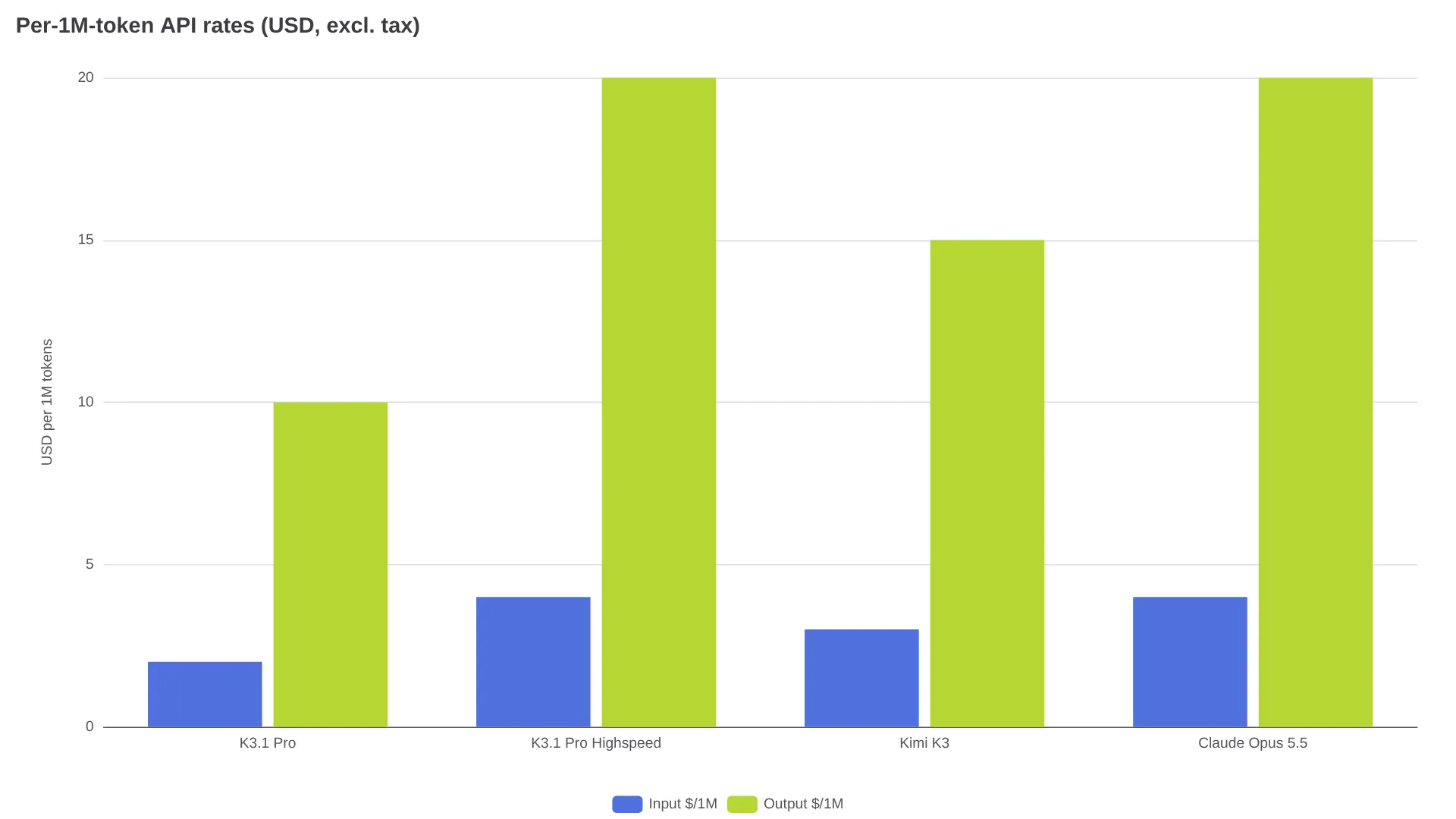
Kimi K3.1 Pro API pricing comes down to one split: the $2/$10 sticker versus what reasoning and cache behavior add to the invoice. Standard costs $2 per 1M input and $10 per 1M output, Highspeed doubles both for speed, and cache-hit reads stay $0.20 on either tier (platform.kimi.ai).
| Model | Input / 1M | Output / 1M | Cache-hit read / 1M | Cache write 5-min / 1M | Cache write 1-hr / 1M |
|---|---|---|---|---|---|
Kimi K3.1 Pro (kimi-k3.1-pro) | $2.00 | $10.00 | $0.20 | $2.00 | $4.00 |
Kimi K3.1 Pro Highspeed (kimi-k3.1-pro-highspeed) | $4.00 | $20.00 | $0.20 | $4.00 | $8.00 |
| Kimi K3 (previous gen) | $3.00 | $15.00 | $0.30 | $3.00 | $6.00 |
Rates are USD per 1M tokens before tax, flat across the full 1M context with no long-context surcharge, per Kimi's official pricing material (kimi.ai).
A 100K-context request lists at $0.30, the invoice adds the rest
A textbook example of 100,000 uncached input tokens plus 10,000 output tokens costs $0.20 plus $0.10, or $0.30, by direct arithmetic from the official $2/$10 rates. Use this general formula for any real request (standard tier; double the input, output, and write rates for Highspeed):
Total = (uncached_in x 2 + cached_read x 0.20 + write_5m x 2
  + write_1h x 4 + (visible_out + reasoning_out) x 10) / 1M
  + searches x 0.004
The formula follows Kimi's official cost breakdown of uncached input, cache hits, cache writes by TTL, and output (kimi.ai), plus the $0.004 per Web Search invocation. Because billing is pay-as-you-go per request (kimi.ai), a retried request runs the same meter again. Reasoning is always enabled on K3.1 Pro and billed at output rates, so hidden reasoning traces consume the same $10/1M budget as the visible answer. A 10,000-token visible answer with 40,000 hidden reasoning tokens bills 50,000 output tokens, or $0.50. One real user report of 935 input tokens and 56,097 output tokens for $0.5628 matches the $10/1M output rate almost exactly (x.com).
Cache behavior is the other invoice line people miss. Newly cached prefixes incur a cache-write charge, while reusing an unchanged prefix inside the window drops to $0.20/1M. The default cache lifetime is five minutes with a one-hour option per call (kimi.ai). A changed prefix near the start of the context can invalidate reuse of everything after it (kimi.ai). Verifying that cache hits landed means checking the per-request usage breakdown for cached-read versus uncached tokens, because similar wording alone does not guarantee a hit.
Kimi K3.1 Pro API pricing, line by line: Standard vs Highspeed
Highspeed serves the same claimed intelligence and 1M context roughly 2-3x faster at exactly double the input, output, and cache-write rates (platform.kimi.ai), as described in Moonshot's release post (kimi.ai).
The one rate that does not double is the cache-hit read: both variants pay $0.20 per 1M cached-input tokens. That asymmetry matters for agent loops replaying long system prompts and tool definitions, where the replay discount is identical on either tier while fresh tokens and reasoning cost twice as much on Highspeed.
Three billing facts anchor any estimate:
- API billing is pay-as-you-go with separate input and output metering, and it is separate from Kimi memberships and Kimi Code subscriptions, so a membership balance cannot pay for API calls (kimi.ai).
- The API is OpenAI-compatible with model IDs
kimi-k3.1-proandkimi-k3.1-pro-highspeed, accessible athttps://api.moonshot.ai/v1, and also routed through gateways asmoonshotai/kimi-k3.1-proon OpenRouter and Vercel AI Gateway. - Optional Web Search calls cost $0.004 each on top of token charges, uploaded files themselves are not charged but their parsed content bills as input, and API access unlocks after a minimum $1 top-up with tiered rate limits (kimi.ai).
When Highspeed's 2x price pays off, and when it burns cash
Highspeed only wins when waiting costs more than tokens. Interactive coding sessions, live assistants, and user-facing demos where someone stares at a spinner justify $4/$20 because latency is the product. Batch jobs, overnight agent runs, and evaluation sweeps where nobody waits should stay on standard $2/$10 at roughly half the listed token rates. As a threshold, Highspeed is justified only when the value of saved wait time exceeds the extra token charge, which is roughly the full standard bill again on input-heavy runs.
Reasoning effort is the cheaper lever than switching tiers. The API supports reasoning_effort of low, high, and max, with max as the default and the setting behind Moonshot's reported benchmark scores (datacamp.com). Dropping a probe from max to high, or high to low, cuts reasoning-token volume on easy tasks without paying Highspeed's premium. Keep one level per session, because changing the level mid-session invalidates the context cache (datacamp.com).
Community timing reports put numbers on the tradeoff. A Japanese user comparing matched work found Opus 5.5 finishing in 14:32 versus Kimi K3.1 Pro in 27:53 with close output quality, concluding only wait-tolerant work goes to Kimi:
半額のはずが、待ち時間はほぼ倍だった。... Opus 5.5是14分32秒、Kimi K3.1 Pro是27分53秒。出来は正直かなり近い。僕なら、待てる作業だけKimiに回す。 — @rutinelabo (x.com)
Reddit users describe the same tradeoff as roughly 80 tok/s on Highspeed versus roughly 30 tok/s on standard, while calling the fast tier very expensive:
And once again, the model has a high-speed version that costs an arm and a leg and runs at much more speed than eye can read (80t/s), while the normal version will be running at 30t/s if it feels like it. — u/Kiverty (reddit.com)
Rule of thumb: default to standard K3.1 Pro, drop reasoning_effort first, and pay for Highspeed only for sessions where a human is waiting.
Self-hosting after November 4: the 3T-class reality check
Moonshot says the full Kimi K3.1 Pro weights will be released by November 4, 2026, describing the model as 3T-class with a 1M-token context window (kimi.com). As of November 2, no official K3.1 Pro repository is visible in Moonshot's Hugging Face organization at huggingface.co/moonshotai, which still lists Kimi K3 and earlier models, with only unofficial forks in search results. The final license, file formats, and quantization options are also unconfirmed, a status third-party trackers note as unknown pending the official drop (ctrlaltorion.com).
Scale is why self-hosting rarely undercuts the API here. K3.1 Pro is a post-trained successor to Kimi K3, a 2.8T-parameter mixture-of-experts model, and the 3T-class label points the same direction (datacamp.com). Total MoE parameters are not active parameters per token, so a reliable single-workstation VRAM figure cannot be calculated from the information available yet.
Use a symbolic break-even rather than a guessed GPU price:
API_month = monthly_tokens_1M x blended_$/1M (from formula above)
Self-host wins when cluster_monthly_cost < API_month at sustained utilization
At $2/1M input and $10/1M output, one billion input tokens plus 100M output tokens is $2,000 plus $1,000, about $3,000 in API metering. Self-hosting wins for teams that already own a suitable cluster, run sustained high-volume inference, or must keep data on premises. For teams without that cluster and sustained utilization, the formula above will usually favor the metered API; wait for the official checkpoint plus license before planning anything.
Two billing traps users keep hitting
The first trap is reasoning billed as output, which the formula above already prices: cap runs with max_completion_tokens, start probes at low, escalate to high only on failure, and reserve max for the final hard run.
The second trap is subscription quota burn versus API predictability. Multiple paying users report draining a 5-hour allowance in minutes on demanding coding tasks, with one top-tier user reporting the monthly quota gone in six hours (reddit.com). Moonshot acknowledged the problem on October 25, apologizing for rate limits and unnecessary quota consumption and granting a one-time 25% quota reset while reducing redundant subagent calls and output length (x.com). For heavy reasoning and coding, metered API usage at $0.30 per 100K-input/10K-output unit stays more predictable than subscription allowances that can vanish in one task.
Kimi K3.1 Pro API pricing FAQ
How much does the Kimi K3.1 Pro API cost per 1M tokens?
Standard costs $2.00 input, $10.00 output, $0.20 cached-input read, $2.00 5-minute cache write, and $4.00 1-hour cache write per 1M tokens before tax (kimi.ai).
What is the difference between K3.1 Pro and Highspeed?
Highspeed uses the same claimed intelligence and 1M context but serves roughly 2-3x faster at $4.00 input and $20.00 output per 1M tokens, with cache writes also doubled and cache-hit reads unchanged at $0.20 (platform.kimi.ai).
What are the API model IDs?
Use kimi-k3.1-pro for standard and kimi-k3.1-pro-highspeed for the fast tier on Moonshot's OpenAI-compatible endpoint; gateways list it as moonshotai/kimi-k3.1-pro (openrouter.ai).
Is API usage included with a Kimi membership?
No. API billing is separate from Kimi memberships and Kimi Code plans, with separate keys and balances, so membership credits cannot pay for API calls (kimi.ai).
Can reasoning be turned off to cut costs?
No. K3.1 Pro always reasons; cost control comes from reasoning_effort (low, high, max, default max) and max_completion_tokens, not from disabling thought (datacamp.com).
When do the open weights land, and should I wait?
Moonshot targets by November 4, 2026, but as of November 2 no official Hugging Face repository or final license is published. Plan on the API for now; revisit self-hosting only after the official checkpoint and license appear.
Related reading: Kimi K3.1 Pro API: Pricing, Benchmarks and Highspeed Guide for the full benchmark breakdown, Kimi K3 Pricing for the previous generation's rates, and the Kimi K3 API page for calling Kimi models from one key.