 AIREITER
Sync Labs is the best lip sync API default for 2026 if you retime existing footage at volume, but it stops being cheapest once you need 4K close-ups or burn rerolls on head-turns. The right pick depends on your input, not the demo reel.
Which lip-sync job are you buying?
Lip-sync tools split into three jobs that are not substitutes, and buying the wrong category is the most expensive mistake. Talking-photo tools animate one still image plus audio. Real-video retiming redraws the mouth on footage you already shot and keeps the performance, lighting, and camera. Digital-human platforms generate the whole video from a script and an avatar library.
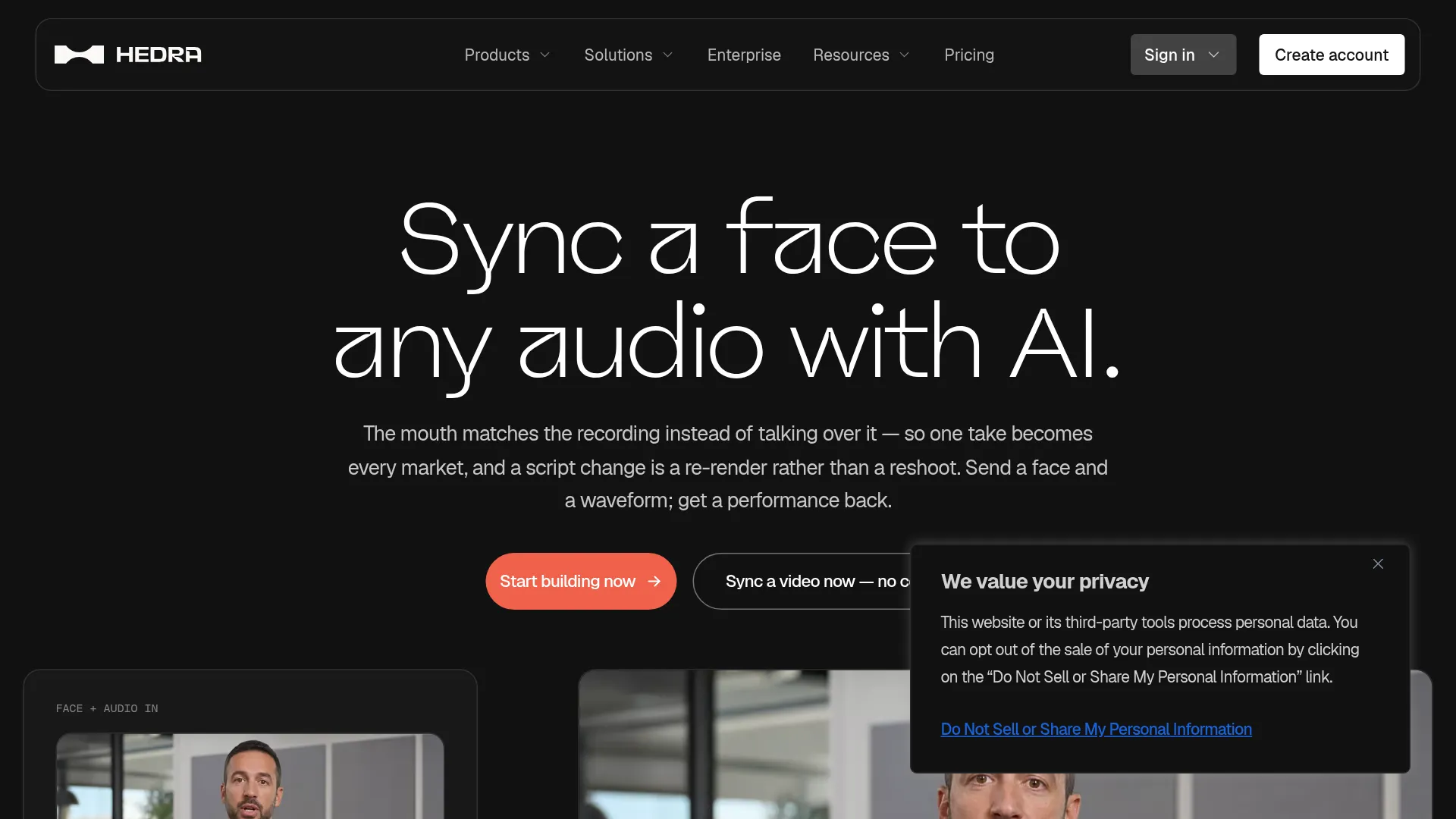
Send a portrait plus a voiceover and you want Hedra Character 3 or D-ID talking photo. Send an MP4 plus a replacement audio track and you want Sync Labs or the HeyGen Lip Sync API (POST /v3/lipsyncs). Send a script and expect a finished presenter and you are shopping for HeyGen avatars, Synthesia, or Tavus, not a pure lip-sync endpoint. That category error is a common cause of "lip sync looks terrible" complaints: a photo model judged on moving footage, or a retiming model judged on a static portrait.
Price per finished minute, not price per second
Headline per-second rates hide subscriptions, resolution tiers, rounding, and rerolls. The table below normalizes list prices to a finished minute before tax, using vendor docs current at the start of November 2026. Your invoice adds the plan fee on top where noted.
| API / model | List rate used | ~Cost per finished minute | Plan gate that matters |
|---|---|---|---|
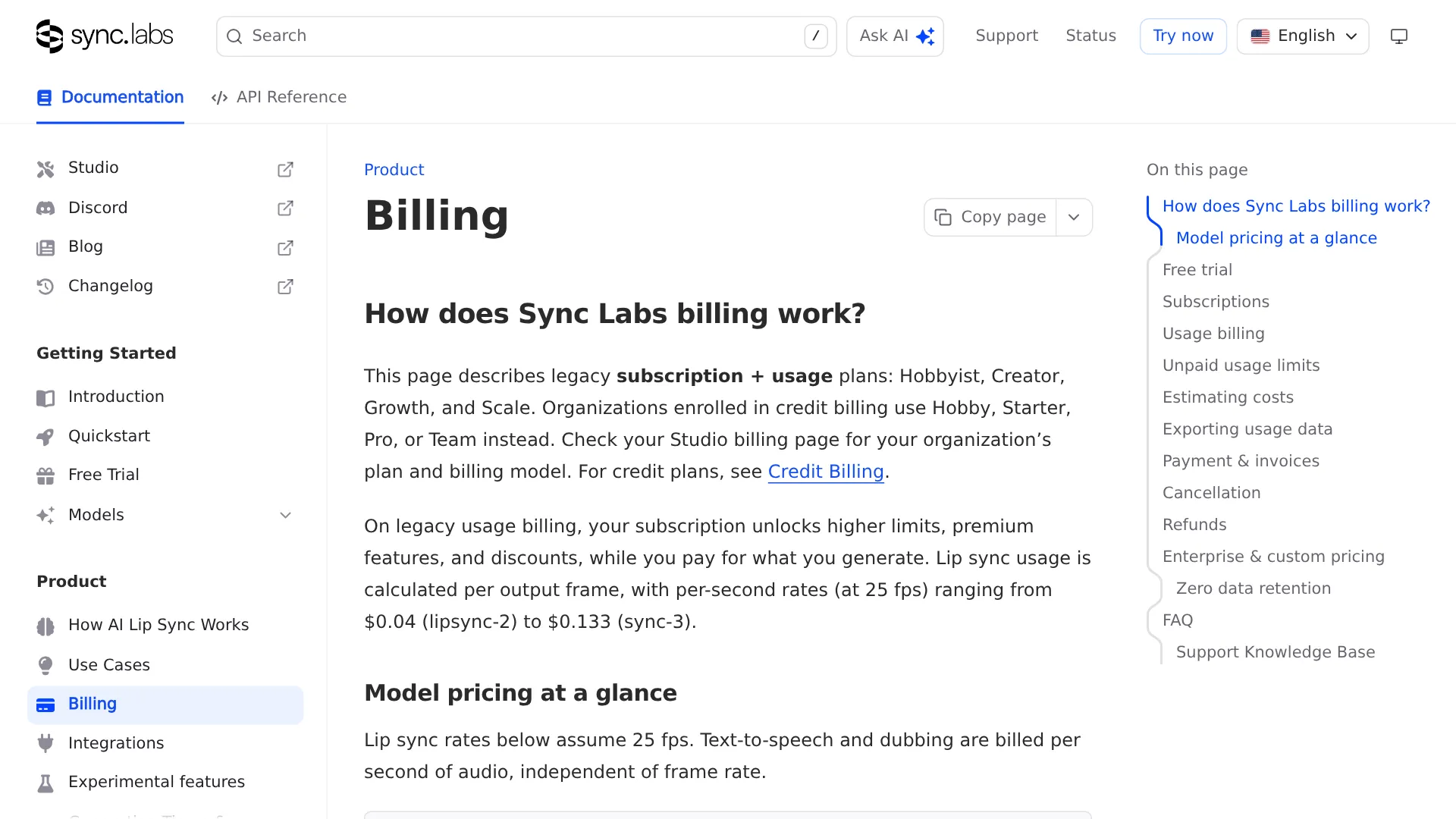
| Sync Labs lipsync-1.9 | $0.025/sec at 25 fps | ~$1.50 | Hobbyist $5/mo; 1-min cap; watermarked below Creator |
| Sync Labs lipsync-2 | $0.04–$0.05/sec, 512×512 | ~$2.40–$3.00 | Creator $19/mo removes watermark; 5-min cap |
| Sync Labs lipsync-2-pro | $0.067–$0.083/sec | ~$4.00–$5.00 | Growth $49/mo; 10-min cap |
| Sync Labs sync-3, 4K native | $0.107–$0.133/sec | ~$6.40–$8.00 | Scale $249/mo; 30-min cap; ~$0.04/sec effective at scale volumes |
| HeyGen Speed (PAYG API) | $0.84/min | $0.84 | No subscription; credits expire after 12 months |
| HeyGen Precision (PAYG API) | $1.74/min | $1.74 | Handles profiles, occlusions, speaker switches |
| Hedra Character 3, 540p / 720p / 1080p | $0.025 / $0.05 / $0.0625 per sec | $1.50 / $3.00 / $3.75 | Paid plans carry commercial use; 10-min single generation |
| D-ID Pro (commercial) | $16/mo annual, 15 min included | ~$1.07 at full use | Lite $4.70 is personal-use only with watermark; billing rounds up to 15-sec increments |
| Self-hosted LatentSync 1.6 | GPU only, ~$0.01/sec cloud estimate | ~$0.60 plus labor | Needs ~18 GB VRAM at v1.6; 512×512 train resolution |
| Self-hosted MuseTalk 1.5 | GPU only | GPU plus labor | 256×256 face region; 30 fps on a Tesla V100; MIT code, weights stated commercial-OK |
Three pricing traps decide the real ranking. First, D-ID Lite headline arithmetic is roughly $0.47 per minute, but it is personal-use only and watermarked; commercial work starts with Pro at about $1.07 per included minute. Second, HeyGen and several credit sellers publish credit balances without a public credit-to-second conversion on some plans, so get the conversion in writing before you commit volume. Third, every retiming tool bills by duration, so chunking a 10-minute video into sections costs the same and lets you redo one bad section instead of paying for the whole render again.
API snapshots with batch and SDK detail
Sync Labs: strongest default for retiming existing footage
Sync Labs takes a source video plus target audio and returns a re-synced MP4 through a REST API with Python and TypeScript SDKs, job IDs, polling, and webhook callbacks. The model ladder runs from lipsync-1.9 for drafts through lipsync-2 for general work to lipsync-2-pro and sync-3 for premium and professional-grade close-ups, plus react-1 for expressive short clips at about $0.167 per second. Dubbing is metered separately at $6.00 per audio minute on entry tiers and $4.80 on Scale. Free accounts get 3 shared generations a month up to 15 seconds each, and Scale supports up to 500 generations per batch with 15 concurrent jobs. Limits scale from 1 minute on Hobbyist to 30 minutes on Scale, and watermarks come off at Creator and above. Bring your own translated audio in any language; the 29-language dubbed count only gates Sync's own dubbing product.
Pick Sync Labs when the input is footage you already own and the job is multilingual re-dubbing at tens to hundreds of clips. Skip the top tier for drafts: sync-3 costs roughly five times lipsync-1.9 per second.
HeyGen: cheapest pay-as-you-go talking heads with a quality switch
HeyGen's Lip Sync API accepts MP4, MOV, or WEBM video plus MP3 or WAV audio or a typed script, and one batch call handles up to 100 videos. Speed mode at $0.84 per minute suits front-facing footage with one speaker; Precision at $1.74 per minute targets side profiles, camera-angle changes, speaker switches, and mouth occlusions, syncing every visible face. The free plan includes 1 to 3 videos up to one minute each at 720p with a watermark, while paid length caps run from 30 minutes on Creator and Pro to 60 minutes on Business and 5 hours on Enterprise. Short clips return in roughly two to five minutes; longer or high-resolution exports take 10 to 20 minutes. API credits are now pay-as-you-go with no subscription required, and pay-as-you-go credits expire after 12 months versus 30 days for legacy plan credits.
Pick HeyGen when you already live in its avatar workflow or want the lowest per-minute API entry for talking heads. Budget for Precision on anything with movement: Speed is a draft mode by the vendor's own description.
Hedra Character 3: best single-photo takes, not a retiming engine
Hedra Character 3 is an omnimodal text-plus-image-plus-audio to video model: one portrait plus one recording becomes a talking performance with blinks and head tilts, up to 10 minutes in a single generation. Resolution sets the meter directly at 540p, 720p, and 1080p. Studio plans run from a 300-credit monthly free allowance through Lite around $10, Creator around $30, and Professional around $75, with commercial use on paid tiers. There is no documented first-class bulk endpoint; throughput is bound by account concurrency, and public docs expose polling rather than a documented webhook path.
Pick Hedra when the starting asset is a photo and the deliverable is a stylized or animated presenter. Do not pick it as a batch re-dubbing backend for footage you already shot; that is Sync Labs territory.
VEED Fabric 1.0: fastest in the vendor's own test, at a premium
VEED positions Fabric 1.0 at $0.15 per second and 720p output, and its own benchmark logged 63 seconds of generation against 91 for Hedra, 139 for Kling V2 Pro, 166 for Creatify Aurora, 167 for HeyGen, and 118 for Omnihuman v1.5 on the same task. That makes Fabric the fastest in that vendor test but the priciest per-second rate in this piece at roughly 5–10x HeyGen's per-minute-converted rate, with Hedra described only as roughly half the Fabric price. Treat the realism verdict as a vendor claim: the page discloses no test assets, trial counts, variance, or numerical accuracy scores, and concedes even strong models need sample checks. The practical read is narrower and still useful: where turnaround time compounds across hundreds of clips, a 63-second versus 167-second gap outweighs a $0.05 per-second saving.
D-ID and the open-source pair: know the licence before the price
D-ID Pro remains the cheapest commercially licensed talking-photo option with published arithmetic: $16 a month annual for 15 included minutes. Translation caps at 5 minutes on Lite through Advanced and opens to 30 minutes only on Enterprise, and the Advanced tier at $108 adds custom-logo output and manual moderation. LatentSync 1.6 trains at 512×512, with guidance_scale between 1.0 and 3.0 trading sync tightness against jitter. MuseTalk 1.5 holds 30 fps on a single Tesla V100 at a 256×256 face region and covers Chinese, English, and Japanese, but its authors note identity preservation drops on moustaches and lip shape. Wav2Lip stays a benchmark, not a product: its README restricts models trained on LRS2 to non-commercial use and points commercial users at Sync Labs.
What breaks at volume
Benchmark tables test clean talking heads. Production footage brings profile angles, hands over mouths, singing, and code-switching, and moving to a pricier tier alone may not solve those cases. The recurring defects, each worth checking at full resolution on hard consonants:
- Teeth flicker and mushy mouth interiors on small faces
- Jaw popping on plosives and chin-line distortion at side angles
- Drift and warping on profiles, plus occlusion artifacts when anything crosses the mouth
- Quiet source audio the phoneme mapper cannot lock onto
- Identity and background drift across batches, so faces read as a different person by clip twenty
A VFX practitioner running mixed pipelines puts it bluntly:
"Só I work in VFX and we found a combination of Lipsync 2 by Sync Labs, Heygen and some custom techniques to fool the models is working ok." — u/OlivencaENossa, r/StableDiffusion
Multilingual output is the second trap. One tester found the same audio-reference workflow worked for English but fell apart for Arabic, with lips moving separately from the mouth, and Sync 3 judged best of the tried options yet still not professional enough. If you ship dubbing beyond English, Spanish, and French, budget a native-speaker review pass per language rather than trusting any headline language count.
"Unfortunately it's not that good and quite often the lips move separately from the mouth." — u/Illuminateehee, r/seedance2pro
The ops layer often decides effective cost alongside the rate card. All four commercial systems are asynchronous: submit media, receive a job ID, poll or wait for a webhook, fetch the output URL. At hundreds of clips a day, confirm whether failed or retried jobs consume credits before scaling, and confirm idempotency with each vendor. Repeated defects across a batch often point to shared source problems like framing, angle, face size, or occlusion, so diagnose the input before resubmitting. On HeyGen's retail tiers, test render times on your plan before committing volume; one free-plan user logged 50 minutes for a 30-second render:
"Man on free plan for 30 sec video it took 50 minutes to make - terrible" — u/Afraid_Cod_6441, r/heygen
Frame-rate stutter invalidates otherwise convincing output: MuseTalk and LatentSync both train at 25 fps, so check delivered cadence and resample policy before you sign, not after the first rejected batch.
Build-or-buy and the ship-legal gate
Self-hosting crosses over on arithmetic most teams can check in an afternoon. Crazyrouter's published cost model puts the Sync Labs versus self-hosted Wav2Lip crossover near 500 thirty-second videos a month: about $240 versus $50 at 100 videos, $2,400 versus $200 at 1,000, and $24,000 versus $800 at 10,000, before engineering labor, storage, monitoring, and retries. Those GPU figures assume willing DevOps; add a week of setup plus ongoing driver and model maintenance before calling self-host free. LatentSync 1.6 wants 18 GB of VRAM at v1.6, while MuseTalk 1.5 runs lightest for live use.
Licensing flips some "free" options off the table. Wav2Lip cannot ship commercially under its LRS2-trained weights. LivePortrait's code is MIT but its InsightFace detection models are research-only until replaced. Verify the repo licence file, not the blog post citing it.
Then clear the legal gate before the first paid render. The EU AI Act's transparency duties are live, including the Article 50(2) machine-readable marking duty with a December 2, 2026 compliance date cited for pre-existing systems: label synthetic video visibly and in provenance metadata. Ship only faces and voices you hold rights to and keep consent records for replicas.
Related reading on this site: MuseTalk lipsync cost review, video generation API pricing dimensions, and face swap API comparison.
FAQ
What is the best lip sync API for production in 2026?
Sync Labs is the strongest default for retiming existing video at volume because of per-model rates, SDKs, webhooks, and batch ergonomics. HeyGen is the better buy for talking-head generation inside its avatar workflow, and Hedra for single-photo takes.
Which lip sync API is cheapest per finished minute?
HeyGen Speed at $0.84 per minute is the lowest metered commercial figure with published arithmetic, followed by Hedra 540p and D-ID Pro near $1.00–$1.50. Sync Labs drafts start near $1.50 on lipsync-1.9 and rise past $8.00 on sync-3 before plan fees.
Should I use Speed or Precision mode in HeyGen?
Speed for front-facing single speakers and drafts; Precision for side angles, moving cameras, occlusions, and speaker switches. Precision costs roughly double per minute.
Can I retime existing moving video, or only animate a photo?
Sync Labs and HeyGen Lip Sync retime footage you supply. Hedra Character 3 and D-ID talking photo animate a still portrait. Moving subjects, gestures, and camera motion remain the hardest retiming case across vendors.
Is real-time lip sync available over API?
The APIs evaluated here are asynchronous: submit, poll or wait for a webhook, fetch output. No vendor here documents production-quality streaming lip sync.
Can I use Wav2Lip or another open-source model commercially?
Wav2Lip's released weights prohibit commercial use, so commercial pipelines use LatentSync or MuseTalk self-hosted or a paid API. Always recheck the licence file at the commit you deploy.
What should I check before scaling to hundreds of videos a day?
Concurrency caps, queue semantics, webhook latency with a polling fallback, p95 render times, frame-rate preservation, reroll billing, and per-language quality judged by native speakers.
Final pick by workload
| Your workload | Pick | Why it wins |
|---|---|---|
| Re-dub footage you own, tens to hundreds of clips | Sync Labs lipsync-2, sync-3 for hero shots | Batch-native API, webhooks, per-model price ladder |
| Talking heads inside an avatar workflow | HeyGen, Precision for finals | Lowest PAYG per-minute entry, 100-video batch calls |
| One photo plus audio, stylized presenter | Hedra Character 3 at 720p | Purpose-built photo input, 10-min takes |
| Latency-sensitive jobs needing fast turnaround | VEED Fabric 1.0 after a paid pilot | Fastest turnaround in VEED's published test; verify realism on your footage first |
| Prototypes and internal explainers | D-ID Pro | Cheapest commercial talking-photo arithmetic |
| Steady high volume with GPU staff | LatentSync 1.6 / MuseTalk 1.5 self-hosted | Crossover near 500 clips a month; keep consent and EU marking duties |
Start with one 60-second clip of your hardest footage on two providers, score teeth, jaw, profile stability, and cadence at full resolution, then multiply the winner's per-finished-minute cost by your monthly volume plus an initial 20% reroll assumption, replaced with your pilot's measured rate.