 AIREITER
Particle-1 matches GPT-6.1 Terra at 40/43 on Plotly's private data exam for $0.35 versus $1.31 — but only when your agent can verify its own work. Without checkable tasks, the token saving that justifies its premium over DeepSeek disappears.
Particle-1 wins on cost per finished task, not sticker price
Particle-1 is Particle AI's agentic-coding model launched October 28, 2026. Particle reports $0.2211 average cost per coding task versus $0.3368 for DeepSeek V4.1 Flash and $0.6523 for GLM 5.3 Flash, with accuracy at 72.57% versus 71.15% and 66.82%.
That vendor math held up once independently. Plotly ran Particle-1 through its 43-question private data-analysis exam on October 31 via OpenRouter and scored 40/43 (93%), tying GPT-6.1 Terra's 40/43 and beating the DeepSeek base model's 36/43. The full run cost $0.35 at OpenRouter prices, roughly one-quarter of Terra's $1.31 run. At 36 models tested, Plotly calls Particle-1 the cheapest model to reach 40+ on its board.
The catch sits in the same report. Plotly estimates a fresh DeepSeek V4.1 Flash run at today's lower prices would cost about $0.24 — cheaper than Particle-1's $0.35. Particle-1 won on quality per dollar at benchmark-time prices, not unconditionally.
What Particle-1 actually is: DeepSeek V4.1 Flash post-train with 1M context
Particle-1 is post-trained on DeepSeek V4.1 Flash, not trained from scratch. Particle trained a rank-64 LoRA adapter covering about 1.25% of base-model parameters with reinforcement learning that rewards successful completion using fewer reasoning and tool-call tokens.
The spec sheet is agent-shaped. Particle-1 offers a 1,048,576-token context window with up to 131,072 output tokens, text plus image input, tool calling with structured JSON output, configurable reasoning effort, and streaming (Vercel listing, Cloudflare docs), with zero-data-retention classification on Cloudflare. Access is live through the Particle API, OpenRouter, Vercel AI Gateway, and Cloudflare Workers AI. General knowledge held up: GPQA Diamond and MMLU stayed within a point of the base model.
Particle-1 API pricing by provider, decoded
Particle-1 API pricing looks contradictory because four storefronts quote the same model ID differently. Particle's launch materials list $0.30 per million input tokens and $1.20 per million output tokens, while gateways undercut that substantially.
| Provider | Input / 1M | Cached input / 1M | Output / 1M |
|---|---|---|---|
| Particle direct (launch figure) | $0.30 | n/a | $1.20 |
| OpenRouter | $0.05 | $0.003 | $0.50 |
| Vercel AI Gateway | $0.13 | implicit | $0.50 |
| Cloudflare Workers AI | $0.25 | $0.03 | $1.00 |
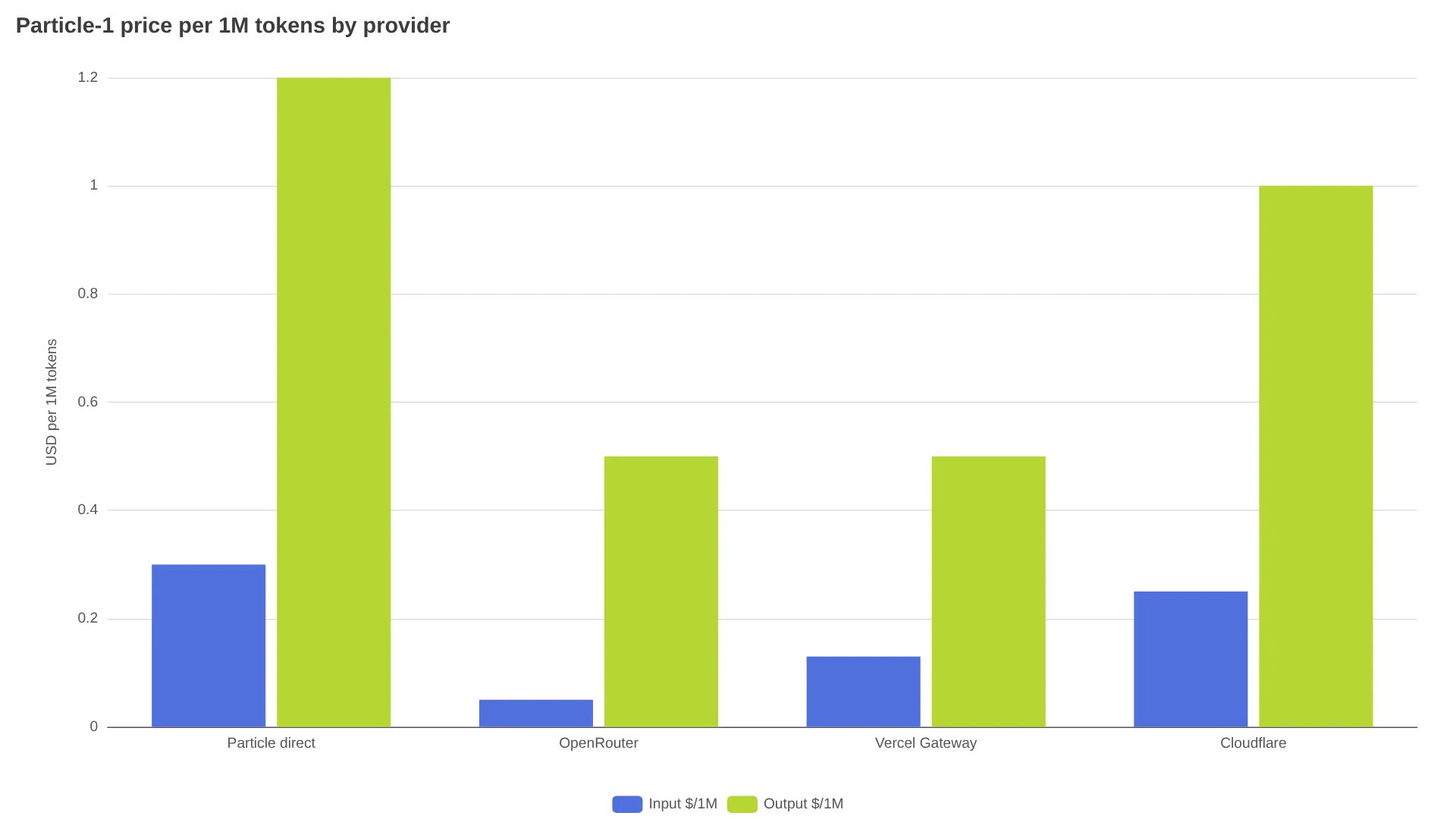
The OpenRouter line moved two days after launch. Price trackers record an October 30 cut from $0.25 to $0.05 input (80% down) and $1.00 to $0.50 output (50% down). OpenRouter rates above match Plotly's listed OpenRouter pricing ($0.05 / $0.50 / $0.003 cached); Vercel and Cloudflare rates match their gateway listing and Cloudflare docs.
"I ain't paying for it. post-trained on DeepSeek and that much more expensive. Seems really greedy." — u/Any_Confidence2580, r/DeepSeek thread on particle-ai/particle-1
Cache rates decide the real bill. Particle-1 read about 80% cached tokens in Plotly's run, which flatters its bill on cache-cheap gateways — compare OpenRouter's $0.003 versus Cloudflare's $0.03 cached-input rates before routing.
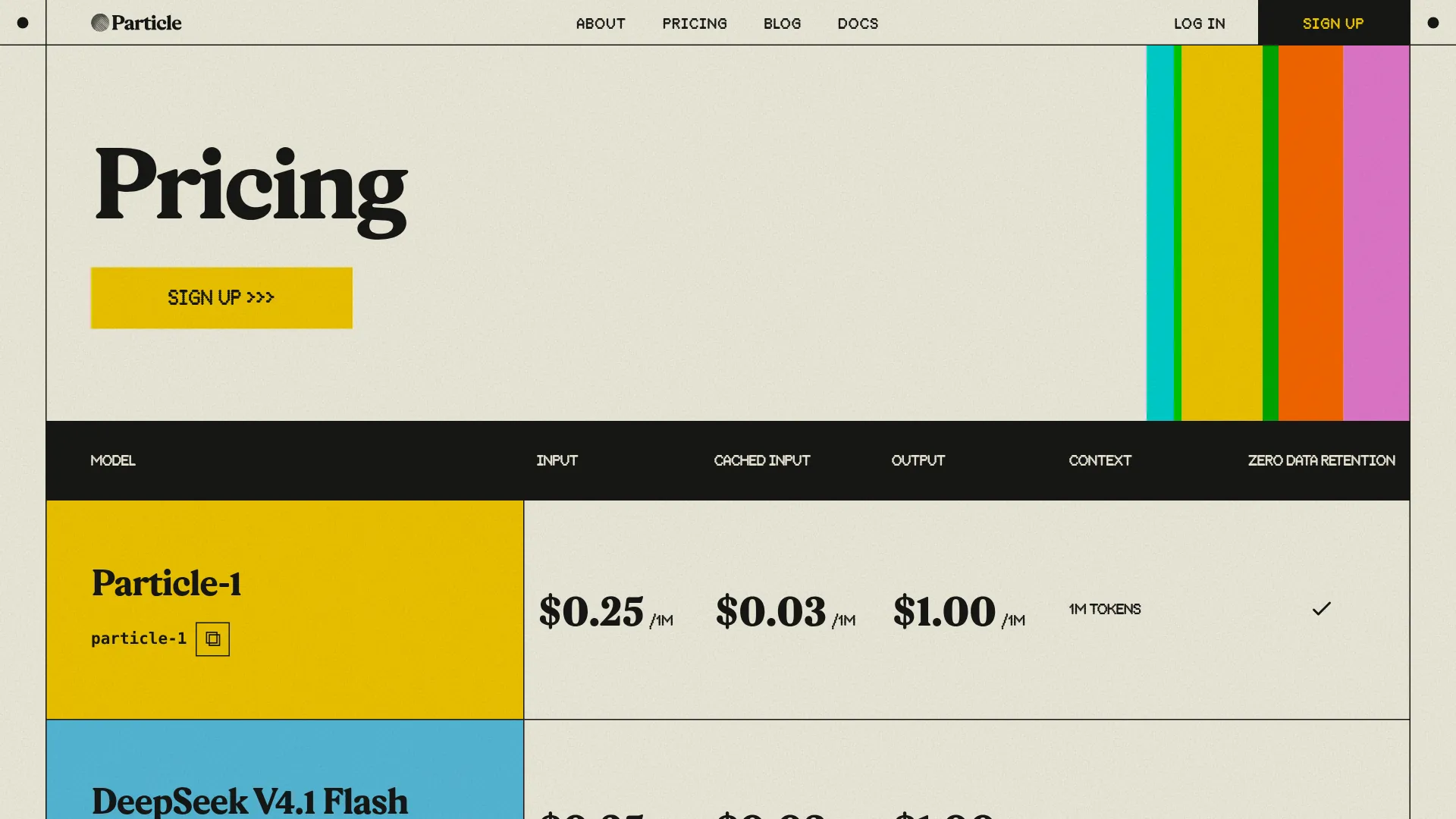
Particle bills prepaid credits with per-token metering and separate hosted web-search charges on its pricing page. Gateway routing adds provider ordering, sorting, and failover controls (documented by Vercel), so pin the model ID (particle/particle-1 on Vercel and Cloudflare, particle-ai/particle-1 on some OpenRouter listings) before benchmarking spend.
Where the 45% token saving comes from — and where it vanishes
Particle claims roughly 45% fewer tokens on average, with 28.4%–52.2% fewer output tokens and 34.4%–51.6% lower cost per task across Terminal-Bench 2.1, ReactBench, ADE Bench, and DeepSWE 1.1. Pass@1 rates stayed within the base model's confidence intervals on those four suites.
The saving is mostly shorter thinking. Particle attributes it to less deliberation, stopping after verification, fewer repair loops, and less exploration; about 90% of the saving on three suites is shorter reasoning, with tool-call text contributing about 30% only on DeepSWE 1.1.
One rollout shows the mechanism and its limit. A Terminal-Bench git task fell from 47,006 to 15,892 tokens by cutting confirmation chatter from 11,445 to 1,765 tokens, while an ADE Bench task saved via a different solution — a 1,602-token macro reuse versus an 8,722-token custom key.
Plotly's exam is the counter-example every buyer should read. On data-analysis questions without Particle's verifier loop, Particle-1 used more tokens than DeepSeek: about 6,900 versus 6,200 output tokens per question, 10 versus 7 model calls, and 380,000 versus 280,000 tokens read. Median latency still won at 16 seconds versus 21 seconds.
"So the gain came from better answers, not shorter ones." — Plotly, Particle-1 Benchmark Results for Data Analysis
Particle's own Harvey LAB arbitration-clause test hit 100% at standard 1x adapter strength with 24.6% fewer tokens, but only three of eight reports passed at 8x strength: compression past 1x deletes qualifications with redundancy.
Early independent users echo the split. Builder account @nexightai reports 35 one-shot build prompts all shipped for $4.12. Analyst @yibie warns the flip side: on tasks with no referee, leaner reasoning can skip the detail a contract review needs.
Should your coding agent call Particle-1?
Pick Particle-1 where verifiers catch mistakes; for cost-only routing, bare DeepSeek is cheaper per run.
| If your workload looks like… | Pick… | Why |
|---|---|---|
| Agent PRs with CI, terminal tasks, dbt pipelines | Particle-1 via OpenRouter / Vercel | Vendor + Plotly agree on 40/43-class quality; $0.35 tied Terra at ~25% of Terra's cost |
| 1M-context codebase sweeps with high cache hits | Particle-1 on a cache-cheap gateway | 80% cached reads in Plotly's run; compare $0.003 vs $0.03 cached-input rates |
| Fuzzy research, contract review, no ground truth | Base DeepSeek V4.1 Flash or larger model | 8x-adapter test and Plotly's false data-quality alarm show what "less thorough" costs |
| Must self-host weights | DeepSeek V4.1 Flash | Particle-1's weights and adapter are not public; only API access exists |
A minimal OpenAI-compatible call (Cloudflare endpoint shown; swap base URL and key per provider):
from openai import OpenAI
client = OpenAI(
    base_url="https://api.cloudflare.com/client/v4/accounts/$ACCOUNT_ID/ai/v1",
    api_key="$CLOUDFLARE_API_TOKEN",
)
resp = client.chat.completions.create(
    model="particle/particle-1",
    messages=[{"role": "user", "content": "Fix the failing dbt test in models/marts/orders.sql"}],
    max_completion_tokens=2048,
)
print(resp.choices[0].message.content)
To compare fairly, multiply your own input, cached-input, and output counts by each provider's rates, then divide by passed tasks. If reasoning share drops but pass rate holds across 50+ of your tasks, the 45% claim transfers to your stack. If output tokens rise like in Plotly's exam, you bought better answers. Price that accordingly.
Particle-1 API FAQ
How much does the Particle-1 API cost?
Direct Particle pricing is listed at $0.30 per million input and $1.20 per million output tokens. OpenRouter lists $0.05 input, Vercel lists $0.13 input, and Cloudflare lists $0.25 input with $1.00 output.
Which provider is cheapest for Particle-1 right now?
Among the four storefronts compared here, OpenRouter's $0.05 input / $0.50 output listing was the cheapest public snapshot on November 1, 2026, after the October 30 cut. Vercel charges more for input at $0.13 but matches on output; Cloudflare undercuts direct pricing at $0.25 / $1.00. Re-check at call time because gateway markups shift.
Is Particle-1 open weights?
No. DeepSeek V4.1 Flash has open weights, but Particle has not released Particle-1's weights or its rank-64 adapter. API access through Particle, OpenRouter, Vercel, or Cloudflare is the only route.
Does Particle-1 work with the OpenAI SDK?
Yes. Vercel and Cloudflare document OpenAI-compatible Chat Completions endpoints with model IDs like particle/particle-1; Plotly accessed the model via OpenRouter. Tool calling, streaming, JSON output, and image input follow the same shape.
When does Particle-1 actually save money?
Savings land when tasks have automated checks and high cache reuse, where shorter reasoning survives verification. On open-ended analysis without verifiers, Plotly saw higher token use, so budget for quality gain rather than token saving.