 AIREITER
Tencent's Hyra 2.0 is a research-agent system that builds reusable scientific models and tools instead of solving one problem and discarding the work. The limitation is scope: the agent itself stays inside Tencent, while selected outputs are public.
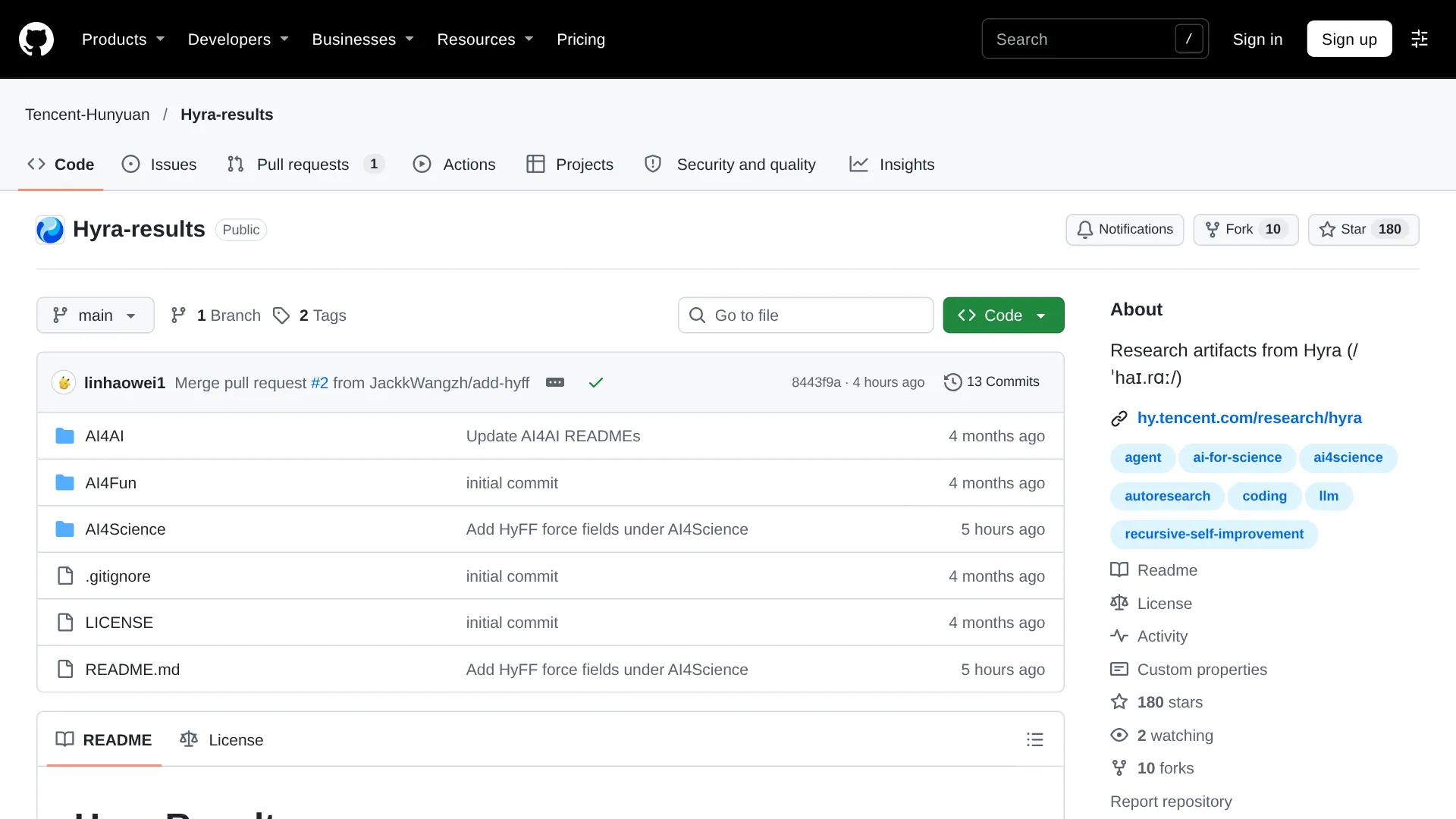
The Hyra-results repository separates downloadable artifacts from announcement-only claims. That split shapes the rest of this guide.
What Hyra 2.0 actually is — and what it is not
Hyra 2.0, short for Hunyuan Research Agent 2.0, is Tencent Hunyuan's hierarchical system for automating scientific research and engineering. Tencent positions Hyra 2.0 as infrastructure that develops reusable scientific models, validation pipelines, and multi-step workflows, rather than as another general-purpose Hunyuan chat model.
Tencent's official X announcement on November 2, 2026 describes Hyra 2.0 as "the next evolution of Hunyuan Research Agent" moving "from solving problems to building reusable tools, models and workflows." The public Hyra-results repository contains outputs and selected trained models rather than the complete orchestration system, and neither the announcement nor the repository lists a public demo, install package, API, price, or quota. Think of Hyra 2.0 as the laboratory and the released HyInv and HyPLM-Flash protein models as specimens that came out of it.
How a weeks-long project survives inside Hyra 2.0
Hyra 2.0 organizes long-running research across three agent layers plus persistent storage and an independent review step. IT之家's launch report, citing Tencent Hunyuan's official WeChat account, describes the Overall, Mission, and Worker split that keeps experiments running for days or weeks without losing context.
Overall agents talk to human researchers, align on goals, and allocate compute budgets. Mission agents each own one research direction, choose experimental routes, and stay accountable for conclusions. Worker agents read code, run live experiments, analyze failures, and can challenge a Mission agent's judgment, with multiple workers running in parallel under different base models.
Three persistence mechanisms sit underneath:
- Project state records where a research program stands, so tasks survive interruptions in persistent queues.
- Layered agent memory separates short-lived observations from longer-horizon findings instead of dumping everything into one context window.
- Shared Books store evidence-graded knowledge — single-run observations versus reproduced findings versus human-confirmed conventions — and methods that prove transferable get extracted into small reusable skills for later runs.
Two guardrails complete the design. Every conclusion ships attached to concrete logs and code versions, and a separate review worker re-examines the claim from a fresh starting point before it reaches humans. Large compute jobs still require human approval, and the system connects to ordinary lab infrastructure including enterprise messaging, job-submission platforms, and code repositories, according to Eyerys' technical breakdown.
That verification has a price. One practitioner estimated that workers inspecting each other's sessions could raise token costs substantially (@d6355v). Tencent has not published token budgets, compute costs, failure rates, or how often independent review catches errors, so treat the architecture as a design for long-horizon reliability whose operating cost is still undisclosed.
What Hyra 2.0 has actually shipped so far
Hyra 2.0's public evidence falls into two buckets: downloadable artifacts with weights and code, and Tencent-reported results still awaiting outside reproduction. The table links each row to its checkable source.
| Artifact | What it is | Headline number | Evidence status |
|---|---|---|---|
| HyInv | 1.96M-parameter protein inverse-folding model, 7.8 MB weights, CLI + Python API | ~57x faster generation than ProteinMPNN; 25 ms vs ~1 s on 148-residue proteins (1x H20 GPU), per TSN's review | Artifact inspectable (MIT); benchmark runnable; headline result not yet independently reproduced |
| HyPLM-Flash | 650M-parameter masked protein language model, 2.6 GB weights, INT8 engine | ~130,000 residues/sec on 1x H20; fastest inference in Tencent's 12-model/35-task test, avg rank 3rd; ProteinGym Spearman 0.409, tied with ESM-2 650M class, per TSN's review | Artifact inspectable (MIT); needs CUDA GPU; two evaluations cover different model/task counts |
| HyFF | 5 ML force fields (Presto, Vivace, Moderato, Andante, Largo), 2.3M–1.2B params, 83 elements | Largo energy error 0.364 meV/atom vs 0.380 DPA4-Pro at 9.7x speed; Andante 29x UMA-S-1.2 speed on 2,586-atom MD, 1x H20 | Artifact inspectable (Apache-2.0) with hyff package; speeds tied to one H20 workload |
| Petty conjecture dim-5 | Proof artifact: every 5-D real normed space holds 6 equidistant points (prior best dim 4, Makeev 2005), per repository index | Settles dimension 5 | Paper inspectable; no journal peer review reported |
| Yau circle-action | Claimed counterexample: closed 7-manifold, positive sectional curvature, no effective circle action, per repository index | Resolves unrestricted case; simply connected case still open | Paper inspectable; no journal peer review reported |
| HyQEC | Quantum error-correction code from qLDPC Challenge lineage, per Prompt Blueprints | ~48% higher encoding efficiency than prior leader | Announced; full artifact pending on GitHub |
| XiangShan RISC-V | Open-source processor optimization, per Prompt Blueprints | +5.79% score per GHz, minimal area increase; multi-core bugs fixed | Announced; benchmark name and baseline undisclosed |
| Robotic hand | Five-fingered hand with graduated finger lengths, per Eyerys | +28.6% object-rotation speed in fixed-budget simulation | Announced; simulation-only so far |
Versus Hyra 1.0, the shift is from answers to assets. Hyra 1.0 proved the loop could work: its sums_diffs entry improved a combinatorics constant from 1.14489 to 1.21079, and Tencent credits it with progress on a 50-year-old additive-combinatorics problem. Prompt Blueprints' launch analysis notes Hyra 2.0 keeps that iterative engine but adds the hierarchy, persistent projects, and skill extraction meant to make each success reusable.
What you can run today versus what stays inside Tencent
You can run Hyra 2.0's products, but the orchestrator itself has no public install. The Hyra-results repository is Apache-2.0 licensed and each result folder aims to include final artifacts plus reproduction scripts. Start here:
git clone https://github.com/Tencent-Hunyuan/Hyra-results.git
ls AI4Science/hyinv
Then pick one path:
- HyInv (lowest friction): open
AI4Science/hyinvfor weights, inference code, and the technical report. The reference path runs on CPU and GPU; the accelerated BF16 path is validated only on Hopper-class GPUs. - HyPLM-Flash (needs CUDA): open
AI4Science/hyplm_flash, then runweights/download.shto fetch, merge, and verify the 2.6 GB weights. Budget an H20/H100-class GPU; use INT8 for representation extraction and BF16 for fine-grained variant regression. - HyFF (needs H20 for claimed speeds): use the HyFF section for five force-field models (9 MB–4.8 GB each) and the
hyffpackage supporting single-structure, batched, and NVE/NVT/NPT molecular dynamics.
What stays closed: the Overall/Mission/Worker orchestrator, prompts, schedulers, evaluators, and the Books/skills store. Human approval gates for large compute jobs mean the system is not fully autonomous on resource allocation. In short: nothing to install for the agent; a 7.8 MB download for the easiest artifact to test, since TSN notes a direct HyInv-versus-ProteinMPNN comparison on identical backbones is inexpensive to set up.
Do the headline numbers hold up?
TSN reported that every performance figure came from Tencent or its model documentation with no independent reproduction published as of November 2, 2026. Read each number with its denominator attached.
First, speed is not quality. HyInv's 57x compares generation throughput on one Nvidia H20 (about 25 ms versus about 1 s on 148 residues; 54 ms versus 2.6 s on 402 residues), not wet-lab success. Structural similarity is scored against predicted structures, and no wet-lab validation is reported:
57x over ProteinMPNN and ~2,500 designs/sec is throughput, not design quality. What I'd want next: self-consistency RMSD and sequence recovery... Inverse folding is rarely the bottleneck anyway — the refold step after it is.
Second, efficiency claims need hardware and scope. HyPLM-Flash's "fastest among 12" describes Tencent's 12-model/35-task blog evaluation; the repository's matched evaluation covers 28 checkpoints and 32 tasks with a ProteinGym zero-shot Spearman of 0.409, statistically tied with ESM-2 650M, ESM C 600M, and E1-600M. HyFF's 29x and 9.7x speeds are tied to a 2,586-atom system on one H20, and Andante's force error (7.65 meV/Å) is slightly worse than UMA-S-1.2's (7.55 meV/Å): speed at near-parity accuracy, not a clean sweep.
Third, reuse — the whole thesis of 2.0 — is still unproven. The launch materials do not disclose how a generated skill is validated before reuse, who approves it, or whether reuse has been measured across projects:
Building reusable tools instead of one-off answers is the right direction. Most agent runs throw away everything they figured out once the task ends. Curious how Hyra decides a tool is good enough to keep and reuse.
A second practitioner asked the same validation question from the human-in-the-loop angle (@ModelPlaneHQ). Tencent's launch materials and the third-party reviews linked above publish no head-to-head benchmark against peers such as Google's AI Co-Scientist or the Sakana AI Scientist, so any ranking today would rest on Tencent's own numbers. Ask four questions of any agent-built model instead: on what hardware, at what quality setting, reproduced by whom, and reused where?
FAQ
Is Hyra 2.0 open source, and can I try it?
The framework is closed; the artifacts are open. There is no public demo, API, or install for the agent. HyInv and HyPLM-Flash use MIT-licensed model packages, while HyFF sits under the repository's Apache-2.0 terms; check each folder's README and license.
How is Hyra 2.0 different from Hyra 1.0?
Hyra 1.0 focused on iterative problem solving, including a long-open combinatorics result. Hyra 2.0 adds the Overall/Mission/Worker hierarchy, persistent project state, Books knowledge, skill extraction, and an explicit goal of producing reusable models and workflows.
Have the math results been peer reviewed?
Not as journal publications. The Petty dimension-5 and Yau counterexample papers are public and inspectable, and the repository index records Lean 4 formalizations for three earlier finite-core results (Beurling-Ahlfors, partial Hadamard, commutator). Treat all of them as claims awaiting expert review.
What hardware do I need to reproduce the protein models?
HyInv's reference path runs on CPU and GPU with a 7.8 MB download. HyPLM-Flash needs a CUDA GPU (H20/H100 class recommended) for its 2.6 GB INT8 engine, and HyFF speed figures assume one H20.
How to judge Hyra 2.0 without overclaiming
Hyra 2.0 bets that the unit of scientific progress should be the tool, not the answer, with reusable skills compounding into what Tencent describes as compounding returns on intelligence (智能复利). The launch shows the project released models and tools attributed to the system; whether those tools repeatedly accelerate later science is unmeasured until reuse rate, validation cost, and independent reproduction appear alongside the speed records.