 AIREITER
Google launched the Gemini Decisions API on November 11, 2026: Gemini Decision 1 scores fixed choices in one pass. The caching fine print decides whether it beats OpenAI for your workload.
What a Gemini Decisions API call costs
The Gemini Decisions API costs $0.10 per 1 million input tokens with zero output tokens billed. The shared multimodal input is billed once per request no matter how many questions are evaluated, and each additional question adds only its own instruction and criteria tokens.
Google positions Gemini Decision 1 as nearly 5x cheaper across a shared benchmark suite than Gemini 3.5 Flash-Lite with the Interactions API. There are no output-token charges, no variable thinking-token bills, and no separate audio transcription or OCR costs. A no-cost API tier in Google AI Studio covers prototyping.
| Workload (500 total billed input tokens / request) | Monthly requests | Input tokens | Cost at $0.10/1M |
|---|---|---|---|
| Support intent routing | 10,000 | 5M | $0.50 |
| Moderation gate | 100,000 | 50M | $5.00 |
| Agent tool-selection layer | 1,000,000 | 500M | $50.00 |
The formula is requests x average billed input tokens / 1,000,000 x $0.10. Because the shared evidence is billed once, packing 50 independent checks against one ticket into a single request adds only question-specific tokens. The savings come from batching, not from a per-question discount.
What Gemini Decision 1 decides
Gemini Decision 1 (model ID gemini-decision-1) is a purpose-built classifier and scorer, not a chat model. One request carries a single shared multimodal input of up to 256K tokens plus up to 1,000 independent questions. Each answer returns probabilities with a confidence score from 0 to 1.
Input modalities cover text, images, audio, video, and PDFs in one shared block, using the same Content block format as the Interactions API. Image and video inputs support tunable resolution, so thumbnailing evidence before upload directly controls token cost. The three question types can be mixed in one call:
| Type | Shape | Returns | Good fit |
|---|---|---|---|
noul (yes/no) | One condition with optional true/false descriptions | Probability the condition holds | Policy checks, spill detection, relevance filters |
choice (multiple choice) | 2 to 255 named options with criteria | Winner plus normalized probabilities per candidate | Model routing, queue routing, next-action selection |
score (ordered rubric) | Ordered levels starting at 0 | Continuous weighted score plus per-level probabilities | Severity, urgency, lead quality |
Google reports median model compute of 50–100ms with 150–250ms end-to-end latency, measured across multimodal inputs and contexts up to 16K tokens and described as nearly flat from 1 to 100 questions per request. On benchmarks spanning agent routing, reasoning, ranking, and multimodal understanding, Google claims Gemini Decision 1 leads the suite with the lowest calibration error. Treat both claims as vendor benchmarks until independent numbers land.
Gemini vs OpenAI Decisions API
The closest comparison is OpenAI's Decisions API, which launched weeks earlier at the identical headline price. The Gemini Decisions API matches OpenAI at $0.10 per 1M input tokens with free typed outputs, then diverges on capacity, modality, and caching.
| Dimension | Gemini Decisions API | OpenAI Decisions API |
|---|---|---|
| Model | gemini-decision-1 | gpt-6-luna class |
| Headline price | $0.10 / 1M input, $0 output | $0.10 / 1M input, $0 output |
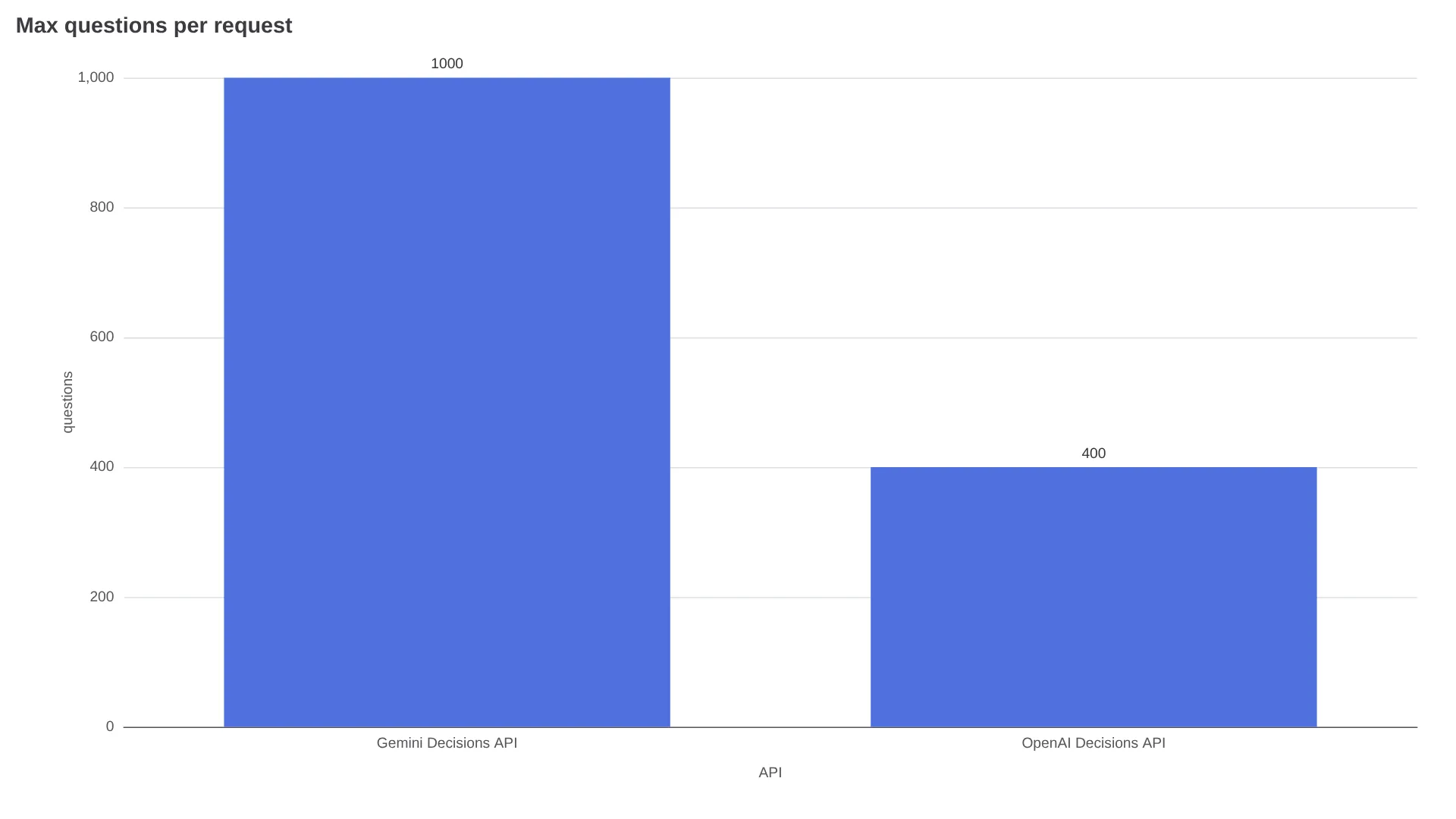
| Max questions per request | 1,000 | 400 |
| Question types | yes/no, choice (2–255), rubric score | predicate, choice, score (2–10 levels) |
| Input modalities | Text, images, audio, video, PDFs (256K context) | Text, images (URLs, base64), native JSON, conversation history, tool outputs; no audio or files |
| Latency claim | 150–250ms end-to-end, 50–100ms model compute | About 10x faster than Responses (no published p50/p95) |
| Prompt caching | Not announced in the launch post | Yes: 1,024-token prefix minimum, $0.01/1M cached reads |
| Free tier | Yes, no-cost tier in AI Studio | No dedicated free tier documented |
| Reporting | Standard Gemini API usage | GET /v1/organization/usage/decisions with admin key |
Gemini column per the Google launch post; OpenAI column per AIReiter's OpenAI Decisions API pricing guide, which cites official OpenAI docs.
Three practical takeaways follow from the table.
- Pick the Gemini Decisions API when evidence is multimodal. Pairing a call recording with account metadata or a scanned claim PDF with damage photos works in one pass, while the OpenAI endpoint would generally require separate preprocessing.
- Pick it for wide fan-out. With 1,000 independent questions per request versus 400, one ticket can carry refund intent, department routing, urgency scoring, and dozens of policy predicates without a second round trip.
- OpenAI keeps one edge for long shared policies. Cached prefixes cut repeat cost to $0.01/1M, which matters when each request re-sends a 5,000-token policy doc and questions are short.
Where Gemini Decisions API fits in production
Google uses the endpoint in Notebook for routing, Stitch for wireframes, CC for emoji picks, and Search for MCP safety, per the launch announcement. The pattern is one shared evidence block plus many bounded options, with code routing on the returned confidence. That is also where one engineer urges caution:
"Cheap is not the point; narrowing the output space is. Confidence is not accuracy, so calibrate on real business samples and set abstention thresholds before going live." — @david1989_zhu (translated from Chinese)
Build a labeled set from the real workload including ambiguous cases, plot false-positive and false-negative rates across thresholds, and give low-confidence results an explicit abstain path to human review. Jobs outside its contract — open-ended extraction, generated explanations, tool calls needing arguments — still belong to the Interactions API, the Responses API, or function calling.
Calling Gemini Decision 1
The endpoint is available through the Gemini API in Google AI Studio with model gemini-decision-1 via client.decisions.create in the google-genai SDKs, with Python, JavaScript, and REST guides in the Decisions API documentation. The official breakroom-counter example checks one photo plus a text note against all three question types in a single request:
from google import genai

client = genai.Client(http_options={"api_version": "v1beta"})

result = client.decisions.create(
    model="gemini-decision-1",
    input=[
        {"type": "image", "uri": "https://storage.googleapis.com/generativeai-downloads/images/spill.jpg", "mime_type": "image/jpeg"},
        {"type": "text", "text": "Breakroom counter check before the 9 AM client meeting."},
    ],
    questions={
        "has_spill": {"type": "noul", "instructions": "Is there an uncleaned liquid spill on the counter?"},
        "next_action": {"type": "choice", "instructions": "Which cleanup action fits the scene?",
            "criteria": {"wipe_with_cloth": "Small counter spill with cloth nearby.",
                         "dispatch_janitorial": "Large floor hazard, broken glass, or active leak.",
                         "ready_for_meeting": "Counter is clean and ready."}},
        "severity": {"type": "score", "instructions": "Rate the severity of the counter mess.",
            "criteria": ["Clean and ready.", "Minor localized spill.", "Major spill or safety hazard."]},
    },
)
print(result)
Google lists integrations with OpenRouter, LangChain, Vercel, LiteLLM, Pydantic AI, Pipecat, LiveKit, and OpenCode, with Google Cloud support coming soon. If you already built on OpenAI's endpoint, the migration heuristic is simple: move multimodal gates and wide fan-out workloads first, keep long cached-policy workloads where caching discounts apply, and re-calibrate thresholds from scratch. Confidence scales are not portable between vendors.
| Your workload | Use this |
|---|---|
| Classify, route, or score with fixed options | Gemini Decisions API |
| Evidence includes audio, video, or PDFs | Gemini Decisions API |
| 400+ independent checks per item | Gemini Decisions API |
| Long shared policy re-sent each call | Test OpenAI cached reads first |
| Need explanation, extraction, or tool args | Interactions / Responses / function calling |
| Destructive or compliance action | Decisions only as a gate plus human review |
Is there a free tier for the Gemini Decisions API?
Yes, a no-cost tier in Google AI Studio covers prototyping.
Does the Gemini Decisions API support prompt caching?
No caching option appears in the launch post as of November 12, 2026.
How many questions fit in one Gemini Decisions API request?
Up to 1,000 independent questions against one shared input of up to 256K tokens.
What latency should production code budget?
Budget 250ms end-to-end until you have measured your own regional p95.
Do I still need the Interactions API?
Yes, for composing text, extracting arbitrary fields, explaining decisions, or producing tool arguments.