 AIREITER
For API production use, GPT Image 2.6 renders the same product shot for about $0.02 at default settings while Nano Banana Pro charges a flat $0.134. Pro is still the safer pick for 4K output or boards full of reference faces. I ran the same prompt through both models and checked an 8-prompt shootout, a 6-prompt scored test, and a 6-prompt API comparison. The pattern: 2.6 is generally the more literal model on layout and exclusion rules at lower cost (with one product-shot exception below), while Pro interprets like a designer and bills accordingly.
The short answer
| Your job | Pick | Why |
|---|---|---|
| Posters, menus, dense text, strict layouts | GPT Image 2.6 Sunburst | Best layout-discipline results in the scored tests below |
| High-volume drafts, thumbnails, concept passes | GPT Image 2.6 Flare | One point behind Sunburst at roughly a third of the latency |
| Clean product shot with no invented branding | Nano Banana Pro | The only model in the 8-prompt shootout that left the bottle blank |
| 4K print, posters, hero crops | Nano Banana Pro | Documented 4K tier at $0.24; GPT 2.6 is token-metered up to 4K with no fixed ticket |
| Group scenes, recurring characters | Nano Banana Pro | Up to 14 reference images in testing; 5 repeatable characters per the documented comparison |
| GIFs, SVG logos, circle-to-edit | GPT Image 2.6 | Native formats Pro does not offer in the cited tests |
OpenAI shipped GPT Image 2.6 on November 4, 2026 in ChatGPT, Codex, and the API with two variants, Flare for speed and Sunburst for detail (OpenAI announcement, technical intro). Nano Banana Pro is Google's gemini-3-pro-image, a GA image tier on the Gemini API at $0.134 per 1K/2K image and $0.24 per 4K, confirmed on Google's current AI Studio pricing page.
Same prompt, two models: what came back
Full prompt, sent identically to both models on November 15, 2026, one attempt each, no rerolls, default settings, outputs shown exactly as returned (Pro via nano_banana_pro, GPT via gpt_image_2 in our pipeline):
Studio product photograph of a matte sage-green ceramic coffee mug with a small printed label reading "KOFFA 250g" in clean sans-serif type, standing on a wet black stone slab, exactly three roasted coffee beans scattered beside it, soft window light from the left, dark gradient background, shallow depth of field, photorealistic, no other text, no hands
In the pair below, the GPT Image render spelled the "KOFFA 250g" label correctly with three beans visible, while the Pro render kept the scene mood but showed visible label and bean-count drift.
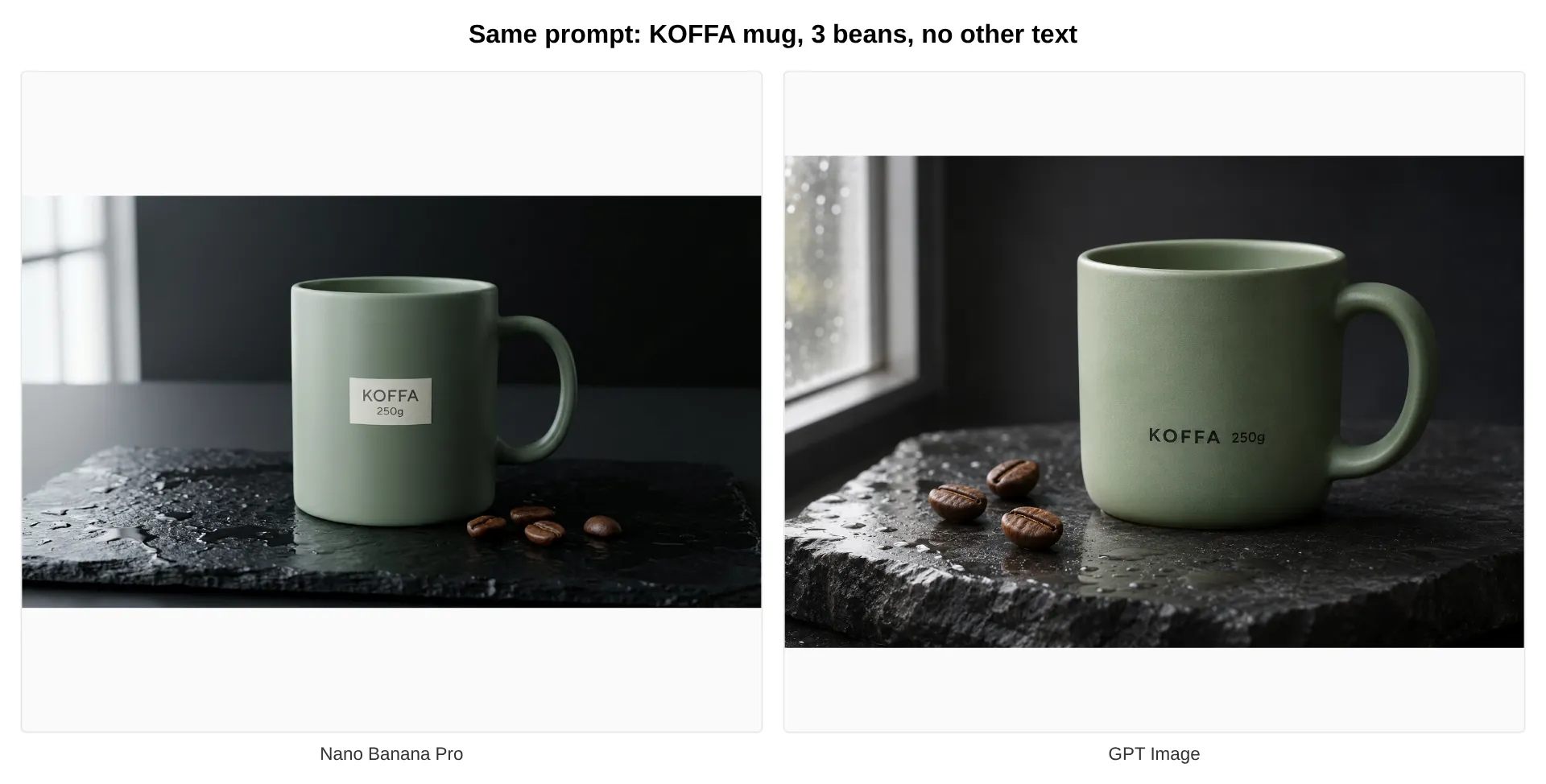
Version-level conclusions come from the larger cited tests below, not from this single run.
Text, counting, and "no" means no
| Stress test | GPT Image 2.6 | Nano Banana Pro |
|---|---|---|
| English chalkboard menu, 4 prices | All correct; 2.6 kept the cleanest board | Correct, but cents rendered as superscripts |
| Chinese tea poster with seal | Every character correct, title to seal | Three small-text errors; the tester called it "the biggest gap in the whole test" |
| Six layout and counting tasks, scored | Sunburst 22/24, Flare 21/24 | 18/24; extra icons, added title, wrong timetable rows, banned grid lines |
The first two rows come from the 8-prompt, five-model shootout; the third from the 6-prompt scored test, whose author stresses it is one small data point, not a general ranking. Portraits were a tie in both tests, so photorealism is not the differentiator here.
Product shots and edits: invention, preservation, identity
Here GPT's literalism flips into a liability. In the 8-prompt shootout it invented brand names ("LUMIÈRE", "VELORA", "LUVÈRE N°07") plus full label copy for a bottle the prompt described as blank, while Nano Banana Pro left the bottle blank (test). When the same bottle was moved to a beach background, Pro preserved shape, label, and water droplets.
Pro also enriches: in the 6-prompt generation test it added unrequested but correct thermometer, stopwatch, and scale graphics to a coffee infographic, and correct extra map labels to a Paris tourist map that explicitly said "no other labels". GPT 2.6 obeyed the label ban.
In the cited 9-gaze-direction test on the same reference face, the tester and commenters judged Nano Banana Pro stronger at holding identity while GPT Image gave more natural expressions:
"I prefer photorealistic — the second set sends me right into the uncanny valley. Too plastic." — u/curiousplaid, r/aiArt gaze-direction comparison
Price and speed in one table
Google's pricing is a flat ticket. OpenAI's is a meter, and the meter's defaults decide whether 2.6 costs a fraction of Pro or more than Pro. GPT figures below are per-image list equivalents at 1024px from the API comparison (Flare/Sunburst share token rates; underlying rate $30 per million output tokens). Pro figures are Google list prices.
| Setting | Cost per 1024px image | Basis |
|---|---|---|
GPT Image 2.6 low | ~$0.006 | Cheapest drafts; token-metered |
GPT Image 2.6 medium / default | ~$0.02 | Everyday setting; 2K ~$0.035 |
GPT Image 2.6 high | ~$0.053 | Still ~2.5x under Pro |
GPT Image 2.6 max | ~$0.211 | Crosses above Pro's flat price |
| Nano Banana Pro 1K / 2K | $0.134 | Same price for 2K, so default to 2K |
| Nano Banana Pro 4K | $0.24 | Only side with a fixed 4K ticket |
Pin quality and complexity (which defaults to high) before budgeting: the gap between GPT low and max is roughly 35x, or about $59 versus $2,107 per 10,000 images against Pro's fixed $1,340 (crossover math). Latency is likewise conditional: in the 8-prompt shootout GPT 2.6 averaged 28s and Pro 51s with one 103s outlier, while the scored test logged Flare 12.4s, Sunburst 34.1s, and Pro 35.2s.
Features only one side has
| Capability | GPT Image 2.6 | Nano Banana Pro |
|---|---|---|
| Animated GIF (2–64 frames) | Yes (launch features) | Not in cited tests/docs |
| True SVG vectors, markup circle-to-edit, exact pixel sizes | Yes (launch features) | Not in cited tests/docs |
| Max resolution in cited pricing | Token-metered up to 4K (4K rows) | 4K at $0.24 (Google pricing) |
| Aspect ratios | Standard set | Ten, 21:9 to 9:16, per the documented comparison |
| Reference images | Up to 16 via API (test log); as few as 4 in some interfaces (report) | Up to 14: 6 objects, 5 characters, 3 styles, per the documented comparison; a matching 14-image session also appears as a single user report, anecdote only |
| Live web grounding | Not documented in cited tests | Yes, via Google Search, per the documented comparison |
| Watermark | Not documented for API in cited tests | SynthID on images, per the documented comparison |
The app is not the API
On the Gemini side, a widely upvoted thread documents prompts failing in the Gemini app with generic errors while the identical prompt succeeds through the API:
"Sadly there's no real 'fix' on the Gemini web/app side right now. The only reliable workaround I've found is using the API." — u/BidBackground6742, r/GeminiAI
On the OpenAI side the divergence runs the other way: paying API users report duller output than ChatGPT for the same prompt, which commenters attribute to ChatGPT silently rewriting prompts before generating. Commenters suggest calling through the Responses API with the image-generation tool and inspecting the returned revised_prompt. Evaluate the exact endpoint you will ship, not the chat demo. Pro's GA identifier is gemini-3-pro-image and GPT 2.6 exposes gpt-image-2.6-flare / gpt-image-2.6-sunburst (model IDs); OpenAI already retired gpt-image-1 with 1.5 and 1-mini scheduled out by December (retirement log), so pin versions.
What real users keep repeating
Side-by-side testers keep circling the same aesthetic split, based on small personal shootouts rather than broad surveys:
"chatgpt images are basically everything people hate about ai images while most people wouldnt even clock the nb pro ones as ai … theres clearly two camps: people who like the engagement maxxed hyperdetailed [images] and people like me who prefer when it actually feels like a normal iphone photo" — @flowersslop
"Crazy that Nano Banana Pro is a year old, and it's still the best image model in a lot of cases. GPT is on the right — has that grainy, gritty 'GPT look.' NBP is on the left — imo looks much more organic and 'alive'" — @thefinnmckenty
Based on these examples, a practical workflow is: draft cheap and literal on Flare, finalize atmospheric or reference-heavy work on Pro.