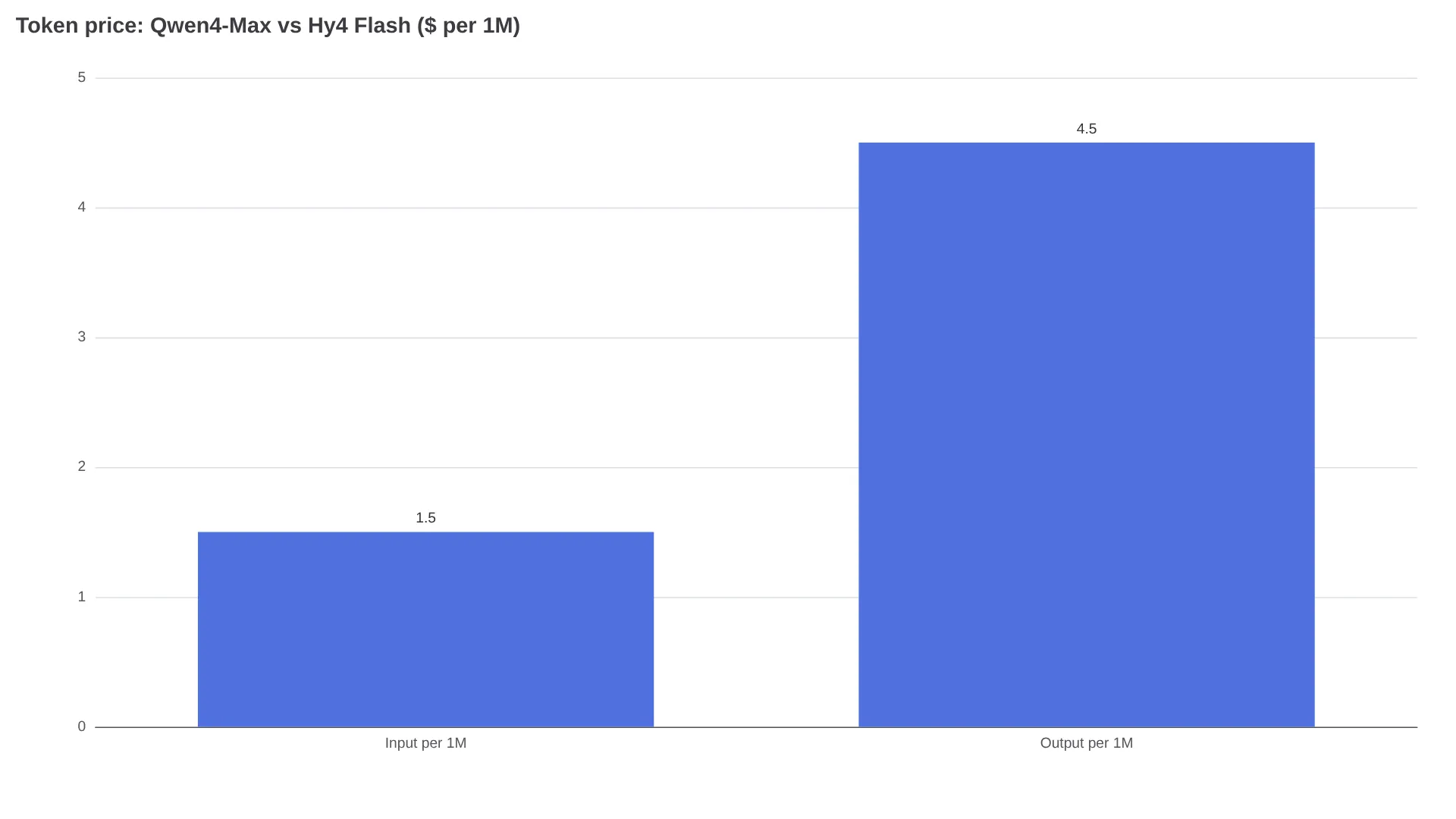
Qwen4-Max leads Hy4 Flash on the cited benchmark results for hard coding and workflow tasks, while Hy4 Flash is far cheaper per attempt. QwenCloud lists Qwen4-Max at $1.50/$4.50 per million tokens, while Tencent lists Hy4 Flash at $0.070/$0.281 — about 21x input, 16x output. Agent bills are decided by reasoning tokens, retries, and cache reuse, not the sticker price. This Qwen4 Max API pricing review puts both models' 1M context, 2.4T vs 224B backbones, and vendor cost-per-task claims side by side, then routes them by workload.
Sticker prices in one table
| Item | Qwen4-Max (Singapore / Intl) | Hy4 Flash (TokenHub Intl) |
|---|---|---|
| Input per 1M | $1.50 | $0.070 |
| Output per 1M (incl. reasoning) | $4.50 | $0.281 |
| Cached input read per 1M | $0.075 | $0.003 |
| Explicit cache creation per 1M | $1.875 (5-min) / $3.00 (1-hr) | Not separately disclosed |
| Blended 0.5M in + 0.5M out | $3.00 | ~$0.176 |
| Model ID | qwen4-max via QwenCloud | Hy4 Flash via Tencent |
A 60,000-input / 4,000-output agentic coding session makes the gap concrete. Qwen4-Max costs $0.09 input plus $0.018 output, about $0.108 per attempt. Hy4 Flash costs $0.0042 plus $0.0011, about $0.0053 per attempt, roughly 20x cheaper per attempt before retries. With fully cached input, the same 60k input costs $0.0045 on Qwen4-Max and $0.00018 on Hy4 Flash before output. QwenCloud bills reasoning as output; Hy4 Flash outputs bill at $0.281 per million, so shorter outputs directly lower billed tokens.
What the backbones imply for bills
Qwen4-Max is a 2.4T-parameter MoE model with 71B active parameters per token (Offloop, DataCamp); Hy4 Flash is a 224B-parameter LatentMoE model with 12B active, 4-bit inference, and a claimed 150+ tokens/second (Tencent). What matters for bills is measured output volume: Qwen4-Max's tested footprint hit 127M output tokens against a 78.6M peer median (DataCamp), while Hy4 Flash post-training cut average output length 50% (Tencent).
Which price you actually pay
QwenCloud Singapore charges $1.50 input, $4.50 output, and $0.075 cached read, with 991,808 maximum input tokens without thinking and 983,616 with thinking, 131,072 output thinking-off and 262,144 combined (QwenCloud). Other deployments (Virginia, Frankfurt, Tokyo, Hong Kong) list $1.413 / $4.24 / $0.071 (regional table via Offloop).
New Singapore pay-as-you-go accounts are advertised a 1-million-token free allowance (conditions apply, via Xenospectrum). The qwen4-max-preview Token Plan route retires November 25, 2026 and never covered production backends (migration notes).
Hy4 Flash lists $0.070 / $0.281 / $0.003 for the flash model, against the full flagship Hy4 at $0.834 / $2.501 / $0.042 (Tencent). Through Nov 30, 2026, TokenHub was half price (~$0.035 effective input) (Tencent). Check OpenRouter for availability. Details: Hy4 Flash pricing.
Three multipliers that decide the real bill
First, reasoning shares the output budget and bills as output. Qwen4-Max defaults to high with a 131,072-token thinking budget; xhigh and low are the alternatives. Simon Willison's SVG test via OpenRouter, summarized in Offloop, used 6,362 tokens at high versus 26,295 at xhigh for the same prompt, 4.1x the billable tokens. Setting max_completion_tokens to 10,000 in thinking mode means 10,000 total for reasoning plus answer.
Second, verbosity and retries compound. Alibaba-compiled figures via Offloop put Qwen4-Max at roughly 105,000 output tokens per benchmark task versus 171,000 for Qwen3.8-Max, a 39% cut yet still far above the peer median. A sandboxed Reddit benchmark (56 tasks, two attempts each, 112 attempts total, thread) found Qwen4-Max Preview succeeding on 64 attempts versus DeepSeek V4.1 Flash on 61, with 16 timeouts against 4 and roughly 13 minutes per task versus 7. A retried timeout creates another billable request.
"the 16 timeouts for qwen are doing a lot of the work in that 64 vs 61." — u/the_crooked_badger, r/DeepSeek thread
Third, cache reuse favors long-context agents. Qwen4-Max's $0.075 cached read is 95% below regular input; one commenter in the r/Qwen_AI thread reported 112M cached versus 14M uncached input. Hy4 Flash's $0.003 cache read is 25x cheaper still, but matters less when extra reasoning loops dominate the bill. As @MarcosRGjr put it, "Ignore the per-token price. Agents get billed per task" (post).
What vendors claim a task costs — and what externals show
Vendor claims versus external proxies, not a verified head-to-head.
| Claim | Figure | Basis |
|---|---|---|
| Alibaba Work360, Qwen4-Max vs Qwen3.8-Max (vendor internal, via DataCamp) | $1.67 vs $4.43 per attempted task | 721-field suite, ~35% fewer tokens at high |
| Alibaba chart incl. AA rows, Qwen4-Max vs Qwen3.8-Max (vendor-compiled, via Offloop) | $3.27 vs $10.02 per benchmark task | xhigh, 105K vs 171K output tokens |
| Tencent WorkIndex, Hy4 Flash vs full Hy4 (vendor internal, via Tencent and breakdown) | ¥0.2 vs ¥5.7 per task | 8-set office suite |
| Tencent blind test, Hy4 Flash vs Claude Haiku 5.5 (vendor-run, via Tencent) | ¥0.26, 2.79/4 vs ¥4.73, 2.81/4 | 85 users, 259 tasks, 6.7 vs 6.8 min |
Work360 scores Qwen4-Max 52.69 versus Qwen3.8-Max 47.74; Intelligence Index rises 34 to 43, still behind Kimi K3.1 Pro at 46 and Opus 5.5 at 59 (Offloop, LLM Leaderboard).
External results reproduced in vendor charts bound the claims. Vals-affiliated testing via the LLM Leaderboard guide measured Qwen4-Max at 63.20% for $9.33 per test versus GPT-6.1 Sol at 63.94% for $3.61. Terminal-Bench 4.0 puts Qwen4-Max at 48.5% and Hy4 Flash at 19.2% on Tencent's chart (full Hy4 44.4%); ProgramBench shows 31.5 versus 16.0 (Offloop). AutomationBench-AA reads 72.5% for Qwen4-Max (DataCamp) versus Hy4 Flash automation at 52.2 (Tokenstrom).
Expected cost per success equals attempt cost divided by success probability. Illustrative only: $0.108 / 0.485 ≈ $0.22 for Qwen4-Max versus $0.0053 / 0.192 ≈ $0.028 for Hy4 Flash, about 8x apart. Benchmark rates are not production retry rates. At these token volumes Qwen4-Max needs roughly 20x higher success likelihood, or equivalent tool, latency, and repair savings, to win on dollars alone.
Route by workload, then verify with a 30-task replay
| Agent profile | Recommended default | Why |
|---|---|---|
| Hard, long-horizon coding and terminal work | Qwen4-Max at high | Higher success rate (48.5 vs 19.2, 31.5 vs 16.0) may justify premium when failure or repair is expensive |
| High-volume office loops: slides, docs, sheet repair, computer-use | Hy4 Flash | ¥0.2 vs ¥5.7 WorkIndex, parity with Claude Haiku 5.5 (2.79 vs 2.81) at ~one-eighteenth cost |
| Cached pipelines and batch extraction | Hy4 Flash default; Qwen4-Max when replay proves quality savings | Compare $0.003 vs $0.075 cache reads plus repair cost on your docs |
Before committing, replay 30 of your tasks on both models. Count reasoning plus output tokens per success, log tool calls, timeouts, fixes, and median time alongside dollars.
FAQ
How much does the Qwen4 Max API cost per million tokens?
QwenCloud Singapore lists $1.50 input and $4.50 output, $0.075 cached reads. Other regions list $1.413 / $4.24 / $0.071. Hy4 Flash lists $0.070 input, $0.281 output, $0.003 cached.
Are reasoning or thinking tokens billed as output?
Qwen4-Max bills thinking at $4.50 inside a shared 262,144-token budget. Hy4 Flash outputs bill at $0.281, so shorter outputs lower billed tokens.
What is the usable context limit, not the headline 1M?
QwenCloud documents 991,808 input tokens without thinking and 983,616 with thinking, 131,072 output thinking-off and 262,144 combined. Tencent lists 1M context for Hy4 Flash. Leave a safety margin.
Is Qwen4-Max or Hy4 Flash cheaper per completed agent task?
Per attempt Hy4 Flash is roughly 20x cheaper; Tencent claims one-twentieth the cost of full Hy4 per task and one-eighth of DeepSeek-V4.1-Flash-1017 at peak pricing (Tencent). On the illustrative math above it stays roughly 8x cheaper per expected success, but Qwen4-Max can win when fewer failures and less repair outweigh token price.