 AIREITER
Gemini 4 Carbon is worth the hassle only for work that survives overnight: multi-agent refactors, 200-view doc builds, and exploit-to-patch loops. Google itself says Gemini 4 Argon remains the ideal choice for the majority of software engineering and knowledge work, while Carbon takes the hardest tasks at higher token burn.
Gemini 4 Carbon is a frontier reasoning model built on Gemini 4 Argon. Google announced Carbon on October 28, 2026 and made Carbon generally available on November 10, 2026. The DeepMind model card lists March 2026 as the knowledge cutoff, up to 1 million combined input-output tokens, text/documents/images/audio/video input, and text output.
Who actually gets Carbon today
Gemini 4 Carbon access is split by channel, and consumer access is the narrowest part. Developers use the paid Gemini API tier in Google AI Studio, plus Android Studio and Gemini for business. Consumers get Carbon in the Gemini app, AI Mode in Search, and Google Antigravity only with Google AI Ultra. Scientists can apply for six months free at Antigravity's highest usage tier, and verified defenders apply through the Fairwind Program.
Google AI Pro subscribers do not get Carbon on consumer surfaces, a restriction raised repeatedly in r/GeminiAI launch threads.
"Available for ULTRA. Argon for pro is gone in two prompts." — u/Nodayssoff on r/GeminiAI
The linked launch materials do not specify fixed consumer quotas, a Pro-tier date, or country parity. Linked user reports describe five-hour and weekly allowances exhausted in a few prompts and keys working in one surface but blocked in Antigravity on the access thread and quota thread, plus day-one An internal error has occurred failures. Budget Ultra as a testing seat, not unlimited Carbon.
Carbon vs Argon in one table
Gemini 4 Carbon and Gemini 4 Argon share list prices and context size. Capability, latency, and token appetite separate the two models.
| Item | Gemini 4 Carbon | Gemini 4 Argon |
|---|---|---|
| Base | Built on Argon, more reasoning for hard long-horizon work | Base frontier, default for routine engineering |
| GA | November 10, 2026 | October 13, 2026 per ToolColumn comparison |
| API model ID | Check AI Studio at call time, no separate stable ID in launch posts | gemini-4-argon per ToolColumn comparison |
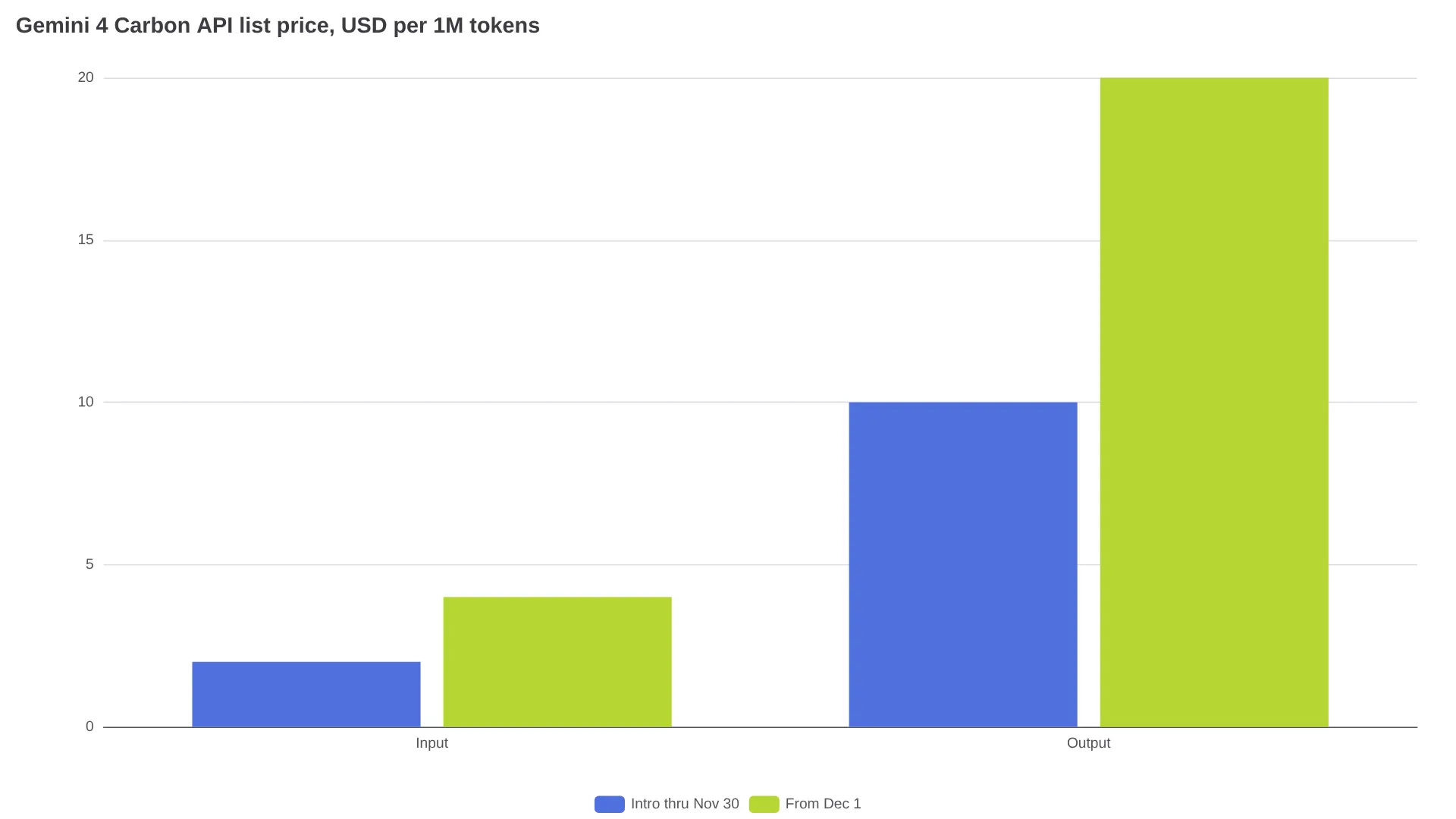
| API list price, intro thru Nov 30, 2026 | $2 input / $10 output per 1M tokens, $0.10 cached input | $2 input / $10 output per 1M tokens, $0.10 cached input |
| API list price from Dec 1, 2026 | $4 input / $20 output per 1M tokens | $4 input / $20 output per 1M tokens |
| Context | Up to 1M combined input + output | 1,048,576 tokens per ToolColumn comparison |
| Modalities in | Text, documents, images, audio, video | Text, images per Artificial Analysis |
| Artificial Analysis Intelligence Index v5.0.1 | 60 | 50 |
| Weighted cost per index task | $7.76 | $9.95 |
| Output speed | 82 tok/s | 68 tok/s |
| Time to first answer token | 67.54 s | 40.02 s |
| Thinking levels | Configurable, higher levels burn more tokens | Low / Medium / High, default Medium per ToolColumn comparison |
Pricing comes from Google's availability announcement; speed, latency, per-task cost, and modality split come from Artificial Analysis Carbon vs Argon. Cached input is 95% off list, which is $0.10 per 1M at intro rates.
List price ties, workload cost does not. Artificial Analysis records Carbon at $7.76 per weighted Intelligence Index task versus $9.95 for Argon, despite Carbon emitting about 7,000 more output tokens per task on average. Carbon finishes weighted tasks in 24.9 minutes versus 28.6 minutes, but waits 67.54 seconds for the first answer token versus 40.02 seconds for Argon. Carbon is the stronger sustained worker with slower first response.
Where Carbon pulls ahead, and where it doesn't
Google reports 17 evaluations; selected Carbon-versus-Argon rows are below. Gemini 4 Carbon beats Gemini 4 Argon on all 17 rows and leads the full five-model field on 15 rows. The two exceptions matter: GPT-6 Astra leads FrontierSWE 2 at 65.5% versus 61.2% for Carbon, and Claude Opus 5.5 leads OSWorld-2.1 offline at 87.2% versus 81.5% for Carbon.
| Workload | Benchmark | Carbon | Argon | Gap |
|---|---|---|---|---|
| Agentic coding | SWE-sweep | 9.6% | 4.3% | +5.3 pp |
| Agentic coding | Terminal-Bench 4.0 | 65.2% | 57.1% | +8.1 pp |
| Agentic coding | FrontierSWE 2 | 61.2% | 55.0% | +6.2 pp, still trails Astra |
| Computer use | Agents' Last Exam v1.1 | 77.4% | 69.0% | +8.4 pp |
| Computer use | OSWorld-2.1 offline | 81.5% | 74.7% | +6.8 pp, still trails Opus 5.5 |
| Knowledge work | AutomationBench, Zapier | 53.9% | 51.3% | +2.6 pp |
| Knowledge work | Vending-Bench 2 balance | $16,484 | $13,718 | +$2,766 simulated balance |
| Long context | GraphWalks 256K-1M BFS F1 | 96.2% | 84.2% | +12.0 pp |
| Science | Terminal-Bench-Science 0.1 | 64.8% | 52.9% | +11.9 pp |
| Science | RiemannBench | 80.0% | 76.0% | +4.0 pp |
| Cyber | ExploitGym | 54.8% | 42.0% | +12.8 pp |
| Cyber | SEC-bench Pro | 88.2% | 83.4% | +4.8 pp |
| Cyber | CWE-bench | 71.0% | 68.0% | +3.0 pp |
All rows from the DeepMind model card table, October 2026. Cyber rows reflect Fairwind access without guardrails, not standard product behavior. The same card adds Chartography (72.5% vs 71.6%), Vals Index (70.4% vs 69.2%), AA Index v5.0 (59 vs 50), and Blueprint-Bench 2 similarity (58.6% vs 54.4%), completing all 17.
- Hardest technical workloads: largest Carbon leads in exploit validation, 256K-1M graph retrieval, terminal science, and multi-step terminal coding.
- Routine knowledge work: gaps shrink to 1-3 points on chart reading, general evals, and office automation.
- Honesty and safety: Google reports agentic-honesty passes at 92% of 375 tasks versus 70% for Argon and 0.0% indirect prompt-injection success versus 0.7% for Argon in the introducing Carbon post, with unsupported claims roughly halved.
Artificial Analysis has Carbon ahead on all nine Intelligence Index components, led by physics reasoning and open-repo engineering such as FrontierCode 2.0 at 40.6% versus 25.7% for Argon. Google's availability post separately claims No. 1 ranks on CursorBench 4.0, Perplexity WANDR, and Zapier AutomationBench at more than 2x lower cost per task than the next-best external model.
What to run on Carbon vs leave on Argon
Use Gemini 4 Carbon for tasks where verification loops pay for themselves, such as 10-loop overnight Three.js rebuilds from 200+ PDF drawing views and multi-agent /swarm physics builds documented in Google's availability post. One community build below illustrates the pattern at smaller scale.
"Touching grass with Gemini 4 Carbon. Made this grass meadow from scratch in CUDA and C++ with no game engine or 3D library. 52k blades and wildflowers, and I ended up synthesizing the wind sound in C++ too so the same gusts [drive the audio]." — @GlitterPixely on X
Leave routine work on Gemini 4 Argon. The smallest measured Carbon edge is in chart reading and office automation, so start single-file edits, standard CRUD work, and schema-locked spreadsheets on Argon, which also avoids Carbon's slower first-token time and higher token burn. High thinking on short storytelling workloads burns tokens fast, with one OpenRouter report citing about 6,000 thinking tokens for a 4,000-character story on High.
Practical setup: start new agents on Argon Medium to validate prompts, quota, and tool permissions. Move to Carbon only the failing long tail: cross-package migrations, root-cause hunts across subsystems, 100K+ token doc sets with drawings and tables, and Fortify-style scan-triage-remediation loops where Google's availability post reports 100% scan recall and 95% triage precision internally. In /swarm, give Carbon the architect, coordinator, and adversarial-verifier roles and let lighter models run parallel workspaces. If a Carbon run throws repeated internal errors, retry on a fresh session before raising thinking; day-one threads report errors with unclear cause.
Budgeting Carbon after Dec 1
When API list prices double on December 1, aggressive input caching (95% off list) is the main lever for reusing repos, drawings, and tool outputs.
Do not budget by list price alone. Carbon emits more output tokens per measured task, so a 50M-input / 5M-output month doubles from $150 intro to $300 post-intro at list rates for either model, before accounting for Carbon's extra thinking. Yet Artificial Analysis still records lower weighted cost per completed Intelligence Index task for Carbon because fewer retries and faster sustained throughput offset token volume. The rule: High thinking for exploit chains and terminal science where Carbon leads by 8-13 points; Medium or Low for docs and UI polish where the lead is 1-3 points.
For deeper line-item math, see the site's Gemini 4 Carbon API pricing review.
Gemini 4 Carbon FAQ
Will Google AI Pro ever get Carbon?
The linked materials name no Pro date. Stay on Argon and treat Ultra as a short-term Carbon test seat.
Which thinking level controls the bill?
Medium validates prompts; High is for exploit chains and terminal science with 8+ point gaps.
Do Carbon and Argon share quotas?
No firm shared-quota doc exists. Check live account limits by surface; the 1M figure is context capacity, not a usage quota.
Your call in one table
| If your work looks like | Call | Why |
|---|---|---|
| Ship this week, routine code and docs | Argon Medium | 1-3 point gap, faster first token, lower burn |
| Multi-day migration, 100K+ token repo + drawings | Carbon, then drop to Medium once green | +8-12 points on terminal and long-context |
| Scan, triage, patch open-source vulns | Carbon via Fairwind/API | +12.8 points ExploitGym per model card; secure-code rate more than 2x Argon |
| Finance/legal doc agents with charts | Argon first, Carbon for disputed figures | Carbon No. 2 on Multimodal Knowledge Agent at 6x lower task cost than leader per availability post, but Argon close on AutomationBench |
| Ultra subscriber with tight weekly quota | Argon daily, Carbon for one hard run | Some users report Carbon drains allowances in a few prompts |
Carbon is the specialist to rent by the hard task, not the model to default. Argon holds the everyday queue; Carbon earns the December list price only when verification loops and exploit-to-patch depth decide the outcome.