 AIREITER
GLM-5.3 launched on August 14, 2026, with Z.ai claiming a 50% coding improvement over GLM-5.2 and a new cybersecurity capability that scores 84.5% on CyberGym. DeepSeek V4 Pro has been available with full API access, MIT-licensed open weights, and an 80.6% SWE-Bench Verified score on the model card (NIST independently measured 81%). The catch: GLM-5.3 has no public API yet. You can only use it through Z.ai's managed products (ZCode and the GLM Coding Plan). That single difference reshapes the entire comparison.
Two access models, not two APIs
DeepSeek V4 Pro launched with open weights on Hugging Face under an MIT license, a documented API on api-docs.deepseek.com, and third-party hosting on providers like SiliconFlow. You can self-host it, pipe it through any OpenAI-compatible client, or call it from Claude Code, Cline, or your own scripts today.
GLM-5.3 takes the opposite approach. Z.ai's launch announcement states that the model is available immediately through the GLM Coding Plan and ZCode (Z.ai's own coding IDE), but API access and open weights will follow only after "rigorous safety evaluations." That means no model: glm-5.3 endpoint, no Hugging Face download, and no third-party inference. Z.ai has not specified a timeline.
Coding benchmarks: vendor claims vs verified scores
GLM-5.3 and DeepSeek V4 Pro are both large Chinese MoE models positioned for agentic coding, but their evidence bases are at different maturity levels.
Z.ai's launch material describes GLM-5.3 as a post-trained variant of its 743B base model, with "top-tier coding and agentic capabilities" achieved through post-training rather than a new architecture. The Chinese-language announcement adds concrete claims: coding performance up roughly 50% over GLM-5.2, first place among open models on Terminal-Bench 3.0, and white-box code review on par with Mythos 5. For context, GLM-5.2 scored 81.0 on Terminal-Bench 2.1 (per Z.ai's release notes), the highest open-weight score at the time, trailing Claude Opus 4.8's 85.0.
DeepSeek V4 Pro's numbers carry independent validation. The model card on Hugging Face reports 80.6% SWE-Bench Verified and 76.8 HumanEval Pass@1. NIST's CAISI evaluation independently measured 81% on SWE-Bench Verified. The architecture is a 1.6T-parameter MoE with 49B active parameters, 1M-token context, and 384K-token maximum output.
| Metric | GLM-5.3 | DeepSeek V4 Pro |
|---|---|---|
| Architecture | 743B base, post-trained | 1.6T total / 49B active MoE |
| Context window | Not stated (GLM-5.2: 1M) | 1M tokens |
| Max output | Not stated (GLM-5.2: 128K) | 384K tokens |
| Coding benchmark | #1 open model, Terminal-Bench 3.0 (vendor claim) | 80.6% SWE-Bench Verified (model card + NIST) |
| Cybersecurity | CyberGym 84.5%; white-box review on par with Mythos 5 | No equivalent positioning |
| Open weights | Promised after safety eval | MIT license, available now |
| API | Not yet | Available (official + SiliconFlow) |
Terminal-Bench and SWE-Bench are different benchmarks measuring different things. Terminal-Bench scores an agent running terminal tasks; SWE-Bench Verified scores automated pull-request patches. You cannot directly compare a Terminal-Bench 3.0 rank to a SWE-Bench Verified percentage.
GLM-5.3 also introduces a cybersecurity dimension that DeepSeek V4 Pro does not address. Z.ai positions the model as "ready for cyber defense" with CyberGym performance at 84.5%. These claims are vendor-reported and not yet independently verified, so treat them as directional rather than settled. Z.ai also says GLM-5.3 achieves "better results with fewer output tokens" than GLM-5.2, which would lower cost per task if the efficiency holds up under independent testing.
Subscription vs pay-per-token: the real cost question
DeepSeek V4 Pro charges per million tokens through its official API:
| Token type | Official DeepSeek API |
|---|---|
| Uncached input | $0.435 / M tokens |
| Cached input | $0.003625 / M tokens |
| Output | $0.87 / M tokens |
GLM-5.3 is available only through the GLM Coding Plan subscription:
| Tier | Monthly price | Allowance |
|---|---|---|
| Lite | $18 | 10,000 credits/week |
| Pro | $80 | 6× Lite usage |
| Max | $168 | 14× Lite usage |
The GLM Coding Plan doesn't define what a "credit" translates to in tokens, so direct cost comparison is imprecise. DeepSeek bills per token with near-zero commitment; GLM Coding Plan charges a flat monthly fee regardless of usage volume.
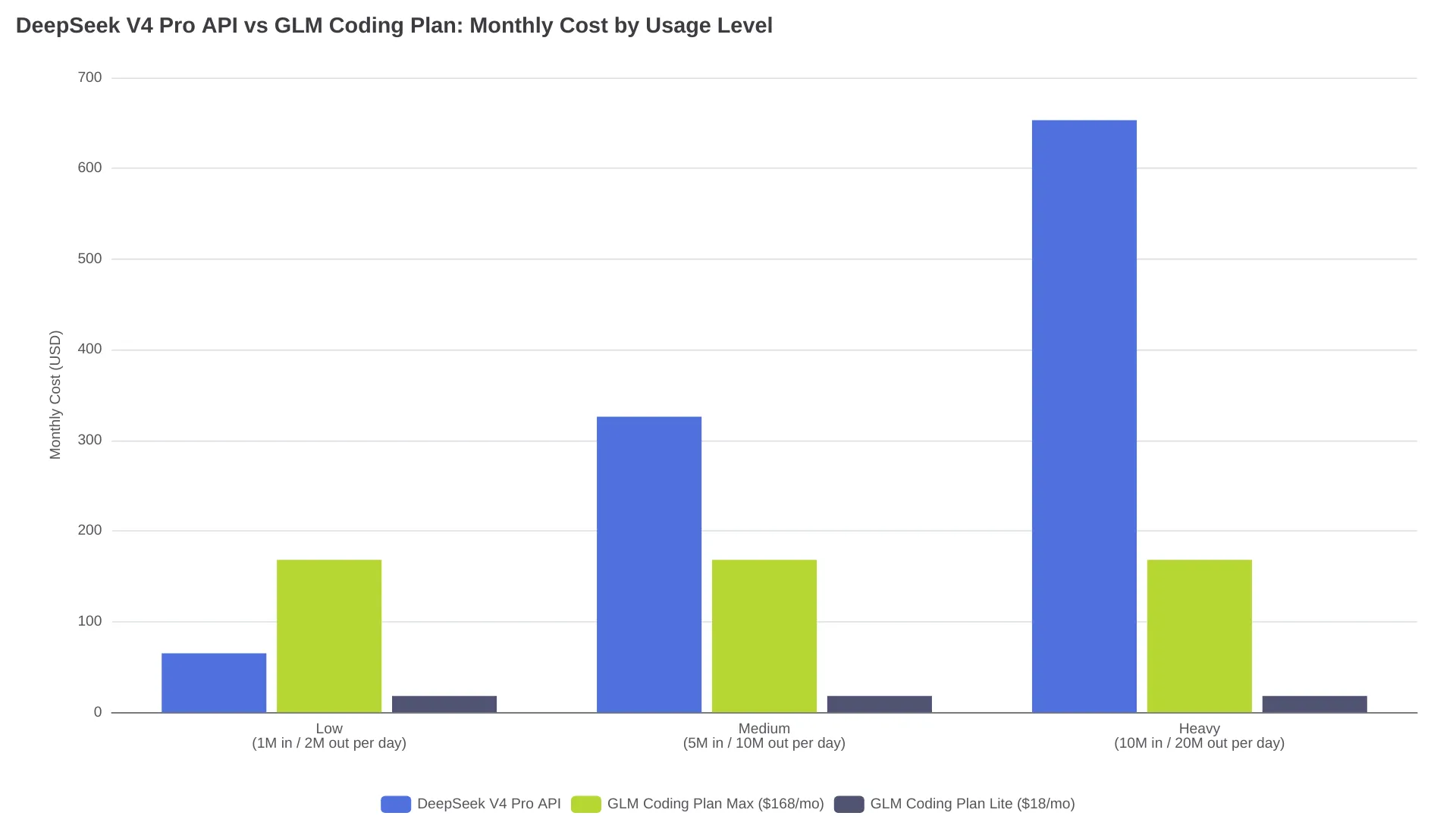
A concrete DeepSeek example: at 1M uncached input + 2M output tokens per day (a moderate coding session), the API costs roughly $65/month. Scale to 5M input + 10M output per day and the bill hits $326/month. Cached input at $0.003625/M can cut costs sharply for repetitive codebases. On the GLM side, the flat $168/month Max tier avoids metered surprise, but whether it covers the same workload depends on the undisclosed credit-to-token conversion.
What developers on Reddit report about each
In a recent r/ZaiGLM thread, one user who had used both models said:
"The task was quicker than GLM but required substantially more hand-holding."
The same thread includes users running multi-model workflows: GLM for coding and repository navigation, DeepSeek V4 Flash for code reviews. Another user noted DeepSeek V4 Pro had only been available for about 24 hours, cautioning against early judgments. These are individual reports from a single community thread, not controlled benchmarks.
Pick your model by scenario
| Your situation | Recommendation |
|---|---|
| Need API access or CI/CD integration today | DeepSeek V4 Pro — GLM-5.3 has no public API |
| Want to self-host for data residency | DeepSeek V4 Pro — MIT weights on Hugging Face now |
| Primarily code in an IDE and want a managed assistant | GLM-5.3 via GLM Coding Plan or ZCode |
| Budget-constrained individual developer | DeepSeek V4 Pro at low volume is cheaper per-token; GLM Lite ($18/mo) caps your spend regardless |
| Security auditing or vulnerability research | Test GLM-5.3 first — CyberGym 84.5% is unique but unverified independently |
| Large-scale agentic coding with long sessions | GLM Coding Plan Max ($168/mo flat) caps cost; verify the credit allowance covers your workload |
| Greenfield prototype with minimal existing code | Either — both handle fresh code; pick by access model preference |
If you're already on a GLM-5.2 Coding Plan, upgrading to GLM-5.3 within the same subscription is the path of least resistance. If you need DeepSeek V4 Pro's API, our DeepSeek V4 Pro GA API guide covers endpoint setup and pricing optimization. For a broader comparison that includes the previous GLM generation, see our GLM-5.2 vs DeepSeek V4 Pro breakdown.
FAQ
Will GLM-5.3 get a public API?
Yes. Z.ai says API access and open weights will be released in stages after safety evaluations. No specific date has been given.
Can I self-host either model?
DeepSeek V4 Pro: yes. MIT-licensed weights are on Hugging Face. The 1.6T-parameter MoE requires roughly 3.2TB VRAM unquantized (FP16) or ~800GB at 4-bit quantization, meaning a multi-GPU cluster with H100s or H200s. GLM-5.3: not yet. Open weights are promised after safety evaluations, and the license has not been disclosed.
Which is cheaper for heavy daily coding?
It depends on volume. At 1M input + 2M output tokens per day, DeepSeek V4 Pro costs roughly $65/month. At 5M input + 10M output, it hits $326/month. GLM Coding Plan Max at $168/month is cheaper than DeepSeek at that higher volume, but only if its undisclosed credit allowance covers the workload. Test both with your real usage before committing.
Does GLM-5.3 support vision or image input?
No. Z.ai keeps vision capabilities in a separate GLM-V model line (GLM-5V-Turbo, GLM-4.6V, GLM-OCR). GLM-5.3 is a text-and-code model. DeepSeek V4 Pro is also text-only.
The question is timing, not capability
GLM-5.3 looks stronger on paper: 50% coding gains, a unique cybersecurity angle, and better token efficiency. But all numbers are vendor-reported from a launch announcement hours old, with no API, no open weights, and no independent benchmark validation yet. DeepSeek V4 Pro offers something GLM-5.3 cannot match today: availability, verified benchmarks, and deployable weights. Use DeepSeek now where you need API access or self-hosting, and track GLM-5.3's API release for a head-to-head test on your own codebase.