 AIREITER
If you searched "Gemini 4" and landed on a page about open-weight models or a 1965 space mission, you're not alone — Google's SERP for this term is a mess of similarly named products. Here's the quick answer: Gemini 4 is Google DeepMind's next-generation frontier LLM, currently in pretraining as of August 2026, with no public release date, no API access, and no published specs. The Gemini 3.x family is available today, including the newly released 3.6 Flash at $1.50 per million input tokens.
What Google Has Confirmed About Gemini 4
The first public mention of "Gemini 4" by name came on July 21, 2026, buried in a Google blog post that was mainly about releasing Gemini 3.6 Flash, 3.5 Flash-Lite, and 3.5 Flash Cyber. One day later, on Alphabet's Q2 2026 earnings call (July 22, 2026), CEO Sundar Pichai stated directly — in Google's own published remarks: "We are now training Gemini 4."
Google characterized the effort as its "most ambitious pre-training run yet" and described Gemini 4 as a "significantly larger" frontier model than anything in the current lineup. Pichai also said Google plans to keep shipping models at high frequency while Gemini 4 is built: "Releasing models almost at a monthly cadence is part of our road map." He acknowledged Google is "a bit behind" in coding and agentic coding — the two capability areas Gemini 4 is expected to prioritize — and noted that Google remains supply constrained, which he framed as "a sign of momentum and rapid adoption."
| Claim | Source | Status |
|---|---|---|
| "We are now training Gemini 4" | Pichai, Q2 2026 earnings call remarks | Confirmed |
| "Most ambitious pre-training run yet" | Google blog, July 21, 2026 | Confirmed |
| "Significantly larger" base model | Pichai, earnings call | Confirmed |
| "Releasing models almost at a monthly cadence is part of our road map" | Pichai, earnings call | Confirmed |
| Google is supply constrained | Pichai, earnings call | Confirmed |
| Coding and agentic coding are priorities | Pichai, earnings call | Confirmed |
| Release date, specs, pricing, benchmarks | — | Not disclosed |
The Gemini 3.5 Pro Problem
Gemini 4's pretraining announcement landed while Gemini 3.5 Pro — the model Google promised for June 2026 at I/O in May — still hasn't shipped. Bloomberg characterized the model as "months late", attributing the delay to coding performance that didn't meet Google's internal expectations. Google's own earnings-call remarks say 3.5 Pro is "currently testing with partners" and will launch "as soon as it's ready." No revised timeline has been given.
The optics haven't gone unnoticed. When PC Guide rounded up the Reddit reaction to the Gemini 4 tease, the second-most-upvoted comment read simply: "3.5 Pro flop confirmed." That's speculation, not fact — but it captures why promoting the next generation before the current flagship ships reads as a bad sign to many developers.
Gemini 4 vs. Gemma 4 vs. Imagen 4: Which One Are You Looking For?
The single biggest source of confusion in "Gemini 4" search results is that the query collides with at least three other Google products. Here's the disambiguation:
| Name | What It Is | Released? | Key Fact |
|---|---|---|---|
| Gemini 4 | Proprietary frontier LLM (text/multimodal) | No — in pretraining | No public access of any kind |
| Gemma 4 | Open-weight model family (2B–27B) | Yes — April 2026 | 300M+ downloads; runs locally |
| Imagen 4 | Image generation model (Gemini API) | Yes | Text-to-image, not a chat/reasoning LLM |
| Gemini 4 (Wikipedia) | NASA's 1965 crewed spaceflight | — | Ed White's first US spacewalk |
If you're looking for benchmark numbers or technical specs, most of what surfaces in search belongs to Gemma 4, not Gemini 4. Gemma 4 is built using research and technology from Gemini 3, but it's a distinct product: open-weights you can download and run locally, versus a proprietary API model you access through Google's infrastructure.
When Will Gemini 4 Launch?
No official release date exists. The closest thing to a timeline estimate comes from 9to5Google's analysis, which infers a November or December 2026 window based on historical Gemini release patterns. That is a journalist's inference, not a Google commitment.
Pichai's monthly-cadence remark cuts both ways for timing. It suggests Google wants frequent model drops while Gemini 4 finishes training — but a frontier model moves from training to release in distinct stages, and none of them is fast:
- Pre-training — establishing broad capabilities across language, reasoning, and multimodality. Google says this phase is underway.
- Post-training — instruction tuning, safety alignment, tool-use integration, and quality refinement. The ongoing Gemini 3.5 Pro delay (months in partner testing without a release date) shows that models can sit between training and launch for a long time.
- Internal evaluation — testing long-context consistency, agent loops, safety behavior, and latency under production load.
- Preview access — limited developer access through API or AI Studio, often with changing behavior and rate limits.
- General availability — stable model ID, full documentation, production SLAs.
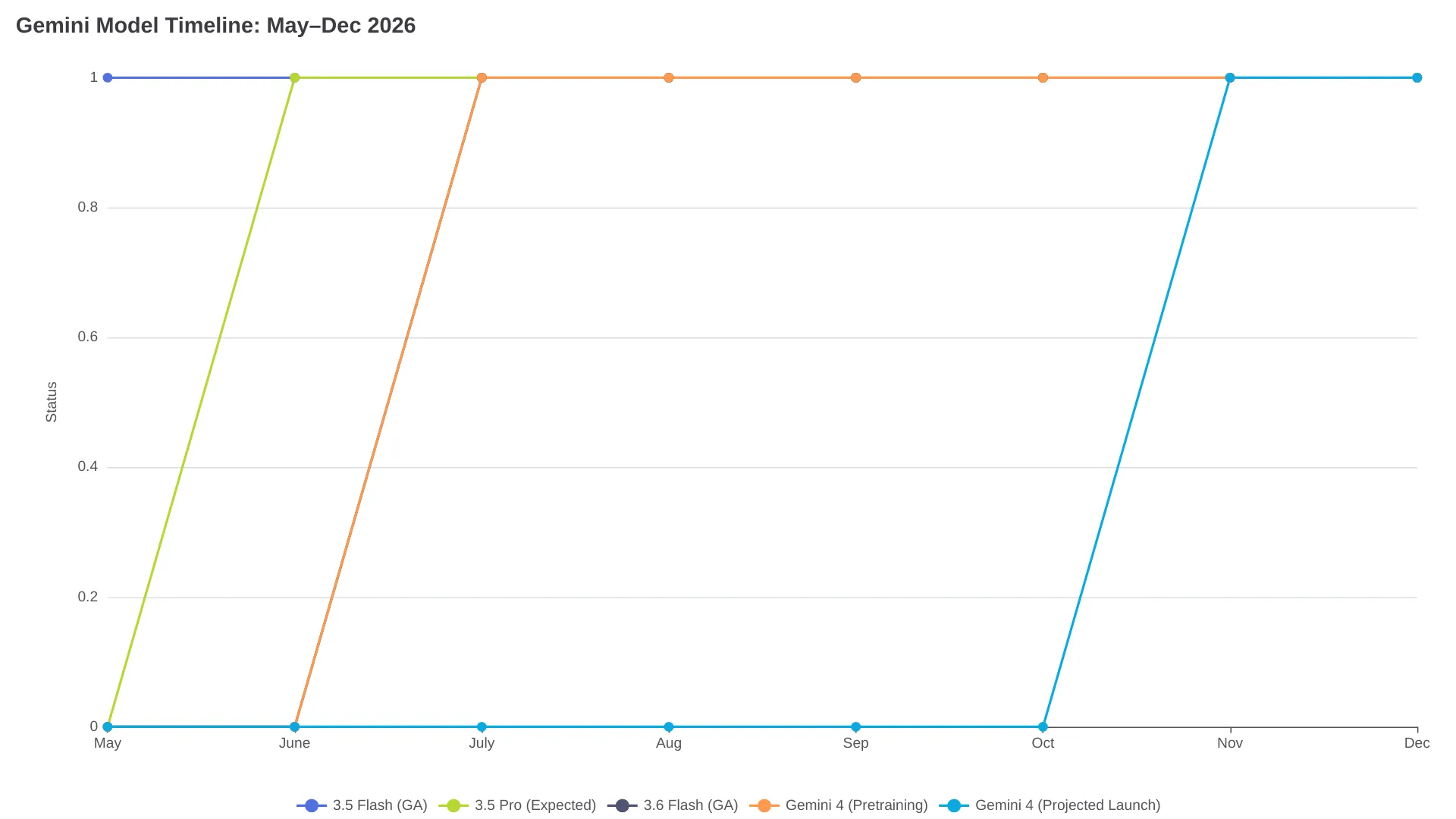
Given that Gemini 3.5 Pro — which entered partner testing months ago — still hasn't reached general availability, assuming Gemini 4 will arrive before early 2027 is optimistic.
What No Source Has Published Yet
Google has not officially published Gemini 4 parameter counts, context limits, benchmarks, API pricing, or model IDs. Any third-party figures you encounter should be treated as unverified unless they link to official documentation. Here's the complete inventory of what doesn't exist:
| Spec | Gemini 4 Status | Closest Current Reference |
|---|---|---|
| Parameter count | Unpublished | Unknown |
| Context window | Unpublished | 1M tokens (Gemini 3.1 Pro) |
| API model ID | Does not exist | gemini-3.6-flash etc. |
| Input pricing | Unpublished | $1.50/M tokens (3.6 Flash) |
| Output pricing | Unpublished | $7.50/M tokens (3.6 Flash) |
| Benchmark scores | None published | DeepSWE 49%, OSWorld 83% (3.6 Flash) |
| Variants (Pro/Flash/Nano) | Unconfirmed | 3.x line has Pro, Flash, Flash-Lite |
| Modality support | Unconfirmed | Text, image, video, audio, PDF (3.6 Flash) |
Community sentiment around the launch is more frustration than hype. A Reddit user in r/GeminiAI captured it:
"I just want a model that doesn't constantly lie to me and double down on it." — u/raycraft_io, r/GeminiAI
Build Now or Wait: What to Use Today
The practical question isn't "when will Gemini 4 launch" — it's "what should I build with right now." Google has three stable Gemini models available as of August 2026 (pricing per Ars Technica and Google's blog), and the choice depends on what you're doing.
| Model | Input Price | Output Price | Best For | Key Benchmark |
|---|---|---|---|---|
| Gemini 3.6 Flash | $1.50/M | $7.50/M | Coding, agentic workflows, multimodal | DeepSWE 49% |
| Gemini 3.5 Flash-Lite | $0.30/M | $2.50/M | High-volume, low-latency tasks | 350 tokens/sec |
| Gemini 3.1 Pro | $2.00/M | — | Advanced reasoning, long context | 1M token context |
If you're prototyping
Start with Gemini 3.6 Flash now. It's Google's current workhorse — 17% fewer output tokens than 3.5 Flash, meaningfully better coding benchmarks (DeepSWE jumped from 37% to 49%), and computer-use support. You can access it through Google AI Studio or directly via the Gemini API. Build a model-agnostic adapter layer so swapping to Gemini 4 later is a configuration change, not a rewrite.
If you have a production deadline
Do not block on an unannounced model. Pin a stable model version, define regression tests, and reserve engineering time for a future migration. A rumored launch date is not a project plan.
If you're doing research
You can wait — but not passively. Build your evaluation harness now: assemble a test set with your real prompts, structured outputs, tool calls, and failure cases. Once Gemini 4 preview drops, you'll be able to evaluate it on evidence rather than marketing claims.
Three Signals That Gemini 4 Is Near Launch
Rather than refreshing tech news sites, watch Google's developer infrastructure. A Gemini 4 launch will likely appear there first:
- An exact model ID in the API catalog. The Gemini API model directory currently lists stable 3.x models. A
gemini-4-*entry with documentation, context limits, and usage caps would be the clearest signal. An unofficial Reddit post claiming to have spottedgemini-4-flash-previewin a public SDK surfaced in July — treat that as a rumor until it appears in official docs.
- A coordinated changelog entry across surfaces. Gemini 4 won't arrive as a single announcement. Look for simultaneous updates across the Gemini API changelog, Google AI Studio, Vertex AI, and the Gemini app — each with the new model ID, migration guidance, and deprecation notices for older models.
- Clarity on Gemini 3.5 Pro. The status of Gemini 3.5 Pro is relevant context for the Gemini 4 timeline, though it does not establish a launch date. If 3.5 Pro ships soon, Gemini 4 may still follow in a separate cycle.
Gemini 4 FAQ
Is Gemini 4 available in the Gemini app, API, or Google AI Studio?
No. Gemini 4 has no public access of any kind — no app, no API endpoint, no preview program, no waitlist. The only models currently available are from the Gemini 3.x family. Anyone claiming to offer Gemini 4 API access is either mistaken or referring to Gemma 4, which is a different product.
Is there a Gemini 4 Pro?
No. "Gemini 4 Pro" does not exist — Google has not announced, named, or scheduled any Gemini 4 variant. Searches for it return speculation built on the Gemini 3.x naming pattern (Pro, Flash, Flash-Lite, Flash Cyber), where "Pro" marks the flagship tier. If Google keeps that convention, a tiered Gemini 4 lineup is plausible — Pichai's monthly-cadence comment even suggests faster iteration across tiers — but as of August 2026 there is no model, no benchmark, and no pricing to compare against. The current flagship tier is Gemini 3.5 Pro, which itself is still in partner testing.
What is the difference between Gemini 4 and Gemma 4?
Gemini 4 is Google's proprietary frontier LLM, accessible only through Google's cloud infrastructure when it launches. Gemma 4 is an open-weight model family released in April 2026 — you can download the weights, inspect them, fine-tune them, and run them on your own hardware. Both are built by Google DeepMind, but they serve different purposes and have different access models.
Should I wait for Gemini 4 or start building with Gemini 3.6 Flash now?
Start building now. Gemini 3.6 Flash is a capable, stable model with strong coding benchmarks and competitive pricing. Waiting for an unannounced model with no release date is an opportunity cost you can't recover. Make your model layer replaceable and you lose nothing by starting today.
How will Gemini 4 compare to other frontier models?
There's no way to answer this yet — Gemini 4 has no published benchmarks. Google's stated goal is to compete at the AI frontier, and Pichai acknowledged the company is currently "a bit behind" in coding. Whether Gemini 4 closes that gap depends on factors Google hasn't disclosed: model size, training data, architecture choices, and post-training quality.
Will Gemini 4 ship in more than one variant?
Google hasn't confirmed any Gemini 4 variant names. The 3.x generation spans Pro, Flash, Flash-Lite, and specialized models like Flash Cyber, so multiple tiers are plausible, but no lineup has been announced and no variant names exist.
The trade-off is simple: waiting for Gemini 4 costs you time and market opportunity; building with 3.6 Flash now costs you a future migration. If you keep your model layer replaceable — pin a stable version, abstract the API call, log everything — that migration cost drops to near zero. You get the option to switch the day Gemini 4 ships without paying for it today.