
On July 21, 2026, Google shipped Gemini 3.6 Flash with two numbers that matter to anyone running agents at scale: output dropped from $9.00 to $7.50 per million tokens, and the model does the same work with about 17% fewer output tokens. Put those together and the per-task bill for an output-heavy workload falls roughly a third. On coding and agentic benchmarks it also clears the older 3.5 Flash, and even the larger 3.1 Pro, on most tests. For existing 3.5 Flash users this is close to a free upgrade, though it is not the cheapest sticker price in its class.
What Google shipped on July 21
Three models landed at once, and they solve different problems:
- Gemini 3.6 Flash (
gemini-3.6-flash): the mainline "fast but smart" model. 1M-token context, 64k max output, knowledge cutoff pushed to March 2026 (up from January 2025). - Gemini 3.5 Flash-Lite: a high-throughput model at roughly 350 output tokens/second, priced far lower for simple, high-volume jobs.
- Gemini 3.5 Flash Cyber: a security-tuned variant that finds, validates, and patches vulnerabilities. It runs inside CodeMender and is a limited-access pilot for governments and trusted partners, not a general release.
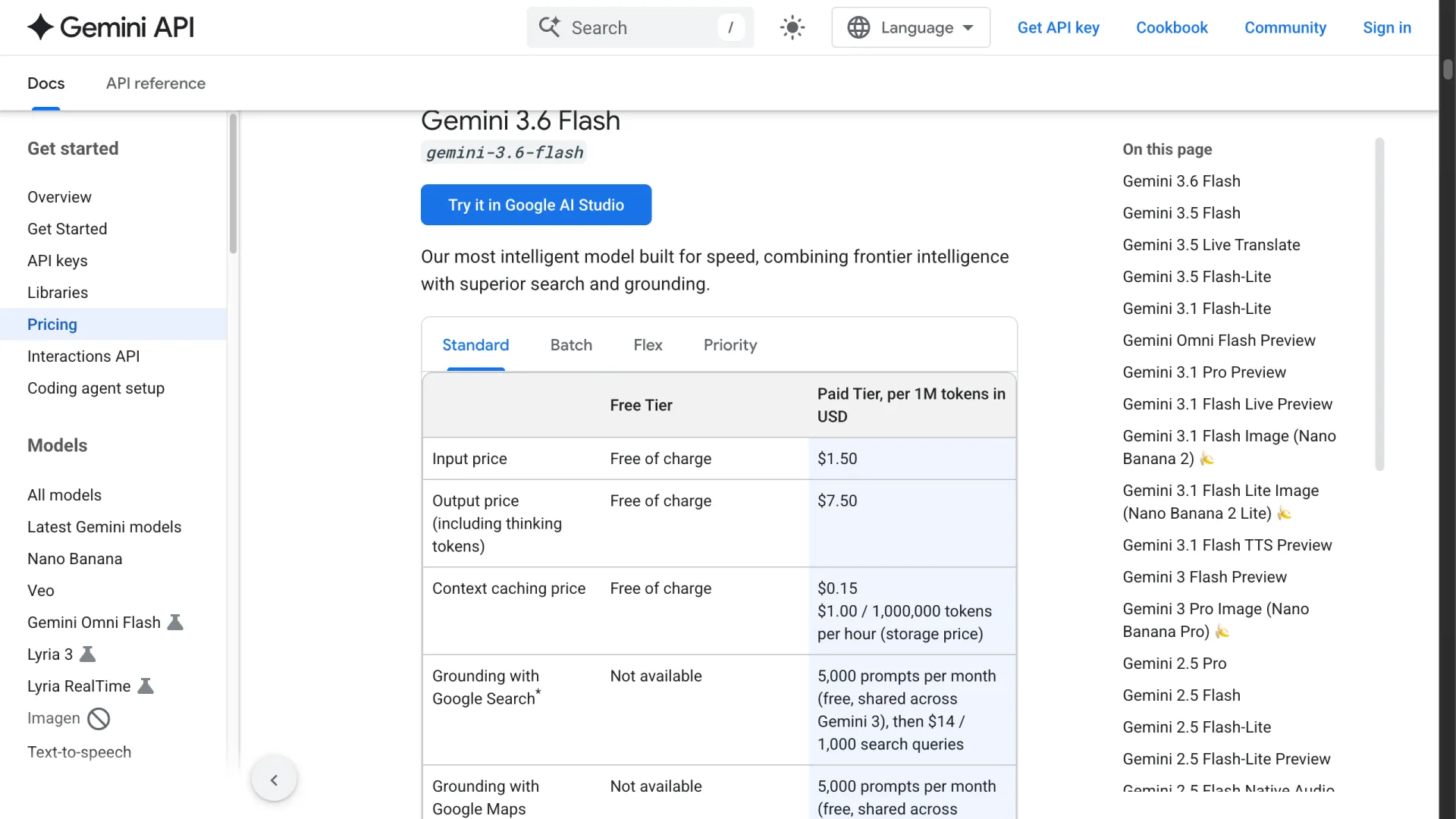
The official model page bills 3.6 Flash as "our most intelligent model built for speed," and the pricing is published on Google's Gemini API pricing page.
Google did not ship this in a vacuum. Its flagship Gemini 3.5 Pro slipped its schedule, and DeepMind has said it has already begun pre-training Gemini 4, so this Flash refresh fills the gap while the bigger releases land.
Gemini 3.6 Flash pricing (and why the "cut" is smaller than it looks)
Standard API pricing for Gemini 3.6 Flash is $1.50 per 1M input tokens and $7.50 per 1M output tokens (output includes thinking tokens). Context caching is $0.15 per 1M, with a $1.00 per 1M/hour storage fee.
Here is the part most launch coverage skips: the price cut is output-only. The prior Gemini 3.5 Flash charged $1.50 input and $9.00 output. Input is unchanged, and output fell from $9.00 to $7.50, a 16.7% reduction rather than an across-the-board discount. If your workload is input-heavy (long documents in, short answers out), the sticker savings are modest. The real gain shows up somewhere else.
The number that matters: cost per task, not sticker price
Sticker price per token is the wrong unit for comparing model generations. What you pay is price × tokens used. Two things move here: the output rate is 16.7% lower, and Google (via the Artificial Analysis Index) reports about 17% fewer output tokens for the same work. Stacked, the best case is roughly 0.833 × 0.83 ≈ 0.69, about 31% cheaper on output.
How much of that you actually see depends on the workload, so I ran the same three prompts (a coding task, a reasoning problem, and a JSON extraction) through both models via OpenRouter at temperature 0 on July 22, 2026:
| Metric (3 tasks, temp 0) | Gemini 3.6 Flash | Gemini 3.5 Flash |
|---|---|---|
| Input tokens | 146 | 145 |
| Output tokens | 2,736 | 2,593 |
| Total cost | $0.0207 | $0.0236 |
| Total latency | 5.20s | 5.19s |
Both models returned correct, comparable answers. On this small sample 3.6 Flash came out about 12% cheaper at roughly the same speed, yet it emitted a few percent more tokens, because it spent more on reasoning. The takeaway: the dependable saving is the output price cut ($9.00 to $7.50); the token-efficiency gain is real in aggregate but swings by task and won't always appear. Plan around 12–17% on output in practice, with 31% as the best case.
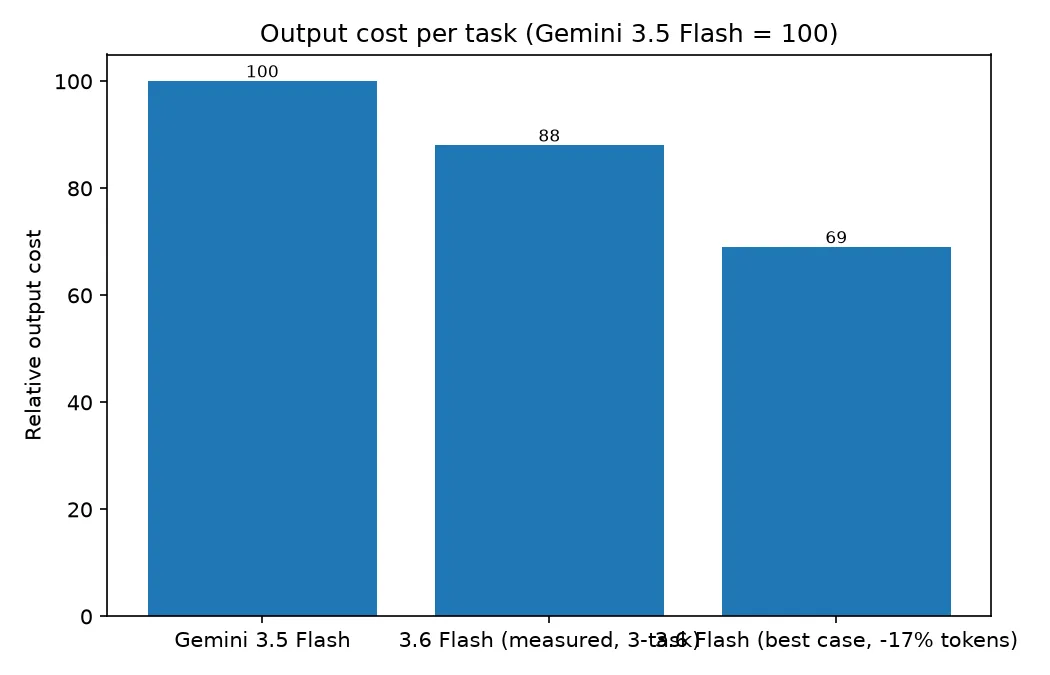
(Small sample: three tasks, temperature 0, not a formal benchmark.)
Gemini 3.6 Flash vs other fast models
Cheapest-per-token is not the same as best-value, so it helps to see the fast tier side by side. All figures are standard (non-batch) per 1M tokens, from each vendor's official pricing page.
| Model | Input /1M | Output /1M | Context |
|---|---|---|---|
| Gemini 3.6 Flash | $1.50 | $7.50 | 1M |
| Gemini 3.5 Flash (prior) | $1.50 | $9.00 | 1M |
| Gemini 3.5 Flash-Lite | $0.30 | $2.50 | 1M |
| Claude Haiku 4.5 | $1.00 | $5.00 | 200k |
| GPT-5.6 Luna | $1.00 | $6.00 | — |
| DeepSeek V4 Flash | $0.14 | $0.28 | 1M |
On sticker price alone, 3.6 Flash is not the winner. Claude Haiku 4.5 and GPT-5.6 Luna undercut it on output, and DeepSeek V4 Flash is in a different universe on cost. What 3.6 Flash sells is intelligence-per-dollar: it posts an Artificial Analysis Intelligence Index of 50 (well above the fast-tier median) at roughly 304 output tokens/second, with a full 1M-token context window. If you need frontier agentic and coding quality without paying flagship prices, that is the case for it. If you need the absolute floor on cost for simple tasks, the cheaper rows win.
How much better than 3.5 Flash?
The generational jump is real, and it is largest exactly where the Flash line was weakest: long-horizon coding and agentic work.
| Benchmark | Gemini 3.5 Flash | Gemini 3.6 Flash |
|---|---|---|
| DeepSWE v1.1 | 37% | 49% |
| MLE-Bench | 49.7% | 63.9% |
| OSWorld-Verified (computer use) | 78.4% | 83.0% |
| SWE-Bench Pro | 55.1% | 58.7% |
| Terminal-Bench 2.1 | 76.2% | 78.0% |
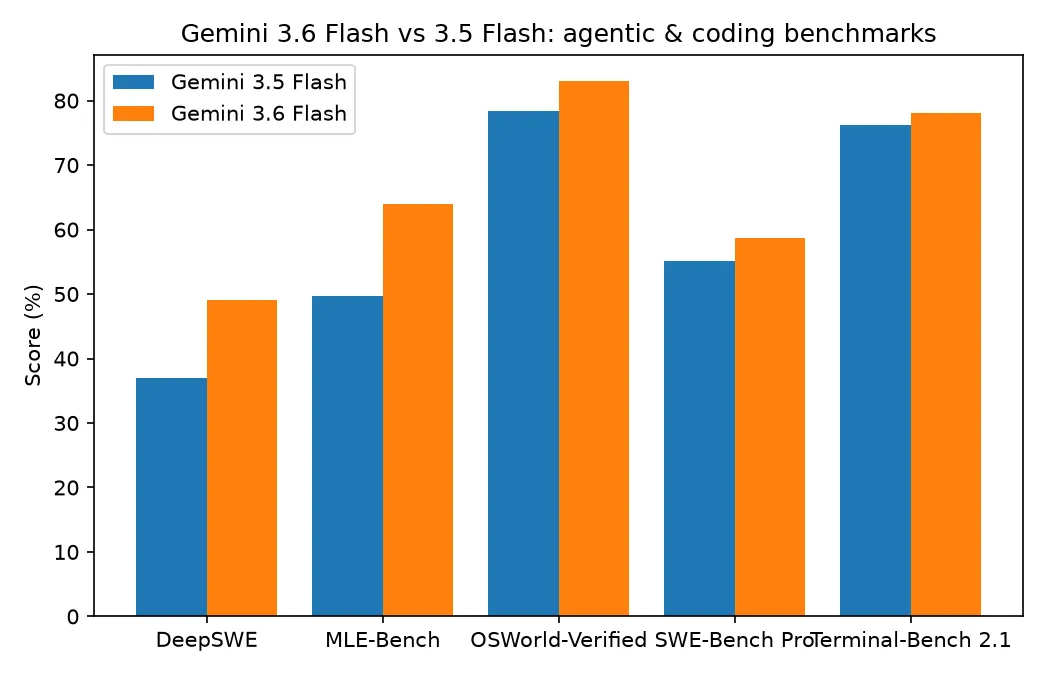
Scores come from the Google DeepMind Flash model page and Artificial Analysis. The DeepSWE and MLE-Bench gains stand out, a 12-point and 14-point jump respectively. Google also reports a GDPval-AA knowledge-work score of 1421 (up from 1349). On several of these, 3.6 Flash edges out the larger, pricier 3.1 Pro, which is unusual for a Flash model.
Gemini 3.6 Flash vs 3.1 Pro
Here is the surprising part: on agentic and coding work, this fast-tier model beats Google's larger, pricier 3.1 Pro. Gemini 3.1 Pro Preview runs $2.00–$4.00 input and $12.00–$18.00 output per 1M tokens (tiered by prompt length), against a flat $1.50/$7.50 for 3.6 Flash.
| Gemini 3.6 Flash | Gemini 3.1 Pro | |
|---|---|---|
| Input /1M | $1.50 | $2.00–$4.00 |
| Output /1M | $7.50 | $12.00–$18.00 |
| DeepSWE v1.1 | 49% | 12% |
| SWE-Bench Pro | 58.7% | 54.2% |
| Terminal-Bench 2.1 | 78.0% | 73.8% |
3.1 Pro is still the larger, higher-priced model, aimed at the hardest reasoning and long-context jobs. For most coding and agentic workloads, though, 3.6 Flash is now both cheaper and higher-scoring on the benchmarks above, which is why the 3.1 Pro comparison is worth running before you default to the Pro tier. The full Gemini 3.6 Flash vs 3.1 Pro breakdown has the head-to-head benchmarks, tiered pricing, and a first-hand speed test.
Should you migrate from Gemini 3.5 Flash?
For most teams already on 3.5 Flash, yes. The math is close to strictly better:
- Same input price ($1.50/1M) and lower output price ($7.50 vs $9.00).
- Fewer output tokens for the same task (about 17% less).
- Newer knowledge cutoff (March 2026 vs January 2025).
- Higher scores on every agentic and coding benchmark above.
Two things to check before you swap it into production. First, confirm your workloads fit the 64k max output limit; if you were relying on longer single responses, test that boundary. Second, run your own eval set. Token-efficiency gains and reasoning changes can shift behavior on prompts you have already tuned, so benchmark latency and output quality on your traffic before flipping the default.
Flash vs Flash-Lite vs Cyber: which one
Three models, three jobs:
- Gemini 3.6 Flash is the default. Reach for it when you want frontier-level agentic, coding, and multimodal quality at a fast-tier price.
- Gemini 3.5 Flash-Lite ($0.30/$2.50, ~350 tokens/sec) suits high-volume, latency-sensitive, lower-complexity work: classification, extraction, routing, simple chat. It is the cheapest way to run Gemini at scale.
- Gemini 3.5 Flash Cyber is only relevant if you are a government or vetted security partner. It is a pilot inside CodeMender, not a model you can call from the standard API.
How to access Gemini 3.6 Flash
The model is live in the Gemini API and Google AI Studio. AI Studio has a free tier to prototype against, then you move to pay-as-you-go with the gemini-3.6-flash model ID, the same free-then-paid Google AI Studio path that applies to the rest of the Gemini line. Enterprise surfaces (Antigravity, Android Studio, the Gemini Enterprise Agent Platform) are also listed. If you need it on Vertex AI specifically, confirm the listing in the Vertex console, since availability there was still rolling out as of July 22, 2026.
A minimal REST call to the Gemini API looks like this:
curl "https://generativelanguage.googleapis.com/v1beta/models/gemini-3.6-flash:generateContent" \
  -H "x-goog-api-key: $GEMINI_API_KEY" \
  -H "Content-Type: application/json" \
  -d '{"contents":[{"parts":[{"text":"Summarize agentic AI in one sentence."}]}]}'
Teams that run more than one provider sometimes route models through an aggregator instead of holding separate keys. Both OpenRouter and AIReiter expose the gemini-3.6-flash model at Google's list price; the difference is what else sits behind the same key. OpenRouter fans out across many providers, while AIReiter is Anthropic-compatible and routes Gemini alongside Claude, which helps if you are weighing 3.6 Flash against Claude's API pricing on one bill. For a single-model deployment, going straight to Google is simpler.
FAQ
Is Gemini 3.6 Flash free?
There is a free tier in Google AI Studio for prototyping, with usage limits. Production use runs on pay-as-you-go pricing at $1.50 input and $7.50 output per 1M tokens.
Is Gemini 3.6 Flash better than 3.5 Flash?
Yes. On the published benchmarks it beats 3.5 Flash on DeepSWE, MLE-Bench, OSWorld-Verified, SWE-Bench Pro, and Terminal-Bench, while costing less per output token and using fewer tokens per task.
Is Gemini 3.6 Flash better than Gemini 3.1 Pro?
On agentic and coding benchmarks like DeepSWE, SWE-Bench Pro, and Terminal-Bench, yes, and at a lower price ($1.50/$7.50 vs $2.00–$4.00/$12.00–$18.00). Gemini 3.1 Pro is the larger model and still leads on the hardest long-context reasoning and multimodal tasks, so the right pick depends on your workload.
How much does Gemini 3.6 Flash cost?
$1.50 per 1M input tokens and $7.50 per 1M output tokens on the standard tier. Context caching is $0.15 per 1M tokens.
What is the knowledge cutoff for Gemini 3.6 Flash?
March 2026, up from January 2025 on the previous Gemini 3.5 Flash.
Is Gemini 3.6 Flash available on Vertex AI?
It is confirmed in the Gemini API and Google AI Studio, along with several enterprise surfaces. Vertex AI availability was not explicitly confirmed at launch, so check the Vertex model catalog before building on it there.
What is Gemini 3.5 Flash Cyber?
A security-focused variant tuned to detect, validate, and patch software vulnerabilities. It runs inside Google DeepMind's CodeMender agent and is a limited-access pilot for governments and trusted partners rather than a public model.