 AIREITER
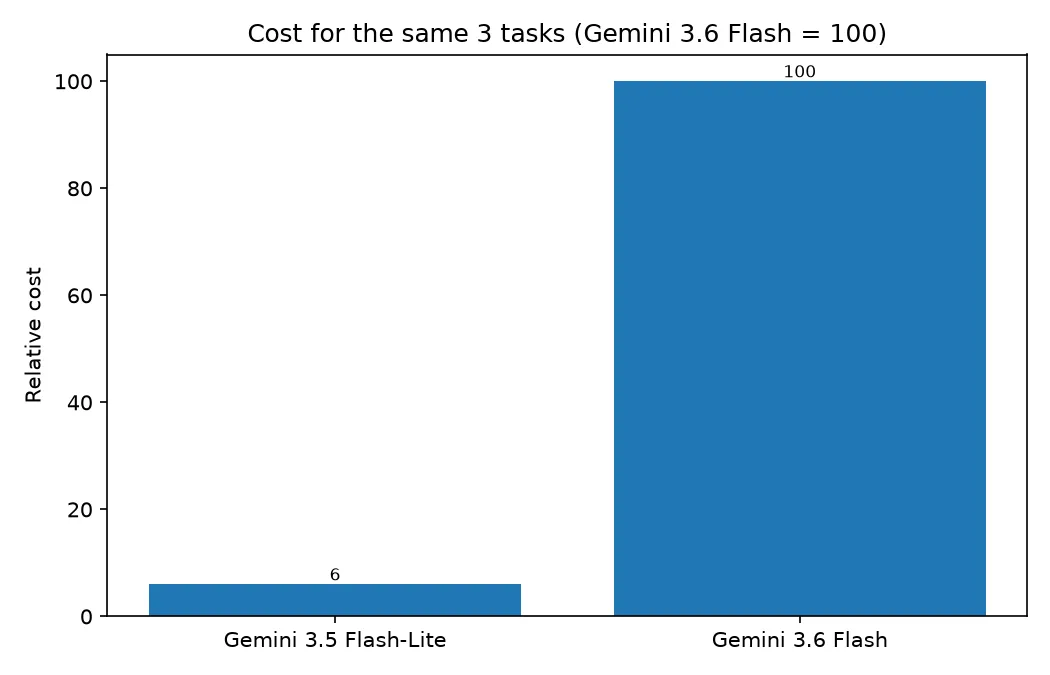
Gemini 3.5 Flash-Lite is the cheapest way to run a Gemini model: $0.30 per million input tokens and $2.50 per million output. In a quick head-to-head I ran, it came out 94% cheaper than Gemini 3.6 Flash on the same tasks, streamed faster, and still returned correct answers. The catch is that it is tuned for volume and speed, not deep reasoning. If your workload is high-throughput and mostly straightforward, this is the model to reach for.
What Gemini 3.5 Flash-Lite is
Flash-Lite is the bottom rung of the Gemini fast tier, built for simple, high-volume tasks where cost per call and latency matter more than raw intelligence. The essentials:
- Pricing: $0.30 input / $2.50 output per 1M tokens.
- Context: 1M tokens, same as the larger Flash models.
- Speed: Google rates it around 350 output tokens/second.
- Intelligence: Artificial Analysis Index of 36, versus 50 for the pricier 3.6 Flash. That gap is the trade-off.
It shipped alongside 3.6 Flash and the security-focused 3.5 Flash Cyber, but it targets a different job entirely: classification, extraction, routing, tagging, and simple chat at scale.
Pricing: the cheapest Gemini tier
Set against the rest of the line, Flash-Lite is dramatically cheaper (all figures from Google's official pricing page):
| Model | Input /1M | Output /1M |
|---|---|---|
| Gemini 3.5 Flash-Lite | $0.30 | $2.50 |
| Gemini 3.6 Flash | $1.50 | $7.50 |
| Gemini 3.5 Flash (prior) | $1.50 | $9.00 |
That is 5x cheaper on input and 3x cheaper on output than 3.6 Flash before you account for how many tokens each model actually spends, which is where the real gap opens up.
I tested it against 3.6 Flash
I sent both models the same three prompts (a coding task, a reasoning problem, and a JSON extraction) through OpenRouter at temperature 0 on July 22, 2026:
| Metric (3 tasks, temp 0) | Gemini 3.5 Flash-Lite | Gemini 3.6 Flash |
|---|---|---|
| Input tokens | 147 | 148 |
| Output tokens | 543 | 3,058 |
| Total cost | $0.0014 | $0.023 |
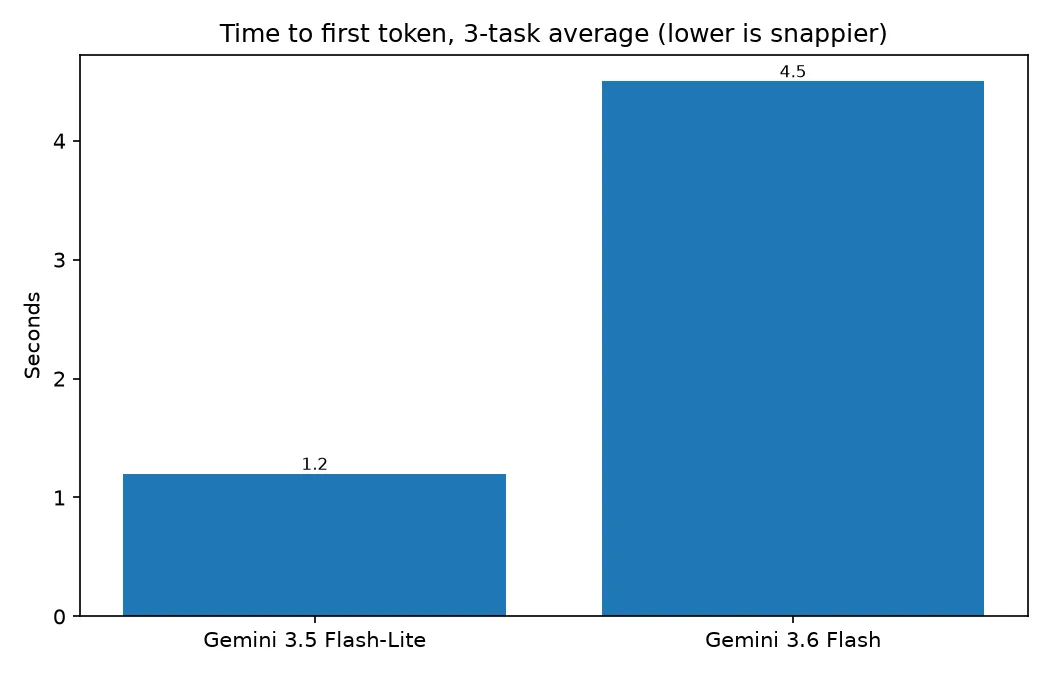
| Avg time to first token | 1.2s | 4.5s |
| Generation speed | over 400 tok/s | — |
| Answers correct | 3 / 3 | 3 / 3 |
Flash-Lite came out 94% cheaper and answered every task correctly, including the multi-step train-timing problem. Two things drive that gap. It streams at over 400 tokens/second, faster than its 350 rating and quicker to first token because it does not pause to "think" the way 3.6 Flash does. And it is far terser, a few hundred output tokens against several thousand, because 3.6 Flash spends heavily on hidden reasoning tokens that you pay for. On simple work, that reasoning is overhead you do not need.
The responsiveness gap is just as noticeable in practice. Flash-Lite returns its first token in about 1.2 seconds on average versus 4.5 for 3.6 Flash, so in a chat or a high-volume pipeline it simply feels quicker.
Two caveats. First, this was a single run at temperature 0, and these models vary from run to run, so read the exact figures as indicative rather than a benchmark. Second, my three tasks were easy: the Intelligence Index gap (36 vs 50) is real and shows up on harder problems, complex multi-step agents, nuanced coding, or anything needing careful reasoning, where Flash-Lite's thin thinking budget becomes a ceiling rather than a saving.
When to use Flash-Lite, and when not
- Use Gemini 3.5 Flash-Lite for high-volume, latency-sensitive, lower-complexity work: classification, entity extraction, routing and triage, tagging, summarizing short text, and simple chat. At this price you can run it at a scale that would be uncomfortable on 3.6 Flash.
- Step up to 3.6 Flash when the task needs real reasoning: agentic coding, computer use, multi-step workflows, or anything where a wrong answer is expensive. The full Gemini 3.6 Flash guide covers that tier's benchmarks and pricing.
A common pattern is to use both: route the bulk of cheap, simple calls to Flash-Lite and escalate only the hard cases to 3.6 Flash. Since both share the 1M-token context and the same API, switching is a one-line model-ID change.
How to access Gemini 3.5 Flash-Lite
The model is live in the Gemini API and Google AI Studio under the ID gemini-3.5-flash-lite, with a free tier in AI Studio for testing. If you route through an aggregator, both OpenRouter and AIReiter expose it at Google's list price, which is convenient if you are mixing it with Gemini or Claude models behind one key.
FAQ
How much does Gemini 3.5 Flash-Lite cost?
$0.30 per 1M input tokens and $2.50 per 1M output tokens, the cheapest tier in the Gemini line.
Is Gemini 3.5 Flash-Lite free?
There is a free tier in Google AI Studio for prototyping. Production use runs on the pay-as-you-go pricing above.
How fast is Gemini 3.5 Flash-Lite?
Google rates it around 350 output tokens/second; in my streaming test it ran over 400, with a first token in roughly 1.2 seconds.
Is Flash-Lite good enough, or should I use 3.6 Flash?
For simple, high-volume tasks Flash-Lite is correct and far cheaper. For reasoning-heavy or agentic work, 3.6 Flash's higher intelligence (Index 50 vs 36) is worth the extra cost.