 AIREITER
Usually the Pro model wins. Not this time. Gemini 3.6 Flash is cheaper than Gemini 3.1 Pro, more than twice as fast, and beats it on nearly every coding and agentic benchmark. The older 3.1 Pro holds on to exactly one thing: a narrow edge on the hardest pure-reasoning tests. I ran both models on identical tasks and re-verified every price and spec below against Google's docs and Artificial Analysis on July 23, 2026.
The verdict in 30 seconds
Gemini 3.6 Flash | Gemini 3.1 Pro | Winner | |
|---|---|---|---|
API price (in/out per 1M, ≤200k) | $1.50 / $7.50 | $2.00 / $12.00 | Flash |
Long prompts (>200k tokens) | same flat price | $4.00 / $18.00 | Flash |
Output speed | 261 tokens/s | 112 tokens/s | Flash |
Coding & agentic benchmarks | wins all 4 head-to-heads | — | Flash |
Hardest reasoning (GPQA, HLE) | — | ahead by 1.3–6.4 pts | 3.1 Pro |
Knowledge cutoff | March 2026 | January 2025 | Flash |
Release status | Generally available | Preview since February 2026 | Flash |
If you stop reading here: default to Gemini 3.6 Flash, and reach for 3.1 Pro only when a task needs the top reasoning ceiling. You can also skip the reading and put Gemini 3.6 Flash and Gemini 3.1 Pro head to head in a browser chat with your own prompts, no API key needed. The rest of the article is the evidence, including a three-task test you can reproduce.
The price gap
Gemini 3.6 Flash is flat-rate at any prompt length; Gemini 3.1 Pro charges more and adds a long-prompt tier. Standard API pricing per 1M tokens, verified July 23, 2026:
Gemini 3.6 Flash | Gemini 3.1 Pro | |
|---|---|---|
Input (≤200k) | $1.50 | $2.00 |
Output (≤200k) | $7.50 | $12.00 |
Input (>200k) | $1.50 | $4.00 |
Output (>200k) | $7.50 | $18.00 |
Context cache read (≤200k) | $0.15 | $0.20 |
Batch (input/output, ≤200k) | $0.75 / $3.75 | $1.00 / $6.00 |
Output is where you feel it: 3.1 Pro costs 60% more per output token on short prompts, and up to 140% more once a prompt crosses 200k tokens.
The gap follows you into the discounts too. Batch mode halves both models' rates, so Pro stays 60% more expensive there. Cache *storage*, billed hourly on top of the per-token read price, costs $4.50 per 1M tokens per hour on Pro versus $1.00 on Flash. At Google's public list prices, no mode (standard, Batch, Priority, or caching) makes Pro the cheaper pick.
I ran both on the same three tasks
Pricing tables assume equal token usage, so I sent both models the same three prompts through OpenRouter (model IDs google/gemini-3.6-flash and google/gemini-3.1-pro-preview) at temperature 0 on July 22, 2026, one run each:
1. Code: write a Python merge_intervals function with a docstring and usage example 2. Reasoning: a two-trains catch-up word problem requiring time-and-speed algebra 3. Extraction: pull action items out of a messy team message as a JSON array
Task | Flash latency | Pro latency | Flash cost | Pro cost |
|---|---|---|---|---|
Code | 2.4s | 4.5s | $0.0085 | $0.0102 |
Reasoning | 1.9s | 2.4s | $0.0082 | $0.0118 |
Extraction | 1.3s | 2.6s | $0.0049 | $0.0057 |
Total | 5.65s | 9.48s | $0.0215 | $0.0277 |
*Totals are computed from the raw millisecond and token logs; per-task rows are rounded, so summing a column can land a hundredth off.*
Both models got all three tasks right — correct merged intervals, the right catch-up time, clean JSON. The difference is what each answer cost.
Flash generated *more* tokens than Pro (2,843 vs 2,285 in OpenRouter's usage metadata, most of them internal reasoning tokens on both sides) yet still came out 22% cheaper and 40% faster end to end. Pro's higher output rate and slower generation outweigh its terser replies. On agentic loops, where every step pays that latency again, the gap compounds.
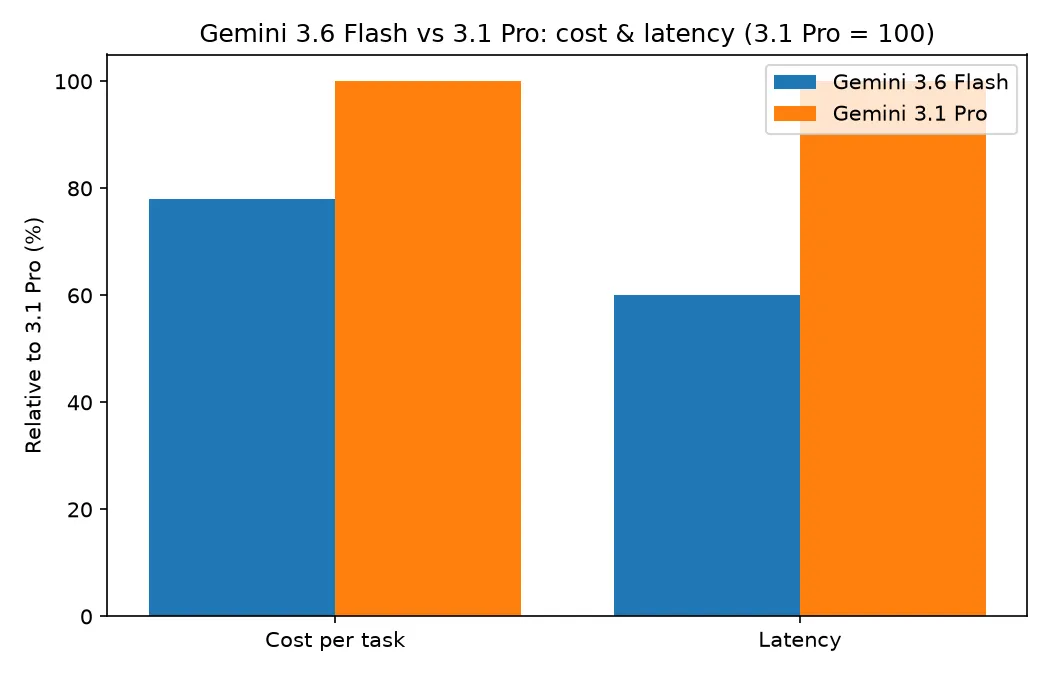
Three small prompts are a spot check, not a benchmark — treat the exact percentages as illustrative. But the direction matches what larger-scale measurements show, which is where we go next.
Coding and agentic benchmarks: Flash sweeps
On the public head-to-head numbers (Artificial Analysis), 3.6 Flash beats the older 3.1 Pro across coding, ML engineering, and terminal use:
Benchmark | Gemini 3.1 Pro | Gemini 3.6 Flash |
|---|---|---|
DeepSWE v1.1 | 12% | 49% |
MLE-Bench | 42.6% | 63.9% |
SWE-Bench Pro | 54.2% | 58.7% |
Terminal-Bench 2.1 | 73.8% | 78.0% |
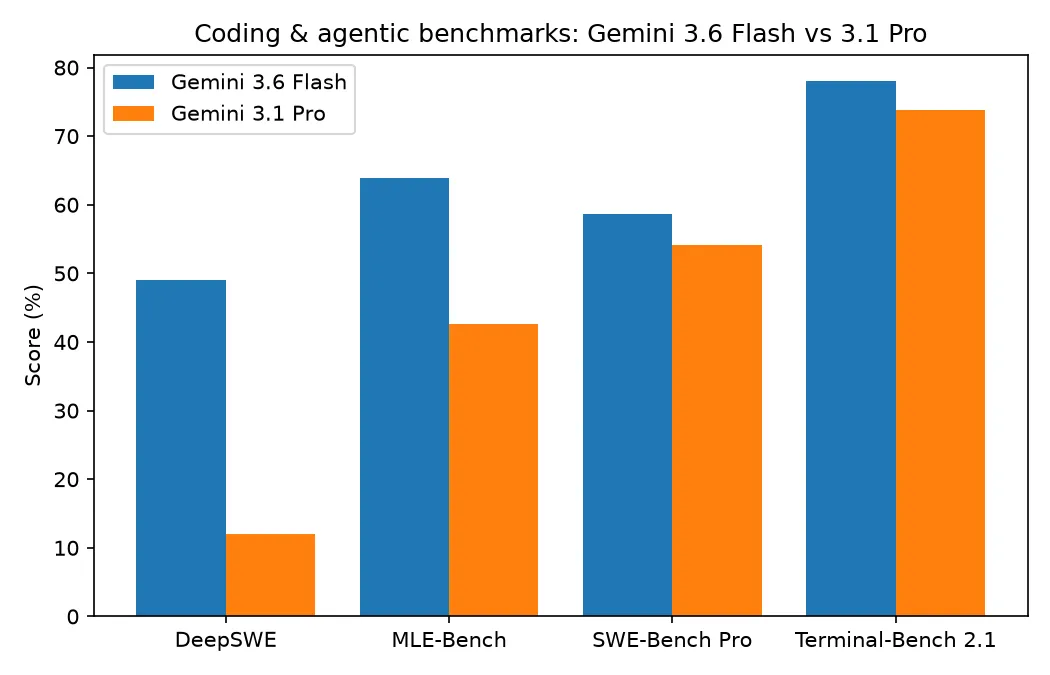
The DeepSWE gap is the widest, 49% to 12%. Flash also edges Pro on multimodal reasoning (MMMU-Pro 83.2% vs 82.4%) and takes the composite Artificial Analysis Intelligence Index, 50 to 46.
Speed shows the same pattern. As of July 23, 2026, Artificial Analysis measures Flash at 261 tokens/second versus 112 for 3.1 Pro (2.3x), and time-to-first-token at 12.8s versus 31.2s on their standard workload. Those first-token figures include each model's thinking time before the answer starts, which is why my short tasks above finished much sooner. Zooming out to the full leaderboard, Flash lands near the top on all three axes at once:
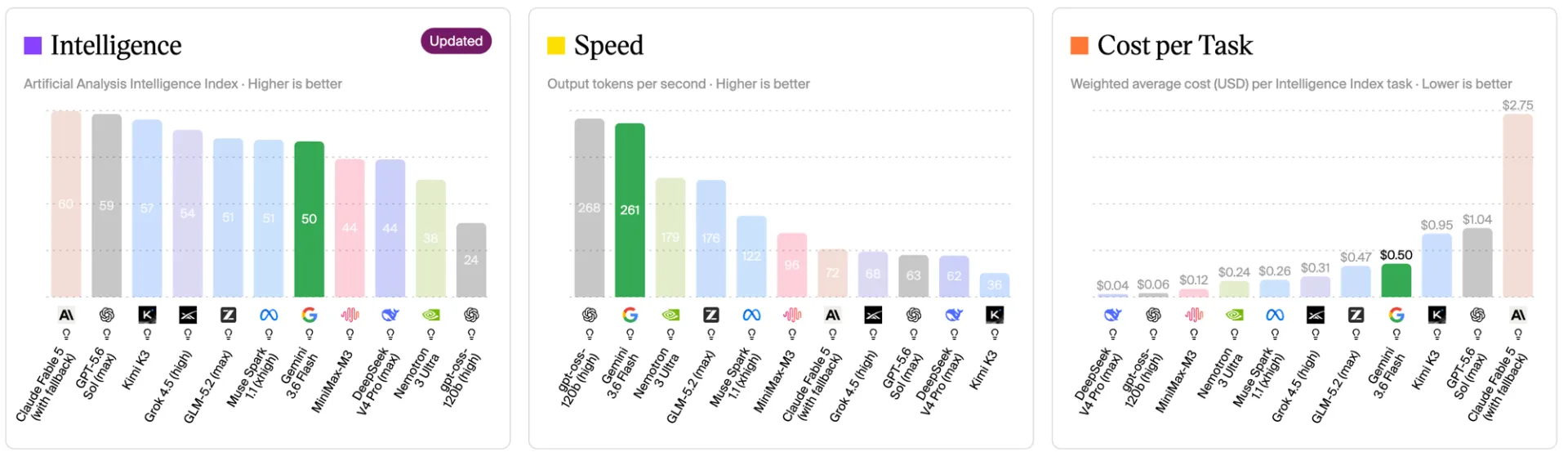
One long-context nuance is worth getting right. Both models take 1M-token inputs, but at the extreme end Flash is far better at *finding* things (MRCR retrieval at 1M tokens: 54% vs under 27%), while Pro is slightly better at *reasoning over* long inputs — covered next.
Where Gemini 3.1 Pro still wins
Being fair to the flagship: 3.1 Pro leads on three benchmarks, and they are all hard knowledge-and-reasoning tests.
Benchmark | Gemini 3.1 Pro | Gemini 3.6 Flash |
|---|---|---|
GPQA Diamond (PhD-level science) | 94.1% | 92.8% |
Humanity's Last Exam (no tools) | 44.7% | 38.3% |
AA-LCR (long-context reasoning) | 72.7% | 69.7% |
The margins are small on GPQA and long-context reasoning, wider on Humanity's Last Exam. Google positions 3.1 Pro for exactly this: "complex tasks that require broad world knowledge and advanced reasoning across modalities." If your workload lives at that frontier (research-grade science questions, multi-step reasoning over a long document), the headroom is real and worth paying for.
Two practical caveats cut against it, though:
Staler knowledge. Pro's cutoff is January 2025, fourteen months older than Flash's March 2026 — the flagship knows less about the current world than the budget model.
Preview status. Five months after its February 2026 launch, 3.1 Pro is still labeled Preview on Google's pricing page (the model ID itself is
gemini-3.1-pro-preview), while Flash ships as the current stable default.
Which should you use
Choose Gemini 3.6 Flash for coding agents, terminal and computer-use automation, ML engineering tasks, high-volume extraction or classification, latency-sensitive apps, and long-document retrieval. On the published numbers it is cheaper, faster, fresher, and higher-scoring for all of these.
Choose Gemini 3.1 Pro when the task is frontier reasoning (PhD-level science, multi-step analysis over long inputs) and a few benchmark points matter more than cost, speed, or knowledge freshness. Budget for Preview-stage churn: preview model IDs get renamed or retired when the stable version lands.
Two things this comparison can't settle for you: reliability under your specific tool-calling patterns, and output quality on your domain's edge cases.
Both models are served through the same Gemini API, so the cheapest way to settle them is to run your own top ten prompts through each. My three-task script above took about a minute to run.
How to access both
Both models are on the Gemini API and Google AI Studio, under the model IDs gemini-3.6-flash and gemini-3.1-pro-preview. AI Studio's free tier is enough to test them side by side before committing.
If you already route through an aggregator, OpenRouter and AIReiter both expose the two models at Google's list price behind one key — that's how I ran the A/B above.
FAQ
Is Gemini 3.6 Flash better than 3.1 Pro?
For most production work, yes: it wins on coding, agentic, ML, computer-use, and multimodal benchmarks while costing less and running 2.3x faster. 3.1 Pro stays ahead only on GPQA Diamond, Humanity's Last Exam, and long-context reasoning, by 1.3 to 6.4 points.
Is Gemini 3.6 Flash cheaper than 3.1 Pro?
Yes, in every mode. Standard API output is $7.50 vs $12.00 per 1M tokens, the gap widens past 200k-token prompts ($7.50 vs $18.00), and Batch mode keeps the same 60% premium on Pro. Caching storage is 4.5x more expensive on Pro.
Which is faster, Gemini 3.6 Flash or 3.1 Pro?
Flash generates about 261 tokens/second versus 112 for 3.1 Pro (Artificial Analysis, July 23, 2026), and starts answering sooner too: 12.8s vs 31.2s time-to-first-token on reasoning-heavy workloads. In my three-task test that translated to finishing 40% faster end to end.
Is Gemini 3.1 Pro still worth using?
Only when you need its reasoning ceiling and can tolerate a Preview-stage model with a January 2025 knowledge cutoff. For tasks below that difficulty tier, the published numbers give no sign the extra cost buys better output than Flash.