 AIREITER
OpenRouter US in-region routing is a meaningful data-residency control, not merely a preference for a US-based provider. The catch is material: it is limited to Business and Enterprise plans, and a request fails rather than leaving the region when no eligible US endpoint exists.
The decision in 30 seconds
OpenRouter US in-region routing is worth considering when an organization must keep prompt processing inside the United States while retaining access to multiple model providers. It is unnecessary for ordinary public-data workloads, and it does not replace zero-data-retention settings or a review of provider terms.
| Question | Answer |
|---|---|
| Regional API base URL | https://us.openrouter.ai/api/v1 |
| Eligible plans | Business and Enterprise |
| API key and model ID changes | None |
| If no US endpoint serves the model | Request returns a 404 instead of routing globally |
| Workspace enforcement | Guardrails can restrict allowed data regions |
| Does it guarantee zero retention? | No; ZDR is a separate control |
| Does every OpenRouter model work? | No; the regional catalog is a subset |
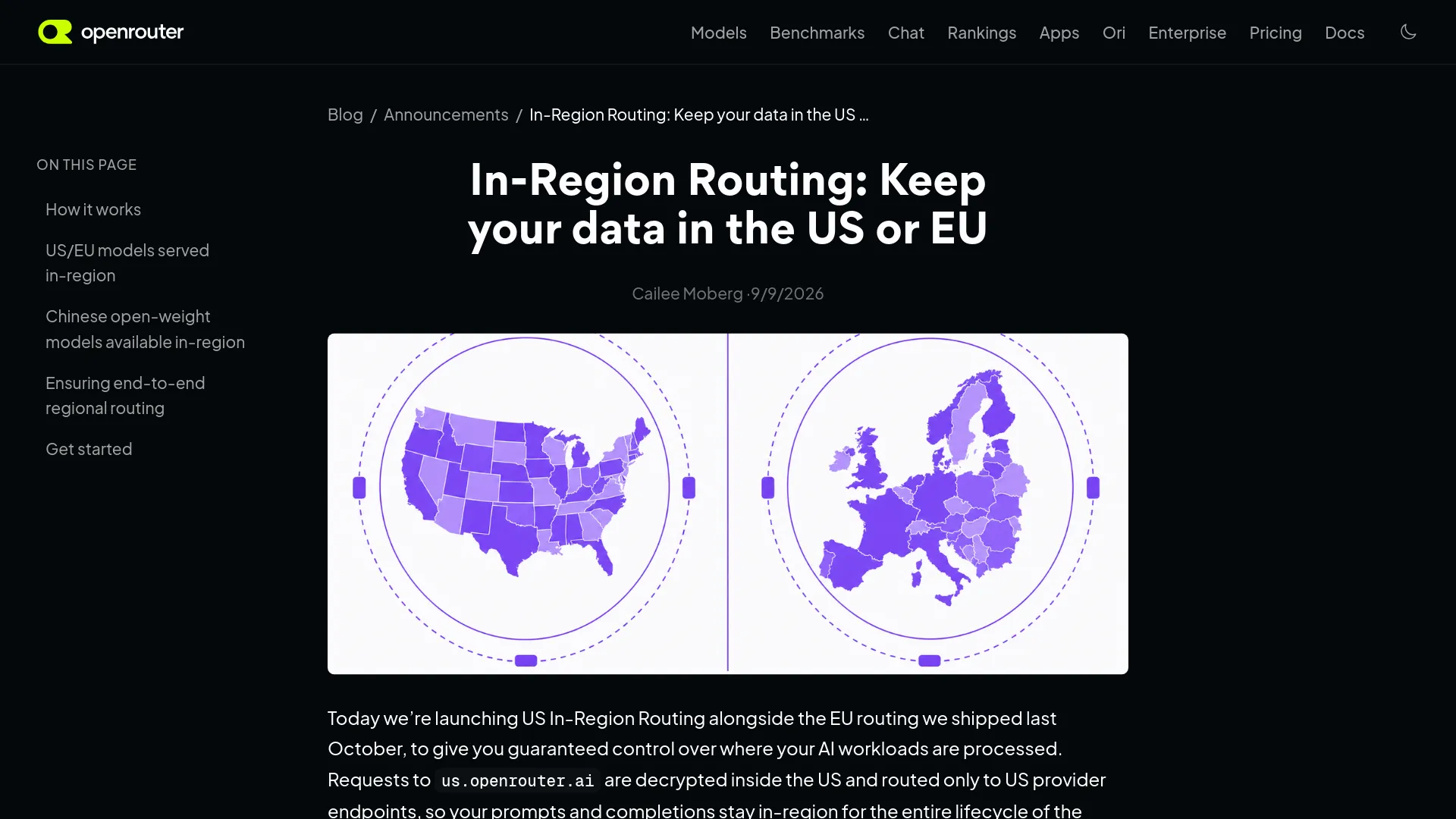
OpenRouter announced US routing on September 9, 2026, alongside its existing EU endpoint. The official launch post says requests sent to the US hostname are decrypted and processed in the US throughout the request lifecycle.
Use US routing for sensitive services while lower-risk traffic remains global; migration can be incremental.
What the regional endpoint actually controls
The regional hostname controls where OpenRouter decrypts and processes a request and which provider endpoints may serve it. OpenRouter also says server tools are evaluated by jurisdiction; a tool that would send data outside the chosen region is disabled rather than silently using global infrastructure.
Model-maker nationality does not establish where a gateway decrypts data or where inference occurs.
OpenRouter describes two paths:
- A request reaches
us.openrouter.ai. - TLS termination, decryption, gateway processing, and eligible server-tool processing occur in the US.
- Routing considers only provider endpoints operating in the US.
- An eligible provider performs inference in the US.
- If no eligible route exists, OpenRouter returns
404 No endpoints found supporting your data region.
The fail-closed behavior matters. A global fallback would improve availability but defeat a strict residency policy; OpenRouter chooses residency over completion for regional requests.
“Provider nationality matters less than the actual data path, logging policy, subprocessors, hosting region, and whether zero-data-retention can be enforced.” — u/MembershipEmergency7 in r/openrouter
That user concern is the right procurement lens. Regional routing answers the processing-location question claimed by OpenRouter, but contracts, retention, subprocessors, audit exports, and incident procedures still require review.
Set up a US-routed request
Setting up OpenRouter US in-region routing normally requires changing the API base URL rather than rewriting the request. The same API key, request body, model ID, provider preferences, fallbacks, and privacy settings carry over.
1. Confirm plan access
OpenRouter lists in-region routing for Business and Enterprise customers. The public pricing page shows a 5.5% platform fee for pay-as-you-go usage, but it does not publish a separate self-service surcharge for US routing; confirm Business or contract pricing before budgeting.
2. Find models available in the US
Query the models endpoint through the regional hostname. The returned catalog reflects models with at least one eligible US provider endpoint.
curl https://us.openrouter.ai/api/v1/models \
  -H "Authorization: Bearer $OPENROUTER_API_KEY"
The regional catalog can change as providers and deployments change. Model discovery should therefore be part of deployment checks rather than a spreadsheet maintained once.
3. Send the request through the US base URL
curl https://us.openrouter.ai/api/v1/chat/completions \
  -H "Authorization: Bearer $OPENROUTER_API_KEY" \
  -H "Content-Type: application/json" \
  -d '{
    "model": "meta-llama/llama-3.3-70b-instruct",
    "messages": [
      {"role": "user", "content": "Summarize this internal policy."}
    ]
  }'
The model in this example comes from OpenRouter's sovereign AI documentation. Verify it against the live US catalog before using it in production.
4. Enforce the region with Guardrails
Application configuration can drift. According to OpenRouter's sovereign AI documentation, Guardrails can set allowed_data_regions to us for a workspace, team, member, or API key; a request sent to a disallowed hostname is rejected with HTTP 403 before processing.
A workspace default is the safer baseline for a regulated application because it does not depend on every developer remembering the regional hostname. Per-key rules can make sensitive services stricter than the workspace default.
5. Test failure, not only success
Run one test with a supported model and another with a model absent from the US catalog. Alert specifically on the regional 404 so an operations team does not “fix” the incident by changing the base URL to the global endpoint.
The privacy controls people conflate
US in-region routing controls geography; ZDR, data-collection filtering, and provider terms control different risks. A compliant design may need all four, and enabling one does not imply the others.
| Control | What it controls | What it does not establish |
|---|---|---|
| US in-region routing | Decryption, processing, tools, and eligible provider endpoints remain in the US under OpenRouter's stated design | Zero retention, no training, or every category of account metadata |
Zero Data Retention (zdr: true) | Routes to providers that meet OpenRouter's ZDR condition | Processing geography or universal model availability |
data_collection: "deny" | Excludes providers whose policies allow the disallowed collection behavior | Geographic residency or independent auditing |
| Provider terms and retention review | Contractual rules for logging, retention, and data handling | Technical enforcement by itself |
| Guardrails | Enforces approved hostname/region policy across covered keys or workspaces | Provider contractual obligations |
OpenRouter's provider logging documentation makes an important distinction: users can filter providers based on training or collection policy, but retention requirements are not automatically converted into routing rules. Teams remain responsible for evaluating provider terms.
A strict request can combine regional routing with privacy parameters:
{
  "provider": {
    "zdr": true,
    "data_collection": "deny"
  }
}
Each added condition narrows the eligible provider set. The resulting 404 or reduced model choice is a policy outcome, not necessarily a routing malfunction.
Verify a workload before approving it
A production review should verify the live route and its failure behavior rather than accepting “US provider” as sufficient. The practical gap is auditability: OpenRouter documents the geographic guarantee, but public material does not provide a universal model-by-provider matrix with latency, retention terms, cache behavior, and contractual evidence in one place.
Use this approval sequence:
- Query the US model catalog using the same account and privacy settings as production.
- Select the required model and record the eligible provider endpoints shown in OpenRouter.
- Apply US Guardrails at the workspace or API-key level.
- Enable ZDR and deny data collection if the workload requires both.
- Confirm the provider's current retention terms and subprocessors through procurement.
- Log the model, serving provider, request ID, status, latency, and policy-related failures.
- Test an unavailable model and verify that no code path retries through
openrouter.ai. - Re-run the check when a model, provider preference, or privacy rule changes.
Community reports explain why the route should be observed after launch. In one Reddit discussion, u/Cooperman411 said, “I couldn’t find Deepseek as a provider because I have ZDR (Zero Data Retention) turned on.” That is an anecdote, not a benchmark, but it demonstrates how a privacy control can remove an expected route.
Do not carry over reported cache-hit or latency figures from another workload. Provider selection, privacy filters, prompt shape, model deployment, and traffic conditions can all change the result; measure the production-shaped request instead.
When US in-region routing is the right purchase
OpenRouter US in-region routing fits organizations that need a fail-closed US processing boundary and value multi-model access enough to accept a smaller catalog. Individual developers and teams without a formal residency requirement should usually stay on the global endpoint because the regional feature requires a higher plan and can reduce availability.
| Workload | Recommendation | Reason |
|---|---|---|
| Regulated US customer data | Shortlist and validate | Regional decryption, processing, provider routing, and fail-closed behavior directly address residency requirements |
| Internal sensitive documents | Consider with ZDR and contractual review | Geography alone does not settle retention or training policy |
| Public content generation | Usually use the global endpoint | Residency constraints add plan cost and reduce routes without a clear risk benefit |
| Chinese open-weight model under a US policy | Strong use case if listed regionally | OpenRouter says US providers serve models including DeepSeek V4 Pro, Kimi K3, and GLM 5.2 from US data centers. |
| Consumer or free experimentation | Not a fit | In-region routing is limited to Business and Enterprise plans |
| Workload requiring a model absent from the US catalog | Do not deploy unchanged | The request will fail instead of leaving the region |
Choose it for residency, not assumed speed: OpenRouter has published no general US-endpoint latency benchmark, and regional provider pools may differ.
OpenRouter US in-region routing FAQ
Are tools kept in the US too?
OpenRouter says it evaluates server tools by jurisdiction and disables tools that would send data outside the selected region. Verify the specific tool needed by the workload before deployment.
Does the guarantee cover all metadata?
The launch material explicitly discusses prompts, completions, request processing, provider routing, and server tools. Ask OpenRouter for contractual detail on billing records, abuse telemetry, logs, backups, and other metadata required by an organization's policy.
Can a personal account use the US endpoint?
In-region routing is documented for Business and Enterprise plans, not the Free or ordinary pay-as-you-go tiers. A developer without plan access can still use privacy and provider-routing controls, but those are not substitutes for the regional processing guarantee.
Approve only when the regional catalog, Guardrails block, privacy-filtered provider pool, and provider terms all pass review. If a check fails, change the model or workload design; a global fallback defeats the residency boundary.