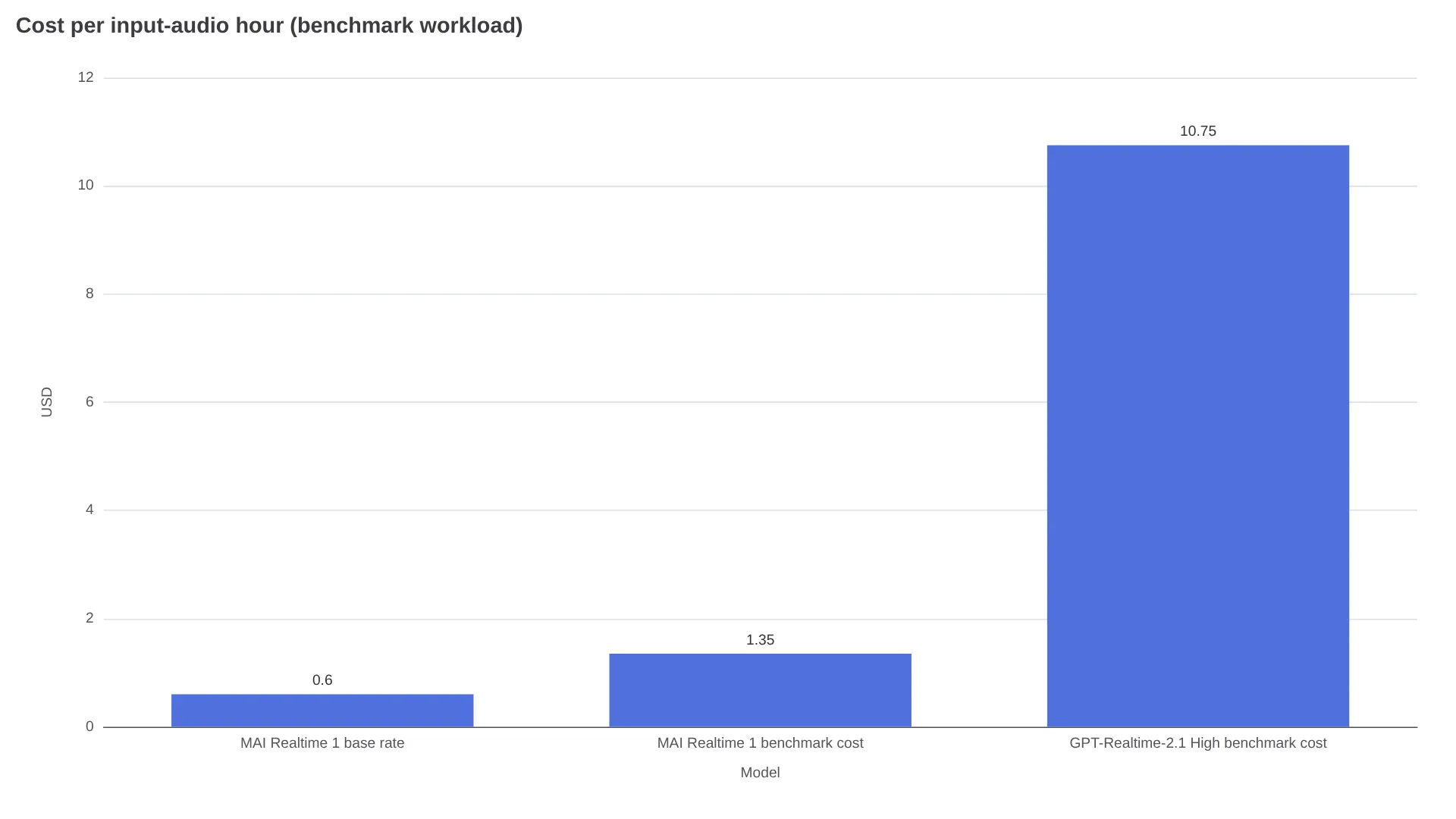
At Microsoft's benchmark-normalized $1.35 per input-audio hour, MAI Realtime 1 is about 87% cheaper than the listed $10.75 GPT-Realtime-2.1 High configuration; its $0.01/minute rate is only the audio floor. Reasoning is billed separately on top.
Microsoft announced MAI Realtime 1, its first speech-to-speech model, on November 17, 2026 at Ignite. It is in limited preview through Microsoft Foundry (registration required, unbilled until public preview) with a short demo in MAI Labs.
$0.01 per minute covers audio, not the answer
The official rate card from Microsoft AI has three lines:
| Charge | Price |
|---|---|
| Base speech-to-speech | $0.01 per audio minute |
| Reasoning input | $1 per 1M tokens |
| Reasoning output | $5 per 1M tokens |
Straight math before reasoning: 60 minutes costs $0.60, and $1 buys 100 audio minutes. Microsoft labels the minute rate "starting at" because any call that escalates to the deeper reasoning engine adds token charges on top.
How often reasoning fires is undisclosed. Microsoft says a fast conversational system handles routine turns and only harder requests invoke stronger reasoning, but it publishes no token-per-minute figure, no definition of whether both caller and model audio count toward the minute, and no rounding rule. Budget the penny as a floor, not a bill.
"Performance, latency, and cost comparisons vary by application and methodology." — Microsoft AI, MAI Realtime 1 announcement
Why Microsoft's benchmark bill reads $1.35 an hour, not $0.60
The $0.60/hour figure is raw audio. The $1.35 figure is Microsoft's benchmark-normalized workload cost; published metering details are insufficient to reproduce the difference from a tokens-per-minute estimate. Figures below come from Magica's breakdown of Microsoft's data.
| Model config | Speech-reasoning (Big Bench Audio, 40q) | Agentic completion (τ-Voice) | Cost per input-audio hour |
|---|---|---|---|
| MAI Realtime 1 | 98.9% | 57.5% | $1.35 |
| GPT-Realtime-2.1 High | 95.8% | 45.7% | $10.75 |
| Gemini 3.8 Live | — | 30.1% | $0.84 |
| Gemini 3.8 Live Extended Thinking (High) | — | 68.6% | $3.50 |
| Phonic 1 (High) | — | 79.9% | $4.20 |
MAI beats the listed GPT config on both tests at roughly one-eighth the benchmark cost, beats the cheapest Gemini by 27.4 completion points, but trails Extended Thinking by 11.1 and Phonic 1 High by 22.4.
Treat each number above as vendor-reported: Microsoft evaluated MAI internally and attributed competitor figures to Artificial Analysis. The Big Bench Audio slice is only 40 selected questions, and τ-Voice completion is a benchmark score, not a measured customer-service resolution rate.
What Realtime 1 does on a live call
MAI Realtime 1 supports interruption handling, tool use, and routed reasoning for phone-agent workloads, with background-noise tolerance and prompt-controlled personas. It targets phone and support work rather than consumer chat. Microsoft describes it as OpenAI Realtime API-compatible to simplify testing and migration, subject to endpoint, tool-schema, voice, and error-handling differences.
Still undisclosed: supported languages and voices, exact latency, context-window size, rate and concurrency limits, regions, and retention policy.
How to try it today: MAI Labs vs Foundry preview
MAI Labs demo: public trial, personal noncommercial use, sessions up to about 2 minutes, users 18+. Good for hearing voice quality and interruption handling, weak for load testing. Foundry limited preview: the enterprise path. Register via the interest form on the MAI Realtime 1 model page, wait for approval, build against the OpenAI-compatible Realtime endpoint. No charges until public preview starts, and no public-preview date announced.
If you need production SLAs, regions, or a GA commitment this week, this model is not buyable yet. Prototype only.
Price your first 1,000 calls before you commit
Per-minute math hides the decision. Use one formula, then finish it per resolved case:
Cost = audio minutes x $0.01 + input reasoning tokens / 1M x $1 + output reasoning tokens / 1M x $5
Worked example: a 4-minute support call costs $0.04 in audio. If it burns 2,000 input and 500 output reasoning tokens, add $0.002 + $0.0025 = $0.0045, total about $0.0445 per call. At 1,000 calls with a 15% retry rate, about 1,150 billed call-equivalents cost about $51.18. If 600 of the original 1,000 resolve, cost per resolved case is about $0.085. Retry length and token burn vary per flow, so substitute your own retry profile.
Use $1.35 per input-audio hour as a vendor-benchmark proxy until your own tests reveal reasoning-token and metering costs; it is not a ceiling. Whether your workload lands above or below that proxy depends on unpublished reasoning and metering behavior, so measure it in preview.
| Your situation | Pick |
|---|---|
| Existing OpenAI Realtime app, cost pressure, simple lookups | Trial MAI Realtime 1 in parallel; compatibility reduces migration work |
| Complex multi-step tasks where completion rate beats raw cost | Benchmark against Extended Thinking or Phonic-class options before switching on price |
| Need GA, SLAs, or disclosed languages/regions now | Wait; stay on current provider and re-check at public preview |
FAQ
How is audio-minute metering defined?
Microsoft says only "per audio minute" with no caller-versus-model split and no rounding rule published. Plan on total audio until the rate card clarifies.
What does the preview actually let me test?
The Labs demo covers voice quality and interruption handling in short sessions. Only the gated Foundry preview exposes the OpenAI-compatible endpoint for tool calls and load testing, still unbilled.
When should I re-check this price?
When Microsoft names a public-preview date and publishes the Foundry rate card with metering, language, and region details. Until then treat every figure here as preview pricing.